Previous Next
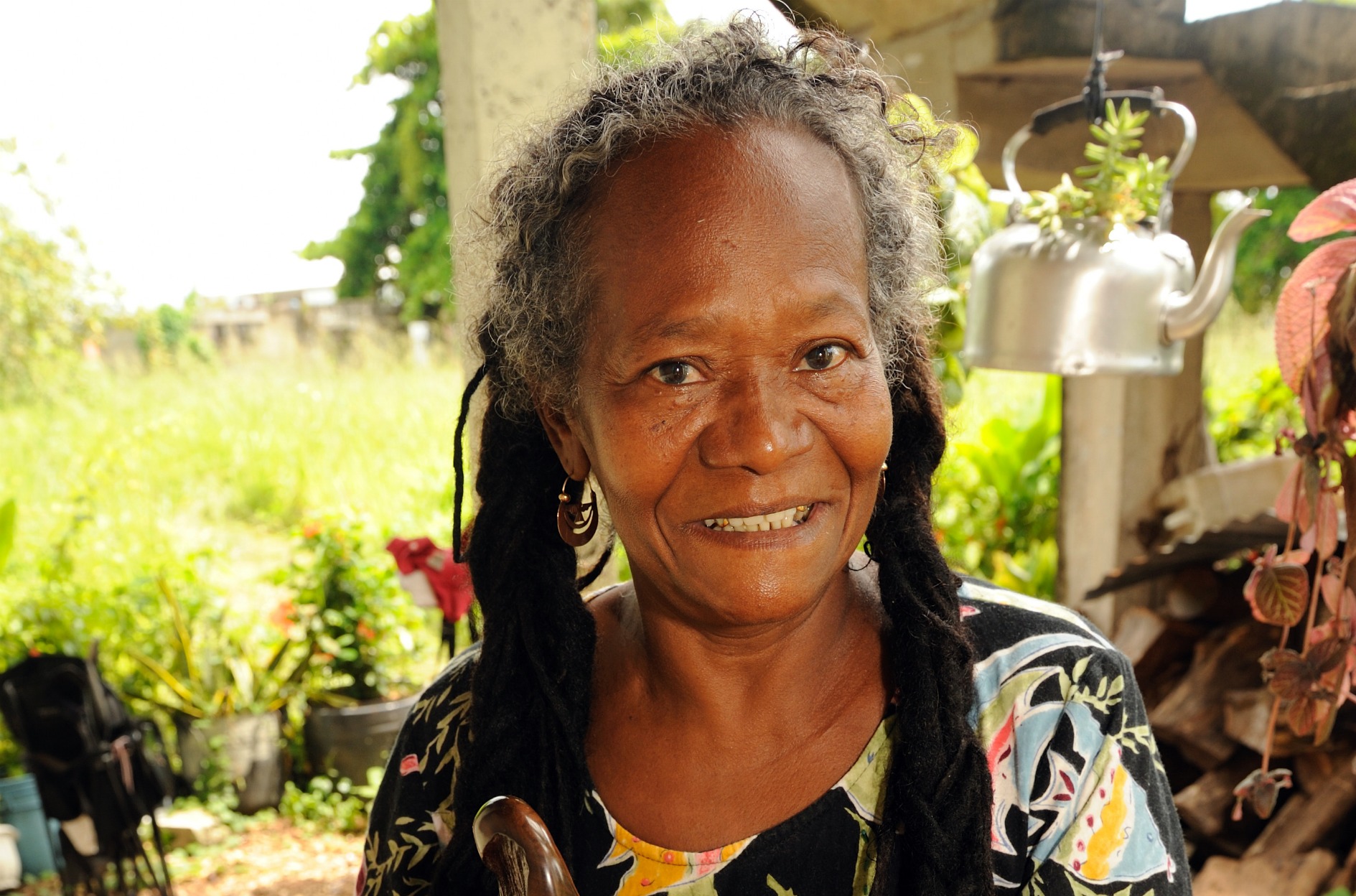
Leela Vernon, Belize

Leela Vernon, top Belizean Kriol artist and advocate, and founding member of the National Kriol Council. Ms. Vernon is currently recording a Kriol version of Belize's national anthem. She's also famous for coining the most famous Kriol phrase in Belize: “Ah wah no who seh Kriol no gat no kolcha?" -- “I want to know who said that the Kriol have no culture?” Photo by author.

MatadorU Road Warrior Lily Girma finds that “evryting aarite” in Belize.

[Editor's Note: Lily Girma is the first photographer-in-residence to participate in the Road Warrior program, a partnership between MatadorU and the Belize Tourism Board. This summer Lily is documenting different cultural aspects of Belize as well as travel and adventure options around the country. Each week she'll be reporting on her experiences for Matador, her personal blog, and for other outlets.]

MY FIRST WEEKS IN BELIZE, I was told that you’re a true Belizean only if you speak Kriol. And it’s true – in three months I found that most Belizeans speak and understand Kriol. Even though English is the official language, Kriol is the default tongue when people speak to each other, and it’s the one element that unites all of Belize’s different ethnic groups.

One guide went even further and joked, “If it’s business, it’s English. But if I’m not getting paid, then it’s Kriol.”

Belize, unlike its Central American neighbors, is a former British colony. It gained independence from Britain only in 1981. The Kriol language originated from the Kriol people in Belize – who are a mix of the British colonial masters and the enslaved Africans who were captured from present-day Nigeria and brought to Belize to work in mahogany camps.

During colonial days the Baymen – or British buccaneers who settled along the Bay of Honduras (present-day Belize) in the 17th century – brought and used Africans to cut mahogany trees into logs which were then shipped off to Europe. Because of the enslaved Africans’ proximity to their British masters while working in the mahogany camps, they began speaking their own version of English – a mix of what they heard from the Baymen and of their own African dialect. This was the beginning of the Kriol language.

In those mahogany camps were also female slaves, who prepared food and took care of the workers. The Baymen, who were far away from their British wives, took the African females as their “local” mistresses. The result of this mix created the Kriol (or “Creole” in English) population.

Over the years, Belizean Kriol grew into more than just a “broken” tongue, and reached the level of a national language in terms of being widely spoken.

Efforts were then made to ensure that Kriol was properly studied, written, and recorded as a language, thanks in great part to the National Kriol Council. The council was created in 1995 as a nonprofit, to promote all aspects of the Kriol culture – from history to music and language. The council was intent on teaching the younger generation how to write Kriol, and started running a language program that produces literature in Kriol for students. The ultimate goal: to instill a sense of identity and cultural pride in all Kriols. A fully developed and documented language was recognized as being a major part of that.

It wasn’t hard for me to understand Kriol because of the time I’ve spent living in Jamaica, and its similarities to Jamaican patois. I would often get mistaken for Belizean because I managed to follow the conversations.

But it hasn’t always been easy to speak it! The pronunciation is faster, the words less articulated, and the accent distinct. There are also more articles used in one sentence than in patois. The few times I tried my luck at Kriol I was understood, and yet asked if I was Jamaican.

Still, speaking Kriol in Belize is a great way to connect with the locals.

Here are a few basic phrases, and some of my favorite Kriol sayings:

Basic phrases

Hello/What’s up? — Weh gaan ahn? or Weh di go ahn?

What time is it? — Da weh time?

My name is Lily — Mi naym da Lily

See you later — Si yoo lata

I’m tired — Ah tayad/mi tayad

Where is — Weh/weh-paat

Everything’s fine — Evryting gud/aarite

Get the hell out of here! — Haul your rass!

Really? Is that right? – Fu Chroo?

Good evening — Gud night

I love Belize — Mi love Bileez

Sayings

Wahnti wahnti kyah geti an geti geti nuh wahnti — You always want what you can’t have

Dah no so, dah naily so — Where there’s smoke, there’s fire

Wait bruk down bridge — Don’t make me wait too long

One day belly full neva fatten maaga dawg — One meal won’t change someone’s life / Give a man a fish and you feed him for a day; teach a man to fish and you feed him for a lifetime

Sleep wit’ yo’ own eye — Only rely on what you know, not what others tell you

One one craboo fill barrel — Every little bit counts [craboo is a Belizean fruit]

~

Special thanks to my wonderful Belizean friends, Marilyn Cutkelvin and Alex Evans, who had the patience to teach me some Kriol during my time in Belize.

You can learn more about the Kriol language from the National Kriol Council.

Language Learning


About The Author

Lily Girma

Lebawit “Lily” Girma is a published travel and concert photographer and writer as well as Matador's newest Road Warrior in Belize. She has a weakness for the Caribbean and Jamaica where she spends the winter, and never goes anywhere without her Nikon. You can follow her photo-travel journey at her personal blog.

More By This Author

view all →

Archived Responses to A quick guide to speaking Kriol in Belize

  1. JC says:

    You can also check out Kriol Word of the Day website to learn more Kriol words!  :)

    http://www.kriolwordoftheday.com

    Website also has information on how to get your hands on copy of Kriol-Inglish DIKSHINERI

  2. Alex says:

    Love it! Thanks for the shout out! “Ah wah no who seh Kriol no gat no kolcha” indeed.

  3. Sweetness says:

    Very interesting article.  I enjoyed learning about the Belizean culture.  The photo of Miss Vernon is filling with richness and makes me want to meet her.   Thank you for sharing this with us.

  4. Seveen says:

    love this picture of this lovely lady! ms vernon thank you for carrying forward – with pride

  5. Seveen says:

    love this picture of this lovely lady! ms vernon thank you for carrying our language forward – with pride

  6. Linda Elul says:

    This is wonderful Lily….dawg noh weh pah weak fence deh….thanks for all your wonderful stories and beautiful photos of Belize.

  7. Thank you all! Happy you enjoyed this piece.

    @8b8c2783507f88e4bfe4bc9d07f1b8a3:disqus, my pleasure, and thanks for your comments.
    Seveen, you would have loved meeting Ms. Leela. She’s a force to be reckoned with!
    Alex, thank you too!

  8. david miller says:

    stoked on this post.

    made me want to read a narrative with kriol dialogue.

  9. Anonymous says:

    I’m currently in Belize and have such a hard time understanding Kriol.  It’s getting easier, but the sounds all run together for me.   It’s a language puzzle for me.

  10. Swampy says:

    Eh bot dis da rice bon ur bon rice…?

    http://swampy.bz/

    Nice to read your blog!

Because "What a beard!" is a phrase everyone should use more often.
"Bob's your uncle" and other essential words, tips, and phrases.
These words are so short and simple you can learn to use them immediately.
My family repatriated to India when I was in the ninth grade.
Sing along to these 8 bands to improve your Mandarin.
Do we really need to teach students outdated idioms like "It's raining cats and dogs"?...
I carried a notebook everywhere, its pages flecked with food stains and warped from...
I learn it because I love the place, because I’m curious, because the sound of it to me...
Just two hours of Mandarin instruction per week is ineffective.
Matador is sponsoring a sweet contest for language lovers and learners at the...
I wanted the international assignment so I could learn to speak Spanish like a native....
I want you to experience a side of Thailand, through its language, that most expats never...
Portuguese is a logical next step after learning Spanish. It is different enough from...