All photos by Neha Puntambekar

On my way to work I take a bus, a train and a taxi. On my way back I take a bus, a train and a rickshaw. I get a lot of reading done in between.

The corner chaiwala pours milky tea into a glass. The glass is filled just halfway – the portion is called cutting. Behind the cart a younger boy, he doesn’t look more than 11, is rinsing out used glasses. Next to them is a tobacco stall. Two yuppies, dressed in formal clothes, ties folded in their front pockets, stand with freshly lit cigarettes. Since single cigarettes are available for a rupee, or less, depending on the brand, corner smokers are a common sight. I walk past them and cross the road to the bus stop.
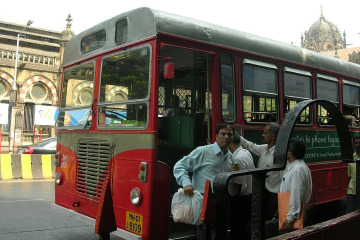
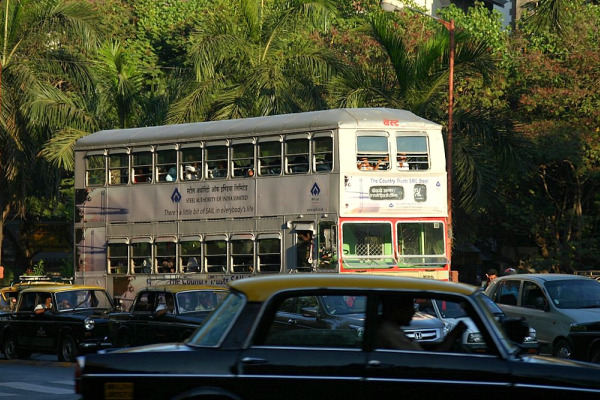
The Bus

Tikeett?” The conductor half barks. The steel box holding ticket coupons is strapped across his brown uniform. He clicks the ticket puncher with his right hand – ‘ticktickticktick’ – and waits for me to handover my Rs.5 bus fare to the railway station. He barely jolts as the bus moves.

We drive past residential colonies; pockets of organized, multi-storied suburban dreams. We drive past a large slum; residents and small-scale businesses (vada stalls, a make-shift fish market, rickshaw service shops) spill on to the road, nudging trucks, buses, cars and bikes into a jam. We drive past newly planned residential colonies built over demolished slums; construction goes on all day and all night.

The Train

The 7:50 slow has just pulled in. Most people jump in before the train stops. I never leaned how to do that, and as a result I only manage to find a corner seat.

This is the Ladies First Class. It has softer seats. I recognize most of my fellow travellers. They are regulars – mostly bankers and students – and I’ve pieced together their stories from overheard conversations. They are ‘train friends.’ A clique has formed during our daily commute. They discuss marital problems, trade dirty jokes and have potluck breakfast parties. When they bring Prasad, food offerings made to the Gods after special prayers and during the festive season, they share with the rest of the compartment too.

Because it’s morning rush hour, there are no vendors peddling knick knacks or fruit. They will come later, with their big baskets, and stay on till the last train. From the grill window barrier I can see into the General First Class compartment. Some men gawk at the women. Others fiddle with cell phones.

With every stop, the windows get a little more closed off. Sometimes it’s so crowded it’s hard to read. Sometimes it’s so crowded I give up my seat and go stand by the door where I can breathe. Sometimes it’s so crowded the train moves before I can get off.

The Taxi

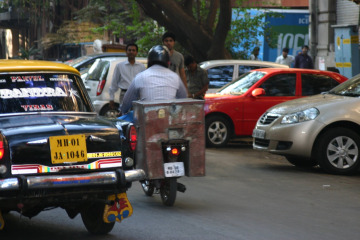
The taxi queue under the Dadar Flyover is the only element of order on a road crammed with office goers and vendors selling fruits, gajras (flowers strung together and fastened by women in their hair) and other knick knacks. When the municipal car comes they use a series of coded calls to pack and empty out in minutes; it was during one such raid/run that I realized the street was actually wide enough.

A guy joins the line behind me. “Share Taxi, na?” he asks. A shared taxi runs between a preset route and carries 4 passengers, each will pay Rs.10 for the ride irrespective of where they get off along the route. It’s more comfortable than a bus and it’s cheaper than taking a cab alone.

I’m sharing the cab with a pin-stripe pantsuit, an orange salwar-kameez and a green tee-shirt. The cab is old and its insides feel tired. The window is stained and only opens midway. When we stop at the traffic light a kid approaches me with a stack of pirated books. His clothes are ill fitting. His smile is wide; he has seen the open book on my lap.

Didi, best books for half price. Didi!” he yells as the light changes.

We cross two worlds at a distance of two traffic lights. On one end are the community housing projects, public schools and gaudy store fronts. At the other are MNCs, showrooms and malls; Mumbai’s textile mills once stood here. I’ve heard the stories from my Dad – of the good years, of the strike and how most mills shut down in the years after. I catch the emotion before he shrugs and says, “anyway…”

At the end of the street, the taxi comes to a noisy halt two minutes away from my office. I gather my bag, my jacket and paperback, pay the cabbie and get off. Today I have a brochure to finish and blogs to read. I punch in my key card and head back out for tea.

Expat Life
 

About The Author

Neha Puntambekar

Neha is a freelance writer from Mumbai, currently based in Zagreb. When she isn't on her laptop, you'll find her at a local cafe, sipping coffee, paperback in hand.

  • http://shantiwallah.com Marie

    I loved this, Neha!

    • http://www.nehasweb.com neha

      Thanks for reading Marie!

  • http://orangesplaash.blogspot.com/ Arwa

    Nice descirption. This reminds me of my time in the Mumbai locals. I liked the line “I’m sharing the cab with a pin-stripe pantsuit, an orange salwar-kameez and a green tee-shirt. “

    • http://www.nehasweb.com neha

      Thanks Arwa. The clothes were always important because they determined how uncomfortable the cab ride would be, especially in the summers. Though it was always either too sweaty or too bare.

  • shweta

    This piece was nice … it felt more like me travelling to Pinxit blue in Mumbai…..miss those days.

    • http://www.nehasweb.com neha

      Ha, but that commute included walking past those butcher shops with the chicken coops (remember those?). That overshadowed everything else. I also think it lead to some brain-damage.

  • http://onelifetoeat.com Sabera

    Great post Neha. It took me right back to my own commute back home. I can’t believe its been such a long time since I’ve done it myself. It felt nice to replay those memories while reading your post.

    • http://www.nehasweb.com neha

      Thanks for reading Sabera! I don’t really use the trains much when I’m home, and I haven’t done the crazy back to back bus-train-rickshaw thing in a while, but I do travel by rickshaw (the LPG ones) a lot. It’s one of my favourite modes of transportation!

  • http://anitasatyajit.wordpress.com Anita Satyajit

    Lovely read, Neha.

    • http://www.nehasweb.com neha

      Thanks for reading Anita.

  • Mary Beth

    Thanks for the story…sounds chaotic, but no worse than a commute on NYC or Boston, MA USA subway that I did for many years. OK, maybe it is a bit more crowded…

    The thing about stories or movies or books about India, which I LOVE and have read many, you don’t get the SMELL of that wonderful country. I went to Mumbai, then Bombay, for business in 1987, and later to Delhi…the smells! wonderful and horrible sometimes. Still, what a fascinating country, I would love to return and spend a long time.

    Lucky you to work there sometimes, and again, thanks for sharing.

    • http://www.nehasweb.com neha

      I agree. The smells (good and bad) have become an architectural component in the Subcontinent. You can tell where you are by how it smells. My favourite Mumbai smell is the aroma of hot pav bhaji and the Monsoon.

  • http://matadortravel.com/traveler/evasandoval EvaSandoval

    Brilliant piece, Neha! Your thoughtful, dreamy images always sing to me.

  • http://wonderandwander.com Ameya

    Great post. I can’t wait to go to Mumbai… whenever that will be!

  • Pingback: InTransit: Ep. 20 – Leon, Nicaragua

  • Pingback: InTransit: Ep. 20 – Leon, Nicaragua | iTravelMags.com

  • Mitesh

    Nice!!

  • Pingback: Journey Across India, 3,000 Photos in Three Minutes

  • Pramod

    Neha, you really took me back to mumbai where i stayed for 3 months. Although tough life, great city which runs with a sprit of never stopping.

Narrative →

He wears a different pair of shorts every day, but always, always that Pacers jersey.

Culture and Art Festivals →

Sumiit Lakhutia takes us inside the huge, 9-day festival in his home city and shares his...

Expat Life →

Across the street, next to the metro exit, a beggar sets up his “office” for the day....

Expat Life →

From my quiet suburb of Ordrup to the already bustling streets of Nørrebro, it takes...

Expat Life →

Although I’ve driven less than a mile, it’s as if I’ve driven into a different...

Expat Life →

Introducing a new series at Matador Abroad.

Volunteer + Work →

Neha Puntambekar identifies volunteering opportunities in Mumbai.

Cycling →

From Mumbai to Blackpool to Tokyo, urban cycling is becoming more accessible, more...

Trip Planning →

While the majority of travelers visit India in winter, some like it hot.


Move over Hollywood! Bollywood provides a unique fusion of traditional Indian culture and...