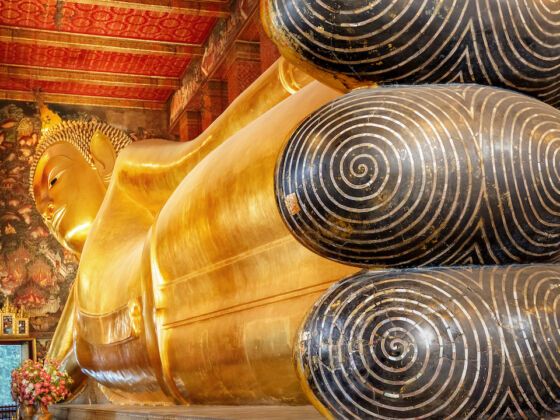
5 steps to save money like Buddha
Buddha saves / Photo mangu wanders
EVERYDAY WE SEE more and more people who dare to leave it all for a few years of backpacking throughout the earth’s vast terrain.
We hear about the adventures, the misfortunes, the soul-searching, the friends found, the friends lost, the breathtaking sights, the new sensations.
No one ever really mentions the one thing that makes it all happen. The money!
A lot of people have done well in their careers and can easily make the decision to take off. Others have investments (i.e. property) that allow them to travel for very prolonged periods of time without having to worry about working.
But the vast majority of us have to save for months, maybe even years, to start even thinking about quitting everything and flying off to Timbuktu.
And even if we do save up as much as we can, we still have to sign up for the occasional odd job here and there during the way.
Anyone who’s attempted months of serious saving is probably an expert already. But for the inexperienced (yet willing and deeply determined), here are a few Buddha inspired tips on saving money for your trip of a lifetime.
1. Reconsider your living situation
If you are renting a flat then leave it and move in with your folks for a few months, or ask a close friend or relative to house you. Cutting rent is one of the huge contributors to saving money.
I moved into my boyfriend’s parent’s place for 4 months to save up on my rent. I was cooked for, cleaned for and pampered as I’ve never been, and all the while saving hundreds of dollars a month. It’s a tough decision, but worth it. Remember the goal!
Handle your money / Photo Akuppa
2. Practice non-attachment
The Buddha says: you only lose what you cling to. Well it’s time to un-cling! Start selling all your stuff, and by stuff I mean everything. The CD collection, the TV, the DVD, the stereo, the bike, the clothes…it all goes.
What good will it all do to you while it’s sitting back home and you’re rafting down the Great Usutu River?
Get rid of junk you don’t need and turn it into the gold you will later enjoy. Once you start getting rid of stuff and you see the money pour in, you’ll be surprised how easy it is to part with your prized possessions.
3. Abstain from expensive evenings
This is what most people have a hard time with. I call them the three No-Outs: no going out, no eating out, no drinking out. It may sound harsh, but have you ever really calculated the money that you spend in one night out? Or two?
That money could fund your traveling through Central Asia for an entire month. Don’t despair though; your social life will not be over.
There are alternatives: go to house parties instead of nightclubs, rent DVD’s instead of going to the movies, cook meals at home instead of going to the new Latin-Korean fusion place down the road, buy your own cocktail ingredients and make them with friends.
However, it’s best to gradually let these party habits die as you won’t be thinking too much about cocktails or gourmet food on the road.
4. Find a transient weekend job
One or two months prior to your departure day, score a job waitressing, bartending, handing out leaflets on the streets, baby-sitting, etc.
Although the money won’t be much, the additional savings will help you acquire the last minute must-haves for your trip: vaccines, a backpack, trekking boots, sleeping bag, etc. You don’t want to go too cheap with these items as they will need to last you the entire length of the trip.
5. Embrace foreign cultures
A lot of people (like me) have trouble setting money aside. My main problem with saving was that whatever money I had, I’d spend. Keeping it in the bank wasn’t enough sometimes.
Keep it real / Photo A Schultz
I resolved this issue by changing my saved money into another currency: Euros or Pounds Sterling preferably. This way I was already stocking up on the currency I needed for my trip and it kept me from accessing it whilst saving.
Remember that if you exchange your money’s currency more than once, you’re probably losing money.
So there you have it.
There are a million more tips but these, in my humble opinion, are the main ones that will get you to where you want to be. The trick is to always look for the alternative to spending money.
Even if your monthly income is nothing to brag about, you’d be amazed at how much you can earn if you set your mind to your true goal. The sacrifices you make now will bring forth many rewards you most probably will never forget.
And if you’re weak when it comes to finances, (like I was) this will only make you stronger and teach you the value of money and earning. After all, it’s only your dream you’re after.
Do you have any more savings tips? Share in the comments!
Lucia Byttebier
A native of Argentina,Lucia Byttebier has lived in Mexico, Venezuela, Indonesia, and Singapore. She is now studying travel writing at the London School of Journalism and looks forward to contributing more articles to the Matador network.
More By This Author
- Iguazu Falls, Argentina: Where romance runs deep (3 comments)
- A History Of Why People Travel (7 comments)


Hey all, I just want to know that this is very good. Many of you talk of sacrifice is difficult, but I know a fellow working as a security guard making 12.00/hour who saved up $50,000 CAD in 18 months from scratch. He did some overtime, but all he earned was $35,000 a year gross and managed to save by couch serfing on his friends sofa, eating free food at various soup kitchens and went to the food bank. Now, he has the money tucked away in BMO Monthly Income fund that gives him 6 cents per $8.07 that he invested in his mutual fund. He is getting $371.00/month from it, without having to touch his principal. He sold his DVD’s on craigslist and even sold his books, tapes, etc to his friends in exchange for a place to sleep. His posessions was used to pay rent to his friends for couch surfing, which will get you a much higher price than if you were to sell it via garage sale, since they won’t be a cut throuat. And what is funny is that being a Buddhist, he actually practiced his mantras as a security guard and practiced his Tibetan Buddhist practices while sitting on site. He actually got paid to do very little working, and he has now inspired me to save likewise.
Great article!
My boyfriend and I recently started doing all of the above mentioned things plus a few more to save money for travel. And we’re making a trip to Panama from the money we saved by not into eating/drinking out. It’s tough, but totally worth it in the end if your primary goal is to travel!
yes, i agree with exchanging money into other currency becoz i did it last year and it works….i have to exchange my money to other currency to prevent using it for extra expenses….
The concept of “saving money” is easier said than done for most people. I understand that it is ‘easy and logical’ for some people, but I also understand it can be a difficult habit to break for others.
If you’re looking to save money or change your lifestyle, my advice is to take it in “baby-steps” because it won’t happen overnight. Here are some tips that helped me out.
1. Always pay more than the minimum on any credit card payments – if you don’t believe me you can calculate it for yourself (http://www.csgnetwork.com/creditcardmincalc.html)
2. Use coupons when grocery shopping
3. Try online shopping – it’s saves on gas & they have bigger markdowns (http://www.shoptivity.com)
4. Read a book – it’s cheaper than going to a movie (http://onlinebooks.library.upenn.edu/)
5. Know your budget! (https://www.dl.ed.gov/borrower/BudgetCalculator.do)
Good luck and happy savings!