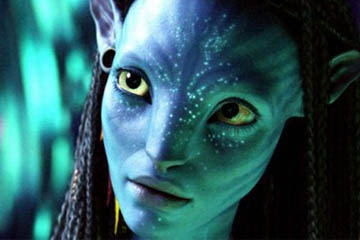
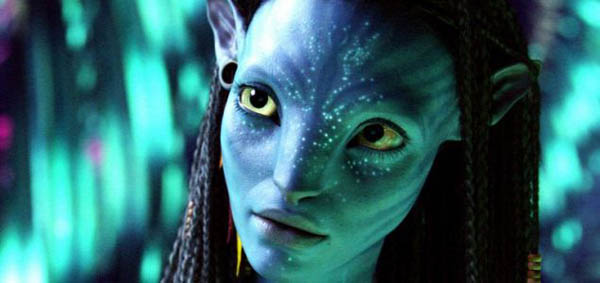
James Cameron’s Avatar

These days, everyone’s talking about James Cameron’s Avatar… but the concept first re-emerged in the sci-fi novel Snow Crash almost 20 years ago.

In the ancient Hindu epic, the Ramayana, the god Vishnu adopts the avatar of Ram to fulfill materially his role as the Preserver. The main purpose of this incarnation is to demonstrate the “righteous path” for all living creatures on earth.
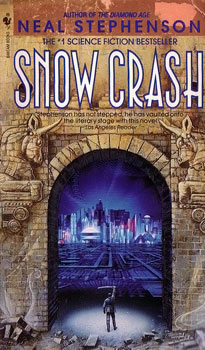
The word “avatar” is a Sanskrit term which refers to a deliberate descent of a deity from heaven to earth. The modern usage of the term is more accurately described as an “incarnation” or “manifestation” – which is how Neil Stephenson reintroduced the term in his 1992 novel Snow Crash.

The book hit me and other science fiction readers with an impact not soon forgotten.

I have encountered only a rare few books that predicted the future and commented deeply on the nature of human existence. Snow Crash is that book.

The main story follows Hiro Protagonist on his mindwarp cyberpunk-samurai-pizza delivery-neurolinguistic-action adventure through California.

From the sovereign kingdoms of gated suburban communities to the magnetic grappling hooks of the hitchhiking freeway skateboarders, Snow Crash repeatedly throws out new ideas of technology and society.

Fiction Meets Reality

The Internet, with its lightning fast data transfer speeds and extensive human involvement, has begun to match some of Snow Crash’s predictions. Its relevance continues to grow as we tumble into the future our on-line world is creating.

Neil Stephenson’s Snowcrash

In Snow Crash, the materially real characters adopt their own avatars in the electronic world to perform tasks in service of their needs in life. It’s those needs and roles that not only help move the plot along, but offer a real portion of Hiro’s identity.

In the book, there’s a virtual nightclub where Hiro meets his friends. He has a history in the club, and also in developing the skills of swordfighting used in the occasional online duels. He is a popular, well-respected avatar in the club, reconnecting with a brilliant ex-girlfriend.

Even though it’s virtual, it’s a legitimate place where he meets old friends, makes new relationships, and inquires about the news. His avatar is his mask, but also an actual social entity.

Today, in social communities like Second Life, we can interact with real people, and indeed earn a real-life living.

Yet the author doesn’t let us forget that the characters are still human, vulnerable to the tough realities of the material world. While you can make a living in the online realm – the earnings need eventually translate into real-world money. You can’t eat digital gold coins.

The Idea Virus

In the novel, there is also a strong exploration on the symbolism of linguistic concepts. A specific thought can be like a virus, and can move the world in a new direction.

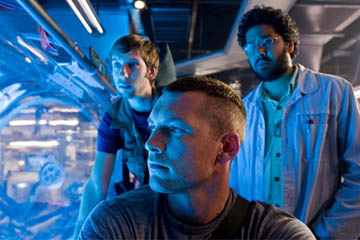
The crew in Cameron’s Avatar

Think of the concept behind the words “twitter”,”status”, or “meme”, and you’ll see how these have sparked new societal formations.

Unlike Vishnu’s divine universe, our material world can be altered strongly by the virtual world. Through these linguistic concepts, the virtual world can directly affect our own lives, and even that of people not directly interacting online. Sometimes these conceptual changes are for the better, but sometimes they can be devastating.

In James Cameron’s film, the main character inhabits his Avatar and affects real-change in the Navi tribe. His Avatar’s actions have real-world consequences.

This is not yet the case today, where avatars are still relegated to the virtual realm. Is there still a danger of taking our online identities too seriously?

The answer lies in the Hindu epic. It’s doubtful that the eternal deity Vishnu was really that concerned about his avatar Ram’s trials on Earth. Vishnu is an eternal concept, and will be reborn a million times in the eternal universe. The avatar is an extension of their essence, not their real essence.

Eventually, no matter how deep you are into the virtual dungeon or how many you’ve accumulated online, you are going to have to get up to use the toilet. If you can’t laugh about that, you are in trouble.

After all, humor is a great escape hatch from the online, subordinate world.

What are your thoughts on avatars and identity? Share your thoughts in the comments!

Pop Culture
 

About The Author

YD Bar-Ness

YD Bar-Ness is a conservation ecologist based in Hobart, Tasmania, searching for the Kalpavriksh, India's mythical wish-fulfilling tree. His work and output have been published or featured in Outlook Traveller, Australian Geographic, Jetwings, The Indian Express, Times of India, GEO-India, and Matador. Please visit www.treeoctopus.net for more.

More By This Author

view all →
  • http://wheretherebedragons.com Tim Patterson

    Fascinating analysis, YD. You got me thinking.

  • ben
  • http://www.timesharerelief360.com/blog/ Timeshare Relief

    Great analysis, I didn’t see Snow Crash but I Avatar is a great story the epic of reincarnation, love, vengeance and power. Congrats to the movie for earning a billion dollar.

  • http://www.nehasweb.com Neha

    Heading out to look for a copy of Snow Crash.

  • http://shanghaijill.wordpress.com jill b

    Funny, a friend gave me a copy of Snow Crash a while back and I just started it the other night. Great writing! Can’t wait to get more into it. Had no idea it was the genesis of Avatar. I saw the movie, but was not a big fan. Needed a better script.

  • http://www.candicedoestheworld.com Candice

    I just saw “Avatar” last night and I had to revisit this article, and I must say, the inner sci-fi geek in me has been revived. Definitely picking up this book. While “Avatar” had a lot of cheese (amazing nonetheless), it certainly got me thinking about my online life and how it affects my “real” one.

    Did nobody else make the connection between Avatar and Pochahontas? Haaa.

  • Femke

    Yeah I totally thought of that when I was watching the movie! It’s modern Pocahontas!

Pop Culture →

Classic Calvin and Hobbes cartoon debating on the true nature of humanity, with a dash of...

Pop Culture →

What happens when a producer from Spike TV finds himself a huge fan of an economic...

Pop Culture →

The babies are here, and they're unbelievably adorable.

Pop Culture →

Steven Levitt and Stephen Dubner's new book, Superfreakonomics, attempts to position...

Pop Culture →

At 4'11", is Dolly Parton tall enough to go on the rides at Dollywood? Perhaps Shaggy...

Pop Culture →

The plastic glory of Hollywood is revered and reviled the world over. Natalie Grant...

Pop Culture →

A new study found that people who don't drink are more likely to be depressed because...

Pop Culture →

One begins to wonder if our protagonist would rather be in bed with the woman or her...

Photo Essay →

3 weeks on the crew of a reality show following the adventures of real-life travel...

Drugs →

Courtesy of the TV show Weeds, here's a short history of marijuana use around the world.

Pop Culture →

So you've been to the Louvre and the Guggenheim and the MET. Bravo.

Pop Culture →

A new report says happiness is tied to economic factors. Christine Garvin thinks the real...