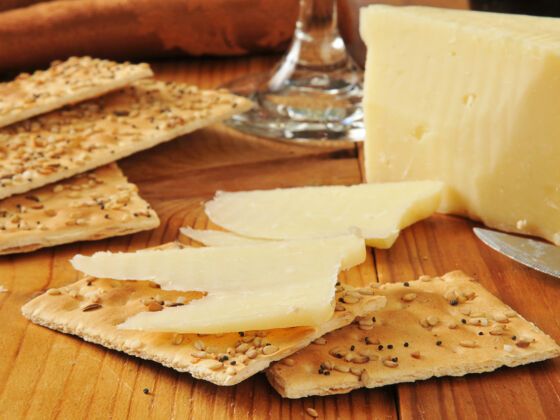
Photo by cwbuecheler

In the first installment in our Green Recipes series, Sara Clarke shows you how to make your own cheese.

You really only need three things to make a simple fresh cheese: milk, heat, and acid. There are some rules to follow, and some kitchen supplies that will make things easier, but in the end it comes down to those three things.

The Milk

It is very important that you do not try to make cheese with ultra-pasteurized milk. Other than that, any milk will do. You could also use the milk of goats or sheep if they are available to you; recently a New York City chef revealed that he’s been experimenting with cheese made from his wife’s breastmilk!

The Recipe

Pour a gallon of milk into a large pot, the kind you would typically use to make a big batch of pasta. Heat this pot of milk over a burner until it reaches the simmering point. Other recipes will specify various temperatures, but using a thermometer isn’t important – our ancestors made cheese for thousands of years without fancy electronic gadgets, and so can you.

When the milk reaches a simmer, it’s time to add your acid. The two most popular acids for home cheesemakers are lemon juice and white vinegar. As long as you use these in the correct ratio to the amount of milk simmering on your stove, you really can’t go wrong.

Photo by juya

Use a tablespoon of vinegar or lemon juice for every quart of milk; so to your simmering gallon of milk, add four tablespoons of your chosen acid. Stir just enough to blend it in, then turn off the heat. Soon the milk will begin to curdle: you’ll see solid chunks of curd floating in the remaining yellowish liquid, called whey. Leave the curds and whey to cool until you can handle the pot and its contents easily without burning yourself.

In the meantime, get out a colander, a slotted spoon, and some kind of cloth or paper towels. You can buy cheesecloth in supermarkets, but a tea towel, a bandanna, or a few layers of paper towels placed carefully inside the colander will work equally well. When the curds and whey are cool enough, use the slotted spoon to remove the biggest curds. Then pour the remaining whey and small curds through your cloth-lined colander. What remains in the colander is cheese!

If you’re hungry, you can stop here. The resulting soft cheese tastes wonderful eaten plain with a sprinkle of sea salt and olive oil, or a drizzle of honey if you have a sweet tooth.

You can also wrap the cheese in a cloth (paper towels probably won’t work) and hang it over the sink to drain out more whey. After 15 minutes or so, the cheese will have the consistency of a good ricotta which you can use to make lasagna, filled pasta, or blintzes.

Why Make Your Own Cheese

Homemade ricotta is far superior to its supermarket cousin, because the latter is pumped full of preservatives and stabilizers to extend the shelf life and make it easier to transport. Sitting on a shelf in the dairy aisle, ricotta becomes bland and gritty. This is the best reason to make your own cheese at home — fresh cheeses are much better when they’re actually fresh and not artificially preserved for months in a plastic tub.

Paneer Chilly – photo by dainee

Continuing to drain the cheese presents endless possibilities. Left to hang for a few hours, the cheese will be a little firmer, with a spreadable consistency like chevre. This is great spread on a slice of toast or added to a sandwich. If you leave the cheese to hang overnight, you’ll be left with paneer or queso blanco, which is perfect in a curry or used as a filling for enchiladas. You can even brine it for a few days in the refrigerator to make feta.

Community Connection

If you’d like to share a Green Recipe, email neha[at]matadornetwork[dot]com with your piece.

Recipes
 

About The Author

Sara Clarke

Sara Clarke is a TV production underling, writer, and general dilettante who grew up in the swamps of southern Louisiana. She's roadtripped through America and drunk chai on trains all over India, but for the moment her heart belongs to Brooklyn.

More By This Author

view all →
  • Abbie

    This is awesome – I love cheese!

  • http://www.expatheather.com Heather

    Bookmarking this! I made my own paneer once while in Pakistan…although it didn’t come out very well. Time to have another go.

  • http://www.bearshapedsphere.blogspot.com eileen

    I have sewn up a little napless teatowel for just this reason. Love homemade cheese. I just wish you didn’t end up with so much whey at the end. Do you have something you do with the whey? It feels wrong to toss it!

    Thanks for reminding me to do this today. I smell something tasty for dinner!

  • http://itchyfoot.tumblr.com Sara C.

    I keep hearing that you can keep the whey to do something useful with it, but I’ve never figured out exactly what that use would be. Supposedly it’s good for watering plants, but I don’t have much of a green thumb.

    I once tried to cook the whey down into Scandinavian gjetost, but to be honest it tasted really bad.

    (By the way, I’m Sara Clarke, the author of the post.)

  • http://nancythegnomette.com Nancy

    Great article, Neha. I’ve actually considered adding homemade cheese (made from milk from an organic, small, local farm) to my vegan diet. Now I know where to find the recipe.

  • Kathy

    It can’t *possibly* be this easy, can it?

    • http://itchyfoot.tumblr.com Sara C.

      Yes, Kathy, it really is.

      Of course, the caveat is that you can’t make just any type of cheese this way – cheddar, brie, mozzarella, gruyere, et al all require more refined cheesemaking techniques, and in some cases cultures and aging in a temperature controlled cave.

      But if all you want is a simple fresh ricotta or chevre, this is really all it takes.

  • http://alainarose.wordpress.com Alaina

    I love cheese! I’m definitely going to try this. Thanks !!

  • Samantha U.

    I just did this in a cooking class that I had to take at university, it is unbelievably easy & the cheese turned out really nice, especially when we added a little basil & salt. Amazing.

  • Pingback: A Jersey Girl’s Top Picks for New York Style Pizza in San Diego

  • rachel

    You can use the whey to soak flour overnight before you make bread (or anything with wheat flour). It makes it much easier for your body to digest properly. You can also make saukraut and other kinds of cultured vegetables. ´Nourishing Traditions´is a book which has loads of uses for whey and explains the historical uses and benefits for your body.

  • Pingback: Tweets that mention Green Recipes: How to Make Your Own Cheese -- Topsy.com

Recipes →

Learn to cook a turkey in a trash can, in a smoker or on the BBQ.

Recipes →

Spiced wine to warm your belly, pumpkin seeds to munch as you cozy up to your favorite...

Recipes →

The What Took You So Long crew brings us camel curd making 101 live from Mongolia.

Recipes →

Find out what a phuchka is, where to find them, how to eat them like a local and how you...

Sustainability →

Neha Puntambekar shares all you need to know about having an environmentally conscious...

Food →

Winter days bring thoughts of long, dreary boredom for many. Find out how professional...

Recipes →

The Backpacker.com trail chef show us how to make no-mess back country pancakes using...

Recipes →

Backpacker.com trail chef shows you how to wow your tent mates with this backcountry take...

Recipes →

Want to have a real happy meal? Adam Roy offers you six online resources for finding the...