Descending from the Andes into the oil boomtown of Coca, the Ecuadorian Amazon, one of the most biologically diverse rainforests on the planet, stretches as far as the eye can see.
Nearly half a century ago, this part of the rainforest was the pristine home of five indigenous groups – the Quichua, Cofan, Huaorani, Siona, and Secoya. In the early 1960s, American oil company Texaco discovered heavy crude oil beneath this jungle region, called the Oriente, or the East.
Over the next three decades of oil drilling Texaco (now Chevron) spilled an estimated 17 million gallons of oil, and dumped over 18 billion gallons of toxic wastewater into the rivers and streams relied upon by local residents for drinking and bathing.
The invasion of the region by oil workers wreaked havoc on the cultures of the indigenous communities while Texaco’s environmental devastation condemned the tribes to an ongoing public health crisis. The extensive oil infrastructure (opening roads to build oil wells and pipelines) propelled a massive colonization of the region by poor farmers from around Ecuador, who in turn would suffer from the same problems faced by the indigenous residents.
This is the first in a series of photo essays documenting the cultural and environmental destruction in this region of Ecuador by Chevron. The people who came to the region hoping for a brighter future in the wake of the discovery of oil encountered unsafe working conditions and exposure to toxic chemicals, and continue to live in the midst of a polluted environment that has caused an epidemic of oil-related illness throughout their communities.
To find out more about the historic lawsuit to demand Chevron/Texaco clean up its contamination, please visit the website of Amazon Watch’s Clean Up Ecuador Campaign, and stay updated about new events and how you can help on Facebook, Twitter, and by signing up to the campaign’s email list.
1
The Ecuadorian Amazon
The sprawl of colonist settlements in the Oriente region of the Amazon, just outside the oil boom town of Coca, in Orellana Province.
2
The Ecuadorian Amazon
Quichua women at an indigenous market in Coca (which is in Quichua ancestral territory) selling traditional medicines. On the left: Boa oil (from the fat of the boa constrictor) is used as an antibacterial and anti-inflammatory to treat wounds and lacerations.
3
The Ecuadorian Amazon
Small lagoon near the town of Taracoa, just south of the Napo River in Orellana Province. Located in the Yuca oil field, there were frequent oil spills here during Texaco's operations.
Intermission
4
The Ecuadorian Amazon
Two workers eating in a cafeteria in the town of Taracoa. Man on left: "I am one of the people affected by Texaco. During the times of Texaco, all the water of the forest was full of salt and toxins." Man on right: "There is no other option but to work for the oil companies here."
5
The Ecuadorian Amazon
Nelson Alvarado, 46, arrived in the Oriente in 1981 and began working for Texaco. Here, he stands next to one of three waste pits near Yuca 2B oil well in the town of Taracoa. Many cows and pigs have fallen into the unlined pits. Texaco covered up two of the pits with soil, and left the third pit open.
6
The Ecuadorian Amazon
Nelson points to Yuca 2B oil well, which he says has poisoned the surrounding area.
7
The Ecuadorian Amazon
Nelson Alvarado in front of his mother's grave site. His mother, Rosario Roman, died of uterine cancer. "She died because of Texaco. She died because there was no water to drink. All of the food was poisoned."
Intermission
8
The Ecuadorian Amazon
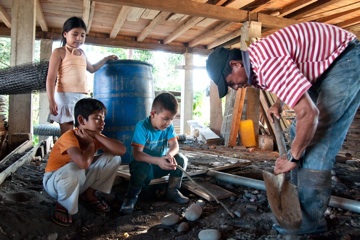
Nelson beneath his home, where a spill from a Texaco pipeline covered his land. He digs up crude oil, as his son, daughter, and nephew look on.
9
The Ecuadorian Amazon
Laguna Taracoa. The locals of Taracoa wish their lake could attract sustainable tourism, but it is too contaminated, poisoned over decades by Texaco's operations. (see next photo)
10
The Ecuadorian Amazon
Antonio Jaime Yanan Gomez, 42, works in oil tank construction for oil industry company ProinPetrol. He arrived in the Oriente in 1982, and lives 500 meters from Yuca Central oil processing station, built by Texaco. Here, he stands next to a small stream which empties into Laguna Taracoa. The locals call it "Estero Salado" (Salty Stream); they have forgotten the original name. Antonio says, "The fish in Estero Salado had white eyes during the times of Texaco. They were blind. But they were all we had to eat."
11
The Ecuadorian Amazon
Antonio's daughter died when she was only a year and a half old toddler. "She died from the contamination," says her father.
Intermission
12
The Ecuadorian Amazon
Home of the Ramos family, a typical colonist house in the region. 13-year old Jose Leodan Ramos died in 1990 from stomach cancer.
13
The Ecuadorian Amazon
Men at a cemetery in Taracoa. There has been no exhaustive health study there, but residents complain of stomach ailments, lung problems, and skin rashes. Men, women, and children in the community have suffered a wave of cancer.
14
The Ecuadorian Amazon
The cow pasture next to Bernardino Reyes' former home, which has been contaminated by leaching toxins from three waste pits surrounding oil well Yuca Sur Pozo 1. He says, "All of my cattle died from drinking the poisoned water. We had no idea of the contamination. Texaco said they had remediated."
15
The Ecuadorian Amazon
Residents from the community of Taracoa bathing in a river that remains contaminated. In fact, say locals, the entire water supply is contaminated.
16
The Ecuadorian Amazon
The Napo River at dusk. The Napo is a tributary of the Amazon. It was from the town of Coca (and the Coca River, a tributary of the Napo) that Spanish conquistador Francisco Pizarro's lieutenant Francisco de Orellana originally sailed to "discover" the great Amazon river, and his crew was the first group of Europeans to sail its length. From the Spaniards to the oil men of Texas, the legacy of colonialism is ever-present in the region.