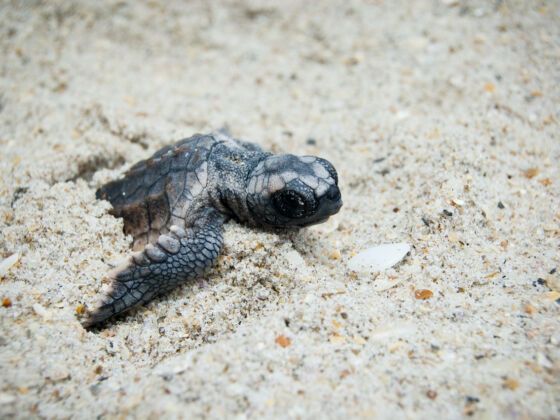
The leatherback is a tank of a turtle: up to 7 feet long and 2,000 pounds.

Photo: paulmannix Feature: Alex Pears

BUT THE WORLD’S largest turtle species is in trouble. Populations have declined 90% since 1980 due to pollution, run-ins with commercial fishing operations, poaching, and unchecked development along their favored nesting beaches.

On the Pacific coast of the Mexican state of Baja California Sur, a handful of people are working on an ingenious and effective project to get more leatherback hatchlings safely to sea.

Photo: mattkk

Leatherback mothers lay their eggs from October through March. The beaches north of Los Cabos, near the towns of Pescadero and Todos Santos, while as yet undeveloped, are too chilly through most of nesting season for the eggs to stay viable—only the early October nests have a chance.

That’s where Project Todos Tortugueros comes in.

In the course of her master’s degree research, biologist Elizabeth Gonzalez designed what is essentially a turtle greenhouse—a structure that raises the temperature of a chunk of the beach just enough for optimum leatherback nest incubation.

A Los Cabos-based turtle rescue group, ASUPMATOMA, donated the greenhouse to the small group of locals and expats who make up Todos Tortugueros.

Twice and sometimes three times a night during nesting season, members of the Todos Tortugueros team patrol the local beaches. As soon as a nest is found, trained volunteers move the eggs into the cozy greenhouse.

As the hatch date approaches, volunteers keep a close eye on the nests. The hatchlings are released on the beach to make their way to the sea, where they’ll confront both natural and man-made dangers. The females who survive to adulthood will return to these beaches to lay their own eggs.

In 2009 alone, more than 500 eggs—eight nests—have been protected. Hatch rates have been high, and local schoolchildren, fishermen, and community members are catching the Todos Tortugueros team’s enthusiasm for turtle conservation.

Photo: kretyen

But even as hundreds of baby turtles make their way out sea to the cheers of much of the community, three resort hotels and a luxury housing complex of over a hundred homes are either being constructed or are in the works along this stretch of coast. Building on the dunes is frowned upon, but the ban goes largely un-enforced.

Is the Todos Tortugueros project enough to keep the leatherback from extinction? Probably not on its own. But it just might be able to buy these incredible animals enough time, and enough fans, for us to do something about the other threats to their continued existence.

Want to volunteer? Adopt a hatchling? Visit the project? Check out the Todos Tortugueros website for contact information.

Community Connection:

Interested in saving turtles in other ecosystems? Check out the profile for Matador member organization, Caribbean Conservation Corporation. Founded 50 years ago, the organization has outposts in Costa Rica and Panama. Its website offers numerous resources for volunteers interested in lending a hand.

About The Author

Teresa Ponikvar

Teresa Ponikvar lives in rural Oaxaca, Mexico. When she's not running after baby, husband, dog, and chickens, or battling the leaf-cutter ants for her garden, or teaching English to unruly preschoolers, she occasionally updates her blog at cafeconleche.

  • http://GHANA.COM EZEKIEL MENSAH

    I REALY LOVE WHAT YOU ARE DOING.I GREW UP BY THE SEA IN BUTERE GHANA.AFRICA AND LOVE LOOKING AFTER NATURE.I AM A CHRISTIAN AND I AM INTERETED IN WHAT YOU DO CAN I COME AND HELP, EVEN THOUGH I DONT HAVE MONEY FOR TRAVELING? PLEASE LET ME KNOW AND YOU WILL DEFINATELY LOVE ME.
    MY EMAIL ADRESS IS PEOPLEOFGODCHURCH@YAHOO.COM.
    THANK YOU VERYMUCH.

  • http://peterholden.com peter

    nice piece – we’ve been going to Todos for years now and have enjoyed the thrill of helping the baby turtles into the sea for the first time, have donated money and always chat with the egg keepers on the beaches there. Thanks for helping raise awareness

  • Mario Flores

    I Loved animals, and go to Baja California for save turtles it´s a great experience. I´m form Mexico and when I can I go to Baja California in this time of the year. If you do this very often and if you don´t have enough money for travel to Mexico, I want to recommend this new mexican airline it´s a low cost airline its name is VivaAerobus http://www.vivaaerobus.com and you can get a lot of promotions and a cheap flights. And one more time thank you for take care of the animals!

  • http://www.bajareport.com Rachel Pack

    Teresa,

    We would like to post you article “Saving Turtles in Baja California Sur, Mexico” in our Weekly Baja Report on Monday 27-sep. We will give you full credit and list you boi as listed above.

    Please email me at bajagoodlifeclub@gmail.com.
    Rachel Pack

  • Pingback: Saving the Turtles of Akumal Bay

  • http://www.permaculturefarming.org Permaculture Farming

    Hello fellow blogger! I’m rather new to blogs but I just wanted to say that I enjoyed your blog here about Permaculture Panama; It kept me engrossed all the way to the end! Keep up the fine work… I’m always hoping to learn more about Permaculture Farming.

Activism + Politics →

With all the diversity, I've noticed one common thread - Belizeans doing good.

Parks + Wilderness →

10 of the animal kingdom's greatest migrations by land, air, and sea that you can watch...

Activism + Politics →

Two filmmakers embark on a 99-day journey to film people who are making a positive...

Wildlife →

Andrew follows a dedicated photographer into the woods of Maryland.

Wildlife →

How smart do you think these animals are?

Wildlife →

Wildlife trafficking is thought to be the third most valuable illicit commerce in the...

Volunteer Guides →

The first article in a series about a year spent volunteering.

Activism + Politics →

Look. Listen. Learn. Voluntourism with Witness for Peace in Colombia.

Sustainability →

Earth's ten most precious species that we cannot afford to lose.