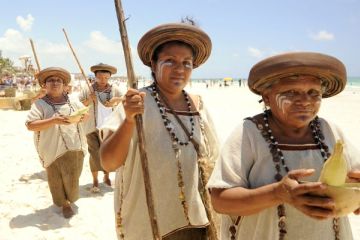
Old women from the village pay tribute to Ixchel / Photo: Karen Leperi

Paddling across the Riviera Maya brings more than a sense of victory over the sea – it’s a victory over fear.

THE SMELL OF COPAL incense hangs heavily in the hot, humid air of the Riviera Maya, as paddlers prepare themselves for a ceremonial pilgrimage to visit the sanctuary of the goddess Ixchel on Cozumel.

Ixchel, goddess of the Moon, was revered by the ancient Mayans; after all, she was the goddess in charge of tides and fertility – two key components that greatly affected life on the deep waters of the Caribbean.

However, the sacred journey remained a relic of the past – a forgotten memory – as the practice virtually disappeared over 500 years ago when the Spanish Crown prohibited the indigenous population from crossing the water. As a result, the goddess Ixchel was eventually forgotten, banished to distant dreams, and relegated to oblivion by the ravages of time.

Rebirth of the Annual Pilgrimage

Despite being wheelchair bound, paddler Aida Gomez made the
crossing both ways / Photo: Karin Leperi

Beginning in 2007, the sacred journey was recreated by a consortium of sponsors interested in reviving the Mayan culture, while strengthening the cultural identity of locals.

By consulting written glyphs, historians were able to reconstruct some of the ritual and ceremony surrounding Ixchel, thus bringing the Mayan civilization of the 11th to 16th centuries back alive.

In the process, the Sacred Mayan Journey has helped instill a cultural foundation for many of those in the Yucatan region, with authentic detailing of dance, dress, food, currency, and beliefs that defined the ancient Maya.

Nowadays, the journey is reenacted with hundreds of volunteers from seven villages who work as the cast of players and support crew. Together, they work with 300 paddlers in 30 canoes who ply the waters from Xcaret to Cozumel and then back to Playa del Carmen on the mainland, seeking favor and special blessings from Ixchel through displays of physical endurance, petitions, and offerings of fruit.

The voyage is no small feat, as it is done in handmade, traditionally-crafted Mayan canoes. Great physical effort is required from the rowers, as the journey is about 31 miles roundtrip and involves 6 to 7 hours of free paddling. For this reason, all paddling participants must agree beforehand to at least 4 months of preparatory workouts in rowing, swimming, flotation and endurance training.

Great physical effort is required from the rowers, as the journey is about 31 miles roundtrip and involves 6 to 7 hours of free paddling.

Contemporary reenactment permits both males and females to row, unlike the original excursions, with one of the participants in the 2010 ceremony confined to a wheelchair.

“I am so excited and proud to be a part of the Sacred Mayan Journey,” said Aída Gomez, who is wheelchair bound. Born in Guadalajara but living in Cozumel, she only walks with the help of a walker. But that didn’t stop her from paddling both crossings.

“This was my first time,“ Gomez explains. “And it was great to have my friends, my mom and family to help support me all the way.” She also had the support of her crew. Once her canoe reached shore, fellow oarsmen carried her piggyback so that she could be a part of the ceremony.

Xcaret – Start of the Journey

Photo: Karin Leperi

The inaugural ceremony for the journey begins in Xcaret, known in the Mayan world as Polé.

“The Sacred Mayan Ceremony is special because it reenacts a pilgrimage that took place in the ancient Mayan times and reaches a lot of people. It helps create a sense of belonging to the area,” according to Iliana Rodríguez, Assistant Director for Public Relations and Communications for Xcaret.

It is here where the seven communities arrive in their canoes during the evening. They come to Polé from Acalán, Conil, Ochtankah, Zamá, Xcambó, Xamanhá, and Ichpatun for rituals, dances, and purification ceremonies to honor Ixchel.

With the first rays of sunlight the following morning, the shamans bid the rowers farewell on their journey to goddess Ixchel.

The 300 paddlers are “chosen ones”, serving as messengers who petition the goddess for good favors and blessings. Their successful crossing of the channel was and is essential to ensuring fertility and abundance for the people of the Yucatan Peninsula.

Ixchel Speaks: Delivering the Message at Playa del Carmen

With attendant ceremonial festivities, the rowers are welcomed to Cozumel after their strenuous journey, with family and friends bearing plates of fresh fruit and drink. After a symbolic meeting with the oracle, rowers are given a message from Ixchel to take back to the mainland.

They rest for the night, and then once again undertake the sacred journey across the channel. This time, however, the paddlers carry a message of abundance from Ixchel.

“It’s not about beating the sea; it’s about beating our own negative thoughts, our own fears.” – Jhoni Puc

After crossing the sea from Cozumel to Playa del Carmen, the canoeists are greeted by the village shamans and the message of the oracle is delivered with gratitude and celebrations.

But as in most things in life, the journey ends up not being about where you go. The message becomes more about what we learn about the process, and in so doing, what we learn about ourselves. As Jhoni Puc, an oarsman for the past 4 years says: “It’s not about beating the sea; it’s about beating our own negative thoughts, our own fears. We don’t beat a sea, we beat ourselves.”

Have you been on a journey where you conquered your fears? Share your experience below.

Spirituality
 

About The Author

Karin Leperi

Karin Leperi, an award-winning travel writer and photographer, feels most at home when immersed in the spirit of nature. Whether desert, plain, mountain or marsh, she ferrets out the best of the natural experience and conveys that to her readers through poetic words and visual imagery.

  • http://wonderandwander.com Ameya

    This is really interesting, thank you for sharing!

  • Angeline

    Karin,
    What a wonderful piece. Thanks for bringing awareness of this history and culture to all of us.

  • Rajasthan Tours Operator

    very nice thanku very much for sharing with us

  • Rajasthan Tours Operator

    very nice thanku very much for sharing with us

  • Rajasthan Tours Operator

    very nice thanku very much for sharing with us

  • Rajasthan Tours

    Excellent .. its really interesting..Fantastic voyage

  • Rajasthan Tours

    Excellent .. its really interesting..Fantastic voyage

Spirituality →

Your voice at the Matador Community gives way to some of the best spiritual travel...

Spirituality →

The spiritual journey often begins from humble origins, and nobody can predict where the...

Spirituality →

"What do you wish to happen at the end of the day?". The second part of a series of...

Photo Essay →

Ian MacKenzie (with the help of fellow photographer Christian Bonanno), share scenes from...

Spirituality →

F. Daniel Harbecke follows up his series on Heroic Travel with real-world examples of the...

Religion →

Time to look back over 2009 and laugh at the fact that the world just keeps getting...

Culture + Religion →

Travel gives us a chance to let those protective walls come crumbling down around us.

Spirituality →

Legendary vagabond and author, Ed Buryn speaks on the fundamental importance of travel.

Spirituality →

Experiencing the bustle of a new place is one of the biggest reasons we travel. But even...

Spirituality →

In part two of a three-part essay, Daniel Harbecke shows travelers how to find their way...

Spirituality →

In this three-part essay, Daniel Harbecke explores our potential for inner travel through...

Spirituality →

Each of us has to take part in the survival dance, but not forget our sacred dance - the...

Christianity →

Venture on your own pilgrimage to these sacred cities around the world.