How do you reconcile following your flow away from family and friends and into a totally different place where you have to relearn everything?

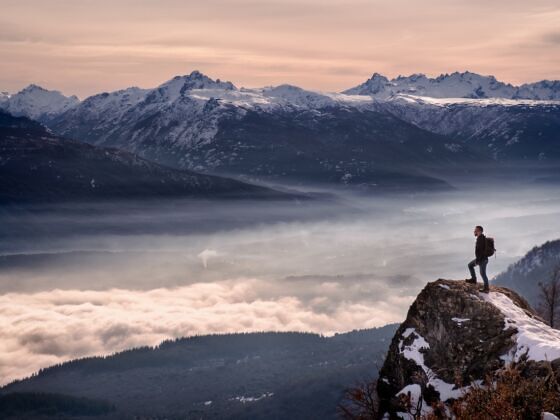
My new barrio (Arrayanes), Piltriquitron in backround.

Admittedly crappy photo (Malbec, cold hands).

AFTER 6 DAYS I feel like I know at least where the sun rises.

This time of year it comes up over the northern flank of Cerro Piltriquitron, just north of the most jagged comb ridge.

Arriving in a new place there’s that need to ubicar, to locate, and not just external things like where they sell homemade bread or empanadas or bed sheets, but to actually be ubicado, to feel yourself located in the place.

For me it always begins with place names and terrain features of the surrounding foothills and outlying ranges, any water–rivers, oceans–as well as prevailing wind or weather directions. In places where the urban or suburban landscape is so sprawled that none of these landmarks are available (Buenos Aires) getting located seems more an act of trust.

Yesterday was Thanksgiving. I woke up in a semi-funk, a new reality seeming to set in that (a) in all my time traveling (probably 3 years combined) I’ve never really thought of myself as an ‘ex-pat’ but I sort of felt like one now, and (b) I have no real emotional reference or precedent for any of this. My default reaction was to head up into the mountains.

Chacras below Piltriquitron. Image: Tetsumo

I took the road past our land then cut north on Camino de los Nogales. This is the most desirable land in all of Patagonia, and chacras, or farms (most of them organic) run along both sides of the road all the way to the foot of Cerro Piltriquitron.

Except for the Caranchos (Polyborus plancus), these kind of South American hawks that have wings shaped like condors’, there seemed to be no movement or people anywhere. I realized it was siesta.

Up the road were broad fields with rows of raspberry bushes and hops for the local breweries. All along the edges grew lupine and other wildflowers. It was hot enough, finally, that I took off my polypro shirt and moved under the shade of the Nogales (walnut trees).

After a while I found a horse trail which veered away from the road and along a forest preserve. At one point I saw movement, which turned out to be two horses. One had his head down feeding, then raised his neck up and transfixed me with ultra pale blue eyes. Then they both disappeared into the woods.

Another 10 minutes of walking and I found an easy place to duck through the fence wires. This wasn’t necessarily the high mountain access I was looking for, but then it seemed like this hidden patch of woods was actually better–out of the sun, out of view.

When I’m feeling depressed it helps to temporarily disappear (ideally inside a wave but that’s a different story), and I realized that in some ways this was as off the map as I’d been in a long time. In what guidebook or any book was this little patch of native Cypress forest?

In what guidebook or any book was this little patch of native Cypress forest?

Later I walked back to town and bought a couple folding chairs and my own little Thanksgiving dinner, a thin carving of bife de lomo with mashed potatoes, which I intended to prepare later with emotionally bolstering doses of raw garlic, fresh parsley, and Malbec.

That evening I was on my pre-dinner wine-stroll through the neighborhood, trying to get a good picture (seemed impossible), and on the way back, there was the moment, finally, where I officially met all the kids who live next door (13, somehow all under the ages of 15).

The way you interact with the local kids in a new place is probably the single most important (and revealing) situation you face as that privileged mofo now living in their neighborhood. No psychoanalyst or therapist can ever give you a more honest or dead-on assessment of who you are than the kids who seem to be playing all day in the dirt, but actually have their eyes on you all the time, and see through fronts.

What soccer in Patagonia looks like. Image: jaytkendall

Anyway, I had a cup of wine in my hand. The whole crew was in the area between our two houses, the two oldest boys with a soccer ball. One of them saw me coming and meant to get out of the way but then realized I was actually coming for the ball.

He tried to dribble past me then but I shot in and got the ball (saying something which came out, I think as, Huaa!) then dribbled around in the dust holding my wine-cup above our heads (both of us laughing) until he, of course, got the ball back. Little dude actually had on cleats.

“What’s in your cup?“ the kid asked.

“Wine,” I said. “Today is a holiday where I’m from [this seemed like a good justification] Thanksgiving.”

“Where are you from?”

“Georgia. Los Estados Unidos. Te ubicas? It’s the state right above Florida.”

The whole circle of the kids closed in then, three other boys, and four girls aged from 5 to maybe 10, each carrying on her hip a different dirt-faced and hugely-smiling baby.

I simultaneously thought (a) if only I could take a picture of these faces right now, of how stoked they are, (b) if my mom saw the picture she’d probably see first how dirty they are and then every other potential emotion / perception would likely be blocked out except for fear and anxiety over my choice to come down here, and (c) how stoked is Layla going to be to meet this crew?

The girls wanted to show off the babies to me. The boys wanted to know if I had a car (I pointed to my shoes.) I explained to everyone that my wife Lau and daughter Layla were coming next week along with our fat cat Lulu and our dog Julio.

I asked about their dogs, which one was the most bravo, and then as if on cue there was some kind of movement in the bushes down the street and all 3 of their dogs took off with their cat taking the opportunity to escape out the back of the yard. Immediately all of the boys started hollering and running after them.

After this I slid back home and skyped my parents for Thanksgiving. The stoke level which I had guarded rather shakily all day seemed to evaporate instantly as I listened to my mom’s plaintive voice describing the ‘concert’ performed by the cousins’ kids. It wasn’t that I didn’t want to listen to that, it’s just that the questions we should’ve been asking each other–how are you–were caught up somehow, unable to flow.

I know they’re suffering because to them I’m no longer ubicado. Seattle was far away from Florida but still essentially on the map. Patagonia is an abstract concept, someplace unimaginably distant (even if it’s not), even though we’re still talking right there on the phone.

The Sun is past morning angles now, high over the valley, although this house has yet to warm up. To locate and be located, not off in some dream or illusion but right at ground level, wherever you are when you finish reading or writing, wherever you are when you fall asleep or wake back, blinking there for a few minutes as you look out your tent or window: you just want to keep telling yourself, your family, everyone, “Don’t be afraid, be stoked! This is all of us together, just moving downstream, you see?”

Community Connection

How do you reconcile traveling in totally different directions than you your friends and family? Please share your thoughts in the comments below.

Narrative
 

About The Author

David Miller

David Miller is senior editor of Matador (winner of 2010 and 2011 Lowell Thomas awards for travel journalism), and BETA magazine. After living for the last two years in Patagonia, Argentina, he is returning with his wife and two young children to the Southern US. Follow him @dahveed_miller.

  • http://musictravelwrite.wordpress.com Michelle

    I just love your descriptions of the kids. I never thought about it, but you’re right – interaction with local kids is so telling, both about you and the place in general.

    • http://matadortravel.com/travel-community/david-miller David Miller

      thanks michelle.

      in the hierarchy of ‘ownership’ that goes something like (a) public spaces governed by the municipality, (b) front yards and driveways governed by people’s moms and (c) streets roamed and turned into playgrounds of kids and dogs, the kids are the default ‘rulers’ simply by their proximity to and time spent at ground level.

      or at least that’s how i see it. property owners may have their names on the title, but its the kids to which the place really belongs.

      which is why you got to get in good with them.

  • http://musictravelwrite.wordpress.com Michelle

    That’s the truth. No one knows a neighborhood better than a local child, for sure.

  • Anna

    Love this David. So well written and gets those well-known “I’m away from where I know, but what do I really know?” kind of feelings…. keep on living fully, it’s what you do best and you inspire the rest of us to do :)

    • http://matadortravel.com/travel-community/david-miller David Miller

      bigup anna, thanks.

  • http://meganahill.wordpress.com Megan Hill

    Right on, David. I’ve never thought about what helps me move from that dream-like, fuzzy state that comes with an unfamiliar place to making it feel like home, but I think this piece will help me keep my eyes open to that, next time.

    Nor does anyone in my family seem to understand the need to be footloose. And they probably wouldn’t understand why I find their stationary lives boring. My mom worries a lot, too.

  • tom gates

    my favorite food quote of the year: “emotionally bolstering doses of raw garlic, fresh parsley, and Malbec.” i’ve bolstered quite a bit that way, this year :)

  • http://carlo-alcos.com Carlo

    I reconcile it as being what I want to do with my life, and how I want to grow as a person. We have no choice as to what family we were born into so for me it’s hard to reconcile any obligation to stay near them just because they are family. Don’t get me wrong though, I love my family. I love my friends back home too, but the reality is that everyone moves on in life and as time goes on everyone drifts towards their own thing and their own passions. For the foreseeable future, this is mine.

  • http://matadortravel.com/travel-community/egypt/nickrowlands/travel-blog Nick

    I found this piece very moving, David – thanks! I think you’ve beautifully captured the sense of dislocation that everyone involved feels when someone goes “off the map”. It’s interesting to see how you deal with it.

    Holidays can be particularly difficult times.

    I wish my mum would read this.

  • http://wayworded.blogspot.com/ Hal Amen

    I reconcile my travels internally with the gut assumption that I’ll always “go back.” I’ve had many homes, but I’ve never reached the point where I can visualize 100% breaking away from *home*–the places and faces I was born into. Sometimes that makes me sad, and sometimes it doesn’t.

    This is amazing writing, btw.

  • http://matadortravel.com/travel-community/candicew86 Candice

    Love love love these descriptions, especially the image of dribbling the ball with the wine cup in the air. I don’t think i’ve interacted with children on a level like that yet on my travels. I haven’t travelled enough long-term for it to be an issue with family or friends, but when I discuss the idea, nobody really seems to understand why I would want to do so. My parents are old, they want grandkids!

  • Jared Krauss

    You know, David, I feel a sense of relation to this set of emotions you portray here. When I started playing soccer with the kids in Lambeth Station (South London), it stopped feeling like a place where my hostel was located. I wasn’t moving to London, but where I am, where I’m sleeping, if I’m happy, is my home; home is where my heart is. I’d be walking down the street towards Borough Market- a ways away- past the little rubber, miniature soccer court and they kids would all stop playing to follow me on the other side of the fence as I walked by to try and get me to play with them. They’d see me on the way back, one or two of them, and they’d smile shyly, slowly raising a hand or two, toothy grins and dirty faces shining bright at me. It made me feel a part of the place. I can’t help but think back fondly on that place. I can’t help but feel like a part of me is still there. It’s a bit of a home.

    Kids are honest. You have to love them for that.

  • http://milesofabbie.com Abbie

    I’ve been thinking about this a lot lately, and what my family would think if I moved abroad… I’ve already gone from the east coast to the west coast, which was a big enough ordeal, but I have to agree with Carlo, and I think our families should see our relocations as awesome vacation opportunities!

  • http://matadornights.com/ Kate

    But how much wine did you spill? Any? Or are you that damn cool? Great read that got me thinking. Thanks.

    • http://matadortravel.com/travel-community/david-miller David Miller

      minimal spillage kate, thanks for asking, and for the nice words.

Narrative →

Aka: "the friends and familia tour 2011"

Narrative →

Robert Hirschfield reflects on the absence of words between two travelers and how that...

Narrative →

In these notes--part memoir, part travel narrative--Mary Sojourner traces friendships,...

Narrative →

Mary Sojourner stops on a South Dakota highway, remembering that there are all kinds of...

Narrative →

Mary Sojourner "discovers" a place far off the desert West of magazine ads, then returns...

Narrative →

"Yea we’re armed. We have swords, everyone in the street with knives and swords. It’s...

Narrative →

On his second visit to the Jaipur Literature Festival, Jonathan Yevin gets ground level...

Narrative →

Robert Hirschfield finds a moment of grace in a street performance in India.

Narrative →

C. Noah Pelletier spends his 30th birthday trying (but failing) to write, checking his...

Narrative →

Reeti Roy arrives in Edinburgh in the middle of the Fringe Festival, but alone,...

Narrative →

They want me to sign paper that say Tibet part of China. I tell them, ‘no, if you want...