Previous Next
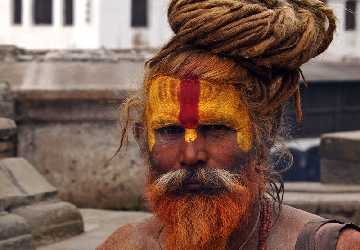
Robert Hirschfield looks at ceremony and how the “mystery of continuity in the presence of collapse” occurs not in the otherworldly, but right at ground level.

Photo: jmhullot

THE TWO OLD sadhus at the Trevini Ghat in Rishikesh were always smoking ganja. They would suck their fat paper horns into their mouths in a way that was so erotic watching them seemed indecent.

I’d heard lots of stories about sadhu stoners. They always made me defensive. I wanted to believe the sadhus kept alive an ancient solitude the world had let die. I wanted to believe they got high only on tridents and lingams and things like that. Until I encountered those two at the Trevini Ghat I never saw proof to the contrary.

Their getting high, I soon realized, was just one part of a benign ceremony that included marathon chatting and robe mending. Their robes were of wrinkled, gashed, pre-historic saffron. Beyond the healing of needle and thread.

Why even bother? Maybe just the need to push along the mystery of continuity in the presence of collapse. I imagined a couple of old ladies on a porch in the Midwest passing time.

Time, I say, not timelessness. The holy men’s tokes and chatter, the shuttling of their needles, blew away my fantasies of sadhu otherworldliness as if they were images on a Tibetan sand mandala.

Community Connections

What ceremonies and traditions have you encountered in your travels that broke away from your preconceptions? Please let us know in the comments.

For an interesting look at Western perceptions of (and issues with) Indigenous cultures, check out Christine Garvin’s recent piece at Brave New Traveler, The Rights and Wrongs of Traditional Cultures.

How to Write


About The Author

Robert Hirschfield

Robert Hirschfield is a freelance writer and photographer whose work appears in Ode Magazine, The National Catholic Reporter, Outlook (the Indian newsweekly), and the London Jewish Chronicle, among other publications. He has travelled most recently to north and South India, and to Israel and the West Bank.

Archived Responses to Notes on Sadhus Getting High

  1. Alan says:

    I spent an academic semester in Nepal and researched/interviewed sadhus for the better part of a month. Traditionally, getting high–or fiery-eyed–is a way to invoke Shiva, sometimes explained as a shortcut to achieve an otherworldly state of mind. It’s a supplement to other forms of asceticism like taking ritual ash baths, performing feats of austerity (genitalia, anyone?) and letting one’s hair grow and grow and grow.

    Nice notes, Robert!

  2. Lovely. Curious, succinct and simply lovely!

  3. Agreed, lovely, as always Robert.

Are guidebooks still worth the paper they're printed on? Maybe. Fact is, they're still...
Direct from email exchanges among Matador crew, here is a transparent way of dealing with...
This Monday we look at the continuing hybridization of nonfiction and fiction, a couple...
A short passage from Raymond Carver is an example of writing that describes not just...
Start flexing a larger vocabulary now with these simple tips.
Writers tend to fall easily into the coffee / computer / confined office trap. If this is...
Whether a famous freelancer or fresh out of high school, the need for persistence never...
Notable writers on plot structure, plot development, and the plot of our lives.
5 tips for writing about the world's social problems more effectively .
"Make no mistake: You will be writing a lot of crap. And that's a good thing. "
What are the implications of growing up reading about characters who are nothing like you?
In a new series, Notes on Writing, Matador editors examine different books and writing...
"...I began to give up on outlining — that is, before I write."