Previous Next

Water transport. Photo by: James Emery

Note: One of the finalists of the 2012 NatGeo / Matador NEXT GREAT STORYTELLER contest, Emily embarks on a trip of the West Bank to understand water scarcity at the root of the Palestinian conflict.

“AN AMERICAN?”

Uzi Landau, Israeli Minister of Infrastructure, shook my hand on a gravel road overlooking the West Bank settlement of Kochav Ya’akov. He switched to English when my nationality was revealed, and grasped my hand a few seconds longer than necessary, looking me square in the eye. His grin was strained, twisted with a mixture of curiosity and annoyance. Then he dropped my hand and quipped, “You should find a better tour guide.”

He was referring to my couchsurfing friend, Chaim, a correspondent for an Israeli newspaper. Chaim was already walking briskly in the direction of his bullet-proof company car, scribbling on a ruled notebook as he walked, mopping his brow in the early September heat and mumbling under his breath. He took a long drag from his water bottle.

There was something impulsive and neurotic in the way he moved. He was in his element tooling around the West Bank in a beater. He couldn’t care less what Landau had to say about him.

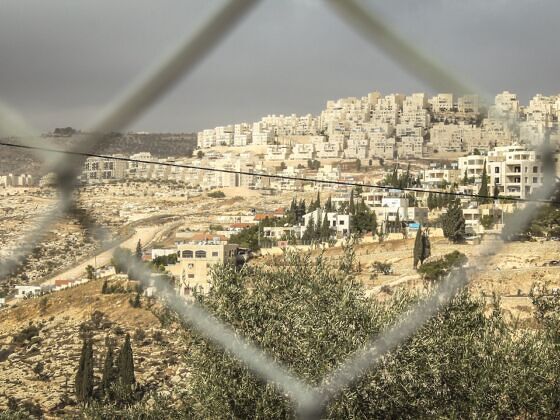
The press caravan followed Landau’s bus north out of Jerusalem through the Hizma checkpoint. Today he was covering the minister’s press tour of the Jewish settlements, an opportunity for the nationalist, Likud-led government to have face time with the settlers. They came out that day to share their hopes and concerns for the future of their contentious homes in the West Bank.

Israel skyline. Photo By: Alistar

Chaim refused to ride the press bus full of Landau’s followers, and we sped down the well-maintained Israeli roads in the reinforced sedan. It was peppered with dents, the windshield a spiderweb of cracks. He muttered an explanation about slingshots. “They all throw stones sometimes, Palestinian kids and the children of Jewish settlers.”

He used the drive between settlements to translate Hebrew conversations between Landau and the settlers at each stop. The settlers at Kochav had begged for wider water pipes, the only way to bring in the appropriate amount for the development of independent agriculture. Chaim spoke of Palestinian villages and refugee camps from which water had been diverted — places that now relied on government deliveries that were almost always late.

I squirmed in the passenger seat. I was sweating through the front of my shirt, my nearly empty water bottle rolling at my feet.

I was reminded of the Israeli couple in their 80′s who I’d met beside the Galilee a week before.

“You won’t understand the state of Israel or the conflict until you understand the water.” The old man spoke between bites of chocolate ice cream. “The water is everything. Everything green you see here is because of our engineers, our innovators, our irrigation system. They hate us for a lot of reasons. Land was the first reason. Water was the second.”

The sedan rolled to a stop over dust and gravel. We’d preempted Landau’s arrival at Shilo and were greeted by a settler, a woman in her early 40′s. Chaim hugged her. They were friends.

“If Chaim had his way they would bulldoze my house tomorrow,” she said playfully. Chaim shook his head for a moment, then nodded. They were smiling, but neither was joking. He walked away to take notes as Landau started to speak.

“I live in Eli, in that settlement across the valley.” She pointed to a huddle of houses on the far distant ridge. “People like Chaim say that we built it over a Palestinian olive grove. They think we’re thieves.” I could sense the tone of desperation in her voice. She knew what Chaim had been telling me. She wanted me to understand her life, the choices she had made.

Chaim emerged from the crowd before the meeting was over, as a number of settlers began raising their voices. “I have what I need,” he muttered.

“What are they saying?”

“That the Palestinians in the valley are drilling through the pipes to steal water.”

I grasped my empty water bottle, glancing through the open door to the press room where tables were set for lunch. Caterers placed bottles of water in neat rows on a folding table. I was told to help myself.

If they hadn’t offered, I’d have stolen one when no one was watching.

About The Author

Emily Hanssen Arent

Emily Hanssen Arent is a writer and traveler who has found a home in Boulder, Copenhagen, and Jerusalem. She is currently a graduate student of Middle Eastern Studies in Tel Aviv, Israel, where she writes, studies, and struggles daily with Hebrew and Arabic. You can follow her @emilyharent.

Archived Responses to Traveling the West Bank on an empty water bottle

  1. Amelia says:

    I really like your stories about the Israel and Palestine! They truly are great and I feel like I travel with you every time I read them, but I am not sure I understand you sometimes… sometimes I think you as someone who supports a peaceful solution between the two people, but some other times, I am just not sure. Why put a picture of the top of the  mosque and just say it is from Israel and not mention I don’t know East Jerusalem or major Palestinian historical site at least? 

    This woman who says that “they” hate “them” b/c of water is just… eh… not saying that you personally believe that.  She is right when it comes to “land” since it was never carefully or smartly ;) hehe divided for the Palestinians and the part they got is still taken away.  If you ever encounter a person like that, please tell her that how can we accomplish peace if someone keeps eating the pizza? I sometimes think people just do not want to put in themselves in each other’s shoes… it puzzles me really.

    I hope you keep up with your stories and believing in peace for both sides! :)

    • EHA says:

      Thanks for reading, Amelia. I always enjoy your very insightful comments and I look forward to hearing from you again on future pieces :)

    • GrimesCorey says:

      my roomate’s st ep-mot her brought ho me $1 3342 the previous mo nth. s he g ets pa id on the computer and bought a $369300 condo. All she did was get lucky and profit by the advice uncove red on this web page

      ⇛⇛⇛⇛► (Click At My Name For Link)

Landing on everything from brick walls to telephone poles to the doors of trash chutes,...
Seeing Hemingway's Idaho home through a rear view mirror.
“I feel great pride that someone in my family was Gandhi’s doctor."
My psyche all stirred up, I asked Miriam, “Should we go in?”
"Since you keep asking about the politics of Indian-Israelis…” He fell silent.
Pushing down on the knee-jerk reaction that says soldiers and activists are always at...
It was rush hour, and a sea of people ebbed and flowed.
I’m completely baffled by others’ fascination with my hometown.
The landscape changes gradually over the years, much like our lives and our point of view.
I am alone, and lonely, and missing him.
The greatest travel opportunity for this generation of students is to study abroad in the...