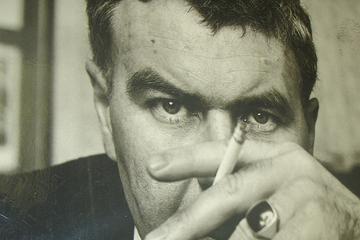
Writing by remixing: Gordon Lish and Raymond Carver
Photo: Pink Moose
THERE’S AN old phrase Brian Eno supposedly said about the Velvet Underground. It goes something like “when the first Velvet Underground album came out, only about 1,000 people bought it, but every one of them formed a rock and roll band.”
I’m not sure what the sales of Raymond Carver‘s first books were, but on a level of artistic influence you could apply a similar statement. People read him and want to become writers. Or they read him and it totally influences their style.
The way we internalize an artist’s work is what ultimately matters. It’s more important than the “truth” about a writer’s life. How can learning about Lou Reed’s adolescence possibly compare with hearing “Candy Says” for the first time during your own?
This is why when I found out that editor Gordon Lish is responsible for much of what I love about Carver’s short stories, it didn’t affect how I felt about him as a writer. If anything it makes him seem more real.
In December 2007, the New Yorker published the original version of Carver’s story “Beginners” overlaid with Gordon Lish’s edits so you can compare the draft with the final version of the story published as “What We Talk About When We Talk About Love.”
The story is about a group of friends in their late 30s sitting around drinking and recounting different relationships, accidents, and people who committed suicide. Like most of Carver’s work, there is minimal plot / action, but instead a kind of tension (and weirdly powerful sense of compassion) that seems to drive everything forward.
Here are several notes about the way the story was edited (and in some cases, rewritten, by Gordon Lish). In the quoted examples, I’ve preserved the formatting as it was printed in the New Yorker, with Gordon Lish’s strikeouts + edits / writing in bold.
1. Temporal references or references to backstory are cut or significantly reduced.
Ex: The four of us were sitting around his kitchen table drinking gin. It was Saturday afternoon. Sunlight filled the kitchen from the big window behind the sink.
Ex: He said When he was young he’d spent five years in a seminary before quitting to go to medical school. He He’d left the Church at the same time, but he said he still looked back on to those years in the seminary as the most important in his life.
Throughout the story, Lish cut references to specific moments in time and specific backstory. This has the effect of making the story seem “truer,” as when we look back in time we rarely remember the exact day (or if we do it doesn’t really matter), but instead tend to organize our memories by “periods.”
If you imagine the story as a film, removing the backstory (where you’d have to cut to a different scene or flashback) and references to time also make the whole narrative move faster, with more tension. It gives you the feeling that you’re speeding towards something (probably bad) happening.
2. Each sentence containing two simple clauses connected with the conjunction “but” is broken into two separate sentences.
Ex: We lived in Albuquerque, then. But but we were all from somewhere else.
This, one of the most characteristic elements of Carver’s style, wasn’t actually the way he wrote the drafts; it was the way Lish remixed it. Although this is a very subtle linguistic element, it’s notable (especially considering the time in which it was published) because (a) it “violated” the rule that you don’t start a sentence with a conjunction, (b) it went against the decades-old prose style pioneered by Hemingway of created long compound sentences with clauses often having little to do with one another but joined anyway by a conjunction, and most importantly, (c) it gave the text this fragmented and on-edge feel as if the narrator was incapable of just letting go (or something) but had to keep backing up everything he said with some other thought or emotion.
Read the full article at MatadorU →
Community Connection
Another closely related topic to editing is translating. Please see Leigh Shulman’s Notes on Iranian Translation, with an excerpt of her translation published at Guernica Magazine.
Related Posts
David Miller
David Miller is senior editor of Matador (winner of 2010 and 2011 Lowell Thomas awards for travel journalism), and BETA magazine. After living for the last two years in Patagonia, Argentina, he is returning with his wife and two young children to the Southern US. Follow him @dahveed_miller.
More By This Author
- NATGEO Traveler and Matador search for the 'Next Great Storyteller' (10 comments)
- Sierra Nevada building brewery in Asheville (2 comments)
- Shon Bollock runs the gnar (3 comments)
-
http://www.sophiesworld.net Sophie
-
http://matadortravel.com/travel-community/david-miller David Miller
-
http://www.candicedoestheworld.com Candice
-
http://matadortravel.com/travel-community/david-miller David Miller
-
http://cuadernoinedito.wordpress.com Julie
-
http://matadortravel.com/travel-community/david-miller David Miller
-
Nick
-
Scott
-
http://matadortravel.com/travel-community/david-miller David Miller
-
http://www.sierrasurvey.com David Page
-
http://matadortravel.com/travel-community/david-miller David Miller

