How to get started mountaineering
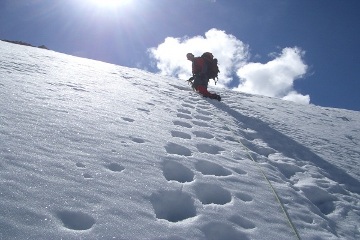
Mountaineering gets you higher. Photo from Ezzz
Basic Skills
MOUNTAINEERING DRAWS ON the full range of outdoor skills, from hiking and camping to climbing and glacier travel. The best way to get started is to master the most basic skills first. Three foundational areas stand out:
Backpacking
Many mountain routes, even on the 8,000 meter peaks of the Himalayas, are really just very long, steep, high-altitude, versions of the hiking trails you can find near your home. The first step, then, is to become comfortable with backpacking, or multi-day hiking, trips. Check out Matador’s guide on how to get started backpacking for more.
Camping in the winter poses unique challenges.
Photo: Weembles
Winter Camping
While most of the skills you acquire on summer backpacking trips will apply directly to mountaineering, there is one important missing element: cold. To transition from backpacking to mountaineering you must be able to perform all of the common hiking and camping skills, from setting up the tent to cooking, choosing the right clothing to planning adequate meals, in the snow, ice, and cold.
Climbing Fundamentals
You don’t have to be a master rock climber to become a mountaineer. You do, however, need to know the basics. Using a harness, belaying, and tying into a rope are the most important skills. The best ways to learn these skills is to spend a day or two at a climbing gym.
Taking the Next Step
You’re backpacking every weekend. You’ve been to the climbing gym and on several winter camping trips. It’s been fun but now you are ready to head into the mountains. If this sounds like you, it’s time to take the next step. There are several ways to do this, each with it’s own benefits.
Scrambling: Mountaineering often requires travel that, while not always technically difficult, is often very exposed. To get used to these airy positions, try several scrambles: difficult hikes that cross third and fourth class terrain. These steep exposed trails will take you to the limit of what is commonly climbed without a rope, getting your legs, lungs, and head ready for a more serious mountaineering objective.
The author taking in the view on a trek in Nepal.
Photo: Matt Spinner
International Trekking: Packing your backpack and setting off on a foreign trail presents a whole new set of challenges. Permits, visas, language barriers, and logistics must all be dealt with. Then, there is the opportunity to get very high and deep into true mountain zones on trails that blur the line between hiking and mountaineering. Treks in Nepal, Peru, Bhutan, and other destinations offer a scale that is hard to find in North America.
Take a Class or Hire a Guide: At this point, it is perfectly reasonable to actually do some mountaineering, especially if you are accompanied by someone more experienced. Taking an introduction to mountaineering class or attempting a route with a guide are both great ways to test your skills and build experience in the mountains.
Specialized Gear
Mountaineering will require all the gear you have accumulated for winter camping, and, to a certain extent, rock climbing. There are, however, a few key items that you will need to make the transition.
A mountaineering harness doesn’t have to be fancy.
Photo: iwona_kellie
Mountaineering Harness: Many climbing harnesses can be used for mountaineering without any problems. To function in the mountains, however, your harness must have enough webbing in the waist to fit over bulky winter clothes, and adjustable leg loops.
Your harness doesn’t have to be fancy: The classic Alpine Bod from Black Diamond is still a favorite and still under $40.
Double Boots: These days, most mountaineering boots consist of a hard plastic outer shell and a soft inner bootie. This is an absolute necessity because it allows you to dry the inner boots in your sleeping bag at night.
Crampons: 12-point, semi-rigid, crampons are the standard for mountaineering. The extra points and flexible instep make them functional on all types of mountain terrain, from flat glacier walks to steep ice climbs.
Piolet Ice Ax: Short, aggressively-curved, ice tools are excellent on steep ice climbs, but for general mountaineering the classic piolet is the ideal ax. Typically 60 to 90 cm long with a gently curved pick, a mountaineering ice ax is important for stability on steep slopes, self arresting in the event of a fall, and chopping steps into snow and ice.
Mountaineering: The Freedom of the Hills: This encyclopedia of climbing is a serious must-read reference for every aspiring mountaineer.
Now that you know how to get started, what are you waiting for? Pack your bag, hit the trail, and soon you’ll be summiting some truely massive mountains.
Community Connection
If you’re thinking of tackling those peaks, check out our review of Survival Straps: Bracelets for More Than a Fashion Emergency,
Related Posts
David DeFranza
David DeFranza is an editor at large for the Matador Network. He has studied in China, worked in Japan, and wandered all over Asia, Europe and North America.
More By This Author
- The 6 best starter ranges for mountaineering (6 comments)
- 7 Mountaineering Essentials (1 comments)
- 6 Bouldering Essentials (1 comments)


Pingback: uberVU - social comments
Pingback: Kamchatka-The Forbidden Zone