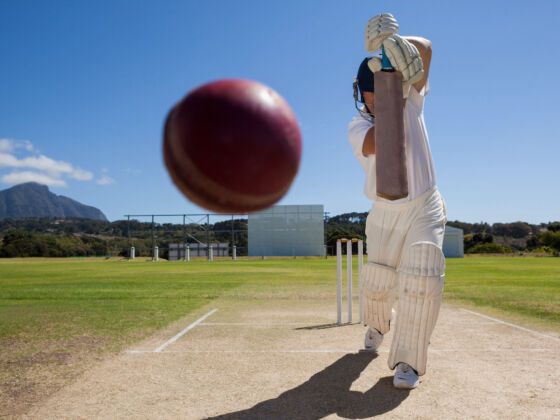
Photo: Prakhar / Feature: Sayamindu

Cricket isn’t just a game, it’s a British tradition. And, like all things British, there’s a proper way to go about it.

Cricket most likely began as a children’s game in the 15th or 16th century, so it’s really simple at heart. Hit ball with bat. Chase ball. Repeat.

Eventually, adults picked up cricket, beginning with farming communities and moving on to the British aristocracy, leading to super-complicated variations in the rules of the game.

Gear and players

Any game of cricket requires a bat, a cricket ball (made of cork and covered with leather) and two sets of three stumps (long wooden stakes). Professional players also use protective gear, like helmets, gloves, and groin guards.

Cricket is played between two teams of eleven players each. Each team is composed of specialist batsmen, bowlers, all-rounders, and a wicket keeper. Two on-field umpires, an off-field umpire, and a match referee officiate.

The basic premise

Each game is split into innings, where each team gets to bat while the other bowls (equivalent to pitching in baseball). Each inning is split into segments called “overs”, groups of six deliveries in a row by one bowler from a particular end. Bowling duties rotate with every over.

At the end of the game, the team with the most runs is declared the winner.

The field

Photo: fiverlocker

Cricket is played on a grass field, at the center of which is a 22-yard strip known as the “wicket” or the “pitch.” This is where most of the action takes place.

The wicket is marked on either end with three wooden stumps lodged into the ground. On top of the stumps balance two small wooden pieces, called bails.

In professional matches, the stumps contain tiny cameras to capture on-pitch action and vital close-ups.

The game

The game itself begins with two batsmen making their way to the pitch while the opposing team takes to the field. Batsmen try to score points by hitting the ball and running back and forth along the wicket.

If the batsman hits the ball past the boundary line, the batting team is awarded four runs automatically. If he hits it out of the ground limit, the team receives six runs.

The bowlers and fielders work at dismissing, or “getting out”, the batsmen, one at a time. The common methods of dismissing a batsman include dislodging the stumps, catching the ball before it hits the ground, and trapping him in front of the stumps. Once all the batsmen have been dismissed or the stipulated time is up, the inning ends.

Format

On the international level, cricket is played in three formats:

Photo: alza06

Test cricket – the classic form of cricket. It is played over five days, and is often considered to be the true trial of a cricketer’s skill. Test cricket is played in whites, a la Wimbledon.

One day internationals – Born in the 1970s, complete with colored uniforms. ODIs are played in two innings of 50 overs, with each team facing 300 deliveries.

Though purists claimed the format would never last, the one-day format led to the formation of cricket’s most prestigious tournament, the Cricket World Cup.

Twenty-twenty – the Twitter of Cricket formats. Added to the international calendar in 2005, twenty-twenty cricket – or T20, as it’s commonly known – is played in short bursts of 20 overs each. As the fastest-paced and most action-packed of cricket’s formats, twenty-twenty matches are usually concluded in less than 3 hours.

T20 also led to the formation of the Indian Premier League (IPL), a professional cricket league based on the structure of European football leagues. It’s a money spinner, both for players and the Indian Cricket Board, and some IPL cricketers earn as much as top English footballers.

Those are the basics: welcome to the tip of the cricketing iceberg.

Community Connection

Still have questions about cricket? Ask them in the comments section!

Team Sports
 

About The Author

Neha Puntambekar

Neha is a freelance writer from Mumbai, currently based in Zagreb. When she isn't on her laptop, you'll find her at a local cafe, sipping coffee, paperback in hand.

  • http://matadortrips.com/ Hal Amen

    Those are some creative kids that made up the game, I’ve gotta say.

    • http://www.nehasweb.com neha

      I don’t think any of them would recognize what the game has evolved to though!

  • Kaja

    i’m having a profound a-ha! moment. it’s been a while, actually. thanks :)

  • http://www.threespoons.co.nz Marie

    Thanks Neha. This article is exactly what I needed! My husband is a die hard fan and I usually just watch so I can hang out with him, but I have to admit I don’t really know exactly what’s going on. Despite being a Kiwi and living in England for 10 years, I never knew this started out as a kids’ game. I wonder if my husband knows that, ha ha.

  • http://www.threespoons.co.nz Marie

    Thank Neha, I really needed this article and all the good info here. I try to watch cricket with my husband who is a die hard fan, but I have to admit that I often don’t know what’s really going on!

    • http://www.nehasweb.com neha

      Glad this helped! If you are interesting in following the game, I recommend the T20 version. It’s fast (relatively speaking) and action packed.

  • http://www.sophiesworld.net Sophie

    I saw a match years ago. It took all day; stopped for tea and everything. A great social event. (I’m afraid I didn’t pay much attention to the match itself, though, apart from looking at all those gorgeous men in white). Immigration has brought the game to these parts (Scandinavia), too.

  • http://www.sophiesworld.net Sophie

    Forgot to say: Great intro to cricket, Neha. It seems much more straight-forward than I had thought.

  • Pingback: My Hometown: A Day in Calcutta | LunarTravel.net

  • Pingback: What NOT to Do in Auckland, New Zealand

  • Pingback: Cricket Community Rallies to Help Pakistan Flood Victims

  • Pingback: Cricket Fan Cycles From England to Australia

  • Pingback: Photo Essay: 15,500 Miles With a Bike and a Cricket Bat

  • Pingback: Tweets that mention How to Play Cricket: a Guide for the Confused -- Topsy.com

Team Sports →

At a local sports bar, we screamed at TV screens and got really drunk.

Team Sports →

As the government considers new safety legislation for youth football players, Benita...

Team Sports →

With the holidays over, there is just one more winter tradition left: The Rose Bowl.

Team Sports →

The history of the NFL's Thanksgiving Classic, from the 1930s until today.

World Events →

A look inside spot-fixing, a new method of match-fixing in cricket that’s giving...

World Events →

International cricket elite urge their fans to donate towards disaster relief funds for...

Team Sports →

The Institute of Aesthletics mixes art and sport to drum up community pride. Now, they're...

Team Sports →

A dogsledding team in Jamaica? Yeah, mon!

Team Sports →

Yuletide in the States means more than celebrating a certain holy man’s birthday.

Team Sports →

Kareem Abdul Jabar on Hoopfest: “I’ve never known a town to give itself up to gym...

Photo Essay →

Matador Goods editor Lola Akinmade breaks down a typical rugby game through photos.