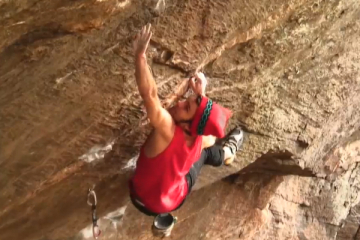
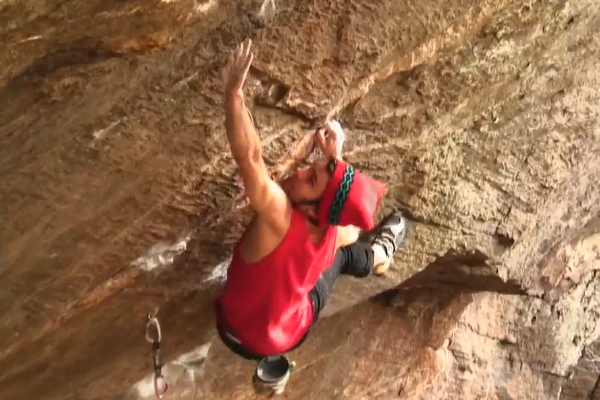
The climber pictured above, Max Zolotukhin, has just lost his handhold. He has no rope.

FOR THOSE OF YOU WHO haven’t heard the story, on October 18th, Zolotukhin suffered an accident while attempting a ropeless ascent of Supernova, a 5.14b route at Rumney’s Starship Wall in New Hampshire. Taylor de Lench, a filmmaker and friend of Zolotukhin, was on site to film the climb for his upcoming film SICK: Climbing in New England.

In the video, Zolotukhin starts out strong, making his way through some half-dozen moves with no apparent problems. Then, at about twenty feet up, his hand slips from a hold and he falls. From there, the video becomes genuinely unpleasant to watch.

“The second I hit I knew things had gone wrong,” writes Zolotukhin on the Boston Rock Gym’s blog. “My foot was facing due west instead of straight ahead like a normal foot should.”

But besides broken bones, Zolotukhin got something that very few free soloists get – a second chance.

“My lessons were clear,” he writes. “DON’T be overconfident; DON’T assume that everything will be okay.”

As a rule, there are no second tries in free soloing: there are sends and there are accidents. A significant chunk of the discipline’s big names, like John Bachar and Derek Hersey, met their ends in climbing accidents, most of which could have been avoided by the use of safety ropes.

The accident has provoked discussion within the climbing community about what constitutes responsible free soloing. Online, many climbers have emphasized the importance of a good attitude to free soloing and highballing, with some pointing out Zolotukhin’s own admission that he pushed himself to climb the route despite not feeling sure of his ability to do so.

World-class free solo climbers like Alex Honnold are legendary for being cool-headed even under the worst pressure, and it’s not hard to see why. When all that separates you from a fatal fall is your grip on a dime-sized nub of granite, you’d better not flinch.

Still, it’s difficult to talk about safety in a discipline defined mostly by its rejection of safety equipment. As Zolothukin’s friend Gavin Heverly writes on his blog, not even experienced soloists can escape the danger.

“[Honnold's] free-solos are awe-inspiring and downright impressive. But they are also mind-numbingly stupid,” writes Heverly. “Dying doing something you love is in a way amazing. But…I mean, wouldn’t you rather CONTINUE to do what you love?”

Community Connection

Is free soloing worth the risk, or is it inherently irresponsible? Tell us what you think in the comments section.

Climbing
 

About The Author

Adam Roy

Chicago native Adam Roy is the former-Editor of Matador Sports and an aspiring renaissance man to boot. For more of Adam's writing, check out his blog at Ill-Advised Adventures.

  • http://milesofabbie.com Abbie

    I have a very “strong” opinion about free soloing, so I’ll try to reel it in a bit…
    As a climber myself, I can appreciate climbers who have a cool head and can stay calm in uncomfortable situations. That said, I also know how a foot can unexpectedly blow, or you can grab a hold and it just doesn’t feel quite right, or you are climbing fine and then something tweaks, OR you are climbing and a bee flies up your sleeve and stings you. My point is that anything can happen, no matter how calm you are, and you could fall and get hurt (or worse). I think that free soloing is incredibly irresponsible. Especially if you have a family (i.e. John Bachar, a famous climber who recently fell soloing in Mammoth and died), the rush is not worth the potential consequences. It’s not just about you, it’s about your family, your children, your friends.

  • Somchai

    Soloing isn’t necesarily about a rush, but more a calmness that come from being under control. A similar feeling to that felt while climbing extremely run out routes.

    I discussed just this topic more than a couple of times with Derek Hersey mentioned in the fourth paragraph.

    Some thoughts.

    Soloing should be done with the knowledge and acceptance that the price of failure is death. If one doesn’t understand and fully appreciate the consequences one shouldn’t solo.

    Climbing ropeless twenty feet off the ground is more akin to high altitude bouldering, not free soloing.

    Free soloing, especialy routes that haven’t been rehearsed leaves no ambiguity as to ethics. So many people climb at what is in reality far above their ablilities these days. Soloing teaches one to truly asses ones abilities, failure to recognise one’s limitiations can ruin your day.

    Lastly some choice quotes from Derek. The first while belaying he sits right on top of the bad anchors he spent half an hour trying to find and set up securely so that I can’t see the anchors at all and assume him to have none. When I reach the crux and can see his seeming lack of anchors he looks over, gives a serious look, and dead pans, “Don’t fall or we both go”.

    The other while simulsoloing the exit from a long route he looks back and says, “slip now and you’ll fall the rest of your life”.

    I’m now old fat weak and have trouble climbing out of bed.

  • http://milesofabbie.com Abbie

    “Climbing ropeless twenty feet off the ground is more akin to high altitude bouldering, not free soloing.”

    Actually, it is free soloing. High altitude bouldering refers to bouldering at a high elevation, and has nothing to do with the height of the climb. For example, Rocky Mountain National Park is “high altitude bouldering” because it is around 10,000 feet versus Joshua Tree, which is around 4,000 feet.

  • Pingback: 5 Climbing Videos We Can’t Wait to See

  • Pingback: 5 Climbing Videos We Can’t Wait to See | LunarTravel.net

  • atp

    soloing is personal. Everyone has different feelings because there sensitivity is different, peter croft said it well in the movie painted spider. Its amazing what the mind is capable of, most who think its “crazy” its because there meantally not capable of soloing. If i were to set ten ladders at ten feet tall in a row most could climb and travers all of them without failure (meantal) its the same feeeling when soloing something rehursed then climbed. Death is not an option just enjoying the climb. While some have died from it, not all have, and its about prep. For those who remember an occupation we’ve been involed in for years we know in the begining we were focused but later we can be more unfocused…..and if there are people thinking- but what if this happened- then i would say thats not reasonable. if you look at satistics, all kind of random things that can HAPPEN to people, bugs and rock fall aren’t top rated. Lets appretiate what people can do, not critizie what we can’t do. (spelling needs help- i know)

    • Adam Roy

      Spelling aside, you do say it pretty well. I think that what people often miss is that there’s no clear line between safety and failure. There are scenarios in roped climbing (like runouts or sketchy placements in trad) where a fall could severely injure or kill you. On the other hand, guys like Alex Honnold and John Bachar aside, most people who solo stick to stuff that’s well below their physical limit, and most of them are still alive.

      That said, I don’t know if I agree with the idea that free-soloists are in total control of their destiny. Everyone makes mistakes, and holds break more often than you might think. It’s up to everyone to decide for themselves whether they’re willing to take the risk.

  • http://www.monicaprelle.com Monica Prelle

    Free soloing is neither worth the risk or irresponsible – it’s a personal decision.

  • Pingback: Extreme adventure – how far is too far? | NewsWeasel.com

  • Waggle_rock

    We already face waning access to climbing areas. Free soloing inevitably leads to accidents which lead to area closures.

  • Waggle_rock

    We already face waning access to climbing areas. Free soloing inevitably leads to accidents which lead to area closures.

  • Anonymous

    I do believe it’s irresponsible and stupid… and the more accidents the more locations get closed to climbers.

  • Anonymous

    I do believe it’s irresponsible and stupid… and the more accidents the more locations get closed to climbers.

  • Anonymous

    I do believe it’s irresponsible and stupid… and the more accidents the more locations get closed to climbers.

  • Dp11west

    Mind numbingly stupid is right!  Lost a friend in Boulder Canyon doing the same thing!  Fell 150 ft to his death.  He was invulnerable until the end.

  • Wade

    Free soloing is both dumb and selfish.  There are people who depend upon you, or at least love you.  By free soloing, you are essentially saying those things aren’t important – only your needs are important.  

    While people can die traditional rock climbing or even crossing the street, the chance that you’ll die free soloing if you don’t free solo climb are zero.  You may still die a mundane death in a car wreck, but you are increasing the odds of an early death astronomically if you add the risk of free soloing on top of it.

Climbing →

Stone Summit has over 30,000 square feet of climbing surface, all indoors.

Climbing →

Majestic scenery paired with adrenaline-infused rock scaling.

Climbing →

Jyoti Raju makes racing up a 100-foot-wall in just a few seconds look easy. But when it...

Climbing →

The Insiders brings together some of the US' best climbers and one of its best route...

Climbing →

Bold, colorful portraits of climbers in Utah and its neighboring states

Climbing →

With Paul Robinson calling his new climb Lucid Dreaming a V16, the US now has two boulder...

Climbing →

A winter visit to one of the most beautiful boulders in the US

Climbing →

An indoor climbing film featuring Paul Robinson, Sasha DiGiulian, Vasya Vorotnikov, and...

Climbing →

2010 is here, and so are plenty of opportunities for adventure. Here are five of the best...

Health + Lifestyle →

A British man who faced amputation after a climbing accident will keep his leg, thanks to...

Climbing →

The final ascent to the roof of the world, caught on video.

Climbing →

Pulling down hard routes on the wild limestone formations.