Bolivia’s southwest circuit, backwards
Photo above: NeilsPhotography, Feature photo: juanete
Psychedelic desert: the Southwest Circuit
You’re in the middle of Bolivian nowhere.
In front of you is a shallow bowled depression, its center carpeted in a bright green lake filled with flamingos. Over your shoulder rise twin volcanic peaks, capped with ice. Just beyond the next ridge stretches a snow-white salt flat, rippling with heat from the midday sun…
Few travelers to Bolivia miss the “Southwest Circuit.” The Salar de Uyuni, the world’s largest salt flat, is its star attraction. Standing in the center of its 4,000-square-mile expanse, horizons vanish, leaving nothing but blinding white below and rich, unblemished blue above.
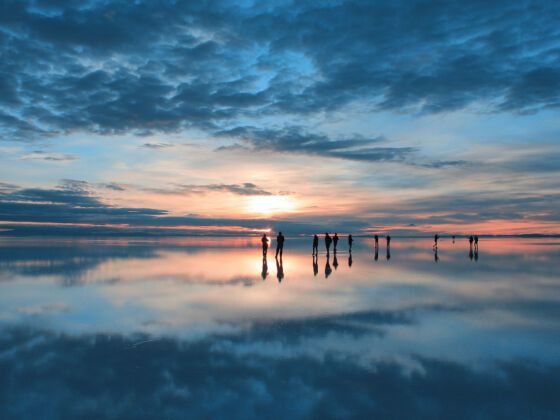
Those lucky enough to visit during the wet summer, when the entire plain is covered in an inches-thick pool of water that reflects the cloudy sky, can convince themselves their Land Cruiser has taken flight.
But the salar fills only one day of the circuit tour. The rest are spent tearing through some of the most inhospitable desert terrain on the planet.
Brilliantly colored chemical lakes, peak after peak of snowy volcanoes, and Andean wildlife (llamas, alpacas, vicuñas, flamingos, and ostrich, for starters) all compete with the salar for your camera’s memory card megabytes.
Photo: zaturno
I doubt anyone regrets the trip—that said, all tours are not created equal.
The salar and deserts of Los Lípez see more visitors every year. Caravans of jeeps depart daily from the town of Uyuni, the traditional starting point. After four days stuck in the middle of the globular tourist amoeba, many are left asking, “Is there a better way to do this?”
The answer is yes.
Turn the tables: start in Tupiza
Your best option for escaping the crowds is to traverse the circuit in reverse. Make the town of Tupiza your point of origin, with a tour that loops through the sights and ends in Uyuni.
Photo: zaturno
In addition to having the Lípez to yourself, you’ll be saving the best for last. Why knock out the salar on the first day, as the typical Uyuni tours do? They also require a long, backtracking drive on the last day.
By ditching the masses, you’ll avoid the sketchier agencies operating out of Uyuni. Companies there pop up and disappear again without notice, making it close to impossible to get reliable recommendations.
For the most part, Tupiza-based agencies are more established. They have a smaller customer base, and therefore more to prove.
Regardless of who you go with, your tour from Tupiza will look something like this:
Day 1
Bust out of town around 9am and drive till sunset through canyon-cut, cactus-covered terrain. Though lacking “big-name” sights, the day exposes you to the desolation of Los Lípez and gives you a glimpse of what life is like for the few communities living here. Other jeeps = scarce to nonexistent.
Day 2
The mountainous, llama-filled desert continues, transforming mile by mile into the surreal vistas that make it onto the postcards. Once you enter Eduardo Avaroa National Wildlife Refuge, it’s on: colored lakes, hot springs, flamingo flocks, geysers, crazy rock formations, and painted volcanoes.
At some point, you’ll hit Laguna Verde and Volcán Licancabur in the country’s southwest corner. From here, you can tack on an extra day and climb the 19,400 ft (5900 m) Licancabur or other peaks. It’s also possible to hop over the border, connecting to San Pedro de Atacama, Chile.
Photo: wili_hybrid
Day 3
After two days of solitude, the Land Cruisers start to multiply around the eerily red Laguna Colorada. Pulling up at the sculpted rocks that surround Árbol de Piedra, only to find them covered with sunburned, North-Faced climbers, comes as quite a shock.
More lakes await, and the end of the day will bring you to the edge of the salar itself.
Day 4
Photo: hillsieboy
This is really a long half day. Wake before dawn to catch the sunrise on the salt.
A visit to the cactus-infested Isla del Pescado is followed by a group photo shoot in the middle of the salar, where the lack of distance perspective makes all kinds of crazy camera illusions possible.
After checking out a hotel made entirely of salt and a stop at a tourist market, you should pull into Uyuni around 1pm.
Practicalities
Tupiza is roughly 11 hours by train from Oruro, and a handful more from La Paz. Hop the train if you can; the buses running the route are old and drafty. Breakdowns are common.
Solo travelers and couples should schedule at least one extra day in Tupiza — longer in the low season — to find a group to hook up with. Standard tours won’t leave with fewer than four passengers; five or six means less legroom but bigger savings.
Photo: Naturaleza
Killing time in town isn’t difficult. This is Butch and Sundance country (the outlaws were gunned down in a village less than an hour away), with scenery rivaling the best of the American West.
Horseback riding, canyon hiking, and rock climbing will keep you occupied till your tour leaves.
Operators running out of Tupiza are scarce compared to the hordes of Uyuni-based agencies. Tupiza Tours is one of the originals and has managed to maintain a solid reputation through the years. Yet even with them, it’s essential to double check the contract—triple check if your group is doing anything other than the standard 4-day tour.
Other options include Valle Hermoso and El Grano de Oro Tours.
One last note: it gets cold in the desert. Damn cold. Accommodations are basic and unheated. Bring a sleeping bag or rent one from your company — even in the summer. During the winter, if you’re lucky your guide will give you a hot water bottle each night to stuff into the bottom of your bag. Yeah…daaaamn cold.
Photo: jaytkendall
Community Connection:
Check out today’s companion post, “Summiting Mount Doom in Bolivia,” for further details on climbing Volcán Licancabur.
For more on Bolivia’s spectacular sights, read about photographer Ron Dubin’s assignment in the country in “Big Bolivian Sunsets.”
If you’re looking to mix a little philanthropy with your visit to the country, Matador member org Sustainable Bolivia offers a range of rewarding volunteer opportunities.
Hal Amen
Hal Amen is managing editor at Matador. His personal travel blog is WayWorded.
More By This Author
- 13 arresting travel photos from Nat Geo's 2013 contest
- 23 photos that will make you want to travel (6 comments)
- 50 stunning ice formations from around the world [pics] (8 comments)


Hal, don’t spoil the secret!
I did this “backwards” in 2005 and it was a brilliant choice. I was in a jeep with a British couple and a Quebequois couple and all of us were extremely grateful to have left from Tupiza–I think we all sort of randomly ended up there and didn’t actively choose to leave from there, but damn, we were glad we did. Also, the train ends in Tupiza. and I loved that train ride (sorry, I forget where the train left from!). And Tupiza is supposedly where Butch Cassidy and the Sundance Kid (the real ones) camped out for awhile. The landscape is crazy and really different from La Paz and the big mountainous areas.
I know, I know, that’s the risk we run as travel writers, right? The thing is, there are so many ways to approach the region, there should always be “one more” that hasn’t been overrun yet.
I’ve tried to comment a couple times and not had it show up yet, so I’ll keep this brief:
The trip, whether backwards or forwards is a definite must-experience, and I agree with a lot of what you had to say about it. I started from the Chile side, and we were most certainly not alone for many parts of the trip.
One small discrepancy though, ostriches are from Africa. What you saw were their tiny cousins, called ñandues (sing: ñandu).
oh sorry, and in English they’re rheas.
Thanks for the correction, eileen! I actually wrote in ostriches meaning to go back later and find the correct term…it seems I forgot!
About the comments, all first-time posters (and this might have rolled over when we launched the new version) must be approved. Now that you have, you should be good to go.
I’m going to bolivia in september for 3 months, how much does this tour cost?
Hi Becca,
I was in a group of 6, and we each paid 1,100 Bolivianos (around $160USD), which was more or less all inclusive. However, we added an extra day to climb a volcano, so that obviously upped the price. Check the website listed for current rates.
Enjoy your trip!
Hi,
I was thinking of doing one of these tours either from San Pedro in Chile or Tupiza (which sounds like a good option!) but am a little worried about Altitude sickness which I´ve had before. Do you know at what heights you sleep on the tour??
Thanks!
Hi Flic,
I believe our highest night was at ~4700m, at the base of Volcan Licancabur. However, you only sleep there if you’re going to climb the volcano.
The entire region is up there, but to be honest I don’t think altitude sickness is much of a concern because you’re not exerting yourself. You never even have to get out of the jeep if you don’t want to. Just drink plenty of fluids and you’ll be fine. Also, spending a couple nights in either Tupiza or San Pedro (both are at around 3000m) to acclimate couldn’t hurt.
Have fun!
This was my favorite trip in Bolivia! I highly recommend it and totally recommend not leaving from uyuni. Costing around 120 usd (better if u negotiate or maybe a group of around 6!) You can take a land cruiser from san pedro de atacama, chile! this is an awesome option and you dont need to back track! youll get to Uyuni in time to catch a bus to potosi or lapaz! Also be warned i heard of a few horror stories of bad guides,4×4, etc but i Highly recomend Cordilla travelers (have a base in uyuni and san pedro). Maybe 10usd more but your quality of travel and food will be lots lots better! O also 6 people in a land cruiser is easy plenty of room!
I think it’s one of the best tours of South America, and the Salar de Uyuni my favorite place. The across the street from the volcanoes and see wild animals in those remote lands is an unforgettable experiecia