Volcano erupting in Tanzania

Photo: Cessna 206

A list of some of the most dangerous places in the world to call home.

TRIPS HAS ALREADY introduced you to America’s Most Dangerous Neighborhoods, rankings that were based on crime statistics.

Sometimes, though, people don’t need to go out of their way to imperil the lives of those around them. Mother Nature’s pretty good at that, too.

Popularmechanics.com takes up the issue with 8 of the Most Dangerous Places (To Live) on the Planet — human habitations facing very real threats from volcanoes, killer storms, desertification, and more.

Here’s what they got:

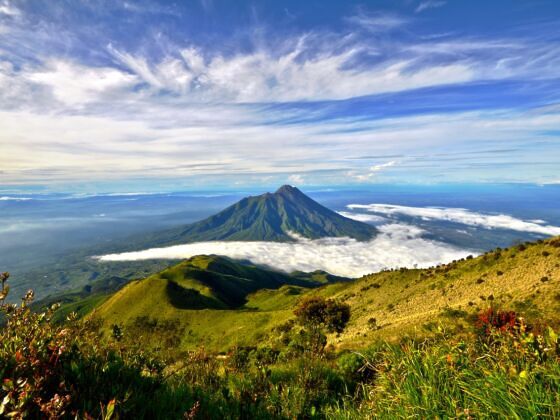
Mt. Merapi and Borobudur

Photo: ctsnow

Mt. Merapi, Java

This active volcano’s constant smoke belching is a tipoff — it’s averaged 12 eruptions per century over the last 500 years. Still, 200,000 people live within an ominously short four miles of “Fire Mountain.”

And they’re not alone. The article claims as many as 120 million Javanese reside inside the danger zones of the island’s 22 active volcanoes.

Central Africa’s Lake Kivu is on the list as well due to the region’s seismic-volcanic instability that threatens to unleash trillions of cubic feet of poison gases trapped beneath the lakebed.

This phenomenon isn’t confined to Asia, either. For months in 2008-9, southern Chile’s Chaitén volcano blew its top. Residents of nearby Esquel, Argentina, where I volunteered earlier this year, tell of a months-long period of ash-mud raining from the sky and the necessity of HazMat suits whenever stepping outside.

Still, a handful of residents in the town of Chaitén have refused to leave.

Maldives

With an elevation peak of six feet above sea level, the 1,190 islands of the Maldives are demonstrating the effects of climate change today.

The 2004 Indian Ocean tsunami rendered 10% of the nation’s land area uninhabitable, and since then local leaders have been hammering out plans to relocate the entire Maldivian population.

The Maldives at sea level

The Maldives / Photo: notsogoodphotography

The islands are still considered a beach-bum hot spot, but you’d better hurry if you want to catch a glimpse before they literally vanish.

Grand Cayman

Other potential casualties of global climate change are places already at high risk of violent storms.

That obviously includes the Cayman Islands’ Grand Cayman, otherwise known as the “hurricane capital of the world.”

For proof, you need look no further back than 2004, when Hurricane Ivan destroyed 70% of the buildings on the island and left 40,000 residents with zero power and clean water.

The Haitian city of Gonaïves also makes the list for its recent streak of hurricane bad luck, and Oklahoma‘s I-44 “tornado corridor” gets a nod as well.

Verkhoyansk, Siberia

Long-time favorite exile spot for Russian czars and Soviet premiers alike, the Arctic town of Verkhoyansk is officially the world’s coldest, a distinction that carries its own terminology: the “Pole of Cold.”

The record-low temperature was mercuried over 100 years ago (long before meteorologists thought up the concept of wind chill): -90F/-68C.

Camel trek in the Gansu desert

Photo: Kiwi Mikex

Minqin County, China

Drought, water diversion, and a position directly between the encroaching Tengger and Badain Jaran Deserts likely spells annihilation for this section of China’s Gansu province.

The national government has been making efforts to relocate farmers to greener pastures, but the area’s population is swelling, now at 2+ million.

Have you been to any of these or other “days-are-numbered” destinations? Did you get any insight into why their inhabitants continue to live where they do? Share your stories in the comments.

Community Connection

Here are some more titles for your “most dangerous” fix:

Top 10 Most Dangerous Waves in the World

The World’s Most Dangerous Hike?

Food for Thought – the Most dangerous Cities in the Americas?

11 Most Dangerous Mountains in the World for Climbers

The Best, Strangest, and Most Dangerous Roads in the World

About The Author

Hal Amen

Freelance writer Hal Amen edits Matador Trips. His personal travel blog is at WayWorded.

  • http://milesofabbie.com Abbie

    Nothing like livin’ on the edge, right??? :)

  • http://matadortravel.com/travel-community/simonemarie Simone

    When I was in Indonesia, I was amazed by how many people stayed on living at the foot of active volcanoes. But it’s understandable. People just didn’t want to leave their villages, their families. It’s their home, and often has been for generations.

    Natural threat is so prevalent there, though, that many people are living on the edge of some kind of natural disaster — earthquakes, mudslides, floods, tsunamis. Just being there really does make you feel that much closer to the edge.

    Pole of cold, though — that sounds the worst!

  • http://matadortravel.com/travel-community/vagabonderz Carlo Alcos

    I’d also not really like to live near Vesuvius.

  • Kerry

    Of Course I would live in the Cayman Islands, regardless of how devasting Hurricane Ivan was back on Sept. 12th, 2004. Why? Becasue we are the most resilent people in the world and we suffered no loss of life and everyone helped everyone to get back on their feet. Can you say that about many other places in the world? I survived Hurricane Ivan and can assure you that I would go through it again, because no matter what it is still one of the best places in the world to live.

  • Adri

    Hi Hal,

    Am living in Jakarta, Java Island. Not to close to Mt Merapi, the most active volcano at this moment, but close enough to Anak Krakatau, another active volcano. There are at least 129 active volcanos in Indonesia and as part of the Pacific ring of fire, Indonesia is prone to hit by powerful earthquake, which happened many times lately.

    Why am still here? As Simone said, its my home. For me, stay with my beloved ones, family and friends, I feel safe :-)

    Cheers,

  • http://www.joyofweddings.blogspot.com Joy of Weddings

    I suppose any publicity for our islands is good publicity, but where did you get the idea that Cayman is the “hurricane capital of the world” ? Are you basing that on Hurricane Ivan in 2004? Visitors come to Cayman 5 years later and don’t even know that there was a hurricane. Please, no more reckless statements like this, we depend on tourism to support our economy.

  • http://matadortrips.com/ Hal Amen

    Inspiring! Thanks for sharing your point of view, Kerry.

  • http://matadortrips.com/ Hal Amen

    Hi Joy,

    As mentioned in the intro, this piece is based on a post over at Popularmechanics.com (find the link above). This what they had to say: “According to the tropical-storm-tracking website hurricanecity.com, Grand Cayman, the largest of the three Cayman isles, is hit or brushed by at least one hurricane every 2.16 years, more than any other locale in the Atlantic basin.”

    Their piece included the subtitle “hurricane capital of the world.” In reviewing things, I see that this was only referring to Grand Cayman, not all three islands. I’ve amended my wording above to be more specific.

    Thanks!

  • http://matadortrips.com/ Hal Amen

    Thanks for your perspective, Adri!

  • http://onceatraveler.com Turner

    I could definitely risk the Maldives, as long as I was set up in one of those outrageously expensive resorts. Agree with Simone as to the reason people stay – it’s their home; no explanation required.

  • http://grekya.tumblr.com Greg

    don’t forget Banos, Ecuador. Another town at the foot of a constantly erupting volcano…just waiting. But at least while you are there you can take in some extreme sports or a nice hot water bath!

  • James

    I currently live in Salatiga, Central Java. Mount Merapi is just 23 miles as the crow flies from my home. We are somewhat protected by the larger brother, Mount Merbabu, but when it erupted in 2006, we were duly concerned. More than 100 Javanese died that season. My family was visiting from the States in June when I accidentally drove us too close to the mouth trying to get home at night. We ended up in the ash fall beside a refugee camp. The local police laughed hysterically at us before they kindly led us to the correct road out.

  • http://matadortrips.com/ Hal Amen

    Thanks for sharing this info, as well as your personal account, James. Are you working in Salatiga?

  • http://keepusfree.blogspot.com Matt

    Pretty cool list, though why the heck is everything attributed to climate change? The Grand Caymans are at risk of violent storms due to… dun dun dun… cLiMaTe ChAnGe!!!! arrrrrr!!!!!

    Geez o man.. if it rains, it’s because of Climate Change, if it doesn’t rain, it’s because of Climate Change.

    If it snows, it’s because of Climate Change, if it doesn’t snow, it’s because of Climate Change.

    If it’s hot, it’s because of Climate Change, if it’s cold, it’s because of Climate Change.

    If there’s storms, it’s because of Climate Change, if there’s no storms, it’s because of Climate Change.

    I mean seriously… It’s getting pretty tiring hearing all the “we’re going to burn and freeze to death at the same time!!!” hype. News flash: We humans aren’t *that* powerful that we can have that great an impact on the climate. There’s plenty of other things we can spend our time worrying about…

  • Adri

    Today, its extremely dangerous to stay near Merapi!!

    http://www.cnn.com/2010/WORLD/asiapcf/11/01/indonesia.volcano.erupts/index.html

Climate Change →

You know about melting ice caps, rising sea levels, disappearing islands, and stranded...

Cycling →

Julia Phillips proves that life ain't over after having a baby.

Culture + Religion →

Marc Latham steps beyond Stonehenge to point out other stone circle sites that might be...

Climate Change →

How do you refute the argument of someone using "science" to claim global warming isn't a...

Photo + Video + Film →

Will global warming melt Montana's signature glaciers? Yes. Joshua Johnson interviews...

Climate Change →

Glacier National Park Ranger Matt Graves discusses the challenge of climate change and...

Climate Change →

Ironic that the world's icebergs are cracking up during the climate change talks in...

Climate Change →

Matador's editors share the effects of climate change they've observed on their travels.

Climate Change →

Joyce Hanson joins the Human Countdown to send up a wake-up call to the world about...

Climate Change →

The National Research Council reminds us that we need to make changes, pronto.