17 Historic Cities, 5 Epic Routes: Plan Your Perfect Trip to Germany

Photos: Historic Highlights of Germany

Germany is the heart of Europe — both geographically and symbolically. It has played a pivotal role in shaping the continent’s culture, religion, and politics since the time of the Romans. While big cities tend to get most of the international spotlight, it’s the smaller towns and quieter regions — the Historic Highlights of Germany — where the country’s character comes to life. If you want to experience Germany like a local, head here.

The 17 heritage cities below blend medieval grandeur with vibrant student energy, and they’re easy to explore thanks to Germany’s high-speed trains and well-connected autobahn network. That means you can (and should) visit several historic cities on a single vacation. Along the way, try regional food and drink that’s just as compelling as the art and architecture, from grapes grown in vineyards once tended by Middle Ages monks to regional sausages, pastries, and beers. So, pick a route, bring your appetite for exploration, and get ready to experience Germany like you've never seen it before.

This post is proudly produced in partnership with the Historic Highlights of Germany and the German National Tourist Office.
 

Laced with tributaries of the Rhine, northwestern Germany is a scenic region that once sat at the center of European power — home to Charlemagne’s empire and the signing of the Peace of Westphalia. As you travel through valleys lined with poplar trees, stop in cozy taverns for Töttchen (a hearty traditional stew) and Eierlikör (a boozy version of eggnog) to get a taste of the area.


Aachen

Long before Aachen became Charlemagne’s imperial capital, Celtic tribes were drawn to its hot springs...

Visit

Aachen

Long before Aachen became Charlemagne’s imperial capital, tribes were drawn to its hot springs, gathering in the hills to soak in the mineral-rich waters. The Romans followed, turning the city into a fortress, and by the eighth century, it had become the heart of a new empire.

Today, the emperor's legacy lives on at the impressive Aachen Cathedral — a UNESCO World Heritage Site — and in the city’s forward-thinking spirit. RWTH Aachen University is one of Europe’s top tech schools, and its student life fuels a lively mix of beer gardens, cafes, and taverns. Be sure to try Aachener Printen before you leave: a spiced gingerbread, originally created in Aachen, that tastes like the holidays in every bite.

Bonn

Bonn might be best known as the birthplace of Beethoven, but there’s more to this riverside city than classical music...

Visit

Bonn

Bonn might be best known as Beethoven's birthplace, but there’s more to this riverside city than classical music. Before reunification, it served as the capital of West Germany — and that legacy of democracy and diplomacy still runs deep. Today, Bonn hosts several important UN institutions, global environmental organizations, and museums, making it a modern hub for international cooperation.

Start your visit with a trip to the Beethoven House Museum, then wander the Rhine promenade. Over a plate of Sauerbraten (marinated beef roast) and a glass of local Bönnsch, toast to peace and progress. If you’ve got a sweet tooth, don’t skip the Haribo flagship store — Bonn is where Gummibärchen (gummy bears) were born over 100 years ago.


Münster

Münster earned its place in history in 1648 as one of the cities where the Peace of Westphalia was signed...

Visit

Münster

Münster earned its place in history in 1648 as one of the cities where the Peace of Westphalia was signed, marking the end of the Thirty Years’ War and reshaping Europe. That legacy of diplomacy continues to define the city, which now hosts global peace forums and interfaith events.

The historic center is compact and walkable, lined with gabled merchant houses and arcaded streets that give it a timeless charm. Stroll around until hunger strikes, then head to a local Gasthaus (inn) for Töttchen and a cold glass of Pinkus Müller, an organic beer brewed since 1816. On Wednesdays and Saturdays, you can also wander the square by St. Paul’s Cathedral, where you’ll see farmers’ market stalls piled high with fresh produce.

Osnabrück

Osnabrück shares the honor with Catholic Münster for concluding the Thirty Years’ War...

Visit

Osnabrück

Osnabrück shares the honor with Catholic Münster for concluding the Thirty Years’ War — it was here that Protestant leaders signed the Peace of Westphalia in 1648. Framed by forested ridges, Osnabrück is an architectural mosaic of Gothic churches, Hanseatic merchant houses, and Baroque facades. Keep an eye out for the city's brick-built Steinwerke, or vault houses, whose medieval designs once played a defining role in Osnabrück's characteristic look.

Lower Saxony’s cuisine is as rich as its history. Try the traditional dish of Grünkohl mit Pinkel — braised kale with smoky sausage and potatoes. You’ll find plenty of places to stop for a bite around Marktplatz, or market square, which also serves as the backdrop for local goings-on and festivities throughout the year. 


Traveling from the edge of the Black Forest through southern Bavaria's verdant terrain is a culinary tour de force. Bavaria and Baden-Württemberg have long served as a bridge between Germany and the Mediterranean, acting as an important trade route that has infused southern Germany’s cuisine and culture with a cosmopolitan flair. On the scenic train ride or along winding country roads, gaze out the window at family-owned farms and rustic hamlets, and dream about hearty plates of Maultaschen (meat-filled pasta, similar to ravioli) and buttery Spätzle (small egg noodles).


Freiburg

Set on the edge of the Black Forest, Freiburg has been welcoming traders and travelers since the 12th century...

Visit

Freiburg

Set on the edge of the Black Forest, Freiburg has been welcoming traders and travelers since the 12th century, when it was founded as a bustling market town. Today, it’s better known for its sunny vibes, sustainability, wine, and student life.

Stroll through the medieval core to spot the Bächle — narrow water channels running along cobblestone streets — and check out the farmers’ market that unfolds beneath the towering cathedral. Local flavors shine here: think Black Forest ham, delicious Schwarzwälder Kirschtorte (Black Forest cake), and Flammkuchen — a crunchy flatbread topped with onions, bacon, and crème fraîche. Save room for an extra pour of Baden wines, with every variety of Pinot — from crisp whites to velvety reds — produced in abundance.

Tübingen

In the heart of Swabia, Tübingen is home to one of Germany’s oldest universities...

Visit

Tübingen

In the heart of Swabia, Tübingen is home to one of Germany’s oldest universities, Eberhard Karls University, founded in 1477. You can bet today’s students still enjoy local Swabian treats like cheesy Spätzle, pan-fried Maultaschen, and hazy wheat beer. Outside of the classrooms, students and locals congregate around the market square, where you’ll find not only great bites but also artisan shops, a tri-weekly farmers’ market, and a lively alfresco ambiance.

After a tasty meal, float down the Neckar River on a Stocherkahn (a flat-bottomed punting boat typically captained by students) past half-timbered houses and Hohentübingen Castle, the city’s stunning hillside fortress. For a different view, climb the tower of the Collegiate Church, where a jumble of red roofs spreads beneath you in a panoramic sweep.

Augsburg

Augsburg is one of Germany’s oldest cities, originally founded by Roman legions...

Visit

Augsburg

Augsburg is one of Germany’s oldest cities, founded initially by Roman legions as Augusta Vindelicorum. Centuries later, it flourished under the Fugger family, an influential merchant and banking dynasty that left behind a legacy of Renaissance mansions and civic landmarks.

Walk through the Fuggerei — considered the world’s oldest social housing complex still in use — then grab a table at Riegele Brewery, founded in 1368. For something special and sweet, don’t miss Augsburger Zwetschgendatschi, a seasonal plum sheet cake that pairs wonderfully with coffee. Augsburg is enchanting year-round, with two beer festivals in the spring and fall, but the season of the Christkindlesmarkt, one of the world’s oldest Christmas markets, is particularly special; the historic center glows with lights, music, and mulled wine.


Follow the curves of the Rhine and Moselle through four of Germany's 13 wine-growing regions, where vineyard-covered hillsides meet riverfront towns steeped in history. Romans planted the first vines here more than 2,000 years ago, laying the groundwork for the crisp, mostly dry Rieslings that wine lovers around the world seek out today. Along the way, visit family-run wineries, ride cable cars and funiculars to panoramic viewpoints, and end the day alongside locals in sun-dappled squares or cozy wine bars.


Koblenz

Where the Rhine and Moselle rivers meet, Koblenz blends military past with riverside charm...

Visit

Koblenz

Where the Rhine and Moselle rivers meet, Koblenz blends a Prussian past with riverside charm. Its layout traces back to a Roman outpost from the first century, and echoes of that heritage remain in the winding streets and centuries-old stone churches. Ride the cable car up to Ehrenbreitstein Fortress for sweeping views of the valley, then wander down to the Basilica of St. Castor — a Romanesque landmark that’s watched over the city since the ninth century.

For a taste of the region, try Debbekooche, a golden baked potato dish with bacon and onions — best enjoyed with a glass of crisp local Riesling. If possible, align your visit with one of Koblenz’s wine festivals to celebrate centuries-old wine-making traditions.

Trier

Trier, Germany’s oldest city, was founded by the Romans in the 1st century BC...

Visit

Trier

Trier, Germany’s oldest city, was founded by the Romans in the first century BC. Today it feels like an open-air museum, from the massive Porta Nigra gate to the remnants of baths and amphitheaters. Step inside the Trierer Dom, a cathedral with fourth-century roots, then wander into the lively market square for a taste of modern-day life.

This is Riesling country, but it’s also home to Elbling, one of Europe’s oldest white grape varieties. Both pair beautifully with hearty local fare like Kappes Teerdisch — mashed potatoes mixed with sauerkraut and meats like smoked ham, Bratwurst, Leberwurst, or Blutwurst. Not to be missed: Viez, a low-alcohol still apple wine similar to cider.

Heidelberg

Home to Germany’s oldest university, Heidelberg was the Teutonic answer to Athens...

Visit

Heidelberg

Home to Germany’s oldest university, Heidelberg was the Teutonic answer to Athens: a cradle of humanism and philosophy. It wasn’t just German literary giants who fell under its spell. Mark Twain wrote glowingly of the city’s beauty in A Tramp Abroad, his memoirs of touring Europe.  

Stroll across the Old Bridge to admire the Neckar River, then ride the Heidelberg funicular to the summit of Königstuhl for skyline views. Catch the train from the Old Town for a stop at Heidelberg Castle, the iconic red sandstone fortress. The castle’s cellar houses the Grosses Fass, the world’s largest wine barrel. At sunset, walk in the footsteps of intellectual titans like Hegel, Weber, and Jaspers on the Philosophers’ Walk, a serene footpath above the banks of the Neckar.

Wiesbaden

The capital of Hesse, Wiesbaden has been a spa town since the Roman era...

Visit

Wiesbaden

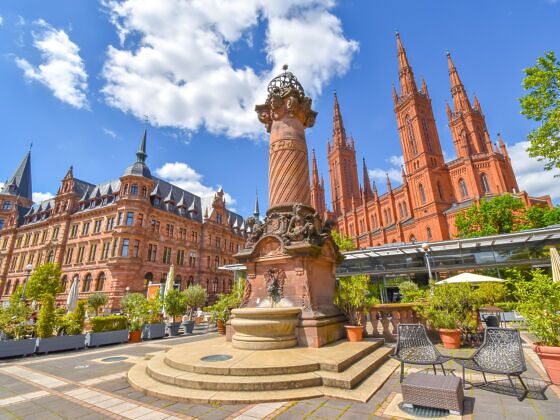
Wiesbaden has been a spa town since the Roman era, and with 26 hot springs still flowing today, it remains a premier European wellness destination. In addition to its rejuvenating thermal waters, the city is renowned for its good life, art, wine, and regional specialties, such as Handkäse mit Musik, a sharp cheese served with onions and vinegar. Pair a plate of it with Rheingau Riesling.

After a restorative soak, stroll avenues flanked by stately villas and lush gardens that reflect Wiesbaden’s 19th-century grandeur, stopping to admire landmarks whose architectural styles range from Neoclassical to Art Nouveau. Later, channel your inner Bond girl as you gamble the night away in the glamorous Kurhaus casino. Dostoevsky, one of literary history’s most avid gamblers, was once a regular patron.


This route winds through the legacies of northern Germany’s maritime might and monarchical ambition — where Baroque palaces, red-brick guild halls, and fortified harbors tell stories of power and prosperity. The region was once the heart of the Hanseatic League, a network of cities that controlled the flow of goods and ideas across the Baltic and North Seas. Trade flourished, as did the arts, with wealth from seafaring commerce and princely courts funding universities, theaters, and architectural masterpieces. Proximity to the Baltic also enriches the local cuisine — think delicacies like smoked herring and eel, along with crisp Pilsners to complement seafood-centric local dishes.


Potsdam

Just 30 minutes by train from Berlin, Potsdam was once the royal seat of the Prussian kings...

Visit

Potsdam

Thirty minutes by train from Berlin, Potsdam was once the royal seat of the Prussian kings and cherished retreat of Frederick the Great — a monarch, philosopher, and nation-builder. His beloved Sanssouci Palace, nicknamed the “Versailles of Germany,” is a gilded marvel of Rococo exuberance. During Frederick’s reign, Sanssouci became a salon for the leading minds of the Enlightenment, and Voltaire found refuge here during his exile from France.

Modern Potsdam is an architectural mosaic of Baroque palaces, Dutch-style mansions, and Italianate gardens. Spend the morning wandering through Sanssouci’s halls and gardens, then admire Impressionist and Expressionist masterpieces at the Museum Barberini. Conclude the day with a pint or pastry in the Dutch Quarter, once home to a community of artisans and merchants from the Low Countries.

Rostock

With its red-brick gables and Gothic church spires, Rostock still evokes the days when it thrived as a Hanseatic hub on the Baltic Sea...

Visit

Rostock

With its red-brick gables and Gothic church spires, Rostock still evokes the days when it thrived as a Hanseatic hub on the Baltic Sea. Once a vital stop for ships trading salt, cloth, and beer, the city’s old harbor now blends history with a laid-back coastal vibe.

Many of the former merchant warehouses along the waterfront have been reimagined as galleries, cafes, and taverns, but the scent of salt air and the rhythm of the waves still anchor the city in its seafaring past. Snack on a Fischbrötchen (fish on a bread roll) from a harbor stall, then sip a Rostocker Pils before walking the medieval ramparts or watching fishing boats pull in the day’s catch.

Lübeck

The stately gabled warehouses and merchant manors of Lübeck...

Visit

Lübeck

The stately gabled warehouses and merchant manors of Lübeck speak to its illustrious past as the capital of the Hanseatic League. The city rose to power as northern Europe’s leading trading hub, and today, the entire Old Town is protected as a UNESCO World Heritage Site, with winding alleys, brick façades, and hidden courtyards that once served the merchant class. Trade brought not only fabulous wealth to the coastal city but also exotic ingredients and spices. Marzipan, introduced via the spice routes, remains a must-try specialty of Lübeck.

After touring the European Hansemuseum and the Holsten Gate, wander past church towers and riverside promenades, then toast with locals in a harborside tavern with a glass of Rotspon — French red wine aged in Lübeck cellars.


The heritage cities of Thuringia and Bavaria feel plucked from the pages of a fairy tale. Medieval town squares, half-timbered houses, and castle-topped hills set the stage in Thuringia, while Bavaria contributes its Alpine villages and ornate Baroque churches. The local cuisine in this region is archetypically German — think roast pork with crackling skin, dumplings in gravy, and sauerkraut. In Thuringia, specialties like Rostbratwurst (regional sausage) showcase the region’s rustic flavors. At the same time, Franconian viticulture is best known for Silvaner, a white wine characterized by notes of stone fruit, apple, and minerality. Here, the Historic Highlights of Germany host traditional beer festivals starting in the spring and continuing through summer into fall. Join the festive crowds of locals wearing dirndls and lederhosen (traditional attire) and enjoy seasonal fest beers, hearty fare including vegetarian and vegan options, live music, and ample cheer.


Regensburg

On the banks of the Danube, Regensburg began as a Roman fortress...

Visit

Regensburg

Regensburg originated as a Roman fortress, and the Porta Praetoria — a stone gate built by legionaries — remains standing. In the Middle Ages, the Bavarian city flourished from trade on the Danube, and today its intact historic core is a UNESCO World Heritage Site. Stroll across the 12th-century Stone Bridge to gaze at colorful mansions, impressively tall towers, and medieval church spires lining the riverside. For a keepsake, visit local artisans like a fifth-generation workshop that hand crafts brooms and brushes.

Enjoy a meal at Historic Wurstkuchl, one of the world’s oldest continuously opened street kitchens. Helles in hand, savor charcoal-grilled bratwurst with sweet Bavarian mustard. In winter, Regensburg’s Christmas markets across town and at the Thurn und Taxis Palace are magical.

Würzburg

Würzburg is the gateway to Franconia, a northern Bavarian region with a distinct dialect, culinary traditions, and cultural pride...

Visit

Würzburg

Würzburg is the gateway to Franconia, a northern Bavarian region renowned for its culinary traditions and cultural pride. The city’s crown jewel is the Residenz — a UNESCO World Heritage Site and one of Europe’s grand Baroque palaces. Built for the Prince-Bishops of Würzburg, it is stunning with its grand staircase, lavish interiors, and frescoes by the Venetian master Tiepolo.

Würzburg is equally known for beer, the almost 1,000-year-old Kiliani festival, and its Franconian wine. Local favorites like Silvaner and Müller-Thurgau are often served in the Bocksbeutel, a distinctive bottle shape unique to the region. Some of Franconia’s best wines come from vineyards maintained by historic spitals — hospitals and homes for the elderly. Pair a glass with Schäufele (roast pork shoulder), then join locals on the Old Bridge for golden-hour views of the Main River.

Erfurt

Erfurt, once a center of religious learning and political influence, is where a young Martin Luther studied and took monastic vows...

Visit

Erfurt

Erfurt, once a center of religious learning and political influence, is where Martin Luther studied and took monastic vows before igniting the Reformation. Its Old Town remains one of the best-preserved in Germany, with a tapestry of Fachwerkhäuser (houses with timber frames and steep gables lining cobbled lanes).

The Krämerbrücke — a medieval bridge packed with shops and cafes — offers the perfect place to browse for crafts or grab a bite. Nearby, the Old Synagogue, one of the oldest surviving synagogues in Europe, is a UNESCO World Heritage Site and home to a museum featuring medieval Torah manuscripts. Closer to the river, you can see a rare 14th-century mikveh (ritual bath). After exploring, settle in for a comforting plate of Thuringian Klöße (potato dumplings in gravy served with slow-braised beef).

This post is proudly produced in partnership with the Historic Highlights of Germany and the German National Tourist Office.
Save Bookmark

We use cookies for analytics tracking and advertising from our partners.

For more information read our privacy policy.