About an hour’s drive north of LAX, Hollywood Burbank Airport has long sold itself on what larger Southern California airports struggle to provide: a fast trip from curb to gate. That promise is about to be tested at a larger scale. This October, the airport is scheduled to open a 355,000-square-foot, 14-gate replacement terminal in the northeast quadrant of the airfield. The nearly $1.3 billion project, named Elevate BUR, is meant to fix safety, accessibility, and passenger-flow problems without changing the airport’s basic operating proposition. It’ll also be in-line with building codes designed for seismic activity.
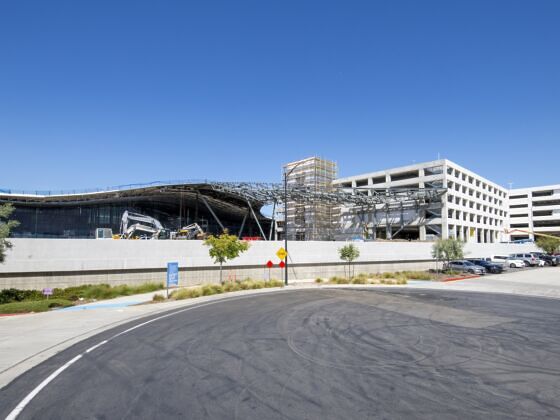
Photo: Robert V Schwemmer /Shutterstock
Hollywood Burbank Airport’s New Terminal Is Built Around an Old Promise: Keep It Simple
“The thing we kept hearing from everybody about why they use this airport is it’s so convenient,” Patrick Lammerding, deputy executive director of operations, security, and safety management systems at Hollywood Burbank Airport, tells Matador. “That’s the word that keeps coming up.”
The replacement terminal is not an expansion in the usual airport-development sense. Burbank voters approved Measure B in 2016, authorizing a 14-gate, 355,000-square-foot terminal maintains the same gate count as today while giving the city additional control over future airport decisions. The City of Burbank says the project is needed to meet current FAA standards for runway distance to buildings, while adding seismic safety and ADA features.
What travelers can expect at the new terminal
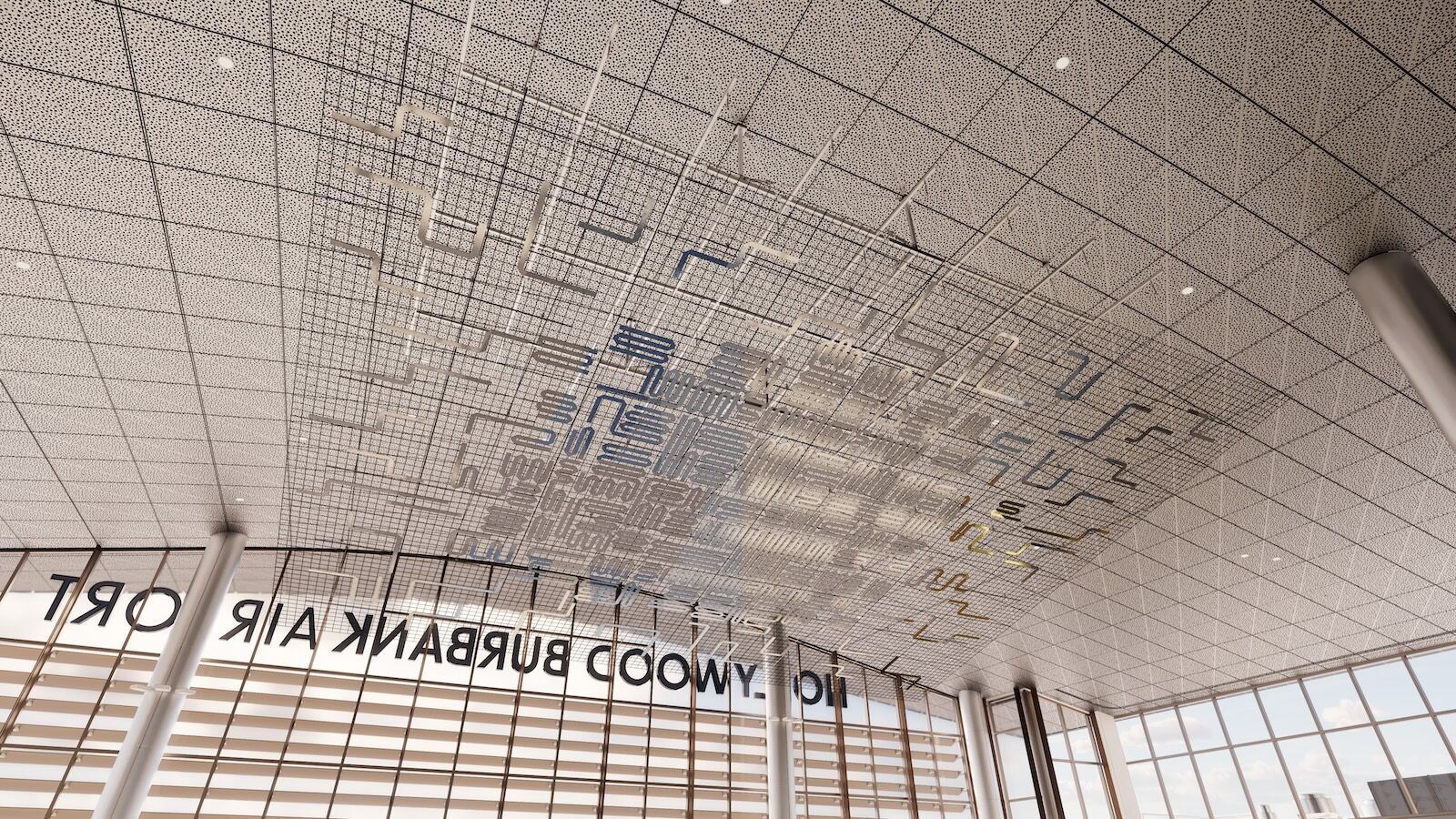
“When We Reflect” will adorn the ceiling in the new terminal. Rendering: When We Reflect. Artist Glenn Kaino. Copyright (c) Glenn Kaino 2025
For travelers, the most immediate change will be the consolidation of functions that are now split across two older terminal spaces. Lammerding said the airport is consolidating the bag claims into one three-carousel bag claim area, and that ticketing will also be consolidated into one space.
Instead of interpreting separate terminal zones, travelers will encounter a more direct sequence regardless of which airline they fly or where they’re headed: ticketing, security, gates, baggage claim, and ground transportation, all in one place instead of two.
“By consolidating those things and improving on the experience of those, it actually makes things easier to use, and it’ll make it more intuitive,” Lammerding says. “It’s all right there in front of you. It’s very obvious. There’s only one place to go for each of the things you need to do.”
The new terminal is being built across the airfield from the existing terminal, allowing the airport to continue operating during construction. The Burbank-Glendale-Pasadena Airport Authority approved a guaranteed maximum price of $1.11 billion for design and construction in 2024. With owner costs and demolition of the existing terminal and garage included, the total project cost is estimated at $1,298,700,000. The airport broke ground in January 2024, and the facility is on track to open in October.
The new Burbank terminal will have more food options and extra space
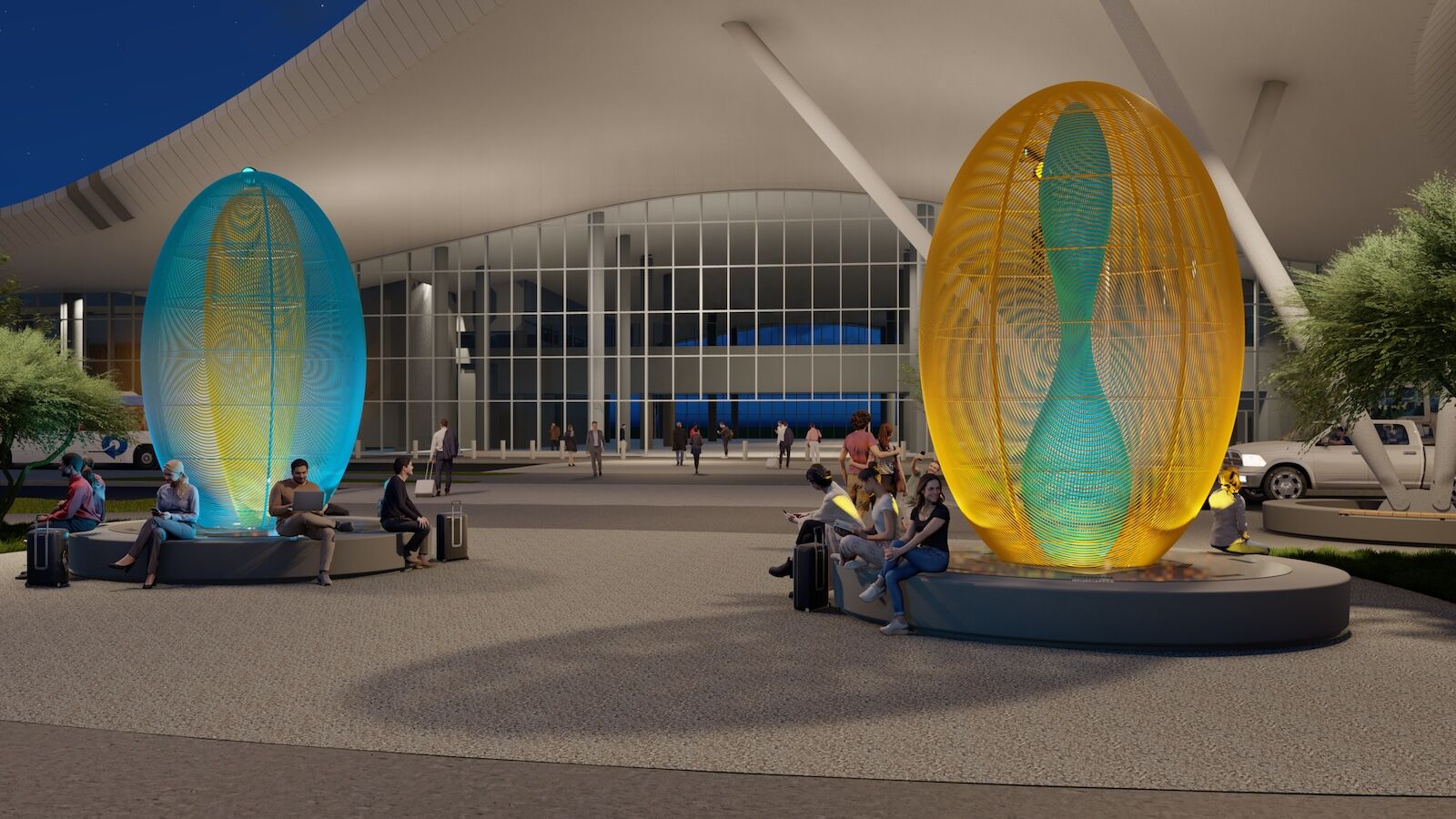
“The Two Electras” shown in this rendering exemplify the art-first approach of the new terminal. Rendering: The Two Electras. Artist Cliff Garten. Copyright (c) Cliff Garten Studio 2025
Inside, the current terminal has a limited footprint, and Lammerding said that constraint has shaped everything from food service to passenger waiting areas. The replacement facility, he said, allows the airport to have more concession options because today’s options are limited by the size of the existing terminal.
“The new building will have more options and restaurants and retail,” Lammerding says. “Along with the hold rooms and everything, not just the concessions. The spaces for people to be and to use are going to be such a vast improvement.”
The Burbank-Glendale-Pasadena Airport Authority has solicited artist qualifications for temporary artwork to be displayed in interior light boxes inside the replacement terminal, with a pool of selected artists receiving $5,000 each for a 12-month licensing period. The airport has described the terminal design concept, “The Icon,” as inspired by Hollywood and the film industry’s roots, and the art program gives local and regional artists a direct role in translating that context into the passenger experience
The building will also include individual restrooms and “family rooms.” Like those of many smaller airports, the terminal project is focused less on monumental architecture and more on removing small sources of stress. Larger restrooms, clearer circulation, consolidated security, family spaces, and better food options are now core passenger-experience infrastructure.
Getting the Hollywood Burbank Airport will be easier than ever
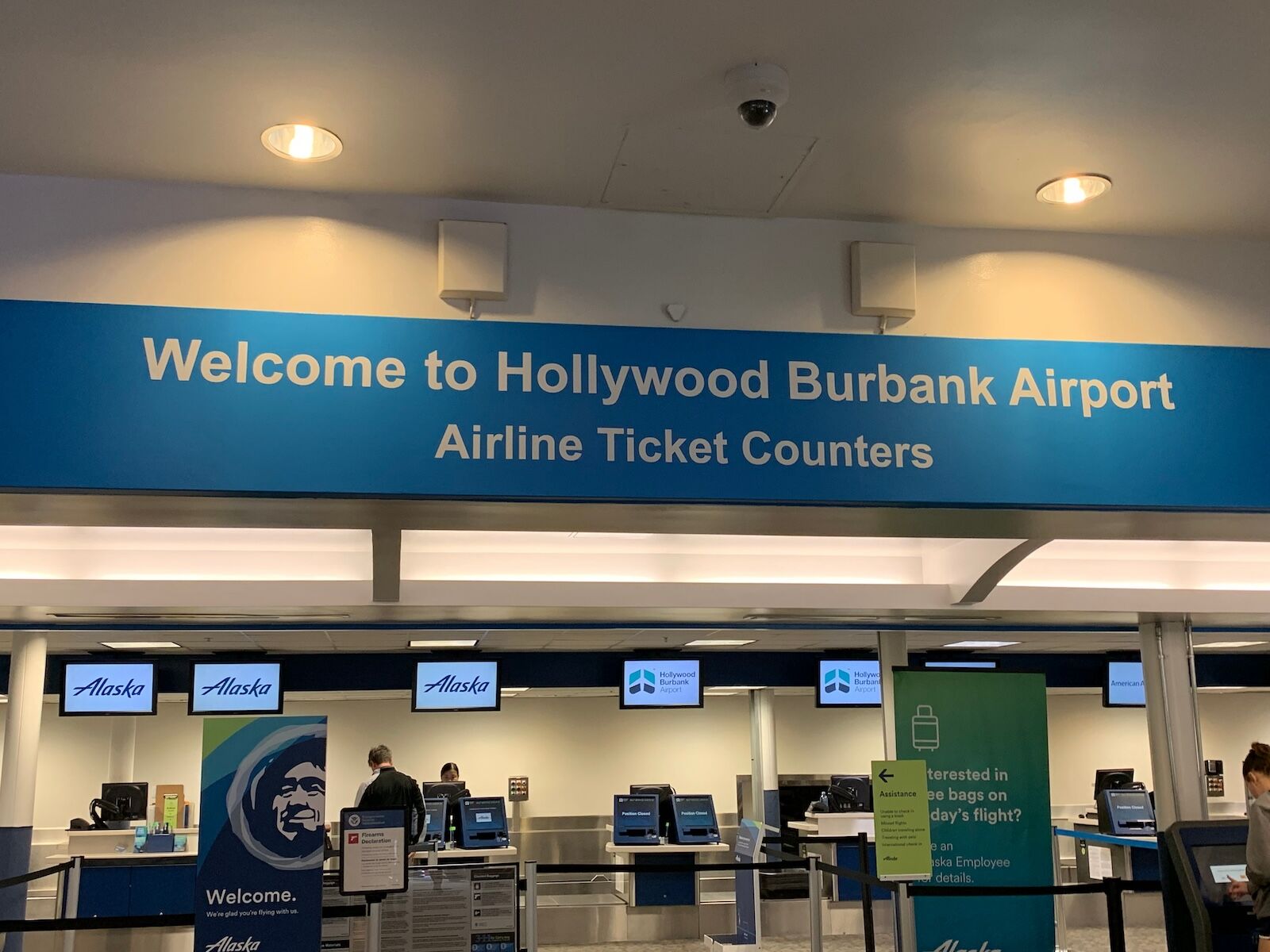
The new terminal will consolidate all ticketing, security., and baggage claim processes into one area. Photo: 1000Photography /Shutterstock
Ground access may be the most consequential part of that strategy. Hollywood Burbank Airport is already served by two rail stations: Burbank Airport-South on the Ventura County Line and Burbank Airport-North on the Antelope Valley Line. The airport also offers complimentary shuttle service between the terminal and both stations, and Amtrak’s Pacific Surfliner serves the South station.
“What’s really great about this airport is we’re situated between two rail lines, the Antelope Valley line and the Ventura County line,” Lammerding says. “No other airport in California has that rail connectivity.”
The new terminal, he said, will provide short shuttle access to both stations. The airport sits closer to the San Fernando Valley, Hollywood, Universal City, Pasadena, Glendale, and parts of the entertainment-industry corridor than LAX does. A rail-linked Burbank arrival can reduce the need for a rental car depending on the final destination, especially for travelers heading to Downtown Los Angeles via Union Station or to the San Fernando Valley by transit, shuttle, rideshare, or local pickup.
Lammerding framed the entire terminal as an upgrade to the airport’s central advantage. The project, he says, is focused on “taking that aspect of this airport and making it better.” 