China’s massive new Chongqing East Railway Station, opened last year and now in full operation, marks a new era for rail travel. The station was assembled with a battalion of AI-guided construction robots including autonomous welders, rebar tiers, and inspection drones working alongside human crews. The result is a hub spanning more than 13 million square feet, with 15 platforms and 29 tracks designed to move tens of millions of passengers a year. Chongqing East will serve as the hub of China’s massive high speed rail network, connecting a centrally-located metropolis to coastal cities and frontier hubs. It is, by any measure, one of the most ambitious infrastructure projects on Earth right now.
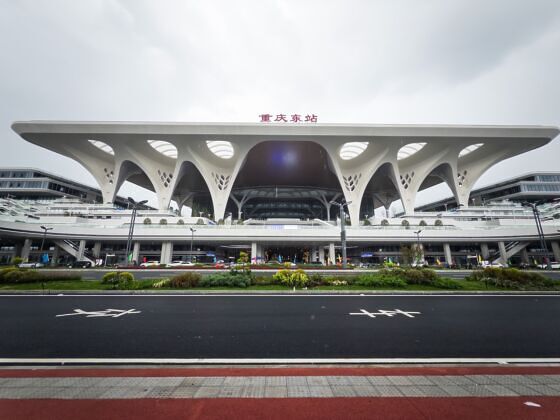
Photo: dyl0807 /Shutterstock
China’s Massive High-Speed Rail Hub Signals a New Future for Train Travel
Chongqing East makes Grand Central Station seem small
@sxefinance China’s NEW World’s Largest Train Station Is BIGGER Than 2 Vatican Cities #news #finance #china #train ♬ original sound – sXe Finance
China now operates nearly 30,000 miles of high-speed rail. Chongqing East Railway Station is built for the scale of modern China travel: It opened to passengers on June 27, 2025, in Nan’an district, its 13.1 million square feet dwarfing New York’s Grand Central Terminal’s 3 million square feet, making Chongqing East more than four times larger by total area.
For travelers, the size is the point and the challenge. Chongqing East expands the city’s rail reach across southwest, central, and coastal China, with service or planned high-speed links to Chengdu, Guiyang, Kunming, Wuhan, Xi’an, Shanghai, Shenzhen, Beijing, Guangzhou, and Changsha. It also improves access to regional tourism stops including Wulong, Qianjiang, Zhangjiajie, and Fenghuang, making the station useful for both cross-country itineraries and shorter trips into Chongqing’s surrounding mountain and karst landscapes.
The AI construction is another sign of where the future of travel is headed. Robots were central to Chongqing East Railway Station’s accelerated build, not as a novelty but as a response to the site’s scale, terrain, and heat. Construction teams used machines including four-head screed robots for floor leveling, tile-laying robots, and glass curtain wall installation robots, with China Railway 11th Bureau saying the approach tripled average work efficiency and nearly halved labor costs. The result was not an unmanned construction site, but a hybrid one with technicians, engineers, and builders directing specialized machines through one of western China’s largest rail projects. 