Photo: Anna Ewa Bieniek/Shutterstock

In Hue, Jungle-Covered Ruins and an Abandoned Water Park Show a Different Side of Vietnam

Parks Art + Architecture
by Sarah Arksey Njegovan Sep 1, 2026

Most travelers pass through Vietnam between Hanoi and Ho Chi Minh City without stopping in the country’s former capital. But it’s a city where the past is hard to ignore.

Huế, about halfway between the two cities, is the country’s last imperial capital. It was the seat of the Nguyễn Dynasty, Vietnam’s last line of emperors, who ruled from there from 1802 until 1945, at which point Hanoi became the capital once again.
But Huế’s history didn’t end with the emperors. Initially, the emperors ruled outright, but in the 1880s the French took control of central Vietnam, keeping the emperors on the throne as figureheads even when power sat with a French administrator. That created a city that today is shaped by both imperial and colonial influences. It also creates questions about how to preserve — or not — its architecture and historical leftovers, some of which are key tourism sites today.

As I walked the streets of Huế, it was hard not to notice its main tourist draws: meticulously maintained pagodas, tombs, and temples. But there’s a parallel world just beneath the surface, and it’s one of abandoned water parks reclaimed by nature, decaying industrial sites, and a near-forgotten arena that once hosted battles between tigers and elephants. Together, the popular sites and neglected ruins tell a fuller story of the city and what’s been forgotten, remembered, or salvaged in an entirely different way.

A city that chooses both old and new

hue abandoned places - cement factory hallway

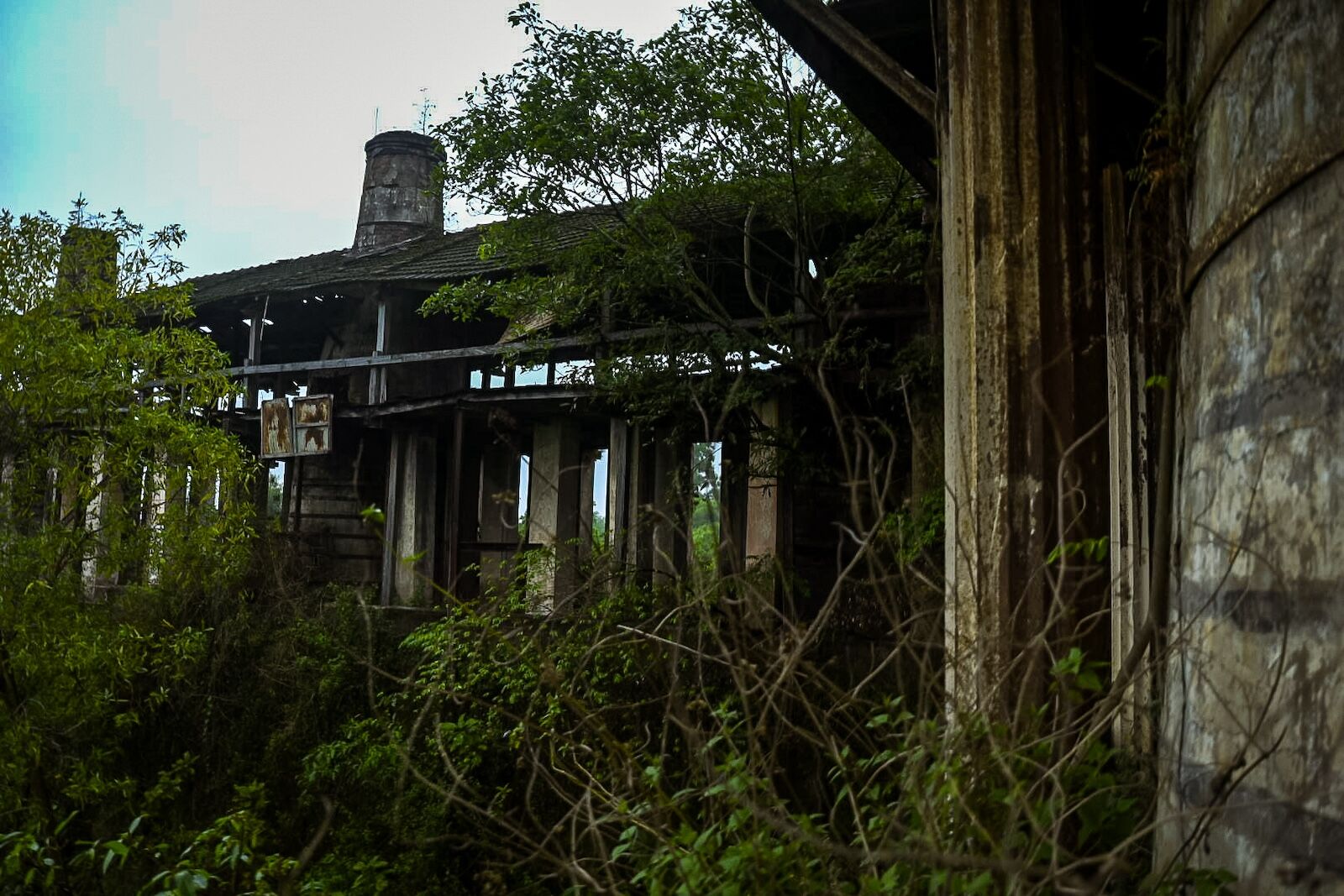
The abandoned Long Thọ Cement Factory. Photo: Sarah Arksey Njegovan

Vietnam is experiencing a massive tourism boom. The country welcomed a record high of more than 21 million visitors in 2025, which can increase the pressure on destinations to accommodate growing numbers of travelers. But in Huế, officials responsible for the city’s historic monuments say that growth won’t come at the expense of conservation. “Huế recognizes that conservation and development are not two opposing goals, but rather two parallel processes, in which conservation is always the foundation of sustainable development,” the Huế Monuments Conservation Centre said in a statement. It added that its goal was to preserve sites not just for future generations, but in a way that provides cultural and economic value for the surrounding communities.

On my first night in Huế, I passed the abandoned Long Thọ Cement Factory. While it’s closed and trespassing is forbidden, the skeleton of the large structure can be seen from the road and has become a popular photo stop. It’s one of the lesser-known abandoned sites in the city, and one I only found because a helpful local on Reddit sent me the coordinates on Google Maps. Though I could only see it from afar, it provided a quick taste of what was to come the next day, when I toured more of the city’s abandoned sites.

hue abandoned places - water park slides

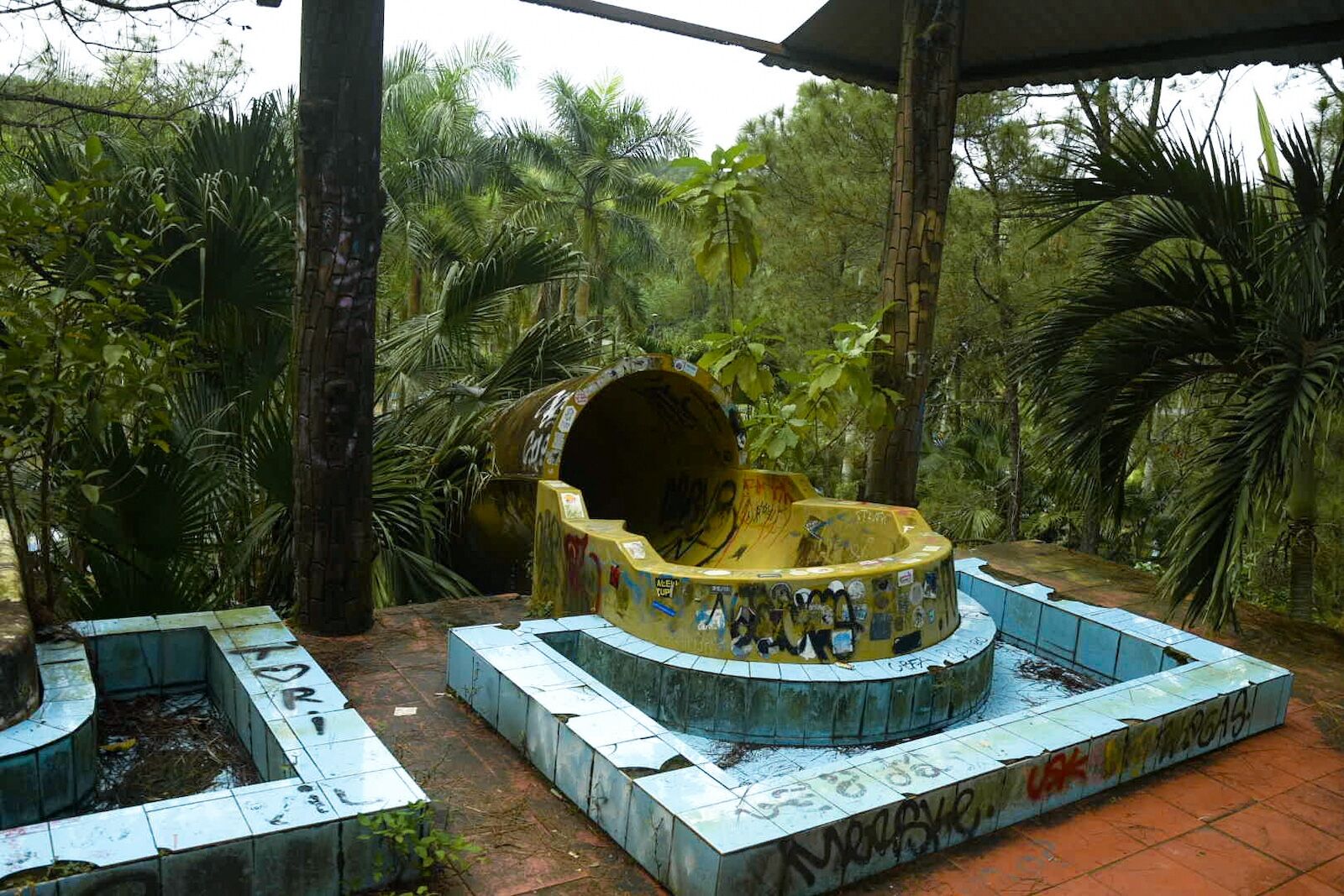
Long-closed waterslides at the community park. Photo: Sarah Arksey Njegovan

The next morning, I found myself at Hồ Thủy Tiên water park, an eerie lakeside remnant reclaimed by graffiti and jungle growth. It opened in 2004, but according to many accounts, it was never finished, and it was closed by 2006. In 2025, it reopened as a community park, now fully legal to visit and maintained by a group of city workers with an entrance fee of 10,000 VND (under $1). Visitors can even rent bicycles and purchase snacks. Structures like water slides and a three-level, dragon-shaped aquarium remained architecturally sound, despite only being functional for a short time. It’s clear that the viral appeal of maintaining the space outweighs the likely high cost of demolition and rebuilding something new.

“Foreign tourists are fascinated by Thủy Tiên Lake,” says Peter Pham of Huế Private Excursions. “The contrast between nature and the old man-made structures makes the lake feel like a place from a movie or a hidden adventure.” He’s not wrong. But the park felt oddly tranquil, despite the fact that it could double as the set for a post-apocalyptic film. It was also far less crowded than any of the city’s other tourist attractions, which Pham says creates an “unforgettable experience.” The park’s surreal ruins eventually became a filming location in their own right, appearing in music videos by artists including NIKI, Meduza, and K-pop group ONF.

hue abandoned places - inside dragon

Wandering around the former water park. Photo: Sarah Arksey Njegovan

For decades, a story has circulated that the crocodiles once kept in the aquarium escaped after the park closed and settled into the surrounding waters. Locals and backpackers reportedly fed them live chickens and store-bought meat while authorities debated what to do; the animals were eventually moved to a rescue facility. Photos said to show them have circulated online, including on Huffington Post. I later learned from a guide at Let’s Huế Local Buddies, a free student-run walking tour group, that the crocodiles did initially stay at the park after the attraction closed, but were relocated to secure sites long ago. But I was still glad to be exploring on a bike rather than on foot.

The remnants of French Colonialism

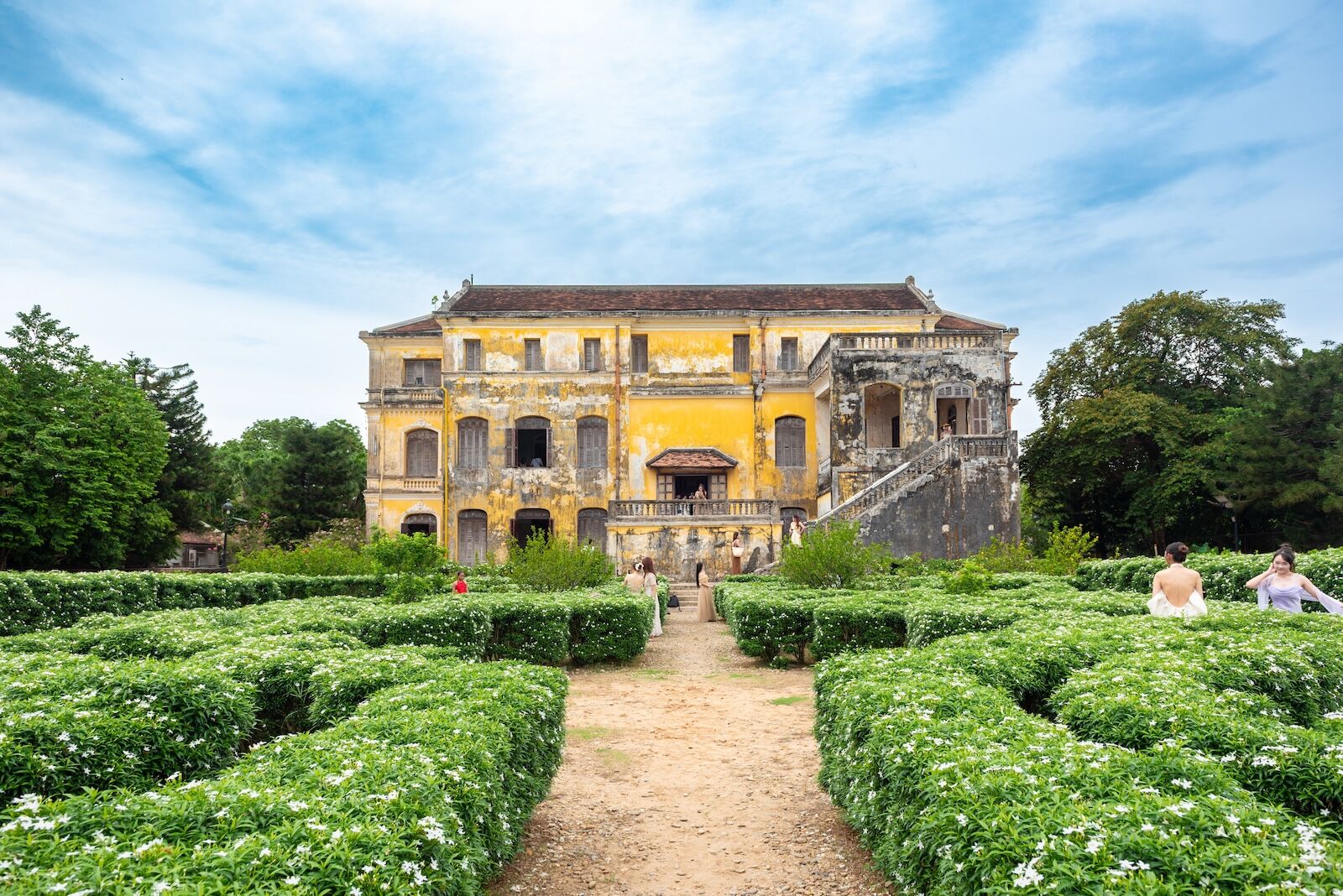
An Dinh Palace in hue vietnam

Photo: KIEUTRUONG/Shutterstock

It’s not just water parks and power plants left in the city — the architecture left over from Huế’s decades under French control also sits at a crossroads between decay and preservation. Some are being restored, while some are falling apart, and you can see both types happening at once.

At An Định Palace, you can see both. It was built probably around 1900 or 1901, but significantly rebuilt to include a blend of Vietnamese and European architectural styles by Emperor Khai Dinh in 1917. (Coincidentally, he was widely criticized for his close cooperation with the French). In the 1940s, the royal family stopped using it, and the building degraded for decades until a German conservation team restored it in 2002. Today many of its rooms are maintained down to the furniture and decor, though signs of its earlier abandonment are still visible, especially on the rear exterior wall. Today, it’s open daily as a conservation/visitor site managed by the Hue Monuments Conservation Centre.

Visitors with time to spend outside of the city might want to head about an hour south to Bạch Mã National Park, where 100 French colonial villas are in various stages of decay. Unlike at the cement factory, urban exploration, or urbex, is totally legal here. A round-trip private transfer costs roughly 100,000 Vietnamese VND, or about $40. I spoke with An Nguyen of Connect Travel, which runs day and overnight tours through Vietnam. These historic villas are worthy of special preservation, she says, noting that they’re very popular with photographers for the haunting effect caused by frequent heavy mist. “Clouds often pass directly through the open stone window frames and doorways of the roofless villas,” Nguyen adds. Villas in similar condition have been reported elsewhere in Vietnam, from Cao Bang in the north to Dong Nai in the south, though such sites are unofficial.

Of 240 French colonial structures still standing in Huế in 2000, only about 77 remain today due primarily to urban expansion, according to a peer-reviewed analysis in Sustainability. In 2018, the city released a list of 27 colonial structures slated for formal protection, which critics argued effectively gave the okay for the other remaining buildings to be destroyed.

While it’s easy to empathize with a country wanting to move past reminders of colonization, the destruction of these buildings has been criticized by residents who feel they are important landmarks of Vietnam’s cultural history. Pham of Huế Private Excursions agrees with the pushback. “It’s a part of our history, whether you like it or not,” he says, adding that protecting the structures would create educational opportunities for future generations while simultaneously boosting tourism.

The monuments officially being saved

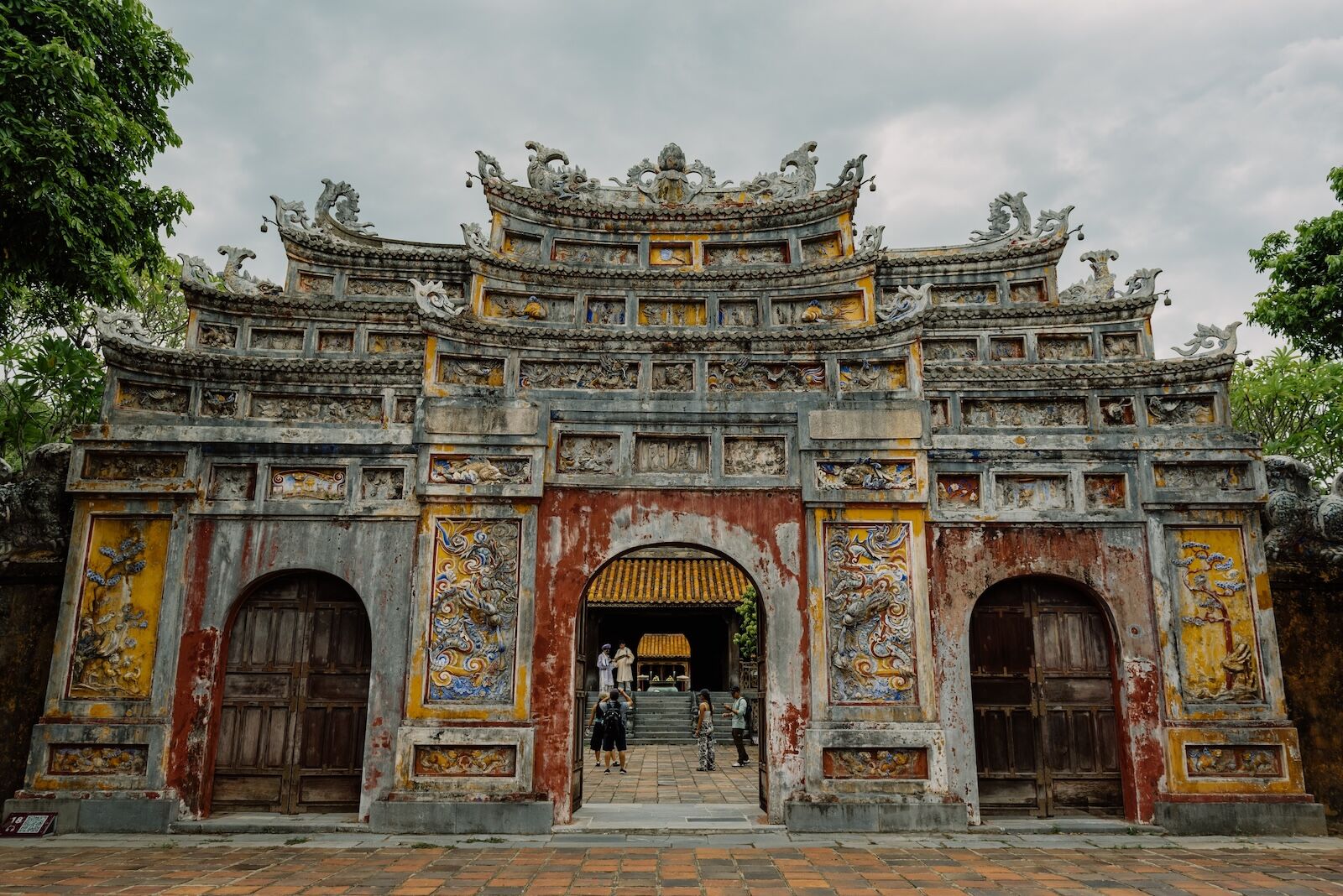
A gate at the entrance to the Tomb of Emperor Minh Mạng.

A gate at the entrance to the Tomb of Emperor Minh Mạng. Photo: Sarah Arksey Njegovan

On my last day in Huế, I hired a driver to bring me to my next destination. But he convinced me that I couldn’t leave the city without seeing its imperial sites; in fact, he seemed somewhat shocked I’d even consider skipping them.

The Huế Monuments Conservation Centre is responsible for managing around 40 formally protected sites, including tombs, temples, and pagodas, among others. There are also a few wild-card sites in its purview, such as Hổ Quyền arena. It’s a site where brutality was framed as an imperial spectacle: elephants represented the Nguyễn monarchy, while tigers symbolized its enemies and rebels. Tigers were reportedly declawed and defanged to help ensure the emperor’s elephants won, symbolizing the triumph of monarchy over rebellion.

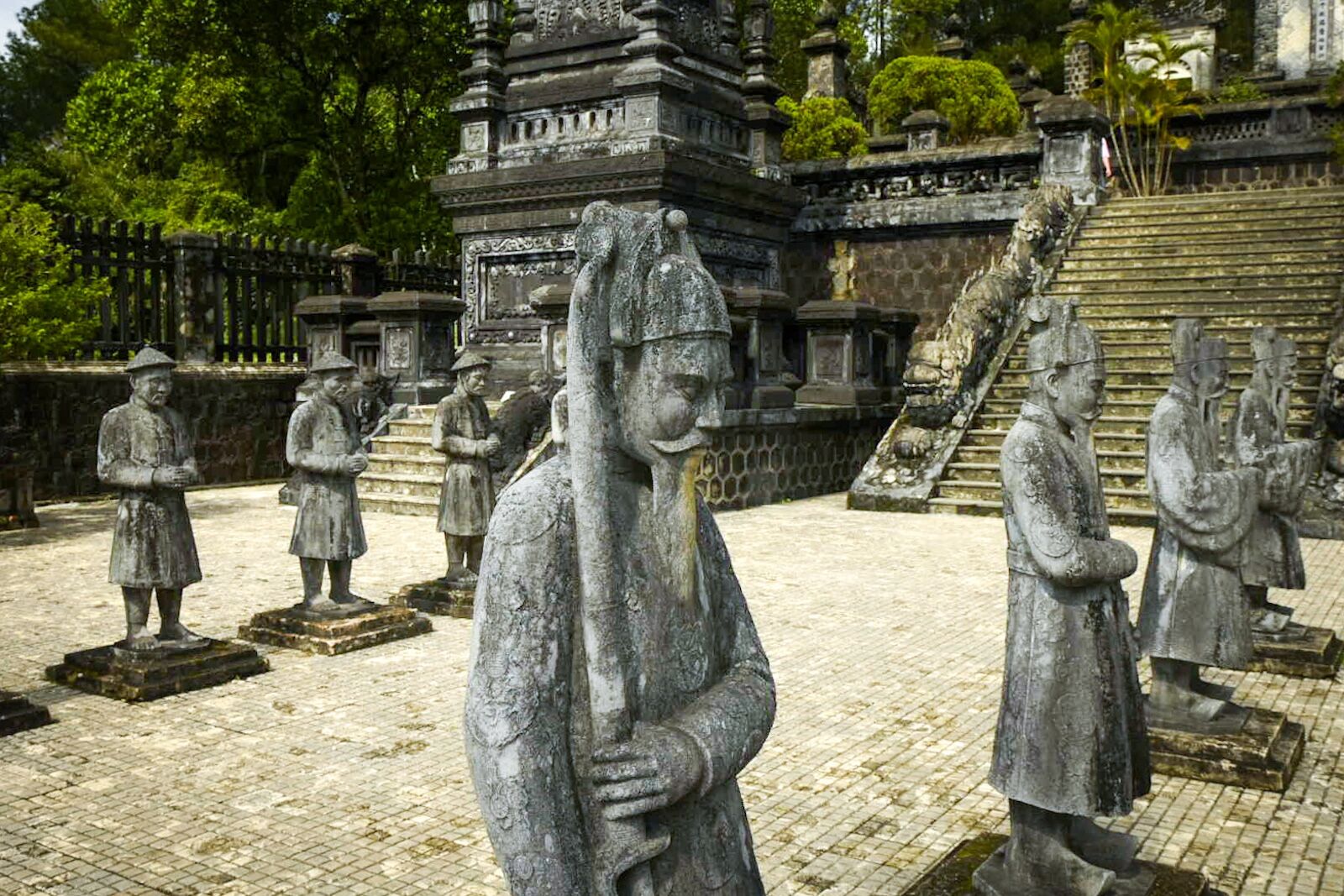
My driver made what he considered a mandatory stop at Huế’s conservation centerpiece: the Imperial City, a palace complex that served as the seat of Vietnam’s emperors from 1802 to 1945. We also stopped at the tombs of Nguyễn emperors Minh Mạng, Tự Đức, and Khải Định. The latter, I learned, may not be a tomb at all, with rumors circulating that the emperor’s fear of grave robbers led him to orchestrate a secret off-site burial.

hue abandoned places - warriors

Stone warrior statues at Khải Định Tomb. Photo: Sarah Arksey Njegovan

Minh Mang ruled at the height of the Nguyen Dynasty, and his impressive resting place is great for nature lovers, with ponds where visitors can feed koi for a few coins. We also stopped at Thien Mu Pagoda. It’s on the grounds of an active monastery where visitors stroll as monks go about their daily tasks: watering the gardens, talking with community members, and doing the maintenance needed to keep the grounds in excellent condition. A pagoda has stood on this hill since 1601, when Nguyen Hoang, the first Nguyen lord, founded it. Buddhist monks have kept it going ever since.

After getting to my next hotel that night, I reached out to thank my driver for his insistence on making stops — and realized it was a real-world example of how having these historic sites available to the public helped drive tourism, or at least keep tourists like me in the area a little longer.

How growing tourism helps the cause

hue imperial city

A gate in the old Imperial City. Photo: Timmy.Tran photo/Shutterstock


Huế offers curious travelers a rare chance to experience centuries of architectural and historical preservation. In the first three months of 2026, the city saw nearly 2 million visitors — a 30 percent jump over the same period in 2025. There’s no doubt it’s a destination on the rise.

Local experts like Pham say mass tourism can be a blessing when it comes to preservation, since increased tourists funds and tax revenue mean more money for preservation and management. It also brings in visitors like me, who come to see its lesser-known sites as much as its famous ones. Pham acknowledges that there are also challenges associated with rapid tourism expansion, but remains optimistic. “Overall, I think Vietnam has made meaningful progress in balancing development with heritage conservation,” he told me.

Most visitors to the city go for the pagodas and palace, and those are worth the trip. But the city’s harder question is what happens to everything that didn’t make the protected list, like the water park, the factories, and the villas with mist blowing through them. How Huế makes those decisions – and whether tourism can help tip the scales – will decide what’s still standing the next time I visit.

Discover Matador

Save Bookmark

We use cookies for analytics tracking and advertising from our partners.

For more information read our privacy policy.