
There’s a tension underneath every fall foliage trip: nature runs on its own schedule, and your ability to see the trees in peak shine depends entirely on whether or not you can get there when nature decides its time. You know roughly when the sugar maples turn in northern New England, roughly when the aspens go gold across the Colorado high country and the eastern Sierra. What you can’t know is whether the flight there will cost $220 or $70, because the airline pricing that seat isn’t thinking about leaves. The same seat can run $500 on a Tuesday, drop to $150 by Thursday afternoon and climb back before the weekend.
Dynamic repricing is why genuinely cheap fares exist at all, and it’s also why they evaporate before most people notice. Catching one isn’t a research problem. It’s a timing problem, and you’d have to be looking at exactly the right route in exactly the right hour.
RatePunk is the solution to that churn. For the first time, without having to constantly monitor price tracking data, you can stay on top of the best deals and book when it benefits you. RatePunk started in 2020 as a small European startup and has quietly picked up a following – more than 370,000 members, and a 4.6-star iOS rating worldwide that ticks up to 4.7 among US users. If you’re looking to get the best deal on fall travel this year, the service is more than worth exploring.
Setup takes under a minute

Photo: Akarawut /Shutterstock
I came across RatePunk about a year ago while discussing the recent growth of international flights from Denver. I’ve lived in Colorado my whole life, and we’ve come a long way from the days of our little Stapleton airport – Denver International is now the 10th busiest airport in the world. One of my colleagues told me he’d started using RatePunk to find deals from Denver, because it had become the best way to stay on top of deals from both the city’s two hub airlines as well as those that operate less thoroughly from this airport.
Signing up for RatePunk took less time than brewing the cup of coffee I’m drinking while writing this. I entered my home airport (DEN) and my email, and was directed to a landing page displaying current deals. Downloading the app and signing in was equally simple.
That’s essentially all it took from me. The deals started arriving in minutes. Beyond the alerts, you can open the app and browse everything that surfaced that day, sorted by price with the cheapest first or by AI Deal Score with the best first. Filters narrow it to long-haul, last-minute, family-friendly, and a handful of other destination types. It’s less of a booking interface than it is a set of controls that let you find what you want. This is, to me, what makes RatePunk different from the plethora of booking services available nowadays.
For example, on my first dive into the deals, I came across an offer to fly from ORD to London for a price that sounds more like a happy hour special than a flight deal. I took a screenshot, just so you’ll believe me:
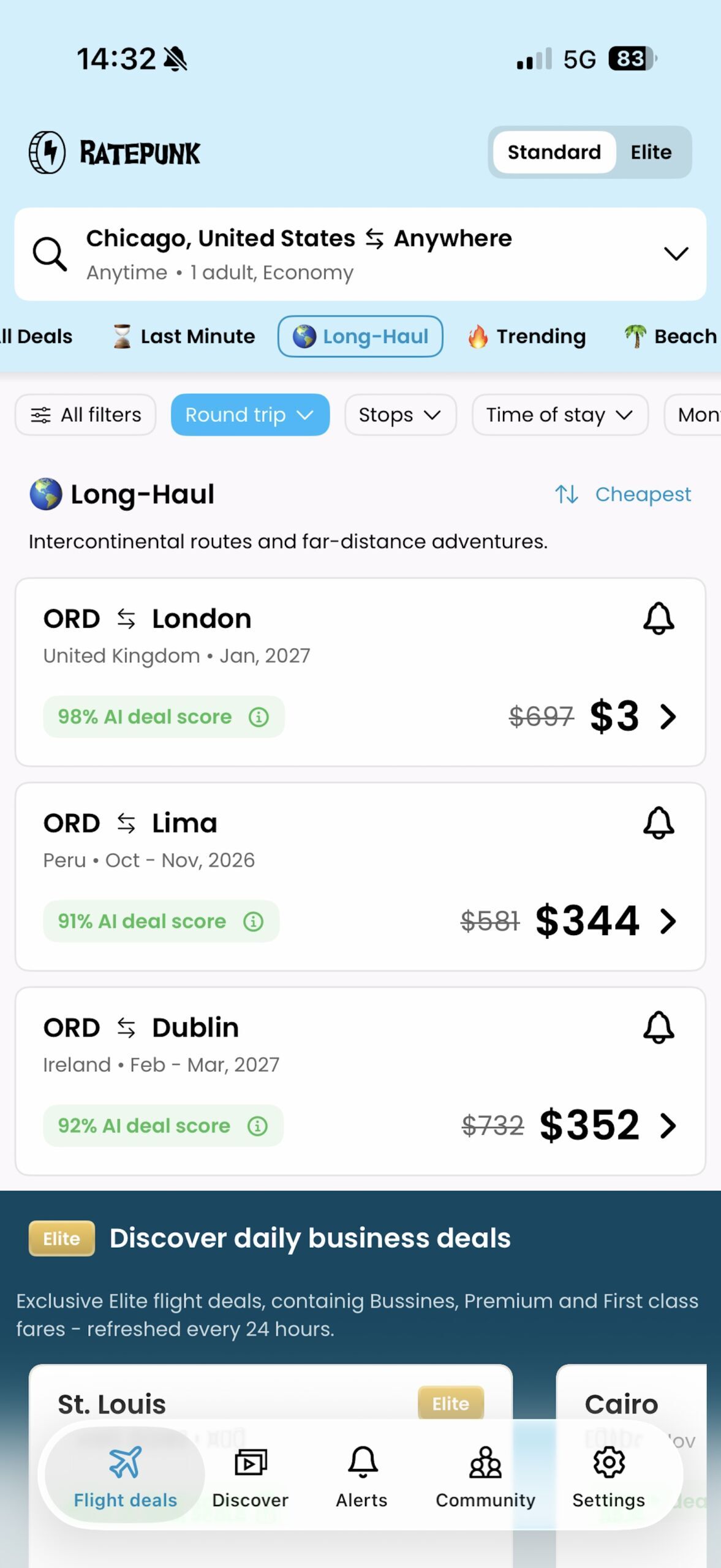
Photo: RatePunk
Of course, I fly from Denver, which shares an airline hub with ORD, so getting over there for the London leg is quick and cheap.
What the AI Deal Score is actually measuring
Every fare RatePunk surfaces gets an AI Deal Score out of 100. I’ve learned that this is an important metric. It isn’t a price ranking, but rather a score weighs factors including airline quality, airport quality, departure and arrival times, layover length, and the route’s own price dynamics alongside what the fare costs. The cheapest result on any route is very often a bad trip. Think two connections, an overnight layover in a terminal with nowhere to sit, or a 5:40 am departure that costs you a hotel night. A score of 80 or above is meant to signal a good trip at a good price.
The score is also comparative, measured against what that specific route genuinely averages and what it has historically cost rather than against a generic sale threshold. Plenty of things in travel will tell you a fare is discounted. Discounted from what is usually left unanswered. Here the benchmark is the route’s own history.
Fares scoring 80 or above from your home airport trigger a notification the moment the price drops. This also means you’re not getting blown up with notifications that are irrelevant to you. You’re pinged when something unusual is happening, instead of every time a fare moves.
What the fares actually look like this fall

Photo: Marcos Castillo /Shutterstock
Here’s the part that matters more than any explanation of the algorithm. These are round trips RatePunk surfaced this August, all real and bookable at the time to get you to the flaming oranges and yellows of the high country:
- Orlando to Denver: $70, typically $223. Deal Score 87.
- Miami to Boston: $80, typically $222. Deal Score 83.
- Los Angeles to Worcester, Massachusetts: $317, typically $653. Deal Score 91.
- Los Angeles to Hartford: $250, typically $459. Deal Score 91.
- Houston to Sacramento: $152, typically $268. Deal Score 84.
- Chicago to Bishop, eastern Sierra Nevada: $414, typically $667. Deal Score 84.
- New York JFK to Fresno: $317, typically $414. Deal Score 86.
Read those as a set and the savings clearly aren’t uniform. Miami to Boston at $80 is an outlier. JFK to Fresno at $317 against a $414 average is a solid but unremarkable win. The Deal Scores track that honestly, which is a point in the system’s favor: the 91s went to the two routes where the gap between fare and average was widest.
There’s also some consistency in places that people tend to travel to at specific times of year. Half these routes point at New England, where most people’s mental image of fall color lives. The rest point west at Colorado, the Sierra foothills, and the Owens Valley below the eastern Sierra crest, where the aspens turn earlier and the crowds are thinner.
Who this actually works for

Photo: Studio Romantic /Shutterstock
RatePunk suits travelers with flexibility, and that flexibility can be quite broad. You might know your dates but not your destination. You might know you want to see aspens and not care much whether that means Colorado or California. On the flip side, you might be someone who visits the same cabin in the woods each fall, but the dates vary depending on pricing, your work schedule, or whatever the case may be. This is when RatePunk shines, because you can monitor what’s happening and book when it works.
The core user of RatePunk is someone who already compares fares religiously, but who has decided that’s a poor use of their evening. If you’re like me, you’re value-conscious but not budget-desperate, and are specifically irritated by opaque pricing (I don’t want to get my credit card out at check-in, thanks). I do, however, jump out of my seat at a screaming deal, and that’s the core of RatePunk’s value proposition.
If you know exactly where you’re going and exactly when, the alerts will mostly be noise. If your travel is dictated by a wedding date or a school calendar, flexibility isn’t something you have to trade. Because alerts are tied to the home airport that you set, the value drops sharply if you live somewhere with thin service (like a regional airport). Though, if you’re a points optimizer, connecting from that regional flight to a RatePunk deal can be a great way to get the most out of your points bank.
There’s also that category of traveler who enjoys the hunt, and for them automating it removes the fun rather than the friction. RatePunk is, in essence, that category in digital form.
RatePunk is a shortcut to cheap flights. It is not a tool that pays off for everyone on every trip, and anyone telling you otherwise is selling something. If your fall is loose enough to be shaped by a fare, you can set up RatePunk here. It’s available on iOS and Android. Pick your airport, then go back to whatever you were doing. Your next trip will be in front of you shortly. 