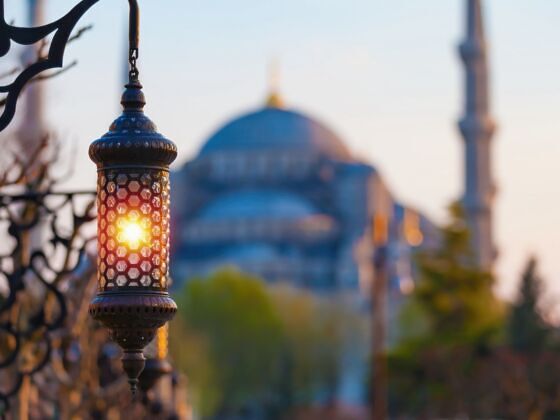
Photo: Ranoush.

Hannah Barth gives a glimpse into what happens when a non-believer decides to participate in an intense Muslim ritual.

It’s just past midnight in Turkey on the first day of Ramadan, 2010. I’m not a Muslim. I’m not anything for that matter, but I consider myself spiritual. From that end, I’ve decided to try to fast for the first two days of Ramadan.

After living nearly seven months in Turkey, I’ve barely seen real Turkish culture. I’m part of a dance troupe that lives out of hotels and eats only catered food, so I’ve missed some things. Taking part in Ramadan is my attempt to feel more connected with the real Turkey.

My local friends keep using the words ‘relaxed’, ‘calm’ and ‘cleanse’ to describe the holy month. They don’t describe fasting – oruç in Turkish – as something painful. It seems to be a way to connect with what’s inside.

It seems kind of Zen.

Day One

1 Ramadan, 5 AM
The fast officially began at 4:30am. My friend and I stayed up until breakfast at 4 where I drank as much water as I could and recited the Ramadan prayer. A true mix of ancient and modern, I ate my first Sahari while one friend checked the local Ramadan timetable on his Blackberry and another phoned in to make sure I’d beat the morning call to prayer.

Photo: darkpatator

1 Ramadan, 11:30 AM
I woke all through the night thinking of water. It seemed funny then, but now that I’ve really awoken for the day, I’ve had my first pangs of thirst. It’s difficult to not see this fast as a battle, and I revert to writing as a distraction.

1 Ramadan, 1 PM
I choose avoidance as my first means of coping, and head back to bed for another few hours.

1 Ramadan, 4 PM
After sleeping until three o’clock, I’m now at work on my laptop in the hotel lobby. My hunger is very mild and almost feels cleansing, but my thirst is intense. I’m more distracted than normal. A few times already I’ve started to count the hours until sun down and had to steer my mind in other directions. This is not a fight, I keep reminding myself.

1 Ramadan, 5 PM
I take a brisk walk outside to fetch something I need for work. It’s in the low 30s Celsius and I begin to feel slightly lightheaded. I imagine clairvoyance, but really I think I’m just reaching to find significance in today. I see discarded room service trays outside people’s doors and I think of the waste. One of the key points of Ramadan is to feed those who are unable to feed themselves and to thank Allah for that which you have.

1 Ramadan, 6:30 PM
I’ve moved from the air-conditioned lobby to the outdoor dance studio. It’s hot. My thirst is kept mostly in-check except for when a friend cracks open an iced tea at my elbow and offers me some. I want to tell her I’m fasting; I want to hear her reaction. But am I just a silly non-religious American playing Muslim dress-up?

But am I just a silly non-religious American playing Muslim dress-up?

I shouldn’t feel this way, I tell myself. Internally defensive, I think about how all my friends who know I’m trying the fast have been impressed at both my desire to learn and the determination they know it will take someone new to fasting to do it.

This afternoon I find out many more of my Turkish dancer friends are doing oruç than I had imagined. One of them joins me at my computer and tells me the personal significance fasting has to him. “It’s not about not eating,” he explains. “It’s about giving part of yourself to Allah. And not in a sacrificial way, but because you want to; because it brings you peace and makes you more aware of what’s important in the world.”

This is the kind of conversation I imagined.

1 Ramadan, 8:03 PM
I break my fast by downing an enormous glass of water and then another. Only then do I move on to the food. “Now you understand what it’s like to be hungry,” someone says, and for the first time I feel like I’m beginning to get it. I think of the children I taught on the streets of India a few months back. I can barely imagine not having water to drink at the end of the day.

As we eat I wish my friends Allah kabul etsen (May Allah accept you) rather than the traditional Turkish Afiyet olsun (May you have health). I continue to debate weather I’ll fast again tomorrow as my Kurdish friend insists I should to truly understand this aspect of Ramadan.

1 Ramadan, 10:45 PM
I’m still on the fence about continuing my fast tomorrow. I feel like participating is noble in some way, but I just don’t know if I want to feel that uncomfortable again for a whole day. I feel weak.

Day Two

2 Ramadan 3 AM
In an interesting mix of cultures I find myself spending the night with my Orthodox Georgian friends. The social activity and light snacking seem fitting, even if the religion is wrong.

Somehow we enter a heated discussion about why the Turks are ‘bad’. While working to defend basic human goodness, I make up my mind to fast again tomorrow. I’m hoping to find increased clarity in day two of Ramadan, which I can already feel is going to be more difficult than today.

2 Ramadan, 3:30 AM
I sit down to breakfast by myself. It’s a different feeling eating Sahur alone and I say the mealtime prayer with a friend on the phone because I still can’t remember it by heart. It feels wrong to eat without saying this prayer, even if I’m praying to a different god in my head than Allah. I hesitate reciting the words with my Orthodox friend sitting across the room. I eat with the hope that maybe he’ll understand my reasons for doing this.

2 Ramadan, 5:30 AM
I wake up thirsty. I consider bailing right then and there, before the day has really started.

2 Ramadan, 11:45 AM
As fitting as last night was being with friends, this morning is already proving difficult. Refusing Georgian hospitality isn’t something one does lightly and my friend and host is scolding me for my decision not to eat. He quips something in Georgian about why I’ve refused the tea his sister offered and my imagination starts racing. Is he calling me an infidel?

2 Ramadan, 5 PM
My productivity at work has dropped to zero. Watching movies online is about all I can do to keep my mind from counting down the hours. I also discover I’m growing a grudge against the fast. I feel like it’s taken me away from my friends and reduced me to a moody puddle for the better part of the day. I feel weak. Again.

I can’t call out Allah’s name in this hotel dining hall just as I could never call out the name of Jesus in the churches I visited while traveling.

2 Ramadan, 8:02 PM
I arrive at dinner early and prepare my plate so it will be ready when I am. Although I’ve never longed for the dogma that organized religions impart, I’ve always envied the community they foster. I adore waiting with my friends for the fast to break and feeling like I’m a part of something much bigger when we all simultaneously achieve the same goal.

My Kurdish friend – the same one who really encouraged me to try oruç – stops me as I raise my water glass to my lips to drink for the first time today.

“You have to think about why you’ve done this and tell it to Allah.” He wants me to raise my hands in the Muslim gesture of prayer; a gesture I find uplifting and esthetically stunning.

“I’ve thought about it.” I pause, my glass trembling before my lips. This moment feels sacred, and I don’t want to ruin it with semantics. “And I’ve told it to God.”

We negotiate with our eyes and I know he’s wondering if I’ve given the moment proper respect. I want to respect everything about it, but I can’t call out Allah’s name in this hotel dining hall just as I could never call out the name of Jesus in the churches I visited while traveling. My God is my own and he doesn’t belong to any religion. He has allowed me to see Islam through this fast and for that I drink and am thankful.

What do you think about the religious tradition of fasting during Ramadan? Share your thoughts below.

Religion
 

About The Author

Hannah Barth

Hannah J Barth is a physically-based performer who thinks the Bard said it best: "The whole world is a stage..." She has been involved with the performing arts in one way or another on three continents and is currently working with the dance company, Fire of Anatolia in Turkey. You can follow her via her blog.

More By This Author

view all →
  • http://matadortravel.com/traveler/evasandoval EvaSandoval

    Hats off to you for embracing local culture in this physically demanding way! I do think some clarity was gained – you wrote a really nice piece about it. Thanks for the great read!

    • http://hannahinmotion.wordpress.com Hannah In Motion

      Thanks Eva. In a lot of ways, I really wish I could have fasted for the entire month. I was able to *see* a lot of the mental hurdles in two days and understand them, but not necessarily overcome them, which I think is a real goal in this endeavor.

      Thanks a lot for reading.

  • Casey

    I’m another non-muslim fasting for ramadan. I’ve defintely felt the same way, like I’m just playing pretend, or missing out on some part of it because I’m not doing it for a God but instead for a connection to the culture, a learning experience, a personal challenge and because, as you said, it is important to remember how much I take for granted being able to eat and drink whenever I feel hungry or thirsty, a luxury not afforded to much of the world’s population. I’m fasting for the month and you should know it gets way easier after the first few days! At this point I barely even notice anymore. But it’s been a really positive experience for me as well, when other muslims find out I’m fasting they’ve been nothing but enthusiastic that I’m making the efforst to learn about there culture and to sharing the common experience of fasting with them, it does help me feel more like part of the community here. (a bedouin village in southern Jordan) It was great to read your piece about fasting as an outsider!

    • http://hannahinmotion.wordpress.com Hannah In Motion

      Thanks for your comment, Casey, and congratulations on fasting for the whole month! I could see – and was told – that the fast gets easier as one goes along. What really boggles my mind are the dancers I work with – trucking through rehearsal in the sweltering heat without any water. It makes you realize what we’re really capable of, right?

  • huseyin

    I appreciate your concern that you has tried this Muslim ritual ‘oruç’ though you call yourself ” non-believer” , as many Muslim believers dont participate in this islamic ritual of purificaiton.

  • http://www.desiblonde.com/ Meliha

    Congrats on fasting! It’s difficult at first, but it DOES get easier. It just takes a few days for your body to get into the groove. I wrote a little bit about fasting on my blog at http://bit.ly/dADyJl

  • http://www.localphilippines.com/ Rich

    I am enticed to do the same after reading this, only 2 things are stopping me: well, after all, Ramadan is already over, and I’m afraid of the productivity issue. Im both working and studying and though I do have a classmate whose a devout Muslim, works ANd studies too, Im not entirely sure I can function just as well. Makes me a whole lot proud of our Muslim brothers and sisters.

    • http://hannahinmotion.wordpress.com Hannah In Motion

      I totally understand that fear! My productivity plummeted while I was fasting. I’m told it gets easier as you go through it… give it a try next year and let me know what you find.

Religion →

On the windswept heights of Mount Gerizim, the Samaritans keep ancient Passover customs...

Religion →

In the face of mass destruction, how does faith react? The 2004 tsunami offers...

Religion →

A new study found that people with tumors in the back part of their brain are more likely...

Photo Essay →

The spiritual and cultural mochitsuki ceremony, where mochi, a Japanese rice cake is...

Religion →

Ian MacKenzie shares his thoughts on finding authentic spiritual teachers, and how to...

Religion →

Buddhism implores one to meditate in order to learn the art of non-attachment. But could...

Religion →

Most stories about religion in mainstream media are negative. Every once and a while,...

Religion →

This week is not just about Americans giving thanks. All over the world, there are many...

Religion →

'40 Days for Life' uses non-confrontational approaches to spread their pro-life message....

Religion →

Ramadan, a holy month of spiritual fasting, is an opportunity for travelers to experience...

Religion →

No longer do we have to choose from among just a few systems of faith. Here are three...

Religion →

If you look around, you'll see an unprecedented movement towards bettering our world.