A baby from Seva Jyothi Leprosy Colony in Andra Pradesh, India. Photo: jcandeli/ Feature Photo: amanderson2

January 31st is World Leprosy Day, a good time to join the fight to eradicate leprosy.

Every day thousands of people across the world are diagnosed with leprosy. But what exactly is leprosy? And why should we care about World Leprosy Day?

What is Leprosy?

Leprosy is a chronic condition caused by the bacteria Mycobacterium Leprae. First identified by Norwegian physician G.A. Hansen in 1873, it is also known as Hansen’s disease.

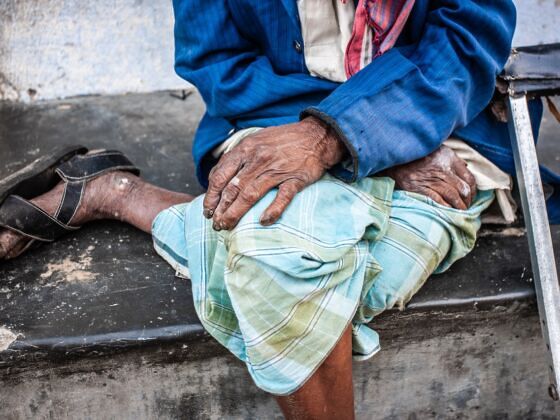
Leprosy affects the nervous system, damaging the nerves and eventually manifesting in deformities along the hands, feet, and face. In extreme cases, patchy skin is accompanied by loss of sensation, clawing (of hands and feet), and even loss of limbs.

Leprosy Treatment

Leprosy treatment consists of a very effective multi-drug therapy (MDT), a cocktail of three drugs: dapsone, rifampicin and clofazimine. Early detection and treatment ensure infection is stamped out within no time; if leprosy has progressed, treatment will cure infection, but not the resulting deformity.

Global Spread and Stigma

Given the easy availability of medication, leprosy should be a thing of the past, yet it remains a problem, especially in poverty stricken regions of the Indian subcontinent, Africa, and Latin America.

This continued prevalence of leprosy is a result of historical stigma, traced back to a time when patchy skin and clawed hands meant isolation in leper colonies. Leprosy continues to instill fear and discrimination; even today leprosy stigma devastates social and economic ties, along with healthy living.

It is this very stigma that obstructs early reporting, effective treatment, and recovery.Stigma leads to progression of the disease and deformity, causing further isolation.

A number of local and global agencies, including Seva Life Project, WHO, LEPRA and ILEP are attempting to address these very issues to eradicate leprosy worldwide.

World Leprosy Day – Eradication through Awareness

World Leprosy Day aims to increase awareness and make treatment more accessible to those in need. As stated on the ILEP website:

World Leprosy Day was created in 1954 by Raoul Follereau “so that people affected by leprosy could be cared for like all others who are ill and so that those in good health could be cured of their absurd and often criminal fear of this disease and those who are affected by it.”

In other words, leprosy eradication requires the changing social perception of leprosy; by recognizing leprosy as just another curable illness, social stigma can be eliminated, thereby increasing chances of early reporting and cure.

The process also includes monitoring availability of medication and training personnel in proper diagnosis and patient care. Patient rehabilitation – social, economic and physical – is also important, allowing them to reintegrate into society. These very points form the crux of WHO’s “Final Push” strategy for the elimination of leprosy.

How can you help?
Organizations fighting leprosy are constantly in need of support, donations, and volunteers to eradicate leprosy and improve lives worldwide.

Community Connection:

Read more about India, one country where leprosy rates are high. “India, Poverty, and the Fear of Traveling to Poor Places” is just one of many articles in our archives.

About The Author

Neha

Neha is a freelance writer from Mumbai, currently based in Zagreb. When she isn't on her laptop, you'll find her at a local cafe, sipping coffee, paperback in hand.

More By This Author

view all →
  • Nancy Harder

    Thanks for this article Neha. I’m sad to say that leprosy hasn’t really been on radar. I think most people associate it as a disease of the past (at least I did). Thanks for bringing awareness to the issue.

    • http://www.nehasweb.com neha

      Thanks Nancy. It’s true that leprosy is pretty much a forgotten issue but for the regions where it still persists. Hopefully, it will become a non-issue soon.

  • http://wheretherebedragons.com Tim Patterson

    Thanks for this article. I always felt lepers condemned to that beautiful Hawaiian island at least had a pretty good silver lining.

    • http://www.nehasweb.com neha

      Thanks Tim. Unfortunately conditions around the world (for leprosy patients) continue to be pretty depressing.

  • Sabina

    Great article, Neha. I knew nothing about modern-day leprosy until I read this. Perhaps it should be called Hansen’s disease from here on out. That term carries no stigma at all.

    • http://www.nehasweb.com neha

      Sabina, that’s an excellent suggestion! Though the other problem associated with leprosy is with cases in the western world. Since leprosy is fairly non-existent here, actual cases tend to get misdiagnosed.

  • http://collazoprojects.com Julie

    Neha-

    Like Nancy I viewed leprosy as an “old” disease; I wasn’t really aware it’s still a problem, as I hadn’t heard anyone talk about it for a long time. Thank you for raising my awareness.

    • http://www.nehasweb.com neha

      Thanks Julie. I really think that increasing awareness, both within the pockets of infection and outside, is the key to eradication.

  • http://www.mikesryukyugallery.com Ryukyu Mike

    Excellent, informative article, Neha, Magic on ya

    Cheers,
    Mike

    • http://www.nehasweb.com neha

      Thanks for reading Mike.

  • http://thefutureisred.com Leigh

    I also wasn’t aware of leprosy as a modern problem. I always think of it as from old movies that took place in the time of Jesus. And leprosy as the sort of disease God punishes you with in the Bible.

    But of course, it makes sense that it wouldn’t just disappear. Thank you for putting the spotlight on this and information and links that allow us to help.

    Seems that this is something that is easily addressed (certainly in comparison to something like Haiti). It’s a matter of making sure the people who need it get adequate treatment and prevention.

    • http://www.nehasweb.com neha

      As Doug states below, the treatment is available free of cost, I think the main problem is poor self reporting, which again is linked to the issue of social stigma.

  • http://www.ilep.org.uk Mr Doug Soutar

    Reading through the comments it looks as though many are not aware that leprosy is a continuing problem in the world. We thank Neha for drawing attention to this and the need to address the social dimensions of this disease. Raising community awareness of the fact that leprosy is fully curable and that treatment is free contribute towards changing attitudes and behaviour towards people affected by leprosy.

    ILEP is a federation of 14 Members working towards a world without leprosy. We hope some of your readers, particularly as they are travellers and writers, who are interested in life and people, would be interested in finding out more from our website: http://www.ilep.org.uk

    Doug Soutar, General Secretary, ILEP

    • Julie Schwietert

      Doug-

      Thanks for your comment. We’re happy Neha brought the issue of leprosy to our attention; it really hasn’t received any spotlight in the Western media for many years. Thank you for the work you and your colleagues are doing to eradicate this disease.

    • http://www.nehasweb.com neha

      Thank you for your comment Doug, and for the amazing work you, and your foundation are putting in towards leprosy elimination and facilitating social change.

  • Suresh Puntambekar.

    Dear Neha,

    I liked your article. I am proud of you as a Father. The article is on more serious note and making one aware of the plight of leprosy patients. I suggest you to go through web site – http://www.anandwan.in Dr. Baba Amte has done great social work in the upliftment of leprosy patients. His children are carrying forward the mission. After going through the web site, may be some one would be interested in assisting in this noble cause. Great!! God Bless you!!

    • http://www.nehasweb.com neha

      Thank you so much for the comment, and for the link!

  • jesus babu

    Hi Neha, I like ur article, my name is jesus babu im working with Leporsy community in Nellore Andhra Pradesh, Thank u so much for sharing abt Leorsy. Ur using my photo, we Sevalifeproject.com trying to help in the community also we r runing children’s home and school for this Seva jyothi Leprsy colony. We need ur support.

    Thank U

  • Linda George Brown

    My uncles had leprosy as children in 1925. They were taken from the family and one died in quarentine. How incredibly sad for my immigrant grandmother. They came to NJ from Bermuda in 1919 and it was there that the boys probably contracted the disease.

    Thank you for your interest and your work.

    • Rachel

      Hello Linda, I know you left this reply a long time ago but I felt I had to reply. My great-great-grandfather also had leprosy and lived in Bermuda. I’m not sure when he caught the disease – probably about 1910-20. He and his daughter both caught leprosy – he caught it from a man with leprosy that he had lent his tools to (he was a stonemason). A very sad tale, they were also stigmatised by the community.

      • Linda

        Hi Rachel,  Will I ever remember to come back here again to reply?  Do you know what happened to your family?  Where were they sent for quarantine.  Let’s share more info…

        email me at hoonoo@aol:disqus.com

        Linda

  • Erica Hale

    i find hansens disease a very unfortunate disease as well as any other disease that isolates people and stigmatizes them. i hope that someday i can be like you and do something to help. :)

Contests →

I've learned a lot about what it takes to keep a non-profit on its feet.

Healthcare →

The Canadian Cancer Society might not be putting your money to good use.

Charity Events and Fundraisers →

Do the Write Thing for Nashville has raised $27,000 for the flooded city... and counting.

Charity Events and Fundraisers →

Various news sources are reporting an imminent re-recording of We are the World to be...

Charity Events and Fundraisers →

Riding my bike for 10 weeks, meeting new people, singing songs around campfires, sleeping...

Environment →

"Green" isn't just about changing our patterns of product consumption; it's about...

Supporting Our Community →

Please consider offering a donation that will support the party's cause.

Supporting Our Community →

Matador is bringing its online community off-line with a blow-out party to raise money to...

Charity Events and Fundraisers →

20 years ago, London celebrated Mandela's 70th birthday while he remained imprisoned, and...