Previous Next
What can mapping tell us about famine? The devil is in the detail. Or in this case, the distribution.

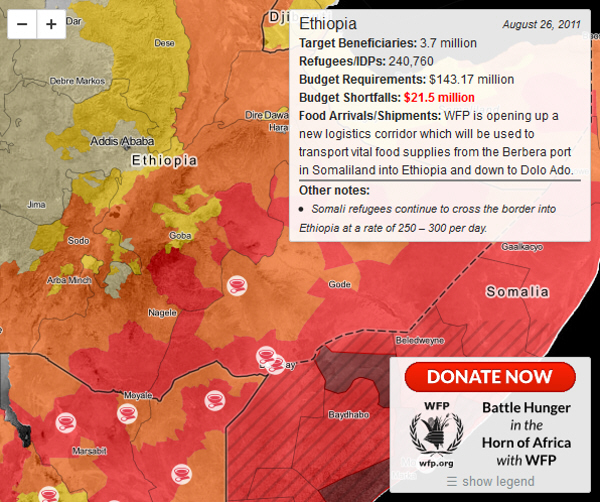
For map nerds like myself, we tend to take in spatial information better than straight up numbers and statistics, and the World Food Programme, along with Development Seed, are mapping the wide-reaching effects of the famine all across East Africa. The map below shows all the WFP’s distribution centers in the region, the hardest hit areas in red, as well as some statistics and funding numbers.

According to Matador’s Richard Stupart:

Note how the famine follows national and provincial borders? Natural disasters don’t do that. Disasters of politics, markets, and economic policy do.

Definitely a lot of food for thought, especially since many media outlets are reporting the famine as most likely man-made. If you’re looking for ways to help and reach famine victims, we’ve compiled a quick list of five international organizations worth contributing to.

Human RightsWorld Events


About The Author

Lola (Akinmade) Åkerström

Lola (Akinmade) Åkerström is a MatadorU faculty member and Network contributor. Her work has appeared in National Geographic Traveler, Vogue, BBC, Fodors.com, and many more. Follow her photoblog at Sweden.se.

Archived Responses to Mapping the food crisis and famine in East Africa

  1. Abbie Mood says:

    I also heard on NPR this morning that 30,000 children have died over the last 3 months…

  2. Anonymous says:

    So sad :(

I'd rather be taking pictures of these waves than trying to ride them.
Advice and photos on how to get to and around La Guajira desert, Colombia.
Searching for waves leads us down many unmarked roads.
Documenting some of the city's holistic practices and cultural festivities.
The roads in this part of the Nepal are like paper cuts on the lip of a cliff.
What I tried to capture in my photos were the in-between, ordinary moments.
Honduras? I kept thiking I was in the South Pacific.