Growing Up in East Germany: Reflections 20 Years Later
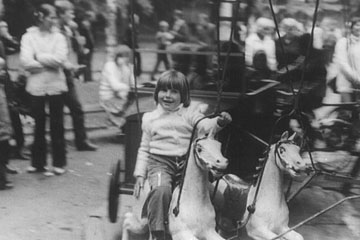
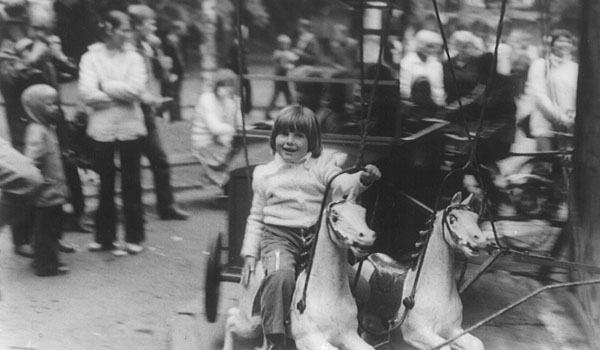
The author’s wife, Yvonne, enjoying her childhood
I always love hearing my wife’s stories about childhood life in East Germany. Yvonne was 10 years old when she left for the West before the wall came down (yes, it was possible to leave — just very difficult).
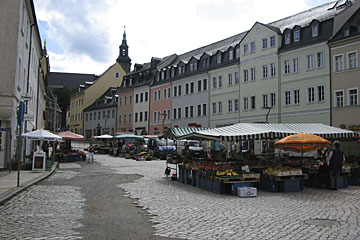
Modern Schneeberg, where Yvonne grew up
I was finally able to visualize her stories on a trip to Germany in 2007. The DDR museum in Dresden is like stepping into a time machine — separate and fully furnished rooms of typical houses and offices rekindled strong memories for Yvonne and provided me with a glimpse into the past. (Another entertaining look back is the film Goodbye Lenin!)
After reading another traveler’s account of his brief visit to East Berlin in 1987, I thought I’d start peppering Yvonne with more questions about what it was like to grow up in the East. The below anecdotes are strictly from her memory, the way she remembered things. I didn’t want to mess that up with any research.
Childhood life in East Germany in the 80s
1. There were no bananas. You could only get them once or twice a year, and you’d only be notified of their availability by word of mouth. So you’d have to rush to the veggie store (not a veggie store as we know it — just cabbages, potatoes…anything grown locally) and stand in line to get your one banana per person in your household.
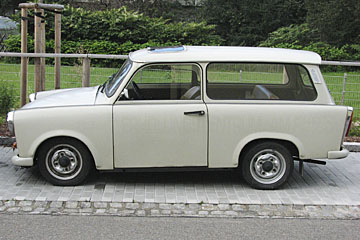
The ubiquitous Trabant (Kombi model)
To stretch the rations, Yvonne’s mum would quarter the banana, slice it thinly and serve it on bread to her and her sister.
2. You couldn’t buy strawberries from a store. If you wanted them you had to go and work in the fields picking them for hours. You were allowed to buy a certain portion of the ones you picked.
Yvonne remembers her mum telling her, “Don’t worry about picking, just eat as many as you can!”
3. Luxury items were priced way out of proportion to people’s salaries. A black and white TV might cost 10 times a person’s monthly salary; a 200g bag of coffee would cost around $20.
4. If you wanted to buy a car — most likely the ubiquitous Trabant — you had to wait years. Like, 10-12 years. So people who turned 16 (although you had to be 18 to drive) would put their orders in to get their mitts on a car when they were in their late 20s.
5. Yvonne remembers visiting the Baltic Sea twice in her childhood for vacation. They didn’t have much choice of where they could go. Holiday homes were usually linked and subsidized through work and you could obtain use of them once in a while.
6. You could only watch one of a few state channels, but radio waves know no walls (well, except maybe lead ones), so those close to the border were able to pick up signals from the West.
Luckily, Yvonne’s family was able to, so they had some access to the West’s news. Obviously, this was all very hush hush.
7. Every child was part of the Pioneers: Grades 1-4 were Blue Pioneers, 5-7 were Red Pioneers, and grades 8-10 graduated to the Free German Youth (FDJ).
When you first arrived to school, all the students would stand at attention and salute the teacher.
The teacher would say, “Be prepared!”, and the students would reply, “Always prepared!” before giving the salute, and then the day began.
Every 7 October, Yvonne — along with all the other Pioneers — would join in the parade commemorating the birth of the GDR. They dressed up in their Pioneer outfits, waved flags and flowers, and cheered.
Yvonne taking a bath in the sink.
8. Yvonne’s home had no bathtub or shower, only a sink and a toilet. She was fortunate enough to have a grandma with a bath, so once a week they would make their way there. Hot water didn’t just flow out of the taps though.
The water was heated by charcoal stove. A big water tank sat next to the tub with a little stove underneath where charcoal had to be shoveled in. The charcoal was delivered a few times per year by a big truck. They would leave a big pile of it and the residents had to shovel their portion of the coal into their allotted space in the basement.
Even at her own house without tub or shower, they needed to heat the water this way. They lived on the fifth floor, so Yvonne remembers having to walk all the way down to the basement with a couple of buckets and back up with them topped full of charcoal.
The fonder memories
It wasn’t all trying though. Everyone had a job, school lunches were free, after-school care was free, people were generally happy, necessities were extremely cheap, and there was more community spirit than there is nowadays. In those times, there were no Joneses to keep up with.
COMMUNITY CONNECTION
For a beautiful photo essay on modern Berlin through an ex-pat’s lens, check out Paul Sullivan’s Berlin 20/20: A Photo Tour of a Reunited City.
To find out how Berliners are going to celebrate this November 9, check out Two Ways to Celebrate the Fall of the Berlin Wall.
Do you have any of your own stories to tell? Share with us below!
Carlo Alcos
Carlo is a Managing Editor at Matador and co-founder of Confronting Love. His new project, Toxic Masculinity and the Paradigm Shift, takes a hard look at detrimental societal norms. Like him on Facebook and follow him on Twitter. He lives in Nelson, British Columbia.


This reminds me a bit of some of my mom’s stories, though her family got out right after the wall was built (there were a few years there where you could still sneak out relatively easily). The most interesting – and profound – perspective to me was when she and I were in Prague a couple of years ago, and went to the Communist museum. With almost all of the propaganda “PSAs” they had there, ones most people would think were crazy, my mom would say, “I remember that!”
My favorite was the American bug (or something like that)…an insect supposedly dropped on the farms of the East by those awful Americans. The kids would go during school to pick the bugs off of the plants. And yep, they had a poster of it at that museum. Classic.
Of course, America had propaganda just as bad!
Christine, I saw that poster and thought it outrageous. But then my friend said she remembered it from when it was in circulation. She said they were told that’s how the season’s harvest (mostly potatoes, if I’m not mistaken – the bug was even called the American Bug) was being destroyed by the West. I think I have a picture of that poster somewhere.
Carlo, Yvonne Thanks for sharing this piece. The details here are so powerful, raw.
Thanks for this timely piece Carlo (and Yvonne)! I had a German history professor in college who had been attending university in a West German border town in the 80s, and he had mentioned that by that time, the border would be open briefly on the weekends for East Germans to come over and purchase goods they couldn’t get in the East, like walkmans and bananas (which you’d mentioned weren’t widely available).
I also remember a conversation I once had with a brother and sister (from the former West Germany) who recalled that on their way home from visiting their uncle in West Berlin with their family, police officers would have dogs check under the train to make sure there was no one hiding underneath, trying to escape.
Thanks Valerie, Yvonne was just telling me how she remembers their tiny little car being searched inside and out when they crossed back into the East after they’d moved to the West. Of course, this wasn’t an easy thing to accomplish either, traveling back East after leaving, but they were able to a couple of times because of certain circumstances.