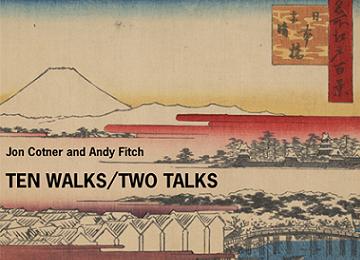
‘Ten Walks / Two Talks’ mixes travel notes and transcripts of conversations from Jon Cotner and Andy Fitch into a super original work of nonfiction, a meditation on place.

PUBLISHER’S synopsis:

Ten Walks / Two Talks updates the meandering and meditative form of Bashō’s travel diaries.

Mapping 21st century New York, Cotner and Fitch tap their predecessor’s collaborative tendencies in order to construct a descriptive / dialogic fugue. The book combines a series of sixty-minute, sixty-sentence walks around Manhattan and a pair of dialogues about walking—one of which takes place during a late-night “philosophical” ramble through Central Park.”

Notes


1. Getting the book

Getting books in here in Patagonia is sort of magical. The roads are muddy and the special delivery mailman rides an old bike. He always comes in the morning when it’s cold. You have to sign something. Then you go back in where it’s warm. You sit back down by your coffee and computer and rip open the package noting the New York address.

2. Opening the package

I looked at the Hiroshige prints on the cover and felt stoked. The book was small (85 pages) and I love books that can be shoved in a coat pocket. The table of contents read, “Early Spring, Early Winter, Late Spring, Late Winter.” The epigraph was by Bashō. The Ugly Duckling Press materials explained that this was part of the Dossier Series: “publications that don’t share a single genre or form. . . but rather an investigative impulse.”

3. Reading the first chapter

The opening paragraph read:

Still spinning out Kristin’s door I decided to change plans. The air stirred gently, made me think of flags. At 9:26 I saw the clean backs of waitresses in a Gee Whiz Diner window.

I kept going:

Pigeons spread up sidewalk on Grand, tearing at cinnamon-raisin bagels. I plowed through then felt bad approaching their patron–a compact lady with bags. One mom strained to tie garbage bags without gloves. One squat guy hauled heavy cement-mix bags to a pick-up. Each time he spun back to the vestibule he faced a chic tall mannequins in short denim skirts. He seemed to appreciate this.

4. Finishing first chapter and analyzing

I finished the first chapter, and saw that the next chapter was in a different form.  I was tired and went to bed.  But I felt really excited and like I would learn things studying the style of this first chapter. Later I figured out some of the structures used:

  1. Each sentence introduces a new “element” of the narrator’s walk,  whether a character, place, thought, action, or event.  There are occasional instances of a follow-up sentence (or two) continuing to describe the same element (as in squat man loading concrete above) but 90% of the sentences introduce something new.
  2. The elements are introduced in an order that seems part chronology of the walks, part reconstructing the walks from memory.
  3. There are almost no “smooth” transitions (like a camera panning across a scene, then zooming into something, then zooming out) but elements are grabbed from  all different distances–super close up, super far away–and placed one right after the other.
  4. This “disorder” would make the writing hard to read were it not for the short length and repetitive rhythm / structure of the sentences–which in some ways gives it a feel of “taking steps.”
  5. This “disorder” also  seems to replicate the feeling of being in an urban area where there are constant stimuli.
  6. All elements–from the letters on a kid’s hat to the smell inside an elevator– seem to have the same level of  “importance”  to the narrator.
  7. This creates a sense of zen, a mix of alertness and detachment (although not in a dispassionate or uncaring way). You’re just “walking through New York.”
  8. Although everything seems equally “important,” the characters described are almost always engaged in some form of action (even a dog lying on the ground is described as “breathing,”) making them seem vital, and making you wonder more about them – who they are, what their stories are – in ways that are sometimes poignant.
  9. Except for mentioning certain errands or decisions made spontaneously (such as changing directions) the narrator never explains anything–why he’s taking the walks, what the purpose is.
  10. This, combined with the neutral levels of “importance,” makes the walks feel very immediate and “alive” – as if there’s no barrier or layers between the reader and the scenes / characters.  As with the best haiku, everything else disappears, and   “you’re there.”

5. Reading the next chapters

The next day I got sick and was in the bed but was glad I had this book to read. I read through the next three chapters during the day / night as I was going in and out of sleep / fever. The third chapter was another week’s walks written in the same style as above. The other two chapters were transcripts of conversations (including ambient noise) between the authors recorded as they were walking around Central Park, and later, Union Square, W.F. (a natural grocery store).

In some ways the transcripts reminded me of Braided Creek by Jim Harrison and Ted Koosier (a book of hundreds of short poems sent to each other that describe different walks the two poets are taking / things they’re observing.)

But instead of having a conversation through poems, Cotner and Fitch are just kind of vibing, relaxing, having conversations in New York – it’s very transparent (including stutters, grammar mistakes–and one talking over the other) and immediate:

A: You’d you’d mentioned paths to the subway station. Lately I never stop moving walking up or down Manhattan. So long as you stay aware of what the the upcoming light says you can run and make it (although this gets hared [Cough] Holland Tunnel). But I’ll wonder if you find New York walks continuous as they should be say, on the hills of Santa Fe–or has there been jostling, pausing, restarting?

J: No I’ve shared your smooth continuous experience, and I haven’t read much Lyn Hejinian, but she makes the same remark in My Life.

A: About New York specifically?

J: Yes about New, about how this great metropolis provides the sensation of crossing through sheer wildern. . .

A: Hmm.

J: And I’ve noticed . . .

A: That sounds slightly different.

J: even if my path gets blocked by cars or a Don’t Walk sign I can cut to side-streets since I’ll have no destination.

A: I’ll save side-streets as long as I can, so when I need one I’m ready to turn.

J: Sure I love in this city the constant dialogue between drivers and pedestriians. It also. . .

A: And, Let’s say, deliverymen. . .

J: Exactly

(Six more lines of dialogue here, then):

J: Yes you feel this great sense of cooperation.

6. Final thoughts

  1. I feel like there isn’t enough experimentation in nonfiction and travel writing forms  (at least what’s being published), and was very stoked and inspired reading Ten Walks / Two Talks. (I’ve already read it through again).
  2. That said, the book itself didn’t feel experimental necessarily but just written in a style that was different than most other books but very natural to these two authors.
  3. There are several works (such as Basho’s travel diaries, Braided Creek, also a short story by Talese (I think) that describes minute by minute “happenings” in New York, that have stylistic elements similar to this book. It’s writing that, if you had to categorize it, you’d put (as is on the back of this book) “Poetry / Nonfiction.”

Community Connection

Please visit Ugly Duckling Presse for more information and to buy this book.

Do other countries (like Japan? France? England?) have a greater (percentage-wise) readership of books that could be classified as “Poetry/Nonfiction”?

What other publishers besides Ugly Duckling are publishing “Poetry/Nonfiction”?

Book Reviews
 

About The Author

David Miller

David Miller is senior editor of Matador (winner of 2010 and 2011 Lowell Thomas awards for travel journalism), and BETA magazine. After living for the last two years in Patagonia, Argentina, he is returning with his wife and two young children to the Southern US. Follow him @dahveed_miller.

  • http://matadortrips.com/ Hal Amen

    Dahveed, can you recommend any truly “experimental” nonfiction/travel writing?

  • http://matadortravel.com/travel-community/david-miller David Miller

    thanks for asking hal.

    these guys would be a good start, and i’d bet the rest of their publishing house’s Dossier Series would be as well. (I reached out to them today)

    i think most ppl used to traditional narrative nonfiction would find this work experimental, although it doesn’t feel that way to me personally

    which i guess becomes a point of entry into another discussion – what is ‘experimental’ nonfiction?

    in some ways there are no original forms, but just remixing the old. basho’s mixed haiku / journal entry travel books, for example: how many centuries ago were they written? what works / forms were they based on?

    perhaps it’s more a question of cycles, of what people are currently trying now.

    i think ‘experimental’ itself as a term is more a way of contextualizing the absence of notoriety or a common frame of reference.

    for example, when DFW was first publishing his nonfiction it must’ve seemed very experimental.

    now it just seems like David Foster Wallace.

    but back to the ‘traditional’ – for me it seems like the elaborately structured narrative nonfiction style that was pioneered by writers like McPhee, Talese, Steinbeck, Hemingway, Wolfe, and Capote (and now has modern masters like George Saunders, Sebastian Junger, John Krakauer, Barry Lopez, Rick Bass) – somehow seems less interesting than it was when I first started trying to write around 2003-4.

    i’m not sure if this is because i’ve started reading so much online and this has changed my perception of what seems transparent or ‘accessible,’ or it’s just a stylistic thing: i’ve always liked looking for something new.

    recently i made some ‘notes to self’ on where narrative nonfiction seems like it ‘should be’ right now: http://www.miller-david.com/2010/04/20/notes-to-self-on-modern-narrative-nonfiction-writing/ *

    [*rereading this post i feel like it's only about 67% true, particularly the parts about mimetic and diegetic storytelling 'vehicles' and the i-wasn't-drunk/stoned-when-i-wrote-it-but-it-sounds-like-i-was example involving deerhunter.]

    all of this said, i can’t wait to read whatever barry lopez or rick bass or any of the other narrative nonfiction ninjas produce next.

    but at the same time the bigger stoke is finding books like this one–seeing how ppl like these guys (Fitch and Cotner) and all other kinds of writers–some within our community at Matador–are trying out new ways (or new mixes of the old ways) to reveal place and character.

    kinda feels like a shitty answer hal, sorry.

  • http://matadortrips.com/ Hal Amen

    More than I was expecting, but not shitty.

    Yeah, I guess “experimental” (or even a label like “new”) can only be subjective–even when the subject is an entire generation of writers/critics. We all take influence from something that’s come before.

    Anyway, pretty psyched to start expanding my reading, and this post is a good start.

  • http://deleted GBSNP Varma

    David,

    “This “disorder” also seems to replicate the feeling of being in an urban area where there are constant stimuli.”

    Now, how do you go about depicting “order” of a place, or “silence”.

    Thanks.

  • http://matadortravel.com/travel-community/david-miller David Miller

    thanks for commenting gbsnp varma, and for the question.

    it seems difficult to answer without establishing a couple points:

    1. there are always two different levels of ‘order’ (or ‘disorder’) happening simultaneously:

    (a) the level or order/disorder of the external environment the narrator is experiencing

    (b) the level of order/disorder of narrator’s consciousness as he/she deals with / ‘processes’ this experience

    [you could argue too that there is also a third level (c) the level of order / disorder that the narrator 'constructs' via writing to depict (a) and (b). ]

    2. in ‘ten walks / two talks’ the narrator’s external environment (a) seems highly disordered, but the way he seems to be experiencing that environment (b) seems very ordered or ‘grounded’.

    he uses abrupt (or no) transitions from one sentence to the next to give the reader (c) that sense of disorder, but the sentences themselves–the way they’re mostly the same length and rhythm–seem to keep reinforcing the ‘centered’ (not really reacting to or feeling strong emotions, but just kind of observing) way he is experiencing them (b).

    so if you wanted to depict a very peaceful or ordered environment (a), the key question is: how is the narrator consciously experiencing (b) this environment? what level of ‘disorder’ (distractedness, being ‘scattered’, or emotional) or ‘order’ (just kind of ‘taking it all in’ or ‘at peace with’) does he or she have?

    regardless of what the external environment (a) is – how ordered or disordered it is – a state of zen or flow or peace (b) can often be depicted (c) when the following occurs:

    a = b

    this is how haiku seems to ‘work’

    the narrator’s conciousness (b) ‘is’ (at least temporarily) the external environment (a)

    the classic example is basho’s haiku:

    old pond
    frog leaping
    splash

    so to answer your question, this is how i’d ‘depict’ a narrator experiencing an ordered environment (a) with and ordered consciousness (b)

    basically i’d just describe whatever scene it was without trying to explain or ‘qualify’ anything.

    but if i were going through an ‘ordered’ place with a ‘disordered’ consciousness, i might try something like this: http://thetravelersnotebook.com/notes-from-road/notes-on-backcountry-visa-renewal/

    here each sentence has the same rhythm / construction, pointing towards the overall order of the environment (a) — which is mostly just wilderness — however, i tried to depict (c) using a verb to begin each sentence — that the narrator’s consciousness (b) is disordered — he’s continually worrying, thinking, reflecting, emoting.

    i hope that helps.

  • robert hirschfield

    David, a deep bow to you from Manhattan. I agree with you that there isn’t
    enough experimentation in travel writing. Instead of so much experiencing,
    what about a coming together of inner and outer landscapes? I love Basho
    because he makes everything new, touches everything with silence.

    I am buying this book immediately. I will send you a letter from Manhattan
    just to to imagine the mailman on his “shitty looking bike” delivering it to
    you.

  • http://matadortravel.com/travel-community/david-miller David Miller

    sweet robert, look forward to that.

    if anyone else is interested, letters and books (if a book, make sure you mark as book in customs form) go to

    David Miller
    Perito Moreno 4567
    El Bolson C.P. 8430, Rio Negro
    Argentina

    If anyone sends me a book that’s relevant to nonfiction / travel writing / writing on place, I will review it here.

  • http://deleted GBSNP Varma

    David,

    Thanks a lot for the explanation. It’s enlightening.

    Your “Notes on Backcountry Visa Renewal” is heck of an REM of verbs.

    Let’s call this experimentation state-of-consciousness writing.

    What do you say?

  • http://matadortravel.com/travel-community/david-miller David Miller

    thanks, glad it was enlightening.

    i enjoyed the description ‘an REM of verbs’

    i grew up in Georgia and was ‘heavily influenced’ by the band REM

    although i realize you meant those three letters in a different way.

    i also enjoyed reading but also felt conflicted re: ‘experimental-state-of-consciousness’ writing.

    so i’m not sure i can call it that.

    referencing hal’s comment above – ‘what is experimental’ – i didn’t really ‘set out’ to create that piece as something ‘experimental’ – i just wrote it in a way that made me stoked. i wrote what i wanted to read, if that makes sense.

    i feel like fitch and cotner probably did the same thing with this book – like they just wrote something they wanted to read.

    hope that continues helping.

    ps–after these comments yesterday i referenced some of wittgensteins ‘philosophical investigations.’

    there was one line in there about creating or ‘imagining’ certain languages. it went roughly like: ‘if you can imagine a certain language you can imagine a certain existence.’

  • Jon Cotner

    Really nice discussion here.

    The Wittgenstein remark that David cites is key for Ten Walks/Two Talks. In one of the talks — the Central Park talk — Andy and I discuss Wittgenstein’s idea that language is intrinsically connected with seeing, that we “see” as we “speak,” etc. Wittgenstein says that language forms the eyeglasses through which we see things. Which suggests the urgent need for us to develop a language of physical things if we wish to document physical things.

    Of course we frequently see things without being able to describe what we’re encountering. But it’s also clear that the struggle towards description tends to intensify any given perception. Don’t we all draw closer to things during these moments? Through the use of stutters and stammers, Andy and I try to capture this process within the two dialogues.

  • Jon Cotner

    Thanks for supporting the project, Robert. Feel free to share any thoughts…

  • http://www.paul-sullivan.com Paul Sullivan

    Great post / thread. Going to buy this book now.

    It’s not “experimental” as such but the ‘psychogeographer’ thread that runs from The Situationist / flaneur idea up to contemporary British authors like Will Self and Iain Sinclair (whose Lights Out For The Territory I’m currently reading/enjoying) is probably relevant here.

    Jon/David, do you know these guys?

  • Jon Cotner

    Another important point, Paul. And going further back, there’s Diogenes — the homeless ancient Greek philosopher who once said “The porches and streets of Athens were built for me as places to live.” Thanks to Diogenes we have the word “cosmopolitan” (he described himself not as a Corinthian, but as “a citizen of the world”). Diogenes practiced a life of voluntary poverty for the sake of this wandering, worldly at-homeness. Guy Davenport’s book Seven Greeks contains brilliant translations of Diogenes’ surviving fragments. Perhaps my favorite is “I learned from mice how to get by: no rent, no taxes, no grocery bill.” Near the end of Ten Walks/Two Talks, Andy and I consider Diogenes’ legacy.

  • Jon Cotner

    P.S. We discuss Diogenes in the second talk, which takes place during a meal we didn’t exactly pay for at a health-food store that we call “W.F.”

  • http://deleted GBSNP Varma

    Hi David,

    ” there was one line in there about creating or ‘imagining’ certain languages. it went roughly like: ‘if you can imagine a certain language you can imagine a certain existence.’”

    How would you imagine a barren woman’s son?

  • http://deleted GBSNP Varma

    Hi David,

    There is a great explanation on Hindu Logos, given by Swam Bhajanananda of Ramakrishna Math & Mission( Reference: Prabuddha Bharata, May 1984)
    What do we mean by words, language and their power, and how the spoken word trickles out of consciousness.
    If you want, I’ll send it across. It’s pretty long for typing here.

  • http://www.paul-sullivan.com Paul Sullivan

    Excellent Jon, looking forward to reading more about the meaningful meanderings of Diogenes in your book…we have a small but growing ‘psychogeographic’ section on my travel site here in Berlin, http://www.slowtravelberlin.com – I really enjoy this method of discovering a city.

  • http://matadortravel.com/travel-community/david-miller David Miller

    ‘How would you imagine a barren woman’s son?’

    i’m not sure.

    trying to put the first thing i imagine [sitting here in Patagonia on a snowy afternoon] and thinking ‘wind, snow, ridge-lines’ feels like i’m just inventing / contriving .

    it doesn’t feel like my concrete reality

    it doesn’t feel like my story to write.

    trying to ‘make myself imagine how it feels’ seems on some level like ‘word-play’ or ‘thought-play’ [like it's a koan] and i feel like i can’t reconcile ‘engaging in this’ when i think about how it is someone’s specific concrete reality.

    like me doing that is disrespectful / ‘leads nowhere.’

    [although as a sometimes fiction writer i do this with my own 'people,' why?]

    it seems on another level like it’s a concrete reality that exists and has always existed in a way that’s ‘pre-language.’

    the wittgenstein quote is part of a philosophy that deals with the exact opposite ‘realm’ – it seems like – it’s dealing with the problems and issues that arrive when looking at the world ‘post language.’

    like it would deal with the mother’s emotions, her existence.

    and like the child seems free of it all.

  • http://matadortravel.com/travel-community/david-miller David Miller

    send it.

    i like epic length comments / conversations.

    maybe fragment into several comments though if you feel like it will help ppl respond easier.

  • Jon Cotner

    Thanks for the link. My friend/collaborator Andy Fitch spent some summers in Berlin. Excited to learn about what you’re up to over there!

  • http://deleted GBSNP Varma

    Excerpts from Seeking God Through Meditation: The Three Streams, Swami Bhajanananda, Prabuddha Bharata or Awakened India, a monthly journal of The Ramakrishna Order, May 1984)

    Sabda literally means sound but in Vedanta it refers to the particular manifestation of consciousness of which the grossest form is the spoken word. It is the meaning-conveying power of words. We cannot think or communicate without words. Behind every word there is meaning. What is meaning? It is a form of chit-sakti or power of consciousness which reveals knowledge and connects the subject with the object. Ancient Hindu grammarians called it Sphota. So then, behind every word there is meaning, behind the meaning there is Sphota and behind this power there is consciousness. This was one of the great discoveries made in India, centuries before Panini formulated his principles of grammar around 500 B.C.

    It led to another discovery. If everyone gave his/her own meaning to the words one uses, it would be impossible for us to communicate with one another. This shows that all words, in fact all languages, are based one common universe of meaning. This means that there is one universal Sphota power associated with Brahman or cosmic consciousness. This universal meaning-conveying power is known as Sabda-brahman or Nada-brahman, the “Hindu Logos’ as Swami Vivekananda called it. It is because there exists this common universal substratum that it is possible for people all over the world to communicate with and understand one another even without the use of words.

    How do we know an object? According to the Adviata and Samkhya theories of perception, the mind goes out through senses like a tube and takes the form of the object, while the light of Atman (called Chidabhasa) inside the ‘tube’ illumines and reveals that form of the object. But according to ancient Hindu grammarians, it is the Sabda-brahman that reveals the images in the mind and the objects in the external world and therefore, conveys this knowledge to others through speech. It is this revealing, opening, manifesting power of words that is indicated by the term Sphota.

    The outward opening or revealing movement of Sabda-brahman takes place in four stages. In the first stage, called Para, knowledge remains as undifferentiated awareness. In the next stage, called Pasyanti, knowledge is split into the word (vak) and its meaning (artha) but these remain unseparated as one unit, like two halves of a seed. This is the level of intuition, the plane of buddhi, the Heart. In the third stage, called madhyama, knowledge gets separated into the sound symbol and its meaning— like a bubble enclosing a bit of air. This is the level of ordinary thinking, the plane of manas. Finally, when we speak, the bubble bursts and the meaning contained in the sound symbol is conveyed to the listener. This stage is called vaikhari.

Book Reviews →

I travel to explore, learn about other cultures, gain new perspectives, take a break from...

Book Reviews →

I travel to inspire myself, expand, explore & learn about this amazing planet Earth we...

Book Reviews →

I travel to celebrate and to dwell in the beauty of humanity. My desire is to really...

Book Reviews →

"A thousand mile journey begins with the first step"...Lao Tzu

Book Reviews →

Central Asia has long remained mysterious to many people who view the region with...

Book Reviews →

Love learning new words in foreign languages, sketching, writing, taking photos,...

Book Reviews →

Before I die, I'd like to live my life the best I can. And when I will be dying, I would...

Book Reviews →

I believe that the meaning of life is to acquire virtues. I think travel makes that...

Book Reviews →

Have you ever been at a crossroads in life, a point where you were actively looking for...

Book Reviews →

"Give me books, fruit, French wine and fine weather and a little music out of doors,...

Book Reviews →

I want to make a difference by writing my truth and inspiring others to find theirs.

Book Reviews →

A student with a passion to travel, doodle, sing, and write...and know many more people...

Book Reviews →

I can write poetry about anything but choose to do so only about some things...