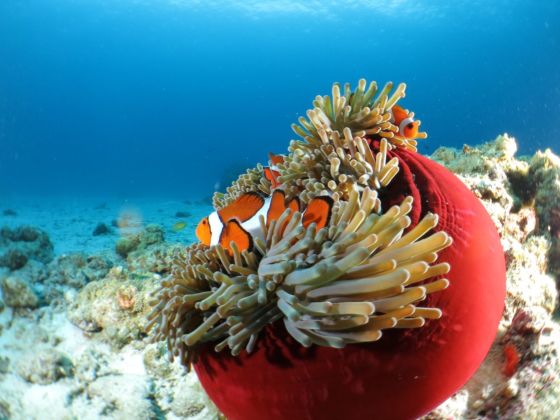
Clownfish PNG

Photo above: petersbar / All other photos: Author

Christina Koukkos reports from a sponsored dive trip to the multi-island nation.

AS A REGULAR DIVER, I know what PNG means: pristine reef, giant schools unaccustomed to divers’ bubbles, an armada of World War II wrecks, and creatures ranging from two-meter hammerheads to two-millimeter pygmy seahorses.

When Matador asked if I’d be interested in joining a press trip there — organized by the PNG Tourism Board — I thought about it for a long, hard, 2.3 microseconds.

Gone Divin’ – Part I

From the capital of Port Moresby, I catch an Airlines PNG flight across the island to Tufi Dive Resort. Below us, the relentless green of the jungle is broken only by the occasional river and odd logging road, thin beige meanderings through the hills. The land ends, replaced with turquoise sea mounts that cut through the deep purple of the Bismark Sea.

I think, “People are diving down there.”

Seahorse, Tufi

On arrival at Tufi, my small group is greeted with smiles, fresh orange juice adorned with hot pink hibiscus flowers, and liability release forms. An hour later, we’re sucking air at 18 meters in the next fjord over. The staff clearly knows what we’re here to do.

The first day of diving is about small stuff: nudibranchs, mantis shrimp, a teeny flasher scorpionfish, a seahorse, and the endemic Papuan western clown fish. Nobody comes to Tufi specifically for the macrolife, however. We’re here for the sea mounts.

The second day we hit Mullaway, about an hour’s motorboat ride straight out to sea. The “we” is a group of five scuba diver girls — including the inimitable Scuba Diver Girls themselves. On the way out, we hold our fists to our heads, up above our ears. Praying for hammerheads.

We quickly gear up, drop in, and circle the sea mount counterclockwise. One of the first encounters is a remora — a cleaner fish often found hitching a ride on sharks. I point it out to my buddy and sign “Big fucking shark.”

It doesn’t take long. Curious grey reefs appear, giving us the eye. A 1.5-meter black-tip shark whips by, as do a few small white-tips. But no hammerhead.

I’m waiting my turn to take a photo of a bat ray tucked into an overhang when our dive guide starts banging on his tank. I shoot over and there it is: my first ever hammerhead! I pump my fists above my head and fin along behind it, shouting into my regulator…and chasing it away, like a total noob. I can’t help myself.

Other favorite sites over the next few days include Veales (similar to Mullaway, but with two hammerheads) and a newly christened dive site called The Overhang, with a cool swim-through.

In addition to sharks, Tufi diving features immaculate coral and giant schools: fusiliers, snappers, surgeonfish, and so on.

Kids at Garewa Guest House
Surface Interval

We spend our last night in the Tufi area at the Garewa Guest House, a few fjords over from the resort.

As our dive boat approaches the beach, we’re greeted by two-armed waves and welcoming smiles from Fabian, the jolly patriarch of the compound, and his extended family. His son, also Fabian, uses a machete to cut open a coconut for each of us to drink. His granddaughters have decorated our hut, which sits on a small palm-shaded bluff above the beach, with jungle flowers.

As night falls and the weather cools, outrigger canoes loaded with goods for trade float by on their long row to market. The rowers’ singing floats up from the dark water.

We pass the evening drinking Russian vodka, eating Australian gummy worms, and giggling over Tok Pisin, the English/German/whatever mashup that’s the national language. My favorite is the phrase “mixmaster blowjesus,” Tok Pisin for “helicopter.”

The following afternoon I’m back at the airstrip, headed to Walindi Plantation Resort, on the island of New Britain, for more diving. As I watch from a dusty, thatch-roofed waiting area, luggage is loaded into a prop plane by Archie and Alex, our group’s dive guides. The whole village has come to watch the takeoff; it’s must-see TV.

One boy, naked except for the snot oozing out his left nostril, stares at me. I smile. He does not. His eyes tell me I am a strange and potentially dangerous creature. The rest of the villagers keep a safer distance, behind a chain-link fence.

Colorful fish school
Gone Divin’ – Part II

While the resort at Tufi is decorated with carved masks and other local artifacts, Walindi’s restaurant is plastered with photos of sea creatures.

Tufi has a small collection of fish books tucked into a corner of its restaurant, while at Walindi a wall-sized, floor-to-ceiling bookshelf is packed with diving books and magazines. Each bungalow comes with maps and descriptions of area dive sites. The staff gives detailed dive briefings that seem to last as long as the dives themselves.

In short, Walindi Plantation Resort is serious about diving.

Imagine my surprise, then, when we don’t go diving immediately on arrival. We have to wait until tomorrow! The dive boat has already left, explains the manager. And the viz at the nearby sites isn’t great because it’s rainy season. “We want you to see our best diving,” she says.

Inglis makes up for the delay. It’s a sea mount on the edge of Kimbe Bay, about 45 minutes by speedboat from Walindi. Sure, it’s got pristine coral, which goes without saying in PNG. But also a half-dozen small white-tip sharks, a chevron barracuda or three, sleepy cuttlefish, and loads and loads of fish.

The kicker: Four male grey reefs circling a lone female in a mating dance — something I’ve never seen outside the National Geographic Channel. Oh…and did I mention the 30-meter visibility?

The unquestioned highlight of our last dive day is the Mitsubishi Zero Fighter wreck. In WWII, PNG was the scene of fierce battles between the Australians and Japanese. During one mission, the pilot of the Zero Fighter, running out of fuel, somehow guided his plane into a gentle crash landing just offshore, on a sandy bottom at 16 meters. He managed to escape into the jungle, where he disappeared; no one knows (or will admit) if he survived the war.

WWII dive wreck, PNG

Mitsubishi Zero Fighter wreck

Alive or dead, the Japanese pilot left behind a formula for a near-perfect plane wreck dive: start with the weightless, “I’m flying” feeling of diving; add a rowdy, fun-loving group of divers on a plane wreck; finish it off with three underwater cameras, and you’ve got the goofiest fun you’ll have underwater. Plus nudis!

Other favorite Walindi sites were South Emma, which has a wicked swim-through, and the aptly named Hanging Garden.

…Part III?

Tufi and Kimbe Bay are just two of many diving opportunities in PNG. At the top of my list the next time I finagle a trip there:

1. Milne Bay: On the southeast tip of New Guinea, Milne Bay is said to be the best macro diving in the country. I don’t believe it, though — the tourism board will just have to bring me back and prove it. Pretty please?

2. Loloata Island: Just 20km from Port Moresby, Loloata has plenty of wrecks to dive and a decent variety of macrolife. It’s a great alternative to staying in Port Moresby before your flight home. Just remember to end your last dive at least 18 hours before your flight!

Sunrise at Garewa

3. FeBrina liveaboard: This comfortable-looking liveaboard dive boat operates out of the Walindi Dive Resort. In addition to the sites in Kimbe Bay, divers on the FeBrina can reach the Witu Islands and the legendary Father’s Reefs. It’s how to go from remote to remote, squared.

Get out your wallet

Papua New Guinea ain’t cheap. Flights are expensive and there’s very little cheap accommodation outside of Port Moresby. Of course, there are always budget options if you know where to look.

Fly: Air Niugini runs regular flights to Port Moresby from Brisbane and Cairns, Australia, as well as from Singapore. There’s not much transportation infrastructure in PNG, so getting around means flying Airlines PNG.

Eat, Sleep, Dive: In Port Moresby, the Airways Hotel is a sleek, heavily fortified hotel within betel-nut spitting distance of the airport. The slightly outrageous $350/night room rate betrays its popularity with foreign workers in the oil and mining industries.

Pool at Tufi

Tufi Dive Resort is truly an escape — the only way in is by plane or by boat. The décor is lush and elegant, with cushioned wicker furniture, traditional carvings and Tapa cloth on the walls, and tropical landscaping around a small pool.

Bungalows start around $160 per person per night, including meals. Boat dives run about $60/tank. Packages are available.

Walindi Plantation Resort sits on 11 hectares of plantation land, right on Kimbe Bay. Starting at $160 per person during peak season, the traditional-style bungalows are spacious and comfortable…at least until 11pm, when the electricity (and ceiling fan) turns off, leaving you gasping in the thick, humid night air.

The meals, included in the room rate, are bigger yet not as refined as at Tufi. Peak-season dive packages offer boat dives for around $60/tank.

Community Connection

Read about how Surfers take “DIY foreign aid” to Papua New Guinea.

Diving
 

About The Author

Christina Koukkos

As a freelance writer Christina has published stories about topics as varied as eclipse-chasing for the New York Times and trekking in Myanmar for The Expeditioner. At the moment she is repurposing her hard-earned apartment downpayment, instead using it for an open-ended, round-the-world jaunt. You can follow her adventures at The Range Life.

  • Jeff

    Wow – that flighter wreck is amazing…and so is that sunset. As an avid diver I’m definitely putting this trip at the top of my list for 2011.

  • Tatiana Prisco

    Mixmaster blowjesus… really? I think I’m taking up Tok Pisin. Think they’ll teach that at Santa Monica College??

    • http://matadortrips.com/ Hal Amen

      My thoughts exactly, Tatiana. :)

      Great piece, Christina. I’d love to make it to PNG, whatever the cost.

  • http://www.worldcurioustraveler.wordpress.com Mary R

    I appreciate how your article supplies so much fantastic information. Where to dive, where to stay, etc… I don’t have a dive cert, but you’ve inspired me to consider getting it while I’m still living in a beachy location.

  • http://therangelife.wordpress.com Christina Koukkos

    Thanks Mary.

    More and more people are getting certified to dive. Join us!

    I’m a giant fan of space tourism (I would like to retire to the moon some day) but in the meantime, under water is the least explored and (to me) most exciting places on the planet.

  • http://brinkofsomethingelse.com Camden Luxford

    Oh man, I wanna go.

  • http://www.sophiesworld.net Sophie

    Inspiring and useful article! Scubadiving PNG looks very tempting – not least for a close-up with that lovely sea horse.

  • http://sleepinginthemountains.blogspot.com Tim Patterson

    Mixmaster Blowjesus….wow.

    • http://therangelife.wordpress.com Christina Koukkos

      Yeah, the language evokes a certain coming-to-terms with the technology that colonists brought with them. It’s a mashup not only of languages, but also of colonial languages and traditional beliefs and culture (including the work of early missionaries).

  • http://andyhayes.com Andy Hayes

    Great piece – though the pics really close the deal for me. Group diving trip? :)

    • http://brinkofsomethingelse.com Camden Luxford

      I’m in! Now we just need Matador to organise another press trip….

  • ross

    PNG has ben on my list for a while but this seals the deal. It’s a big trip and I’d like to spend a while there…2012, it’s on.

  • http://www.papuanewguinea.travel Laura Matar

    Wicked article Christina – such a great account of some glorious adventure filled days in PNG! If anyone out there is interested in packages to PNG let me know and I’ll point you in the right direction!

    Tenkyu Tru!

  • Kelly Kraaimoore

    Great article. I was not aware of all of the diving possibilities in PNG. I lived there before the days of internet, so information was so hard to come by. I am definitely going back and checking out much more of PNG’s reefs and marine life. Thanks for the info.

  • http://travelmedianinja.com joshywashington

    That’s it! i am getting certified! Although the cold, dark waters of the Pacific Northwest seem a bit menacing…

  • http://lifesfast.wordpress.com Eric Warren

    First hammerhead! Amazing. Thanks for the information. This article makes a trip like that seem, almost, easy. I can’t wait to swim with the sharks!
    The descriptions are so visceral–I’m excited to read a space-tourism article by you, Christina.
    -Eric

    • http://therangelife.wordpress.com Christina Koukkos

      Thanks Eric!

      As for space tourism – this is the year! Or really, 2012 is the year. Lots of exciting stuff happening there.

      And once that’s done – I’m off to the 27th dimension! Heh heh.

Diving →

Must-see-before-I-die list of underwater fauna, with tips on how to get it done.

Diving →

Here are three wreck sites Down Under you can dive right now.

Diving →

These schools of technical diving should get you primed for big adventure.

Galleries →

What the Great Lakes lack in coral reefs and colorful fish, they make up in sunken ships.

Diving →

The Great Lakes contain some of the best-preserved shipwrecks in the world. They'll need...

Diving →

Diving with great white sharks in Australia's North Neptune Islands.

Diving →

The breath-hold Buddha shows off his skills by free diving a flooded cave.

Consciousness →

Jonny Finity offers some tips to help travelers dive deeper.

Diving →

Sunken schooners, frozen lakes, seaweed forests - you won't find this in the Caribbean.

Diving →

Your Hawaiian trip can come to a screeching halt if you're zapped, poked, or eaten by sea...

Diving →

Here's a rundown of well-known, unknown, unique, and unexpected dive destinations around...