Unless you travel like Ryan Bingham in Up In The Air, free airline upgrades are becoming a myth. Just ask anyone who’s tried to clear one on a long-haul flight lately. Every airline, from full-service to ultra-low-cost, is redesigning itself around the idea that comfort is something you buy back, rather than something you’re rewarded with. For all the blogs and sites that break down travel rewards points and programs, the bottom line is that year over year, your points are worth less — and that business class upgrade gets further away.

Photo: Cavan-Images/Shutterstock
Travel Rewards Are Getting Worse. Here’s the Airline Miles Strategy I Use Instead.
Subscribe to Matador Network’s
Free Insider Travel Substack
If you’re only flying a couple of times a year, none of this matters much. Buy the cheapest fare, pocket whatever points fall out, move on. But if you’re in the air at least once a month, you’re accumulating enough volume that which program you’re loyal to, and how consistently you stick to it, determines whether you’re getting any actual value. As a travel editor, I’ve become rather familiar with points programs and have tried various credit card schemes in search of the truest hack. My best play was applying for a new rewards card just before my daughter was born, paying the out-of-pocket costs for childbirth on that card, and, a few months later, using the sign-up bonus those costs earned me to take my newly grown family to Mexico for five days.

I call this one “First time in business class selfie.” Photo: Tim Wenger
But here’s what no one is telling you: Unless you travel constantly (upwards of 10 flight segments per month), there’s no need to trade points around or worry about stacking them up across the board.
The best thing you can do as a frequent, but not constant, traveler is to optimize your rewards through one airline program. That way, you’ll earn enough to get a free flight or hotel room a few times a year, and maybe even that coveted upgrade now and then. Though, don’t count on that too often. I’ve been a United MileagePlus member for a decade and just last month received my first-ever first class upgrade.
The steps are:
- Figure out which airline best services your home airport. If one airline uses your city as a hub, that’s your answer right there. If multiple do, consider which flies most frequently or economically to the places you go most. If you fly out of a smaller airport that isn’t a hub, find the hub best served by your airport and go with that airline.
- Join that airline’s rewards program and get its entry- or mid-level credit card, typically with an annual fee ranging from $0 to $150.
- Fly that airline (or its network partners) as exclusively as possible.
- Use most of your points at least once a year to get maximum value. Having 300,000 points sitting in your account is good for barstool conversation, but less practical for travel hacking than having earned and then actually used 300,000 points.
Why is that?
- Airlines frequently make changes to their programs, and points tend to devalue over time.
- Airline miles are generally worth more than hotel points. Airline miles average about 1.2 to 1.4 cents each, while hotel points average between 0.5 and 0.7 cents each.
- Airline reward programs tend to offer perks like credit toward hotel partners, rideshare apps, Global Entry, restaurants, and more. This added value easily offsets a $150 annual credit card fee.
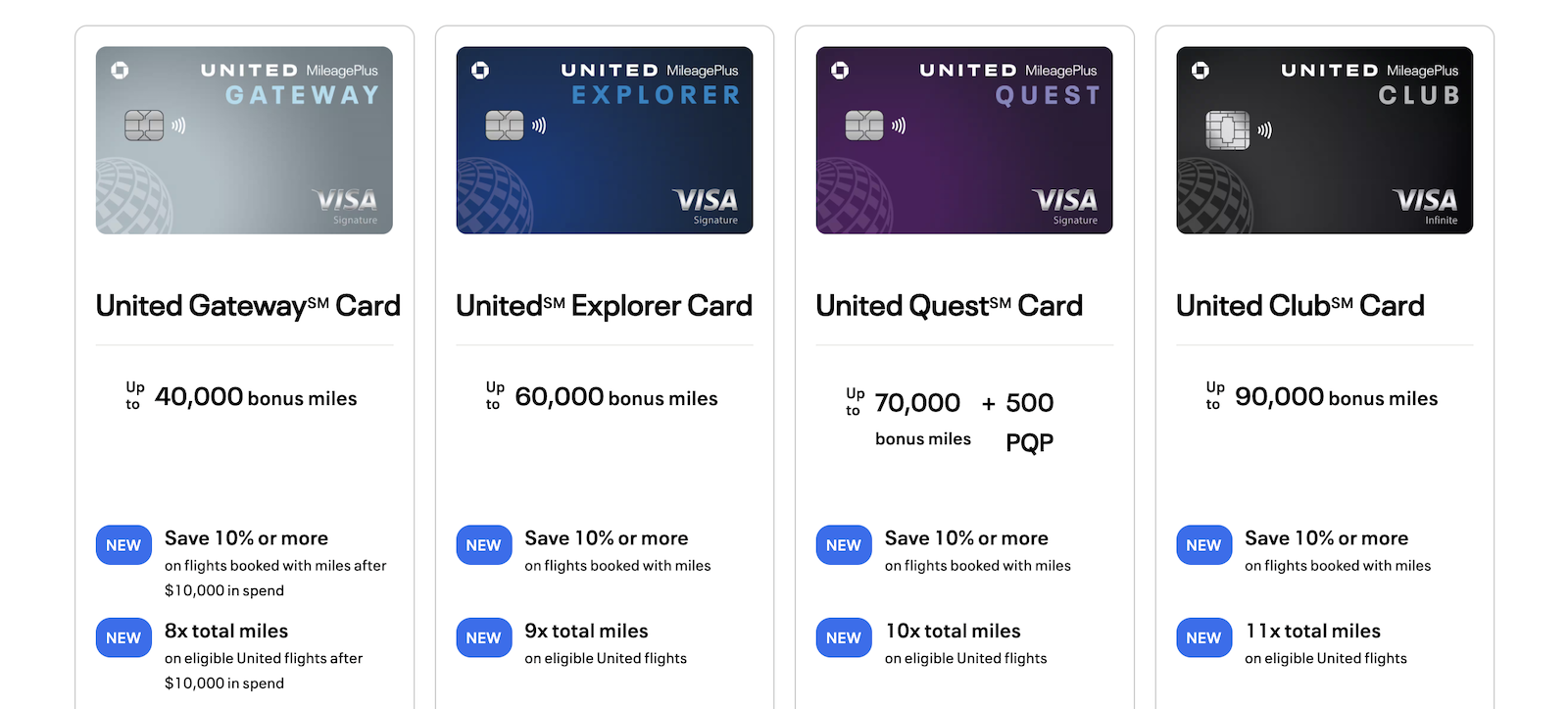
Screenshot from United’s Credit Card Page. Photo: United Airlines
My strategy goes something like this:
I live in Palisade, Colorado, and fly out of Grand Junction Regional Airport (GJT). Denver is a major United hub, and I joined MileagePlus when I used to live there. My general flight path is GJT-DEN-final destination, always on United or an international Star Alliance partner. This allows me to capitalize not only on the extensive list of destinations the airline flies to from Denver, but also to maximize the points I’m earning each time I fly. Tier status in United’s program is partly calculated on the number of “flight segments” you take (the total number of flights, rather than trips), so having that extra leg to and from Denver on each trip quickly raises that total.
If you fly at least once a month, you’ll generally accumulate enough points and status to make it worth always flying the same airline or network.
I hold the MileagePlus Explorer card and use it for most purchases above $20, including a lot of my monthly recurring bills. This adds at least a few thousand points to my total each month. I’ve earned as much as 15,000 in months with lots of travel and/or when spending more on things like restaurants that offer double or triple points per dollar spent. The card also nets me a free checked bag, priority boarding, and other travel-day perks including a couple lounge passes each year.
I accumulate about 150,000 United MileagePlus points per year. In dollar value, that’s about $1,500-$2,000 to spend on flights, offset rideshares, or use elsewhere.
Until earlier this year, I also had a Chase Sapphire Reserve card. For $550 per year, I took full advantage of Priority Pass membership and the ability to spend points on hotels rather than just flights. When that fee was raised to $795, I canceled the card and used up my points. Since then, I’ve doubled down on my strategy of optimizing United points.
Important note: I pay off the statement balance every month so no interest is accrued (this is incredibly important. It’s easy to get yourself into a hole if you don’t pay off your card each month, and that can offset any value you’re gaining).
Or, just get a travel credit card and get it for free. Photo: Idasamsiyah/Shutterstock
The benefits I get from following my strategy (and when I break it)
Because I’ve stayed almost entirely inside the United/Star Alliance ecosystem for a decade, I consistently hit Silver status each year (I may even reach Gold for 2027). A free checked bag (even when not booked with my card, as is the case with most of my work travel) and priority boarding don’t sound like much until you’ve paid for neither in years. Kinda chic to stroll into the United lounge a couple times a year, too.
Because I’m not splitting my spend across three airlines chasing whichever one has the flashiest sign-up bonus that month or the latest fare sale, I hit higher-value tiers of the program faster than I would by juggling multiple systems.
The clearest payoff came on a flight from San Francisco to Istanbul. I’d been stacking points to upgrade into business class on Turkish Airlines, a Star Alliance partner, for the long-haul leg. That’s a major difference in comfort for a fraction of what the seat costs in cash, and it only worked because I hadn’t been splitting my loyalty five ways. If I’d spread those same points across two or three programs chasing the best deal on each individual booking, I’d have had enough for nothing.
I only break my own rules in specific situations, like when a positioning flight or connection makes it geographically or financially absurd to stay in-network. If the only reasonable route to where I’m going runs through a partner-less international carrier, I’ll book it. Other than that, I’m flying Ol’ Blue.
See you at the gate, in line for Boarding Group 2. 
— Tim Wenger, editor