People in the United States usually only mention durian in the form of a punchline. It’s the spiky “King of Fruits” that’s banned on trains and in hotels thanks to a potent sulfur, sewage, rotting smell. The sweet-savory custard flavor that makes it so appealing despite the aroma is often forgotten in the viral videos and meme-ready headlines. So too is the multi-billion dollar (and growing) economy behind this fruit that sends massive shipments from Southeast Asia into China and around the world. The biggest oversight, however, is of the farmers and families who have built a life around durian.
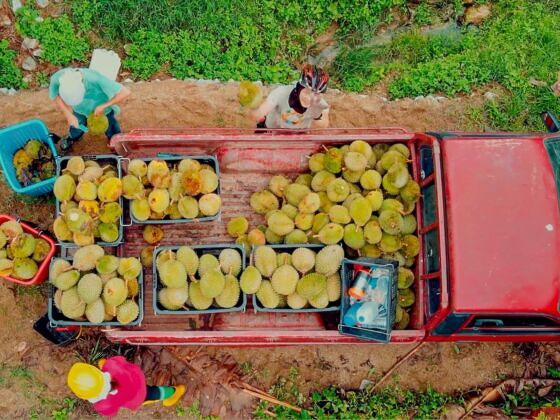
Photo: Ian Poh Jin Tze
Dodging the “King of Fruits”: Inside the Dangerous Durian Plantations of Raub, Malaysia
Ian Poh Jin Tze has spent years documenting the people and places behind Southeast Asia’s most iconic ingredients. In his book, “Behind The Scenes: Lives of These Unsung Heroes,” the Singapore-born freelance writer and photographer follows farmers, growers, and hospitality workers over five immersive journeys across the region. Where he points his lens is informed by a professional life spent largely on the road working for publications like Singapore Airlines’ SilverKris, Eater, Asian Food Network, Le Cordon Bleu, and more.
Photo: Ian Poh Jin Tze
The reality of what it takes to put durian on market shelves sunk in during a shoot with farmers in Malaysia and travels across Southeast Asia. A fruit suddenly dropped from the canopy and slammed into the ground inches from his boots in a way that “sent chills down my spine,” he says. The farmer next to him, however, did not even acknowledge the close call. This is daily life, after all, as jarring as it can be for a photographer shooting a fruit generally thought of as a curiosity.
It quickly became clear that durian is a part of the culture in this part of the world, one that “provokes conversation, sparks laughter, ignites debates, and binds people together.” Families tease one another over it. Friends plan gatherings around it. Communities orient their year around the rhythms of flowering, fruiting, and falling. To him, durian became “a thorn-covered thread stitching together stories, memories, and people.”

The author and photographer. Photo courtesy: Ian Poh Jin Tze
Here, an excerpt from “Behind The Scenes: Lives of These Unsung Heroes” about the dangerous world of durian farming in Raub, Malaysia.
The Untold Dangerous Tales of a Durian Farmer
Following Mr. Hou was like walking through a minefield. As we crossed his durian plantation in Raub, my only guidance of where to step – and where not to step – was the rhythmic BOOM set off by falling fruit. Durian trees can grow to a height of 40 metres and bear fruits as large as 30 by 15 centimetres, weighing several kilograms each. When the Boudica spike-covered fruit ripens, it launches from the tree with enough force to cause serious injury or even death to passersby below.
As my tractionless Timberlands performed mini burnouts in the muddy soil, I struggled down one of the steep hills, a procedure that felt like descending on a sinuous path from the summit of Mount Everest. It was early, and the sun had yet to puncture the darkest corners of the orchard, so I cautiously followed Mr. Hou into what appeared to be a deep, dark abyss. My ridiculous fluorescent-pink skydiving helmet, printed with the Disney character Stitch, seemed woefully inadequate to protect my skull from falling fruit. Prudence dictated that I turn back.
Then the light morning breeze shifted, giving me a whiff of the durians’ strong aroma, a notoriously stinky scent. The smell offered nearly as stern a warning to abandon the plantation as the sounds of the aerial bombardment – except it holds a special allure for those who have come to associate it with the intoxicating flavour of the fruit itself.
My gastronomic curiosity got the better of me.
In his own bike helmet, Mr. Hou seemed unbothered, as he collected fruit and effortlessly tossed it into a flimsy laundry basket, cobbled together with the straps of a backpack. He has spent three decades of his life tending this plantation with the help of his four-legged furry companions, who are good for chasing away the occasional boar but even better at providing company during his daily rounds of the orchard. A seasoned farmer, Mr. Hou doesn’t worry much about falling durians, instead concentrating his worrying on pests and diseases, such as canker or root rot, which could cost him 30 percent of his yield if they take hold in the plantation. Despite braving countless near misses on an almost daily basis, Mr. Hou has never sustained any durian-related injuries.
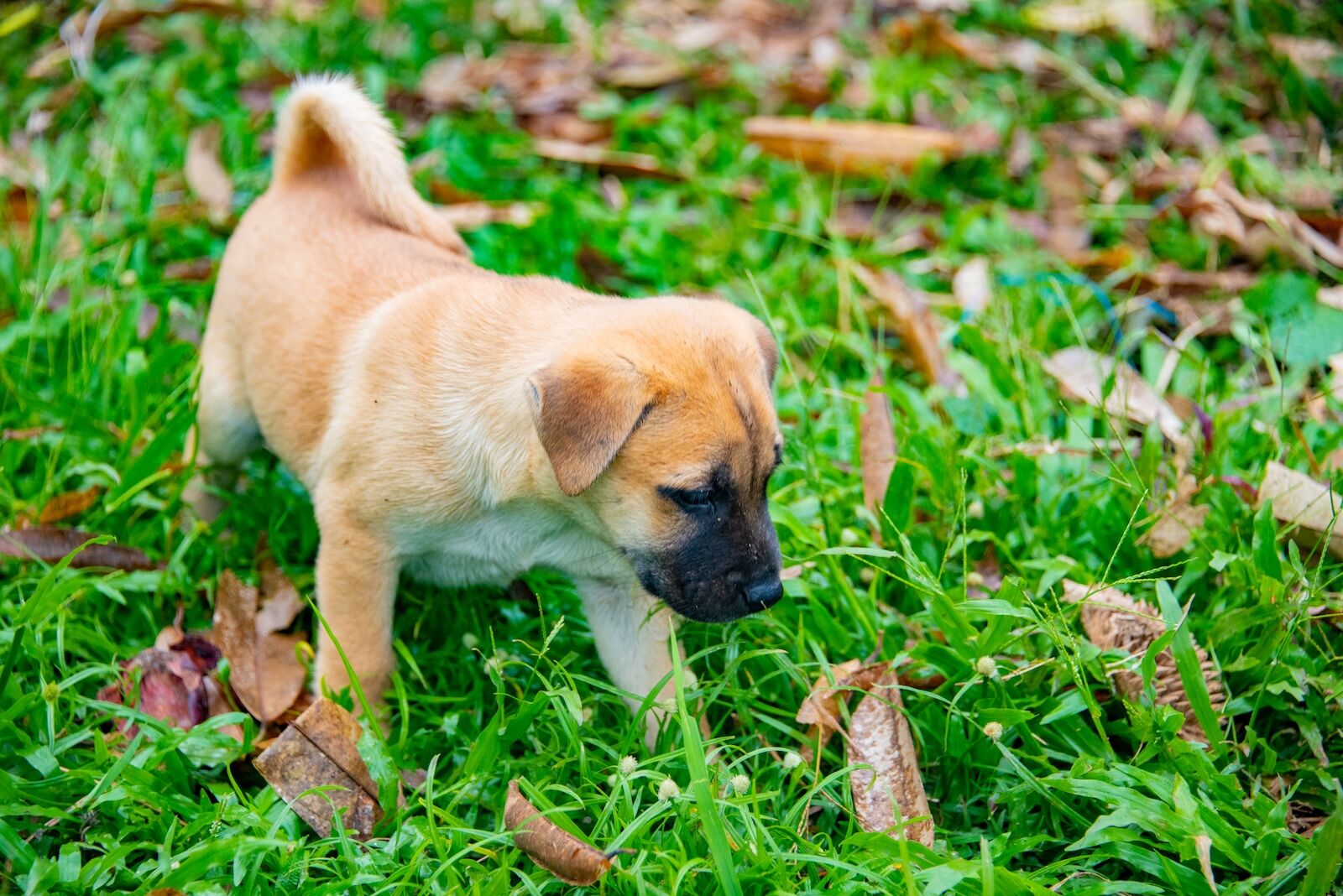
A farm dog smells near fallen durian. Photo: Ian Poh Jin Tze
I didn’t feel so lucky. ‘What am I doing here?’ I silently thought to myself, as I lost sight of Mr. Hou again and ventured deeper into the dark.
Even when they’re not threatening to dive bomb your head, durians are not easy fruits to get to know. Ubiquitous in Southeast Asia, the durian’s most distinguishing feature is its strong aroma. ‘Like pungent, runny French cheese’ is how chef Anthony Bourdain once described it. ‘Your breath will smell as if you’d been French kissing your dead grandmother.’
It doesn’t look particularly friendly either. The fruit is well protected by an intimidating thorny husk. Once you’ve sliced into it, the pale yellow flesh doesn’t appear appetising at first glance. ‘It looks like a human brain!’ exclaimed chef Gordon Ramsay on his encounter with the fruit in Sumatra.
The fruit is sold vacuum-packed or frozen in a feeble attempt to contain and minimise the smell. ‘However, the moment you open the packaging, you’re on your own’, says Nicky Koh, the owner of Koh Durian, a fruit processor.
The smell poses a notorious problem on public transit systems across Southeast Asia, which often ban the fruit altogether. It’s also a challenge for hotels, where staff have difficulty removing the scent, especially once it has made its way into the central ventilation system. It could take up to a week to completely remove the smell from an affected room.
Despite the smell, there’s plenty of affection for durian too, earning it the nickname: the King of Fruits. There are even fans among the people who have to deal with its worst consequences, like Fiona Chan, an experienced hotelier, who has a love-hate relationship with durian. She loves eating it, ‘BUT, not on our premises’, she clarifies.
‘It smells so good! It is my favourite!’ exclaims Abbie Chan, an avid durian lover and home baker, who makes durian mooncakes. (The popular Mid-Autumn Festival treats are typically filled with bean paste, but durian has been showing up as a filling more often in recent years.) ‘The smell usually lingers in the house for a few hours. Be sure to dispose of all the rubbish properly’, she advises. It’s a good idea to have an extremely well-ventilated kitchen too.
The culinary uses of the fruit are endless, especially since the fruit loses much of its controversial scent when used in curries, yielding an enigmatic flavour that causes plenty of debate of its own; connoisseurs can’t seem to decide whether it’s sour, salty or fruity, but they can all agree it’s spicy.
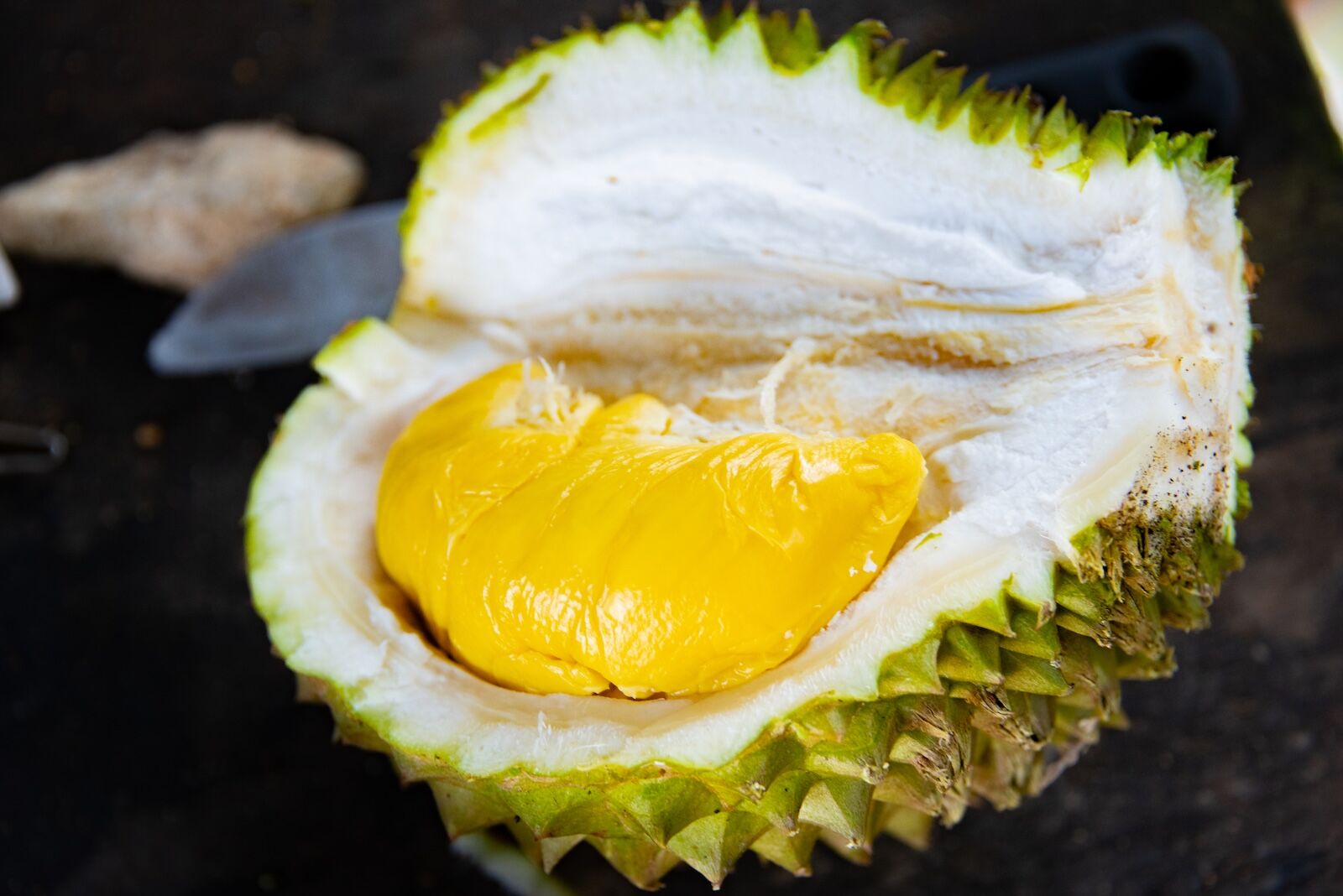
Photo: Ian Poh Jin Tze
Experts at the Raffles Health Group in Singapore have also highlighted durian’s health benefits, such as improved mood and sleep quality, reinforced immunity (thanks to the fruit’s rich stores of vitamin C) and improved digestion. They also note the fruit is considered a ‘heaty’ food in Chinese culture, believed to warm and improve circulation, stimulating the body. (The Raffles team does note that durian is high in sugar and calories, and when consumed excessively, it may cause sore throats, acne or even a fever.)
No matter your exact motivations for first eating durian, if you manage to venture beyond the fruit’s strong aroma and acquire a taste for its unique flavour, it’s hard to resist its attraction from then on. It’s a taste you fall in love with.
I’m one of the people who has fallen for durian (even when it tries to fall on me). I have fond memories growing up with the fruit, which came to my family in Singapore from plantations just like Mr. Hou’s in the heart of Malaysia. In a toned down version of a traditional Chinese family gathering, I would sit on the floor with my prize, a thorny fruit resting upon old newspapers. My father, looking like Rambo, would crack the husks with a huge knife, releasing the aroma from its thorny jail, much to my joy and my brother’s absolute ennui and despair. As my parents and I viciously descended on the creamy yellow fruit, we were oblivious to the realities of the plantation that it came from.
With Mr. Hou, I got a literal crash course in durian. As I came down the hill, I caught a glimpse of his silhouette rapidly disappearing through a steep band of rock. I hurried to catch up, when I stepped on a chunk of loose soil and plunged down a mixture of wet mud and rotting durian husks at a terrifying speed. Whilst unintentionally cutting the shortest way down a durian hill, I found myself with a choice: I could grab the nearest pillar The aerial shot of Raub, a district in the state of Pahang scattered with durian plantations of support, a tree bountiful with ripe durians, and risk getting showered with spiky fruit. Or I could continue my dizzying rodeo down the hill and pray not to slide groin-first into the spiky husk of a fallen durian. I closed my legs and unsuccessfully attempted to steer myself towards Mr. Hou, whose eyes bulged at the human bowling ball thundering towards him.
As I came to a stop, I found I had survived my treacherous downhill journey with nothing more than a mud bath and a bruised ego. (Perhaps my luck was better than expected.) I gingerly picked myself out of the remnants of the morning harvest. Wearing the musky smell of damp soil as cologne, I climbed into Mr. Hou’s pickup truck and headed towards the entrance of the estate.
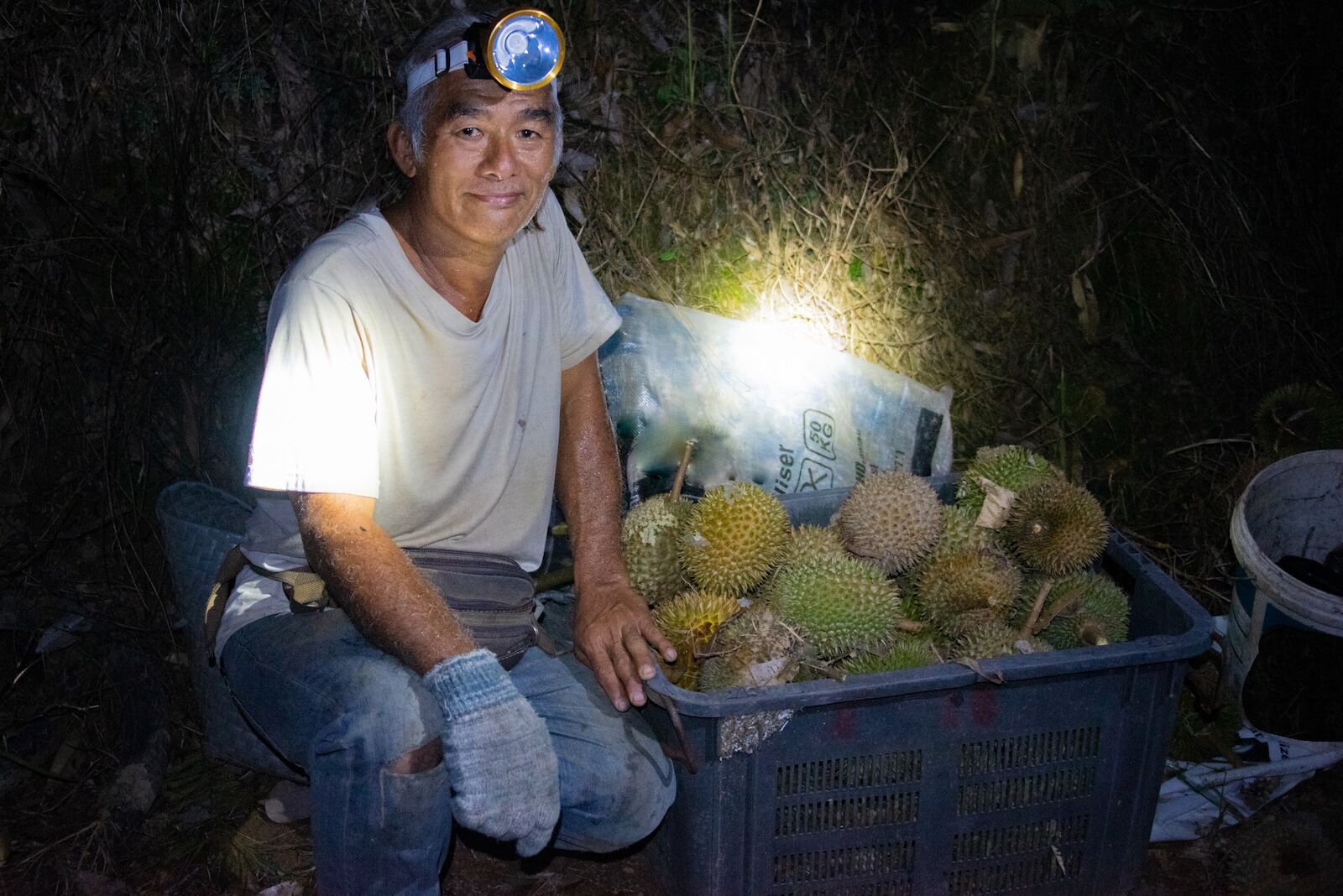
Photo: Ian Poh Jin Tze
After exiting the plantation, we found a middleman stationed by a makeshift table along the dusty roadside, sorting fruits from an endless flow of farmers in similar pickups. Buyers assess durians by variety, size, quality and number of bruises, assigning a grade of A, B or C. An absolute hive of activity surrounded the middleman as he weighed the fruits and transferred them to his truck, which takes the durians to fruit processing facilities like Koh.
Upon arrival at Koh’s facility, the fruits are cleaned with a high pressure air-gun and de-husked. The team then sorts them by grade and variety, places them into endless racks of plastic containers and freezes them at arctic temperatures (-30 degrees Celsius) for 24 hours, before packing them into sealed bags, preserving their freshness and aroma.
The fruit then makes its way to supermarkets, where it’s priced according to weight and variety. Processors like Koh tend to break down lower graded durians into a paste, which is used among both professional and home chefs as an enhancement in beverages and desserts.
Business is booming. According to the Malaysian Agriculture Department, approximately 377,251 metric tonnes of fruit was produced in 2019, the most by weight of any fruit in the country. Khalid Ibrahim, marketing and export division secretary of the Ministry of Agriculture and Food Industries, says annual national durian production is expected to increase to 443,000 metric tonnes by 2030.
Many varieties of durian have surfaced over the last couple years, most known simply by numbers like D24, D88, and D2 (along with a wild forest variety). Then there’s the Musang King, a variety originally discovered in Kelantan in northeast Peninsular Malaysia in the 1980s, which was grafted to trees in Raub and rebranded. It’s one of the most renowned for its extremely creamy texture and bittersweet taste, and it commands a premium price. Mr. Hou maintains a variety of pre-existing durian species in his plantation for income in the immediate future, but he’s increasingly planting Musang King trees. Today, the prized variety makes up 50 percent of his fruit.
Koh says there was actually a substantial drop in domestic demand during the COVID-19 pandemic, which brought dining restrictions at restaurants that would normally order lots of durian. The dip was short-lived, and demand has rebounded to some extent. At the same time, Koh has seen an increase in demand abroad, especially in China. He exported approximately 80 metric tonnes of durian pulp to China in 2022.
Mr. Hou is also optimistic about the future of durian farmers given the ever-growing demand from China, especially for the Musang King variety. Limited production among durian farms, including for popular varieties, has allowed the farmers to demand high prices. According to Koh, there are 40 durian processing facilities across Malaysia certified with Good Manufacturing Practices (GMP), and only half of those have a licence to export.
China’s not the only one. Since 2014, a regional market has been growing for Malaysian durian, with plants exporting fruit to Vietnam, Singapore and Hong Kong. Initially, most exports consisted of durian paste, but in the last few years, consumers have increasingly preferred whole fruits. However, inflated demand has pressured plants to prioritise paste; in the early days, fruits graded A and B would be sold as a fresh fruit in the market, but today even those grades are processed into pulp, which now makes up 30 percent of harvested fruit.
That increased demand convinced Koh to become a fruit processor, and it’s fueling the rest of the industry these days too.
That evening, I stood at the entrance of another durian plantation. I cast a wary eye at an 80-year-old durian tree, the oldest on the three-generation plantation, the limbs heavy with durians threatening to fall towards earth. This would have delighted plantation owner Mr. Yap, but the possibility sent shivers down my spine.
‘Don’t worry. Durians have eyes!’ teased Mr. Yap, wearing only a head-mounted torch light and a cheeky grin to protect himself. Seconds later, a durian dropped only a few feet away. ‘Told you’, he said, as he slung a well-seasoned rattan basket over his shoulder.
As we ventured deeper into the night, the durians faded into the approaching darkness, but their unmistakable scent and terrifying BOOM remained constant.
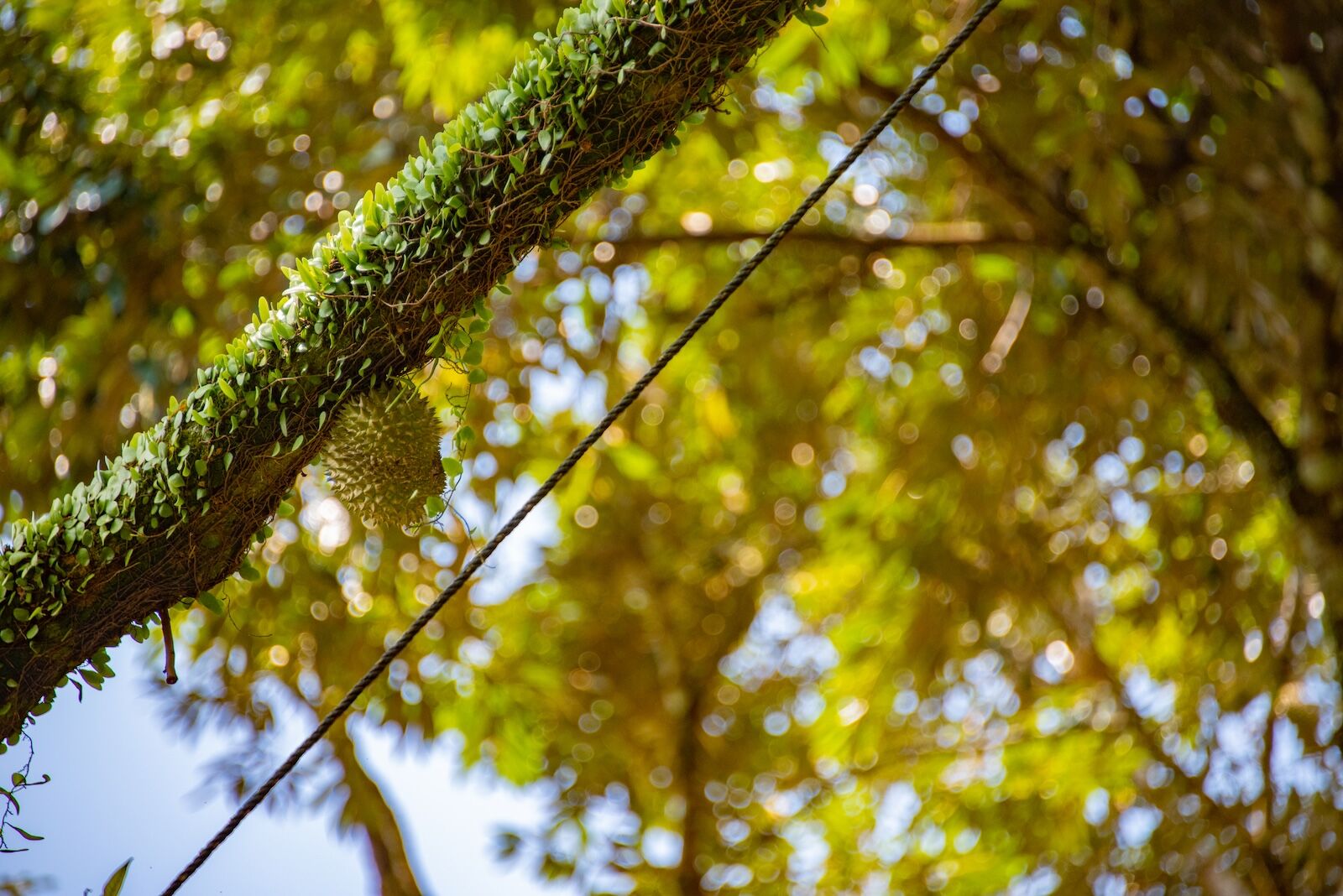
Photo: Ian Poh Jin Tze
Unlike Mr. Hou, Mr. Yap employs netting, installed just above eye level. The net catches the falling fruit, preventing it from hitting the ground and bruising (though it wouldn’t stop the fruit from crashing into your head if you were crouching just below, like I was). It also keeps it out of the mouths of Mr. Yap’s biggest enemy: wild boars. Mr. Yap also uses string to secure the prized Musang King fruits to their trees; when they fall from their branches, they hang menacingly overhead, sharing an uncanny resemblance to guillotines.
After filling his basket to the brim with durians, Mr. Yap placed the fruits in a larger basket at a collection point, which he covered with a used fertiliser bag at the end of the evening to protect the fruit from the boars. According to Mr. Yap, the creatures have good taste, showing a real preference for the Musang King over the D24. Using nothing but their snout, they can penetrate the thorny husk and savour the fruit and seed whole. They can also get aggressive on occasion, so Mr. Yap carries a registered pistol, making him look a bit like a cowboy in his washed out jeans and seasoned T-shirt.
As I ventured into the abysmal darkness of the night, I embraced the fleeting moments of ephemeral relief whenever I successfully threaded around a downpour of fruits and avoided random boar attacks. Like the durian fruit itself, I needed to pierce the prickly surface surrounding durian farming. Feigning ignorance to the invisible threats around me, I remembered the reason why I was even here: to discover the origins of a fruit that had been my favourite since childhood. The smell masked my fear and beckoned me.
Excerpted from Behind The Scenes: Lives of These Unsung Heroes by Ian Poh Jin Tze. Copyright © 2023 Ian Poh Jin Tze. Reprinted with permission from Ian Poh Jin Tze. All rights reserved. 