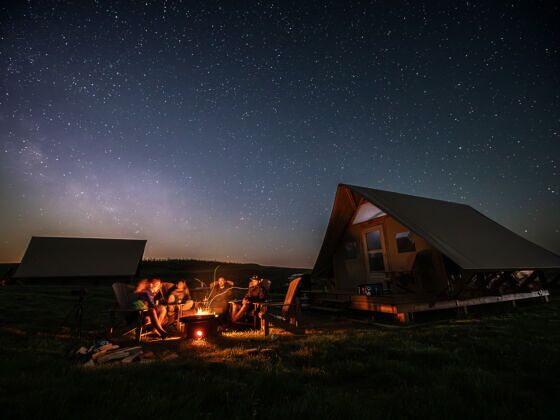

The vast, clear skies of the prairies of Saskatchewan act as an open invitation for the stars to come out, dazzle, and delight. But it’d be false advertising to say a magnificent astro-show is guaranteed. Nothing in nature is 100% — celestial or terrestrial — so keeping a flexible mind and schedule will make any stargazing experience richer and more enjoyable. Read on for tips to up your chances of a stellar Saskatchewan trip.
HOW TO PREPARE
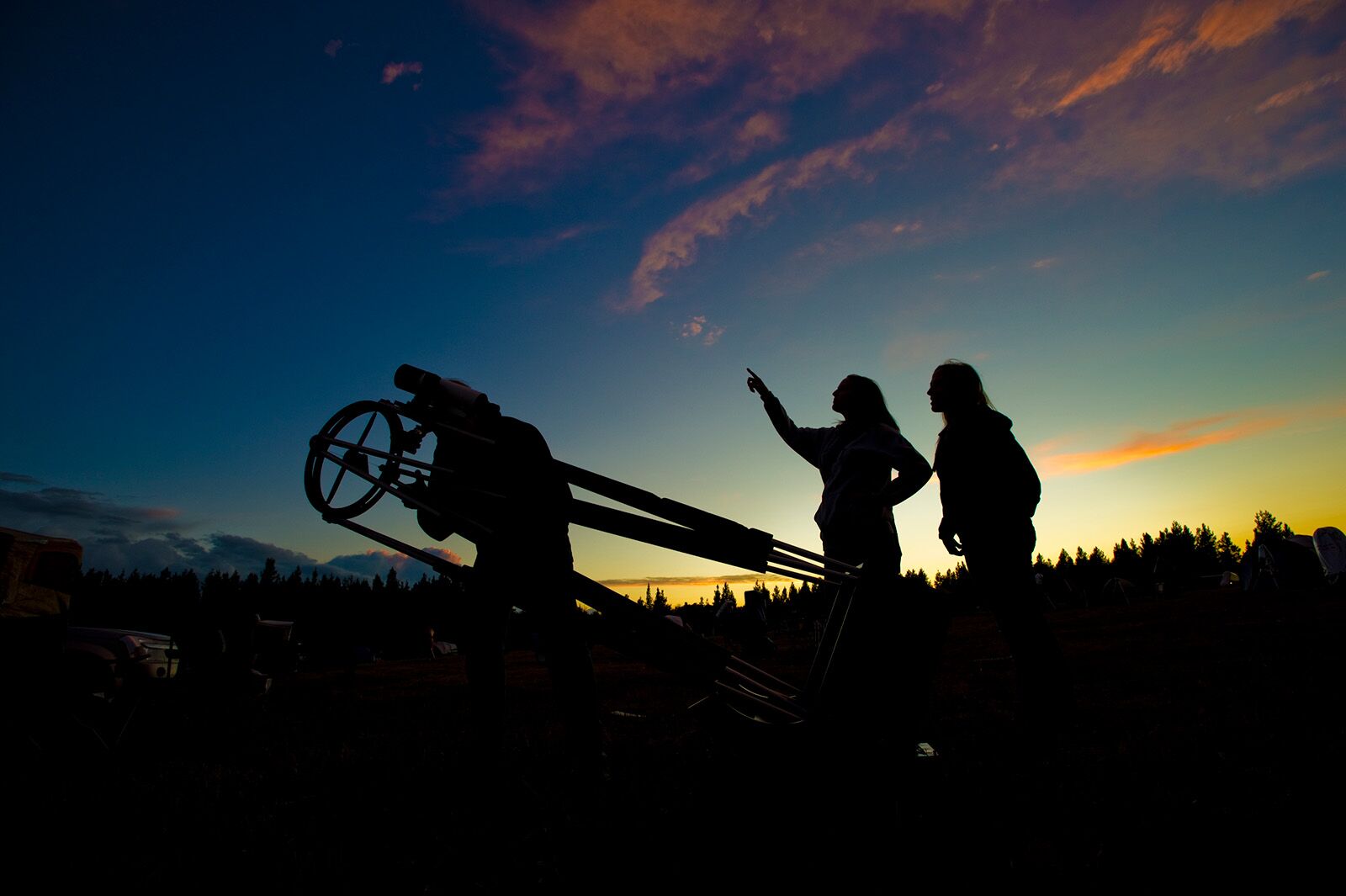
Photo: Paul Austring/Tourism Saskatchewan
Plan as much as you can…
A little research goes a long way when it comes to organizing stargazing trips. Specifically, you’ll want to keep an eye on conditions — weather factors like cloud cover, precipitation potential, and haze can affect what you’ll be able to see. Checking moon phases can also help you choose the best nights for visibility (when the moon is up and larger than a crescent, its light can really wash out the stars).
…then pad your dates to be safe.
Conditions can change; forecasts can be wrong. If possible, plan to stay in your stargazing location for several days to increase your chances of a cloudless, unhazy night sky. Building in extra time also lets you explore the surrounding landscapes at a more relaxed pace, which is part of what makes stargazing in Saskatchewan so rewarding.
Equip yourself for safety and comfort.
Winter nights see the clearest skies in Saskatchewan (and last the longest), but winter temperatures can be extreme. You’ll need to pack carefully — think serious cold-weather clothes and a winterized car. You should also note that, even when it’s cold and clear, strong winds can make it difficult to use telescopes or cameras, and wind changes can impact visibility. Sudden and dramatic weather shifts aren’t uncommon, so it’s always a good idea to check the hourly forecast right before heading out.
Find the right tempo.
Stargazing and astrotourism are about slowing down. Keep a leisurely pace by camping in comfortable, low-impact facilities, whether you bring a tent or glamp at a Parks Canada oTENTik. Taking it easy will help you feel the relationship between the celestial and terrestrial, the connection between earth and night sky.
Commit to a good time…even if the skies are cloudy.
Cloud cover and other unfavorable conditions are always a possibility, but a stargazing trip doesn’t have to hinge on a perfectly clear sky. Wherever you go, remember to look around — not just up — and you’ll find plenty of natural wonders to keep you occupied and entertained, from nature hikes and wildlife watching to appreciating the silence and stillness of the prairie.
WHERE TO GO
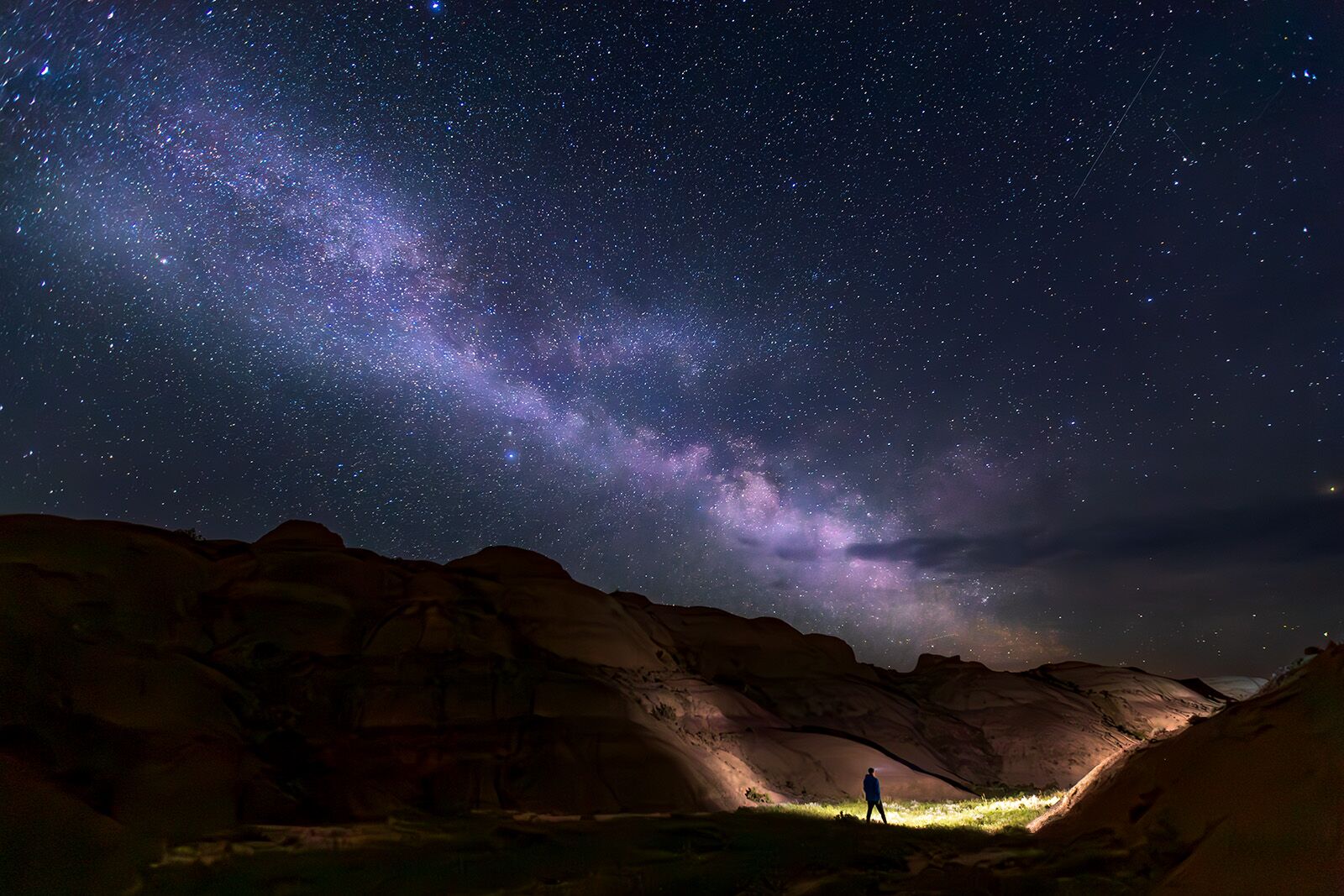
Photo: Benjamin Hutton Photography/Tourism Saskatchewan
Start with one of Western Canada’s finest stargazing centers.
Begin your astro adventures in a place designed to make celestial discovery accessible to everyone. In the town of Eastend, near the province’s southwestern corner, the Wilkinson Memorial Observatory ranks among Saskatchewan’s top public observatories. A local astronomy enthusiast named Jack Wilkinson connected Eastenders with the night sky in 1949, building and sharing an eight-inch reflector telescope with the community — hence the observatory’s name. The gear found there today is more sophisticated, including a large and powerful Celestron Ultima telescope that, together with enhancing filters and a tracking system, allows stargazers to spot not just celestial bodies but details as granular as the gaps between Saturn’s rings.
The Wilkinson Memorial Observatory operates seasonally, roughly between May and September. When the observatory is open, volunteers from the Eastend Astronomy Club lead sky tours both during the day and at night. You can also catch events like an astronomy presentation or astrophotography workshop.
Venture into Saskatchewan’s dark-sky icons.
Grasslands National Park and Cypress Hills Interprovincial Park are the big names when it comes to Saskatchewan’s dark skies. Both provide excellent demonstrations of how life is intrinsically linked to the stars, with their flora and fauna relying on shifts in daylight and nightfall to germinate, migrate, feed, and carry out their most essential behaviors. That means both parks also have plenty to offer beyond stargazing if conditions aren’t cooperating.
Collectively home to hundreds of bird species, these parks are among the best places to experience sound bathing. Ornithologists who’ve measured the auditory horizon in Grasslands National Park say it stretches 12, 16, sometimes 24 kilometers (8, 10, 15 miles) in every direction. Imagine bathing in the calls of ring-necked pheasants, burrowing owls, long-billed curlews, ferruginous hawks, whooping cranes, lark buntings, chestnut-collared longspurs, western meadowlarks, and more — not a cacophony but a symphony of chirps that all fit together. (Pro tip: Visit a lekking ground on an early spring morning to see sharp-tailed grouse perform their mating dance. The males stamp, whirl, and strut in perfect synchronicity, their tails pointed to the sky, while the females look on like judges from Dancing with the Stars.)
Grasslands’ earthly wonders include striking badlands and a unique mixed-grass prairie made up of more than 70 different grass species. The park is home to 30-plus at-risk animal species, many not found in other Canadian national parks. White-tailed deer and badgers run through tall grass. Swift foxes roam. Bison, reintroduced in 2005, cast stunning silhouettes against the horizon — between 300 and 500 of these ecological engineers now call Grasslands home, their grazing keeping the prairie healthy.
When the sun comes out, so do the park’s black-tailed prairie dog colonies. You can spot them along the 20-kilometre (12-mile) Ecotour Scenic Drive and in the Frenchman River Valley. (Make sure to keep a safe distance from these and all wildlife when driving and hiking in the park.) There are spectacular hiking trails, both short and sweet treks like the Rock Creek Trail in the East Block (the entry point to a series of other trails) and more adventurous and challenging options like the exhilarating Valley of the 1000 Devils Trail. Fun fact: You can also see dinosaur fossils in the East Block that offer a window into Saskatchewan’s distant past.
Cypress Hills has marvelous hiking as well. The area was once a giant plateau surrounded by glaciers, and elevation hikes and tours take you through a mixed-forest ecosystem. Trails wind past lodgepole pine, trembling aspen, and stands of spruce, opening onto views you won’t find elsewhere on the prairies. Split your time between the Centre Block — where, in addition to an observatory, there are hiking trails and amenities like serviced campgrounds and an outdoor swimming pool — and the West Block. You’ll find far fewer amenities in the latter but plenty of great backcountry trails and camping opportunities — plus the darkest skies around.
Carry on exploring the province’s extraordinary landscapes.
Beyond the parks and observation centers, there’s a lot worth seeing in Saskatchewan between stargazing sessions. You can explore the desert-like Great Sand Hills, which stretch across some 1,900 square kilometers (733 square miles). These are some of Canada’s largest — and most climbable — sand dunes, and you’ll find ample opportunities for birdwatching and spotting wildlife like antelope and mule deer.
Across the province, near Saskatchewan’s eastern border, Duck Mountain Provincial Park is replete with well-stocked lakes for fishing, paddling on pristine waters, and enjoying the quiet wilderness. Farther north, Prince Albert National Park is a wealth of adventure — think hiking, mountain biking, SUPing, canoeing, and camping. You get the picture. Saskatchewan is big, bold, and beautiful, whether or not the skies are clear.
The moral of the story? Plan a flexible stargazing trip in Saskatchewan, keep an open mind, and no matter what happens you’re guaranteed the experience of a lifetime. 