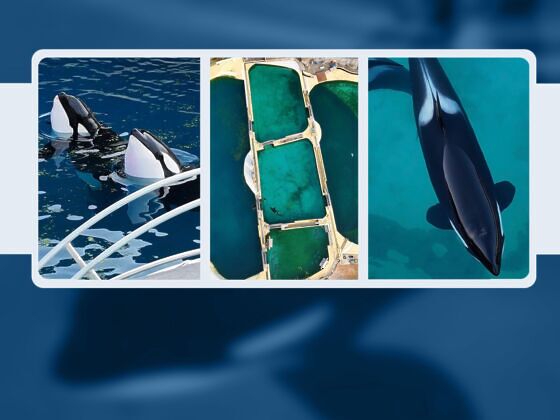
Photos: Seph Lawless

Meet the Man Using Drones to Expose France’s Forgotten Whales at a Shuttered Water Park

France Activism
by Tim Wenger Nov 7, 2025

Videographer Seph Lawless narrowly escaped arrest twice in the past month, in two countries on separate continents. While the circumstances varied – one was a traffic checkpoint in Argentina, the other on foot in France – both incidents occurred for the same reason: Lawless was using his videos as a voice for animal welfare.

In France, Lawless was wrapping up a session flying his drone over the abandoned Marineland theme park, where a pair of orcas are currently stuck, helpless, in unsanitary conditions following the park’s forced closure. Through live footage from his drone he could see security and police forces heading from the park toward where he hid on small 4×4 vehicles, getting closer and closer. He quickly pulled his drone back, grabbed his backpack, and hoofed it to a busy thoroughfare nearby where he could blend into the foot traffic.

Then, one of the 4×4 vehicles rounded a corner, and the eyes of its driver fixed right on him. He ducked into a restaurant and hurriedly asked for a table as the police approached.

“The cop has his hand on my hand holding the drone, and said ‘drone, you know,’ and this is broken English,” Lawless tells me over a call. “And I’m just like resisting it, pulled away, started running towards the hotel.”

Across the street, from his third-story hotel window, he watched as the police entered the lobby and approached the front desk.

“I actually went down to the second floor and jumped off the side fire escape because the lower levels had no way to get out,” Lawless says.

This stressful moment is all part of an effort to expose the orcas’ suffering and their declining health. Lawless has become the whales’ public voice, documenting their plight on social media and advocating for their safe transfer. A bit of trespassing in order to do so, he says, is a risk worth taking.

How Seph Lawless is advocating for whales suffering in captivity


View this post on Instagram


A post shared by Seph Lawless (@sephlawless)


On January 5, 2025, Marineland Antibes, one of Europe’s largest marine-parks and formerly the biggest in France specialising in cetacean shows, shut its doors for good. The reason: French legislation enacted in 2021 prohibited live performances using whales and dolphins, setting the deadline for such shows to end by December 2026. The park’s management cited falling visitor numbers, down from 1.2 million to 425,000 over recent years, as well as the inability to continue public shows, which accounted for about 90 percent of their audience, for the premature closure. While the closure represented a notable shift in France’s approach to captive marine mammals, it left vast numbers of animals, around 4,000 across some 150 species, facing uncertain futures.

Lawless flies his drone over parks like Marineland to expose the conditions of these animals. While he’s not the only one to do so, his high-level proficiency at capturing journalistic drone footage is the highest-quality of anything documenting the situation at Marineland. Marine biologists have praised the close-up shots, which allow them to assess the whales’ skin condition and overall health.

The public has taken notice – Lawless’ Instagram posts documenting the whales at Marineland routinely top 1 million engagements, with shares and comments driving them into the heart of the platform’s algorithm. The animals at Marineland, in Argentina, and elsewhere are suffering — but their hope may lie in this viral reach. With enough pressure, Lawless hopes the French government, Marineland’s owners, and animal advocates can find a humane and sensible solution to rehouse the orcas.

In the aftermath of the closure, the most urgent concern lies with the captive cetaceans, Wikie and her son Keijo, along with twelve bottlenose dolphins that Lawless noted had been removed from the site by the time of his most recent visit, and he isn’t sure where they are. With no definitive relocation plan in place, the animals remain confined in aging, deteriorating tanks. Lawless’ footage shows algae-filled pools and cracked infrastructure.

What the future could hold for the whales


View this post on Instagram


A post shared by Seph Lawless (@sephlawless)


“There are four options being considered,” Lawless says. “One is one that I’ve been advocating for, the Whale Sanctuary Project in Nova Scotia has been doing this as well. It’s a seaside sanctuary, like a sectioned-off pen in the sea where they can be kind of cared for but have that sense of freedom.”

To make that happen for the whales at Marineland, however, requires the consent of five adjacent land owners. Only two have signed on, and Lawless notes it seems unlikely the rest will. Another issue is financing this escape – Lawless says it will cost millions to transport the whales to Nova Scotia, build an in-sea enclosure to help them acclimate living in the wild, and hire marine biologists to monitor their health and well-being.

An easier option is to set the whales free in the ocean and hope for the best. Lawless notes that releasing the whales would “probably be a risk.” The Marineland whales were born in captivity, and that’s all they’ve known. Releasing them creates the moral question of whether that would lead to a quick death in the wild, or offer a better quality of life.

Lawless says he can see both sides, but advocates that the relocation to Nova Scotia is the best option, as distant as its feasibility may seem. Other options include relocating the whales to a marine park in Spain, Japan, or Greece, at least temporarily until a permanent solution is found.

“My biggest concern now is I’m now afraid that they’re going to expedite and do something too quick and too foolish and put them at risk,” Lawless says.

In the end, Lawless’ goal is to use his art as activism, drawing attention to the plight of these animals. Given the virality of his social media posts – his recent drone footage of the whales at Marineland has accumulated more than 15 years of total watch time online – his work seems likely to pay off for marine life stuck at Marineland and other parks.

The public can help the orcas Wikie and Keijo by sharing and engaging with Lawless’ socia media posts, keeping them in the public eye and letting French government officials know they want a permanent solution for the whales. Signing petitions and contacting the French Ministry of Ecology and lawmakers can accelerate relocation decisions and ensure enforcement of animal welfare laws. Supporting the Whale Sanctuary Project (with the Nova Scotia option) and World Animal Protection through donations or volunteer work helps fund legal advocacy and sanctuary development.

Advocating for transfer to a genuine seaside sanctuary rather than another performance park is crucial, as is distinguishing between welfare-focused facilities and commercial attractions. Of course, refusing to visit theme parks that encapsulate animals should be a “travel 101” practice.

Lawless plans to continue his work and says he’ll return to Marineland again. He balked at being called the “drone artist” version of Banksy, but the moniker is somewhat relevant given his tendency to post up unannounced to record the harrowing conditions these animals are living in, and then spread that message around the world – often to the complete surprise of the perpetrators. They don’t know when he’ll show up next, or how red their hands will be as his drone flies overhead. With enough reach and pressure from his followers, the whales may finally see a light at the end of the tunnel.

Discover Matador

Save Bookmark

We use cookies for analytics tracking and advertising from our partners.

For more information read our privacy policy.