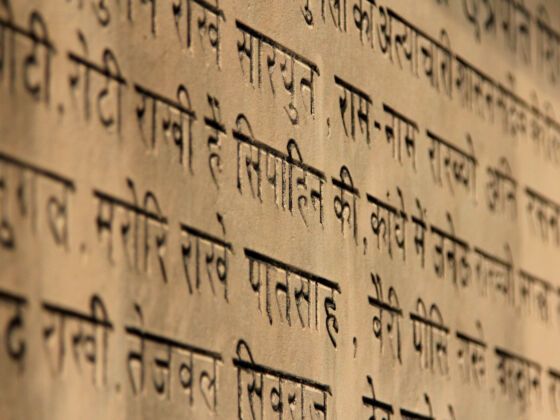
Feature Photo: romana klee Photo: tore_urnes

Linguistic analysis is not always politically correct.

Confusion over the linguistic heritage of Urdu is evident in the comment section of our recent article about the world’s most beautiful languages. While more than one person remarked that the Urdu language is poetic, nobody could agree on where it came from. Matador intern Neha suggested it shared roots with Farsi, while blogger Ameya said that “it’s pretty much the same language” as Hindi. A third person, calling himself or herself the “Indo-Euro language expert” disagreed saying, “Urdu isn’t the same as Hindi…Urdu is in fact almost a mix of Hindi/Farsi.” The Urdu Language website claims, “Urdu vocabulary contains approximately 70% Farsi and the rest being a mix of Arabic and Turkish.”

So who’s right? Where does Urdu come from and what other languages is it related to? Languages cannot be “conglomerations.” When linguists describe language groups, they talk about language trees. Every language has roots. It has sister branches with which it shares common ancestors, and just because it absorbs some vocabulary from another language doesn’t mean that its fundamental structure is changed. For example, our use of Japanese words like “sushi” and “karaoke” doesn’t mean that English is closely related to Japanese.

Hindi script, Photo: tanvi_s19in

Languages and Dialects

Urdu is technically classified as an Indo-European language on the Western Hindi branch of the language tree. It does not only share roots with Hindi, but linguists actually classify Hindi-Urdu as one language with four distinct dialects: Hindi, Urdu, Dakhini (spoken in northern India) and Rekhta (used in Urdu poetry).

Dialects differ from each other in the same way languages do: syntax (structure), phonetics (sounds), phonology (systems of sound changes), morphology (systems of grammatical changes) and semantics (meaning). Two ways of speaking diverge into two different languages due to the degree of difference rather than the types of differences.

Think about American English and British English, or even different dialects of English within your own country. Speakers may use slightly different grammatical structures, sound a bit different, and sometimes use different words to mean certain things, but they can still understand each other most of the time. Two ways of speaking are said to be two dialects of the same language when there is mutual intelligibility, meaning that the two speakers can understand each other.

I’ve crossed the Indo-Pak border multiple times, and as long as I remember to swap Salaam alaikum for Namaste when greeting people and shukriya for dhanyabad when thanking people, nobody in India ever questioned my Hindi. At the intermediate level, I experienced 100% mutual intelligibility. I could understand Hindi speakers, and they could understand me. Most people in India asked me where I had learned Hindi, and when I responded that I had studied Urdu in Pakistan they were surprised.

Languages and Political-Cultural Identity

Hindi and Urdu both originated in Delhi and have roots in Sanskrit. After the Muslim conquest by Central Asian invaders in the 11th and 12th centuries, the new rulers learned the local tongue. These rulers spoke Persian and Turkish and wrote their languages in the Arabic Nastaliq script, so when they started speaking Hindi-Urdu they wrote this new language in the Nastaliq script as well. By the 16th century, it had developed into a dialect of its own termed Urdu with a prominent literary culture revolving around the royal court.

Because it was used by Muslim rulers and became largely used by the Muslim population, a number of Farsi, Turkish and Arabic loan words made their way into Urdu. Hindi, on the other hand, retained its religious and formal vocabulary from Sanskrit and utilized the traditional Devanagari script. Nowadays, a Muslim Urdu-speaking imam and a Hindu priest may have difficulty discussing deep theological topics with one another due to these differences in vocabulary, but for normal conversations they would be able to understand each other just fine.

Pakistani border guard, Photo: tore_urnes

Why are some people so insistent that Urdu and Hindi are different languages? And why have people in Pakistan and INdia been brought up to think that way? Language and culture are so intertwined that people groups often use language to define themselves. In Pakistan, the myth that Urdu comes from Arabic, Farsi and Turkish is prevalent, and bogus claims like Urdu vocabulary being “70% Farsi” are common.

I’ve talked with dozens of Pakistanis about Urdu and Hindi, and many insist that Urdu has more in common with Persian and Arabic than it does with Hindi. When I ask them how they can understand Bollywood films and Indian TV, I’m usually just told that it’s because they “watch it a lot” and hence have “learned Hindi.” Objective analysis seems a casualty to the desire for a strong political, social and cultural identity as a separate, Muslim nation.

From a linguistic standpoint, the idea that Urdu is more closely related to Arabic than Hindi is simply ridiculous. Urdu is more closely related to English, French or even Welsh than it is with Arabic, and Urdu itself is only the native language of about 10% of the Pakistani population. Most families who speak Urdu as their first language emigrated from India during the 1947 partition.

Over 60 languages are spoken throughout Pakistan, and over 400 languages are spoken in India. Many of these languages form what linguists called a dialect continuum, a group of dialects or languages that gradually fade from one to the next across geographic areas. Arabic is also technically a continuum of several languages and sub dialects that differ progressively from each other. While a Jordanian person and a Lebanese person may understand each other just fine, an Egyptian will have much more trouble understanding a Moroccan because these “dialects” of Arabic are not mutually intelligible and are so different from each other they are classified as different languages.

Due to a shared cultural, historical and religious heritage, Arabic is considered as one language by many of its speakers even though they may not be able to understand the several different varieties of Arabic throughout the region. All these “Arabics” do share a common linguistic ancestor, but they have differed so much from each other over the centuries that it’s more the notion of Arab unity that continues to bind these languages than the similarities between them.

Similarly, in South Asia it is more the idea that Urdu and Hindi are different languages that represent different cultures that prevails over their linguistic similarities as sister dialects. We often choose to believe and promote what makes sense in our worldview, and when people come in and question the way we define ourselves or our culture we aren’t very likely to change the way we think about things.

Do you know of any other situations where dialects are considered separate languages or several languages are considered to be dialects of one language? Share in the comments section.

Community Connection

Traveling to India or Pakistan? Find out why you should learn Hindi-Urdu and What Not to Do in Pakistan.

Language + Study Abroad
 

About The Author

Heather Carreiro

Heather is a secondary English teacher, travel writer and editor who has lived in Morocco and Pakistan. She enjoys jamming on the bass, haggling over saris in dusty markets and cross-country jumping on horseback. Currently she's a grad student attempting to wrap her tongue around Middle English, analyze South Asian literature and eat enough to make her Portuguese mother-in-law happy. Learn more on her blog at ExpatHeather.com.

  • http://matadortrips.com/ Hal Amen

    Chinese is a giant can of worms, isn’t it? Aren’t those “dialects” considered different languages?

    • Heather Carreiro

      Can of worms is right. It’s quite fascinating how using one set of symbols for writing creates the illusion that Chinese is all one language, because even if people can’t speak to each other they can write to each other. This wouldn’t work with an alphabet or syllabary system, but since the different Chinese languages share a set of symbols, people who speak different languages can communicate through the written word.

  • http://www.ephemeraanddetritus.com maryanne

    In Turkey, I worked for a while with a British Pakistani fellow and we had a lot of conversations about language. Urdu’s complex origins came up often, as we were both also studying Turkish and we’d noted so many shared words (mostly Arabic or Farsi in origin, but not all and still understandable to a Turkish speaker) . In Turkish, ‘ordu’ is ‘army camp’ and he surmised that Urdu may have evolved through generations of interminglings between the Persians, Hindus, Turks and their various military alliances.

    • http://www.expatheather.com Heather

      You got in Maryanne, “Urdu” the word comes from the Turkish for “army encampment,” and this is because it was the military forces surrounding Delhi that primarily used the dialect (in addition to the court and the poets) under Muslim rule in India.

      • Fadster_316

        Yes. It is also interesting that a cognate has entered into English in the form of the word “horde” !

  • Muhammad Moosa

    When I ask them how they can understand Bollywood films and Indian TV, I’m usually just told that it’s because they “watch it a lot” and hence have “learned Hindi.”

    well, whoever told you , they were wrong, we understand them because they speak mostly urdu , not hindi in their movies to grab the share of pakistani market.
    i remember in india they had a huge discussion over this part , that they should use hindi in movies but that will bring down the business because no pakistani understands hindi.

    the only similarity between urdu and hindi is the use of verbs like “is” , “are” , etc that’s it , not even a single word in urdu and hindi is common except for verbs.
    no urdu speaker understands hindi , if they speak pure hindi, but most of hindi speakers are used to use urdu words because of movies. you will never find those words in hindi books.

    except for verbs , urdu is mixture of farsi, arabi and about turkish i am not sure.
    all the basic words of urdu came from farsi and arabi. that is why we can easily learn urdu and farsi.

    let me now introduce myself,i am pakistani, pushtoon.
    my mother language is pushto(khattak pushto, a very different dialect than genral known pushto)
    my national language is Urdu, and i had my basic education in urdu language upto 10th grade.
    i know arabi because i have been in arab country for 16 years and also it is related to us by our religion islam.
    i know a little bit of farsi because many farsi speakers live in our province migrated from afghanistan.

    so i know these languages with grammar.(except farsi)

    hindi is known to us only by bollywood movies and that is the basic reason why every one is confused about hindi and urdu similarities.

    • http://www.expatheather.com Heather Carreiro

      Sorry Muhammad but you are choosing to believe the myth. I’ve studied Arabic as well so I can offer these comparisons. Take a basic greeting.

      English: Hello, my name is Heather. I speak English. I am from America. What is your name?

      Arabic: Ana ismi Heather. Adrusu al lugha al Ingliziyya. Ana min Amrika. Ma ismu-ka?

      Urdu: Mera nam Heather hai. Mai Angrezi bolti hu. Mai Amerika se hu. Aap ka nam kya hai?

      Hindi: Mera nam Heather hai. Mai Angrezi bolti hu. Mai Amerika se hu. Aap ka nam kya hai?

      You said that “only the verbs” are the same. Well in these sentences, every single thing between Urdu and Hindi is the same. Possessive pronouns, nouns, verbs, helping verbs, postpositions, question words….

      In Arabic, the word order and the structure is completely different from Hindi-Urdu.

      • Muhammad Moosa

        you haven’t studied arabi very well i suppose,
        “I speak English” translates to ” atakallamu anglezi”
        while “Adrusu al lugha al Ingliziyya” is transation for “i teach english language”

        i dont know hindi that much so i cant say what exactly in hindi it would be.
        but that’s not pure Hindi, it’s again Urdu as i said before hindu will say that and understand but that is urdu not hindi, just because they use it in their movies and dramas, if you happen to listen to hindi news channel, you won’t catch anything but mostly verbs that would resemble urdu.
        i do not understand indian news cahnnel, why? because they don’t mix urdu and hindi, they speak pure hindi, while i have no problem in understandng bollywood movies.

        and you cannot compare them with basic greeting message,specially when you don’t know these languages from the root.

        lets compare them from another angle, i agree that urdu and hindi have same structure of words but vocabulary is totally different:

        ilm (knowledge) is word from arabi used in same meanings in farsi, urdu and also pushto but you will also hear it in hindi
        for example:

        english: knowledge is good
        arabi: ilmun jayyad
        urdu: ilm acha hai
        hindi: ilm acha hai

        you will often hear it the same way in hindi movies but thats not hindi in pure hindi it translates to

        giyan acha hai ( here again even word “acha” is used from urdu , i don’t know what is it in hindi, so i just used it)

        ilm word is coming from arabi, and of course hindi is not influenced by arabi but urdu is, so in hindi the word for knowledge is giayn , which means when in hindi you hear word “ilm” thats coming from urdu.

        there are countless examples like that for instance:

        english : school
        arabi : madrasa (root word is daras means teaching)
        farsi : daras gah or madrasa( still root word is daras)
        urdu: daras gah or madrasa(still root word is daras) even it is the same in pushto
        hindi : patshala (totally different)

        english: question
        arabi: sua’al( root word is sa’l)
        farsi: sawal( coming form sa’l)
        urdu: sawal
        hindi: pratigya

        but again they also use word “sawal” but that’s not hindi , they are just using word from urdu or farsi, you wont find this word in their books or even in news channel, they would use word pratigya.

        bottom line is urdu and hindi have same word order and structure but the vocabulary is totally from different roots,urdu draws vocabulary more heavily from Persian and Arabic, while Hindi draws vocabulary from Sanskrit more heavily.
        they might look very similar but only from movies, never from books and novels etc

        In India, Urdu retains its stronghold in the cities of Lucknow, Aligarh and Hyderabad, and in the states of Jammu and Kashmir and Andhra Pradesh. However, few Hindi speakers in other states in modern India can write and read in Urdu.that is why bollywood is mixing urdu and hindi to let every one uderstand, and that is giving illusion of urdu and hindi being same language to the outer world

        one cannot says that these both are one and same because of their same structure or other similarities while having a totally different vocabulary.

        • Heather Carreiro

          You did catch me on the Arabic (my Fusha is a bit out of practice), and yes “I speak English” should be “atakalamu ingliziyya” not “adrusu.” I’m an English teacher so I often used that phrase.

          On the other hand though, you are comparing only nouns like “ilm”, “madrasa” and “saval” which are all loan words into Urdu. The building blocks of language are 1) word order, 2) phonetic systems (sounds), 3) morphological systems (the ways verbs and conjugated and different word types are formed) and 4) function words.

          Function words are words that don’t have concrete meaning by themselves and are opposite of content words. For example, a noun like “school” is a content word, while a preposition like “up” is a function word. Function words are almost never loan words and reveal much more about a language’s background than nouns.

          Take this Hindi passage straight out of “Teach Yourself Hindi” chapter 2 page 36:

          Yaha sab thik hai. Sarmaji accha admi hai, par kafi sakht bhi hai. ham chaudra chatr hai. Dusre chatr zyadatar angrez, jarman ya amrikan hai. Do japani larkiya bhi hai. Dono bahut dubli-patli hai! Dilli sundar hai lekin hava saf nahi hai – bahut gandi hai. Pradusan bahut kharab hai. Par aj mausam thik tahi. vaha mausam kaisa hai?

          Translation in Urdu:

          Yaha sab thik hai. Sarmaji accha admi hai, par kafi sakht bhi hai. Ham chaudra talib-e-ilm hai. Dusre talib-e-ilm zyadatar angrez, jarman ya amrikan hai. Do japani larkiya bhi hai. Dono bahut dubli-patli hai! Dilli xubsurat hai lekin hava saf nahi hai – bahut gandi hai. Pradusan (poullution – I’ve never heard this used in Urdu but am unsure of the Urdu equivalent) bahut kharab hai. Par aj mausam thik tahi. vaha mausam kaisa hai?

          The only thing different between the two is a few nouns – for “student” and “beautiful.” Talib-e-ilm is based on the Arabic root “Talib”, although in Arabic the plural is actually a broken plural that changes the internal vowels to become “Tullab.” I believe the “ilm” part comes into Urdu via Farsi, and “xubsurat” comes from Farsi as well, as in Arabic “beautiful is “jamila.”

          When doing linguistic analysis, you must look at the whole language, not just a few nouns here and there. Otherwise we could think that English came from Native American languages simply because we use words like “teepee” and “powwow.”

          If you want to prove Urdu comes from Arabic or Farsi (and it is much closer to Farsi than to Arabic since they are at least both Indo-European languages), you must show that the underlying structures (and the outward expression) of the languages are similar.

          You also need to look at the basic words of a language if you want to look at nouns. Things like “sun,” “bread,” and “water” should be compared, not abstract nouns like “knowledge.”

          Talk to any serious linguist who does not have emotional ties to this debate, and they will tell you Hindi and Urdu are one language, two dialects.

        • http://wonderandwander.com Ameya

          I only know some Hindi, and I can rarely tell the difference when someone is speaking to me in Hindi or Urdu, because they are basically the same on a convorsational level.

          Higher level, which many news casts might be in, then yes, the fancy words are different. Luckily I have yet to talk to anyone who bothers speaking in “pure” Hindi or Urdu. :p

        • achax

          Some clarifications. Firstly, Accha is an Indian word, not Middle Eastern. In UP the ‘Urdu’ word used is usually Behtar or behtareen, depending on the context. But being Pakistani you would not know that and therefore call accha a word from Urdu, which you consider some kind of Middle Eastern language.

          Ilm is seldom used in Hindi films. In fact I am hard put to recall any non-Muslim-context film (Muslim-context films being like Pakeezah, Umrao Jaan etc) which uses ilm in ordinary dialogue.

          Pratigya means promise, not question. The word that I think you are looking for is Prashan although Sawal is more commonly used in Hindi. Native Hindi speakers use Sawal/Jawaab not Prashan/Uttar, unless we are trying to be sarcastic/humorous/pompous. This in spite of the fact that Sawaland Jawaab are both of Middle Eastern origin. The problem is that being Pakistani, I don’t suppose you know much about Hindi. (Interesting to note the similarity between Sanskrit and Latin languages. Pratigya=Promise. Prashan=Pregunta, etc!!)

        • Nitin

          Muhammad,
          I have news for you. I grew up in Delhi — spent the first 19 years of my life there, and studied Hindi from first to 10th grade, as is required. I don’t understand the hindi news. Rather than the movies fitting the Pakistani audience, I think the news fits a nationalistic hindi audience.

          Regarding your belief that Bollywood films force in Urdu. Don’t you think the Indian audience is a larger part of their market than the Pakistani audience? If they were to use the hindi you hear on news channels, no one but hindi teachers and Sanskrit priests would understand them. Travel in India, as Heather has, and you’ll see that there are huge differences between languages in the various states of North India alone (Rajasthan, Punjab, U.P., Himachal, Haryana). But if you want to speak to everyone, you speak in the language of the movies, the hindi or urdu, or hindustani, or whatever you want to call it.

          • Heather Carreiro

            Maybe we should rename Hindi-Urdu as “Bollywood language” and everyone will agree on what it is. : )

  • http://matadornights.com Kate

    Wow. Really interesting! I always thought it was a bit strange that people say “speak Arabic”. I never knew that about Urdu and Hindi and it looks like you’ve ruffled some feathers.

    It’s also interesting how some foreign accents in Spanish can be so difficult to understand, even for native speakers. I guess if you speak slowly enough it all works out and the ‘sameness’ becomes evident enough.

  • http://wonderandwander.com Ameya

    Interesting! I didn’t know that. :)

    • http://wonderandwander.com Ameya

      oops this was too Maryanne above.

  • http://wonderandwander.com Ameya

    It’s funny, I study Hindi (though my Mandarin gets in the way and I don’t even like it as much!) and I never knew that people were like this about them! I can understand Urdu most of the time (basic, of course) so It definitely hurts my brain that people fight about it.

    Like an above poster said, Chinese is crazy, written it is the same, but spoken it’s very different, talk about strange!

    • sidetrips

      You wrote: “… Chinese is crazy, written it is the same, but spoken it’s very different, talk about strange! …”

      Not really, if you consider that numbers, like 1, 2, 3… 281.., 13,455…. are all pronounced very differently, from country to country yet they all have the same value/ meaning if you just read it. We use these numbers every day (without spelling them out in our own language, and yet they are quickly understood precisely across different languages.

  • http://awakespectator.blogspot.com Irfan

    Even though not in a position to offer a complete analysis to prove whether they are the same or not, but what I can say is that when a Hindi speaker chooses to express himself or herself purely in Hindi, then as a resident of Pakistan and an Urdu speaker I can say that I fail to understand a single word being spoken. The example would be many episodes of the Indian version of Who Wants To Be a Millionaire. When they adopted a more Hindi oriented approach to the question and answer sessions, I was rarely able to understand a single word being spoken. That aside, the reason why Pakistanis are able to understand most of the Indian films is that they are intended to be inclusive rather than exclusive and it is achieved by using a language which is understood by people across borders and that happens to be Urdu and not the pure Hindi.

    • Nitin

      Irfan,
      As I said to Muhammad above, I grew up in Delhi — for the first 19 years of my life — and studied Hindi from first to 10th grade. I don’t understand some of the hindi on the news channels or “Who Wants to be a Millionaire?” Maybe some people in U.P. do. I know there are words in Hindi that I understand and you don’t; and I’m sure there are some in Urdu that you understand and I don’t, but functionally, the languages are 90% the same. We don’t understand each other because I speak Urdu to you; I speak the language that is spoken around me, which is Hindi. Sure I was taught a slightly more Sanskritized version of Hindi in school, as you were taught a more Arabicized version of Urdu, but both those “languages” are nationalistic constructs designed to create exclusivity. You Pakistani muslims want to take pride in your identity as a muslim-arab country, fine. But the reality is that, linguistically at least, you are my brother and the Arab is your cousin.

  • http://www.bearshapedsphere.blogspot.com eileen

    People often trot out the example of Chinese and how we pretend that it’s a language with dialects, when in fact there is a set of languages spoken in China, whereas we say that Norweigan and Swedish are their own languages althought hey are highly mutually intelligible (and to a lesser extent, with Icelandic), so I suppose that’s worth mentioning.

    It’s all a giant game of language meets politics and identity, I suppose. As a child I was told that Yiddish was not really related to German, which fails to explain how, after growing up with about 500 words of Yiddish frequently spoken near me, I can understand some simple German conversations.

    Great piece, and nice discussion!

  • http://www.nehasweb.com neha

    It’s so weird, just last night I was trying to explain to a Croatian friend, how I understood Urdu, spoken by a Pakistani friend, when I don’t actually speak it. And how he understands us (me and my husband) when we speak in Hindi. I didn’t know the two are considered one. I’ve always thought they were two different languages with a lot of common ground.

    And while I don’t agree with a lot of the us verses them arguments here, I have to say conversational Hindi today is filtered with other languages. Not just Urdu though – we use a lot of English and regional language words too. But more than some crazy capitalist Bollywood ploy, I think that’s just an example of how language works. It soaks in some words, it prunes out others.

    If you hear me (or anyone from my part of India) speak Hindi, it’s peppered with English and Marathi (my mother tongue) words. Most native Hindi speakers find it very funny. For example in Mumbai it’s batata and kanda – not aloo and pyaaz.

    The shudh Hindi I learned in school is a little harder to follow. It is also a very formal way of speaking – used in speeches, formal conversation and in formal writing. But that’s true of any language, right? I don’t think too many people speak in pure formal English either.

    Thanks for this piece Heather. Really enjoyed it.

    • Heather Carreiro

      Very true, Neha. Languages are in constant flux, and they are very likely to absorb words and sound patterns from other languages. I was going to mention to Muhammad that even the word for “school” is just “iskul” in common Hindi and Urdu – the English loan word with a “i” added in since consonant clusters like “sk” are not allowed in Hindi-Urdu. Languages do tend to have more formal written variants, and the way we would speak with the president is very different from how we’d argue with our spouse.

      • achax

        Incorrect! You cannot say sk (as in skool) in Urdu but you most certainly can write it in Devanagari.

        A very strange phenomenon with the pre independence generation was that Hindu/Sikh women stayed at home and were taught Hindi/Devanagari while men went out and learnt Urdu script in Panjab and also to some extent in UP. So the men mispronounced words like school as iskool in UP and sakool in Panjab but the women pronounced it right. When I was a child (many many years ago) my parents were posted for a while in Goa where NO ONE amongst the natives spoke Hindi at the time. My Hindi teacher was a Sikh lady whose Sikh husband was in the Navy there. She would always pronounce school correctly while he would say sakool. My parents both pronounced the word correctly but many of my father’s UP friends said iskool. I one day asked my mother the reason for this and she explained that you cannot write skool in Urdu so those who are influenced by Urdu tend to mispronounce the word. UP chooses to use ‘is’ while Panjab prefers to write it as sa koo l. My mother, coming from Allahabad had been educated in Hindi (with the Devanagari script) and so had no problems with this pronunciation although her Urdu pronunciation was not too great Eg., Ghalat for wrong or Lakhnow for Lucknow. My father who grew up in Western UP and Rajputana spoke perfect Urdu although he read and wrote Devanagari, not Nastaliq. Because of this he also pronounced school and station properly.

        • Heather Carreiro

          Fascinating info on the gender difference regarding pronunciation! In my experience in the Pakistani Punjab, both men and women used vowel epenthesis to break up consonant clusters – I have a vivid memory of helping one female friend as she tried (unsuccessfully) to pronounce “Sprite.” It’s really interesting the difference you note – could be a very exciting area for sociolinguistic study.

          • achax

            Yes, Sprite would become Isprite or Saprite in Urdu influenced Hindi (I’m not sure Prime Minister Manmohan Singh could pronounce Sprite correctly, given that he can only read Nastaliq, not Devanagari).

            In devanagari, the Sp would be similar to say, the Sanskrit/Hindi word Spasht (meaning clear). No one who has learnt Devanagari would say Ispasht or sapasht. The only examples in Sanskritised Hindi of Spr known to me are associated with a ri (ru in southern India) sound, such as spriksh (touching), related words sprishya, sprisht, also spriha (desire, requirement, purpose) and the associated sprihi and sprihaniya. However, producing the sound ‘sprite’ using Devanagari letters is quite easy. My computer does not support writing in Devanagari otherwise I would have written it to show you.

          • Heather Carreiro

            Sadly I can’t read in Devanagari anymore (out of practice!), but I remember thinking that the alphabet was much more suited to Hindi-Urdu than the Urdu alphabet is since Devanagari is much more phonetic.

  • http://indicaspecies.blogspot.com Celine

    An interesting post Heather, and I enjoyed going through the comments as well. Now, let me share my two cents worth:

    In Bollywood films, the language used is “Hindustani” – a phonetic mixture of Hindi and Urdu. I believe that is done so for wider publicity of the film, particularly so the people across the border can understand the language.

    Secondly, the reason Urdu speaking people claim Urdu is closer to Arabic than Hindi is because of its script. Scriptwise, the closest resemblance of Urdu is to Arabic. Phonetically, to Hindi.

    I can read, write and speak Hindi and Arabic, and because of the knowledge of these two, I can fairly read, write and manage a conversation in Urdu too though I’ve not studied the Urdu language.

    I can read, write and speak 4 other languages as well but then that’s a different thing altogether. Have a nice day!

    • Heather Carreiro

      Thanks Celine! Nice to meet another language addict.

      From a linguist’s point of view, I’d consider Hindustani to be just another variation of the Hindi-Urdu language, similar to a “Standard American English” dialect that can be understood by all speakers because it doesn’t go too far into one dialect and uses more neutral vocabulary and sound patterns.

  • Rana Khan

    Pakistan’s national anthem hasn’t a single word of Urdu it is all in Persian still every Pakistani understand it because same words are used in urdu.

    Persian remained official language of India for centuries and it was more of language of elite and ruling class. Many poets of urdu did poetry in Persian as well.

    I think urdu and hindi are same language with little bit difference of few words.

  • http://www.sophiesworld.net Sophie

    This is one of the most interesting articles – and discussions – I’ve read in a long time :)

    • Heather Carreiro

      Thanks Sophie! Sorry I didn’t gloss all the non-English stuff, but I’m sure you could get the jist of what was going on.

  • Muhammad Moosa

    wow, nice comments, i must look back too frequently ,this is not my favorite topic and i do not like it but after observing that more people are interested i want to add more…

    now i agree more with you Miss Heather but still it is not clear though, because many relate urdu with punjabi , punjabi and urdu are also closely related and both speakers could understand each other without much difficulties.

    and also maybe hindi/urdu were same language long time ago, but aren’t they different today due to cultural differences, religious, geographical and poitical reasons, i mean how languages evolve from each other?

    have a look at folowing linked article

    http://www.pakspectator.com/origin-of-urdu-language/

    you said “the way we would speak with the president is very different from how we’d argue with our spouse”
    this again makes me think about how languages differ,
    we do speak different while we are with president than arguing with spouse but still it would be the same language right? but in case of urdu/hindi only arguing the spouse makes it look similar languages while if urdu speaker would talk to urdu speaking president will be way more different than a hindi speaker talking to hindi speaker president and hardly both speakers would understand if both tred to speak the same way with each other, isn’t this making them different languages?

    i would like to hear more from you.

    • Heather Carreiro

      Thanks for sharing the Pak Spectator article Muhammad! I really like how the author shared the different theories.

      You’re right, languages do vary in formality, but as long as the two versions (the informal the formal) have about 70% mutual intelligibility (different linguists use different percentages to determine this) it would likely still be considered the same language.

      As for Panjabi, I believe there are four major dialects. Western Panjabi is spoken in Pakistan by more than 60 million people, so there are many more native Panjabi speakers than native Urdu speakers. This is what the Ethnologue says about Panjabi:

      “Dialects: There is a continuum of varieties between Eastern [pan] and Western Panjabi, and with western Hindi and Urdu [urd]. ‘Lahnda’ is an earlier name for Western Panjabi; an attempt to cover the dialect continuum between Hindko, Pahari-Potwari [phr], and Western Panjabi in the north and Sindhi [snd] in the south. Grierson (1903–1928) said Majhi [mjz] is the purest form of Panjabi. Several dozen dialects. The Balmiki (Valmiki) sweeper caste in Attock District speak a dialect of Panjabi. Classification: Indo-European, Indo-Iranian, Indo-Aryan, Northwestern zone, Lahnda”

      Think of it like the color palette. Red fades into orange, but it difficult to tell where red stops being red and becomes orange. It is pretty much the same with these different languages throughout the subcontinent. They are a continuum where one dialect fades into the next, and eventually a certain dialect can not be understood by speakers 50 miles away and then is differentiated as its own language. Classifying languages in a continuum, like classifying colors in the spectrum, isn’t always straightforward. Linguists often go from village to village sharing tape recorded conversations from other villages to see where mutual intelligibility stops and a different language begins.

  • Anthony Mitchell

    What about Nepali?

    Is it simply “bad Hindi” as many Indians claim, or a dialect in its own right?

    • Heather Carreiro

      Good question! You can compare the classifications of two languages to get an idea how close they are:

      Hindi: Indo-European, Indo-Iranian, Indo-Aryan, Central zone, Western Hindi, Hindustani
      Nepali: Indo-European, Indo-Iranian, Indo-Aryan, Northern zone, Eastern Pahari

      They are both Indo-Aryan, which means they will have quite a bit in common, but then from there on the language tree they each branch off in different directions. Nepali is definitely its own language and not just “bad Hindi.” People may have that impression because a lot Nepalis come to India to do lower level jobs (such as work as domestic servants) and may try to speak Hindi as well as they can while mixing it with their native language.

  • http://amhoanna.blogbus.com 暗番아

    “Taiwanese” in Taiwan (a.k.a. Holo or Banlamese), “Banlamese” in China’s southern Hokkien province, “Haklau” in China just east of Hong Kong, and “Hokkien” in Malaysia, Singapore, Indonesia, Myanmar and the Philippines are basically the same language, but some don’t and won’t know it. The Taiwanese are the extreme example. Some Taiwanese say that their version of the language is a different language because of limited loans from Japanese. In general, speakers in Hokkien province and Taiwan “refuse to understand” unfamiliar dialects–switching to Mandarin in order to communicate–while speakers in Guangdong and the Malay/Nusantara countries are comfortable with dialect differences.

    • Heather Carreiro

      According to Ethnologue, it looks like there are two main versions of “Chinese” spoken in Taiwan along with 20 other languages. 1997 stats show 15 million people in Taiwan speaking Min Nan and 4.3 million speaking Mandarin. The two are classified as different languages, but they are both Sino-Tibetan – Chinese languages so they are related.

      Since they’re classed as different languages, it’s likely that mutual intelligibility between the two is less than 70%.

      • http://amhoanna.blogbus.com 暗番아

        Hi Heather–

        Actually, I was only talking about “Min Nan” (Banlamese) as spoken in different areas. Holo-Banlamese is “one language” when we go by the mutual intelligibility criteria. People’s real and perceived inability to communicate with people speaking other dialects of Banlamese … is probably a matter of exposure and propaganda.

        Mandarin is a whole other issue, a drastically different language. There is next to no mutual intelligibility there, by the way. Mandarin and Holo-Banlamese are about as far from each other as mainstream Sinitic languages get.

        From a historical POV, I think the relationship between Mandarin and Holo-Banlamese is similar to the relationship between Vietnamese and either of the two. But there are ways to justify drawing the line where it’s drawn now.

        Interesting thread. Looks like people are working off different definitions of “Hindi” and “Urdu”.

        • Heather Carreiro

          Thanks for sharing! I love what you said about people’s “real and perceived inability to communicate” – it’s true, we can so easily allow our perceptions to overcome the objective reality.

          I’m having trouble following all the Hindi-Urdu conversation, since people ARE all working from different definitions of what “Hindi” is and what “Urdu” is.

  • Syed Bilal Haider

    Actually, pure Hindi was derived from Sanskrit; and Urdu was derived from Persian, Arabic, Turkish and some Sanskrit. This is not an easy topic to answer, but Urdu has been prevalent in the Indian subcontinent since Mahmoud Ghaznavi’s (and also the Mughals, who had a Turkish background) time, the first Muslim to invade the Indian subcontinent. At that time, Urdu used to play second fiddle to Farsi (Persian) in the courts. Urdu slowly started to displace Farsi in the courts, and became the most prominent language in the Indian sub-continent. Urdu underwent a lot of structure, a lot of developments in India through poetry (mushairas), books; in places like Delhi and Lucknow. Urdu is one of the most well-structured languages, because time and effort was made on it to make it like that over the centuries. There are a lot of things you can say in Urdu, that are IMPOSSIBLE to translate in English because it cannot grasp it.

    Pure Hindi has been derived from Sanskrit, one of the oldest languages in India (Sanskrit, along with Telugu and Tamil being the oldest ones I believe). But Sanskrit has been undergoing a demise, because not a lot of work has been done on it over centuries. Hence, Hindi has been undergoing a similar demise. These days, besides Hindu political parties and certain religious leaders, NO ONE speaks Hindi. They like to call what they say ‘Hindustani’ (a mixture of Urdu and Hindi, with Urdu being the major part). I agree with Mohammad Moosa: what you see most Indians speak, and what is spoken in Bollywood is actually Urdu with a Hindi accent.

    How can I say that? Listen to the words they say: they are Persian and Arabic derived words, not Sanskrit. Even Indians themselves do not have any knowledge of Sanskrit based terms. All the dialogs, and lyrics of songs are actually Urdu, but they are given the name of Hindi because of the Hindu-Muslim divide. Hindi was never formally a part of sub-continent India, but was made the national language of India only in 1947, and an effort was made to instill words of Sanskrit origin to make Hindi different from Urdu. It was taught in schools like that, but a language needs to evolve over a period of time like Urdu did, not forcefully implemented. I can easily vouch that 95% of spoken Hindustani is actually Urdu, 5% is Hindi.

  • Pingback: Perception of Race and Skin Color in Pakistan

  • Pingback: What’s a Critical Language and Why Study One?

  • Pingback: What’s a Critical Language and Why Study One?

  • Waqas

    Heather i am not sure urdu is originated from hindi
    or hindi is originated from urdu
    or urdu is originated from arabic , farsi and turk
    BUT this i am sure that you haven’t listen pure hindi language , till now you have just watched bollywood movies or had conversations with Indian people and dont know which kind of Hindi Learning book you have bought in which you found this

    ”Take this Hindi passage straight out of “Teach Yourself Hindi” chapter 2 page 36:

    Yaha sab thik hai. Sarmaji accha admi hai, par kafi sakht bhi hai. ham chaudra chatr hai. Dusre chatr zyadatar angrez, jarman ya amrikan hai. Do japani larkiya bhi hai. Dono bahut dubli-patli hai! Dilli sundar hai lekin hava saf nahi hai – bahut gandi hai. Pradusan bahut kharab hai. Par aj mausam thik tahi. vaha mausam kaisa hai?

    Translation in Urdu:

    Yaha sab thik hai. Sarmaji accha admi hai, par kafi sakht bhi hai. Ham chaudra talib-e-ilm hai. Dusre talib-e-ilm zyadatar angrez, jarman ya amrikan hai. Do japani larkiya bhi hai. Dono bahut dubli-patli hai! Dilli xubsurat hai lekin hava saf nahi hai – bahut gandi hai. Pradusan (poullution – I’ve never heard this used in Urdu but am unsure of the Urdu equivalent) bahut kharab hai. Par aj mausam thik tahi. vaha mausam kaisa hai”

    i still remember when i was 6 or 7 years old i used to watch one indian tv channel , the only indian channed received by tradidional antenna mounted on roof coz at that time there wasn’t cable and extremely few people had satellite receivers , ANYWAY i used to watch that indian channed and couple of times i’d wactched their pretty much old tv show in pure hindi language and i weren’t able to understand a single word

    i dont know why indian people dont speak their pure hindi language but what they speak is like Urdu but not hindi and you cannot assume the langauge origin just because in their movies their speak some version of Urdu which pakistani people can also understand

    I think you can find pure hindi language in their holy book called GEETA

    • http://expatheather.com Heather

      As a linguist, I don’t hold to the notion that “pure” languages exist. Historically older variants of languages exist, but all languages change over time. For example, modern English can be traced to Middle English (which with some work is mutually intelligible with Modern English), which can be traced to Old English (which is so distinct from Modern English it’s like learning another language).

      Just because Hindi has changed over time does not mean the Hindi of today is not Hindi. As a living language, Hindi has a long history and can be traced to Sanskrit. The Bhagavad Gita is written in Sanskrit, and although the exact dates of writing are unknown it is estimated that it was written between the 5th and 2nd centuries BC. That’s over 2,000 years ago! To claim that this language is “pure Hindi” and that the Hindi that has evolved over the centuries is not is a completely unscientific claim.

  • Julia

    Dakhni or Deccani is actually a form of Urdu spoken in southern India, not northern india. It’s named after the Deccan plateau found in AP and Maharashtra.

    • Heather Carreiro

      Hey Julia – looks like according to ethnologue there are two dialects/languages, although some dispute over how to classify them.

      Dakhini (referred to in the article) is a form of Urdu spoken in northern India
      Deccan (spoken in the Deccan plateau and central India) is considered a separate language also called Dakini, Desi and Decanni.

      To make things all the more confusing, it’s noted on Ethnologue that Dakhini and Deccan may very well be the same language, but it looks like there hasn’t been enough research done on it to prove it one way or the other – if you have links to more in-depth information on either of the two languages, feel free to add them here for other readers!

  • Rosh d’silva

    i completely agree with you Heather.
    now for all those who say urdu and hindi are not the same.

    take a paragraph of so called ‘pure urdu text’ (get some from the childrens storybooks)

    now convert that(pure urdu text) text to arabic or persian : lets call this translated text as X

    then translate the pure urdu text into hindi old sanskrit(even though its 1500 BCE, i mean its that old).

    you will find more similarity to sanskrit and hindi than to X.

    >> i am not a linguist, i am a programmer but i have worked on a lot of translation softwares … and i can come to a simple conclusion that hindi and urdu are derived from a common origin.

    • Heather Carreiro

      Thanks for chiming in Rosh! I think once people do start translating, it’s pretty easy to see that Urdu and Hindi have a LOT more in common than they are thought to have.

  • Nithin

    The biggest push in trying to prove that Urdu is different from Hindi is generally politically in nature.

    You would probably see that people from Pakistan would most likely argue that Urdu is a different language.

    This is driven by the Indian subcontinent history, where political leaders of Pakistan wanted to prove they are “non-Indian” and more “Arabic”.

    For a layman given how Urdu is written, it will look obvious that it is different. It is like writing Hindi in English!

    Urdu is Hindi with Persian/Arabic words sprinkled. Just like other languages have evolved due to interaction with other languages.

  • sridhar

    I am a Tamilian who now lives in US but learnt hindi growing up in the north (Delhi, India). I often listen to urdu news and programs on Geo. I was amazed some of the words which are straight from sanskrit find usage in urdu.
    For eg, take the word Aashirward which means blessing in sanskrit, hindi and yes, in urdu as well. Other word would be Saamrajya (or dynasty). There are many many such words. That is the reason why urdu speakers in India and Pakistan (India has millions of people speaking urdu) can understand bollywood.
    At a basic level, both are very similar. However, they start diverging if one starts using too many sanskrit words in hindi or arabic words in Urdu (as political masters and purists in respective nations are prone to do).

    • Heather Carreiro

      You’re so right Sridhar. It’s when the conversation moves into political/religious aspects that the two dialects (as I consider Hindi and Urdu to be dialects) start to really show their differences.

  • sridhar

    Waqas,
    You are bluffing. The language spoken in bollywood reflects the language common man speaks on the streets. Nobody speaks chaste hindi because that exists only in textbooks just like nobody speaks chaste urdu.
    I can perfectly understand everything that is said in a say Pakistani TV serial but not necessarily everything in a Pak news.
    Just acknowledge the fact that over centuries, urdu evolved as a syncretic language taking liberally from farsi, sanskrit and now more recently arabic. BTW, urdu is recognized as one of the national languages in India and is well and alive in India as the number of newspapers in circulation will attest.

  • achax

    Some research on the subject would have been useful. For example, it is perfectly obvious that Hindi is not an Indian but a Persian word meaning ‘from Hind’ Hind being the Persian word for India.

    Hindi (as we know it today) was a language developed beginning in the 13th century for use by low level officials in the Delhi Sultanate and its successors. You see, they had professional soldiers and petty officials who had to manage a disparate empire stretching from the Indus to the Padma and from Kashmir to the Deccan. The common language formulated was very largely drawn from the Khari Boli dialect of the Delhi-Meerut area. It is important to note that Hindi was not a “Hindu” language. It was, if anything, a “Muslim” language because its purpose was the administration of Muslim empires. It enabled officials, Hindu or Muslim, to be drawn from one part of the empire and yet discharge their duties effectively thousands of kilometers away. Local Hindus spoke local dialects. Only those educated for officialdom spoke Hindi. For example, “what happened” is Ki bhel in Maithili, Ka Bhoil in Bhojpuri, Ka Hua or Ka Hoi Gawah in Awadhi, Kya Hua in Khari Boli, Ke Hoyo in Haryanvi and Ki Hoya in Punjabi. However whether in Attock (farthest Punjab) or in Kishanganj (farthest Mithila, Bihar) the official would say Kya Hua and be understood by other officials. This is how Hindi came to be born. Urdu was not used to describe this language till well into the 18th century.

    Persian remained the only permissible royal court (diwan i khas) language till the reign of Mohammed Shah Rangila. He was the first to allow the local language also to be used. At that time the specific local variety went by the Persian description of “Zoban e Ordo e Shahjehanabad” or tongue of the military camp of Shahjehanabad, meaning the area around the red fort in delhi. Urdu is a corruption of the Mongol/Turkish origin word Ordo, meaning military camp. From now, the language was variously called Urdu and Hindi although 19th century poets like Ghalib etc. who were really Persian scholars, tended to refer to their Indian language more as Urdu than as Hindi.

    The schism really developed in the second half of the 19th century, after 1857, when Hindu revivalists decided to appropriate the word “Hindi” and attribute to it a language with minimal foreign influence. They were able to do this because of the economic, political and cultural decline of the Muslims during British rule and the simultaneous rise of Indian languages such as Bengali. Bengali draws on non-Indian languages very little and so its indigeneous vocabulary became the model for Hindu revivalists, courtesy authors like Bankim Chandra, Tagore and Sarat Chandra. It is interesting that while a Pakistani cannot understand this “purified” Hindi, a Bangladeshi almost certainly would, even though Bengali is quite different from Hindi otherwise.
    However, this purified Hindi never really became popular in India, except in political speeches and with Hindu revivalists.

    Similarly, I now discover, thru the internet, youtube etc. that most Pakistanis cannot speak purified Urdu, this again being used predominantly in speeches by politicians and Islamic zealots.

    The language that both sides tend to is the old Hindi. We sometimes call it Hindustani today. An example of the difference could be: If I were to request you to speak, I would say Arz kijiyay in purified Urdu, Vartalap kijiyay in purified Hindi and Baat kijiyay in old Hindi, Hindustani.

    We must remember that Urdu is native to India, not Pakistan, where it is a foreign import. Once 20% of Pakistan was Hindu/Sikh, now it is close to zero. Because of this, Pakistanis have no idea of how others speak so when they hear something that they can understand, they immediately conclude that we are copying them and several go to great lengths to identify reasons for this. The simple truth is that most native Hindi speakers speak like in Hindi films, rather than the ‘purified’ version. This is what we call Hindi in India and use in our homes. The ‘purified’ version is used at home mainly when we wish to be sarcastic. Even in schools, the synonyms taught in Hindi always include one or two Arabic or Persian words and children are required to know both the versions. However we do not use a lot of the ‘purified’ Urdu either. For example, we would typically say “Beizzati ki hadh ho gayi”, not “Zillat ki inteha ho gayi”. Or ” Main us se badla loonga” not ” Main us se intaqam loonga”. Generally, the language used in the dialogue of Hindi films follows badla, not inteqam although the film may be named “Inteqam” or some other purified Urdu or Hindi word like “Mamata” or “Anand” Words like Inteqam, mamata, aradhana or anand are seldom used in the dialogue of hindi films although films may be named with these words.
    The scripts are different. Hindi is written in Devanagari from left to right while Urdu is written mainly in Nastaliq (occassionally Naskh) from right to left. Apart from this, both languages are pretty much the same.

    • Heather Carreiro

      “We must remember that Urdu is native to India, not Pakistan, where it is a foreign import.” – Good point, there are actually 72 languages spoken in Pakistan, and I believe only around 10% of Pakistanis (mostly of Muhajir background and originally from India) speak Urdu as a native language.

  • Vijay

    Wow…
    What a dialogue… To follow and mull over… Thank you Heather… As a Bombayite, these days because of political correctness I would be obliged to call myself a Mumbaikar, I grew up learning and speaking many languages Tulu (a dialect spoken in the Kanarese – Mangalorean – region of what is now Dakhsin Kannada, and Udupi) at home, English at School, Hindi (to listen to the radio, or watch television), Urdu (though then, I didn’t know it to be any different from Hindi), Marathi, Gujarati, Konkani, a smattering of Tamil and Malyalam… I grew up to learn French, and today I make a living by teaching French…

    When I started to read your piece, a lot of thoughts started to form, which I thought I would share once I finished reading your article…

    Now I’m no expert on lingutisics or the ever evolutionary state of a language but I too wanted to put my tuppence worth…

    However, with the feedback that you’ve have got, from so many different perspectives, leaves me with just one feeling…

    Wow… What a debate…!!!

    • Heather Carreiro

      Nice to meet a fellow language teacher! I must say I’m jealous of your multi-linguistic upbringing.

      Yes, there’s a great dialogue happening here – so many different perspectives. I’m always happy when an article sparks readers to think and interact with one another.

  • http://indicaspecies.blogspot.com Celine

    I’ve been following up this interesting post’s comments since May 31, 2010 and the interest has not diminished. Good going Heather.)

    • http://expatheather.com Heather

      Thanks Celine! I think this topic will continue to be debated for some time…

  • Syed I. Ahmed

    Hindi (in Persian) – Urdu (in Turkic) have the same origin. Thus they are not dialects of each other. Today they are independent languages.

    Amir Khusro -– poet, musician, philosopher, soldier, inventor (Tabla, Sitar, Qawwali) — is the Father of Hindi-Urdu. He popularized a mixed style of language and culture. I suppose it was popular at the time of Delhi Sultanate (early 13th century) to serve the purpose of creating a open common language over a vast area, none existed prior to it. By 19th-20th century however it had become victim to Indian and Hindu nationalism with political ‘Sanskritization’ of Hindi. It was not meant to be. The irony that the word Hindi itself is Persian is lost in Indian nationalism.

    Urdu refers to the cultural setting – royal courts, military camps, in which a manner of behavior, culture, use of legal terms, administrative, and expressive/poetic language had the most utility and purpose. Soon enough this manner, style, the whole range of culture from music to poetry to literature, and language came to be called Urdu Adab (though for a long time Persian remained the formal lingua franca in areas of North India, in Pakistan, Afghanistan, and Central Asia).

    Due to the array of words that came into it, Urdu used modified Persian script which in turn is modified Arabic script. In those times only rulers, noblemen, officers, ranking soldiers, administrators, judiciary, few tradespeople, and Brahmin priests would be literate in Northern India. That was 5% or less of the population. Northern Brahmins used Hindi but wrote in traditional Indian based script. Consequently it has a different set of peoples who came into it, different script, different culture and values, with lesser Turkic/Persian influence and words. Yet it still has/had many words from Persian, Turkic, Arabic. To produce ‘standard’ Hindi, Indian national government and politics made effort to remove those words, replacing them with Sanskrit words and declared it India’s ‘national’ language. Therefore it has to be considered a developing language until 20th century.

    Urdu-Hindi base was Brij Bhasha (predecessor of Khari Boli), a rustic language spoken in western UP and Delhi. Amir Khusro wrote poems in Hindavi – a word coined by him, in a style and language mixing Persian with Brij Bhasha. It reflected the culture and environment of the times. Nationalism was non-existent. Muslim Armies were based primarily on loyalty to individuals and dynasties. By current nationalities, armies in Delhi whether Babur’s or Lodi’s were mostly composed of mixtures of Indians, Pakistanis, Afghans, and Turkic-Mongols. This interaction and influx of peoples and languages gave rise to a cultural dynamism that gave birth to Hindi-Urdu. Tradition of acceptance and use of west Asian languages was not new in Pakistan and among certain North Indian nobles, rulers, and warriors. In Pakistan, Aramaic was spoken from the earliest times around 8th century BC. It also had Greek influence from Alexander’s time, and for long it was part of Persian empire.

    • Ajay Sinha

      Today’s Hindi language started to take present shape at around the turn of 10th century when it seperated from Prakit language which is another indian language. Your claim that Amir Khusro is the Father of Hindi-Urdu, a 12th century poet, is laughable lie at best.

      • Syed I. Ahmed

        “Today’s Hindi language started to take present shape at around the turn of 10th century when it seperated from Prakit language which is another indian language”

        What was that language called? Which part of India was it spoken in? This needs an answer.

        Nagri script developed around 11/12th century. Nagri script and Hindi language are two different things. In Northern India there are/were several scripts. Sanskrit does not have an original script as it was oral. The first time Sanskrit was written down it was in a Brahmi script of some form of Prakrit. Prakrit is a general classification of languages evolved or devolved from Sanskrit. So most of today’s North Indian and Pakistani languages can be said to be descendants of various Prakrits, including Urdu and Hindi.

        Refer to Wikipedia on Prakrit, Sanskrit, Brij Bhasha, Khari Boli, Amir Khusro, Urdu-Hindi, Hindavi or Hindvi. They have scholarly details. I already said base of Urdu-Hindi is Brij Bhasha, a rustic language spoken in Delhi and western UP. Amir Khusro was born in this area, and his mother was from this area. Amir Khusro wrote in a style and language mixing Brij Bhasha with Persian, coining the word Hindvi, so as not to confuse either with Brij Bhasha or Persian. Thats logically how Hindi came into existence.

        The belt running from Rajasthan, UP, MP, to Bihar have many languages. They are not off-shoots of some higher language called Hindi. Hindi is a Persian word.

        I did not claim to be a victim and why would I lie. I speak Urdu, I can read, write Urdu and Hindi. I am Northern Indian, not Pakistani. I have studied some Arabic, French and obviously English. My parents have some knowledge of Persian, mother has very good knowledge of Sanskrit. How does it make me a victim?

        • Ajay Sinha

          >>What was that language called?
          Sauraseni Prakrit

          More on it
          http://linguistlist.org/forms/langs/LLDescription.cfm?code=psu
          Brief Description:This Middle Indic language originated in Mathura, and was the main language used in drama in Northern India in the medieval period. Two of its descendants are Hindi and Punjabi. Most of the material in this language originates from the 3rd to 10th centuries AD, though it was probably a spoken colloquial around the 5th century BC.

          >>Which part of India was it spoken in? This needs an answer.

          Obviously North India

          >>Nagri script developed around 11/12th century. Nagri script and Hindi language are two different things.
          Hindi was written in Brahmi script but increasing popularity of Devanagari alphabets, since other Indian language too were written in it, led to devanagari being predominantly used. One benefit of this is a person understanding other Indian language like Bengali for example could write in devanagari without taking the trouble to learn another set of alphabets like Brahmi. Today most Indian languages are written in Devanagari.

          >>Amir Khusro was born in this area, and his mother was from this area. Amir Khusro wrote in a style and language mixing Brij Bhasha with Persian, coining the word Hindvi, so as not to confuse either with Brij Bhasha or Persian. Thats logically how Hindi came into existence.

          I already told you Hindi came into being around 10th century while amir khusro was born in the 12th century. It’s illogocal to suggest amir khusro was inventor of a language which was in existence 2 century before he was born.
          See also the link about Sauraseni Prakrit which correctly identifies the origin of Hindi. And finally its absurd to suggest one person could invent a complex language all by himself.

          >>I did not claim to be a victim and why would I lie.
          You claimed Hindi was a victim of political ‘Sanskritization’, I was refering to that not you, learn to read comments before making your own conclusions.

          >>I am Northern Indian, not Pakistani. I have studied some Arabic
          lol Nobody in India calls themselves northern indian, they call themselves either as punjabi, bihari, himachali or bengali. They are proud of their lingustic background. I see you are trying very hard to hide your real identity and failing.

    • Ajay Sinha

      How silly of you to play the communal card by calling the infusion of sanskrit words into hindi as victimization. Hindi has always been predominantly spoken by hindus and as such reflects their history and religious outlook including taking loan words from sanskrit language. If you didnt know, most hindu/vedic religious texts are written in sanskrit, so its natural for sanskrit words to be used by hindi speakers.

      >>SYED I. AHMED said To produce ‘standard’ Hindi, Indian national government and politics made effort to remove those words, replacing them with Sanskrit words and declared it India’s ‘national’ language. Therefore it has to be considered a developing language until 20th century.

      You make baseless allegations. Hindi is not the only national language, it’s just one of the 22 Indian languages which are included in the national schedule, Do check your facts before playing politics.

      • Syed I. Ahmed

        “You make baseless allegations. Hindi is not the only national language, it’s just one of the 22 Indian languages which are included in the national schedule, Do check your facts. ”

        There are other state languages, but the constitution of India says “The official language of the Union shall be Hindi in Devanagari script.”

        This was declared and implemented. Most people in the so called Hindi Belt did not speak proper Hindi in words or accent. That is because they have or had their local languages, closely related to Hindi. Some or most of my ancestry is in Bhojpuri and there are dozens of such languages running from Rajasthan to Bihar. Nobody is coming originally from Hindi. It was created. There is not a community in India you can go to and say ‘Are you Hindi?’ like you can for Punjabi, Bengali, Marathi, Bhojpuri, Marwari, Gujarati, etc. Why?

        Also historically there was nothing special about Nagri script. There were other Northern and Southern scripts. The British chose the Nagri script to print and publish Sanskrit works. This is what made Nagri become Devanagri for Hindus, it stands for sacred or holy Nagri. Its fine if you want that as official language. My point is there are lot of claims made by Hindus due to nationalist sentiments that are simply not facts. The political pressure to agree with nationalist sentiments in India is enormous.

        • Ajay Sinha

          >>There are other state languages, but the constitution of India says “The official language of the Union shall be Hindi in Devanagari script.”

          So what? The official work in state legistatures and government bodies is still done in local language. For example Tamil in Tamilnadu
          Bengali in West Bengal
          Kannada in Karnataka
          Marathi in Maharastra
          Punjabi in Punjab
          and so on,
          while in hindi majority states like Bihar and Uttar Pradesh, Hindi is used as official langauge.

          >>This was declared and implemented. Most people in the so called Hindi Belt did not speak proper Hindi in words or accent.

          Lol first define proper Hindi.
          For your kind information there is no proper hindi or any other proper language.
          If you are refering to classical hindi, then yes people dont speak in classical hindi in their day to day interactions, neither do native english people in england speak in classical english in daily affairs. This is the same all over the world, there is difference between language of the theatre and common people

          >>Nobody is coming originally from Hindi. There is not a community in India you can go to and say ‘Are you Hindi?’ like you can for Punjabi, Bengali, Marathi, Bhojpuri, Marwari, Gujarati, etc. Why?

          Hindi is a language not an ethnicity, understand this first.

          Punjab, Bengal, Maharastra, Mewar, Gujarat are distinct geographical regions and people native to that region are called Punjabis, Bengalis, Marathis, Bhojpuris, Marwaris, Gujaratis even if they dont speak the native language.
          For example, they are many Marwaris living in Kolkatta(west bengal) who are called Marwaris even though they speak bengali.

          >>Also historically there was nothing special about Nagri script. There were other Northern and Southern scripts.

          So what makes other scripts special in your opinion.

          >>The British chose the Nagri script to print and publish Sanskrit works. This is what made Nagri become Devanagri for Hindus, it stands for sacred or holy Nagri.

          lol dude Devanagri is not sacred for hindus, nobody worships devanagri.

          >>My point is there are lot of claims made by Hindus due to nationalist sentiments that are simply not facts.
          Baseless argument. Learn the difference between language and religion. Go to any reputed university in India, you will find many foreigners there who are christians and studying hindi. Does that make them hindu nationalists in your view? This bogey of hindu nationalism is used by people who fail to make convincing arguments and need to deflect attention from their lack of knowledge about the issue they are talking about.

          >>The political pressure to agree with nationalist sentiments in India is enormous.

          Another deflectory argument without proof.

          • Syed I. Ahmed

            I asked the name of the language preceding Hindi because I wanted to consider the possibility, however unlikely, if the same language over time acquired a different name. The above proved it did not.

            Human language develops because of need to communicate. Every language evolved during pre-modern age has a geographical region mecessarily with a community that ethnically identifies with it. We know where Sanskrit developed and which direction Sanskriti people migrated, and how the language mixed and devolved into other languages and ethnicities. But no such history of Hindi speaking people exists. 10th century is relatively recent history. And why would they give it a Persian name in an area not ruled by Persia. Why would Khusro coin his language Hindvi, knowing there is another language called Hindi. Too many absurdities and contradictions, from every angle – logic, history, geography, ground reality. Things do not happen that way, and did not happen that way. I would have known if Bhojpuri is descendant of Hindi.

            A Marwari who moves to Bengal when asked if he is Marwari, will say Yes. If after a generation he still retains Marwari language and identity, he might say he is Bengali Marwari. Bengali here is reference to the place or state, not the language. Bihar has several major lingual ethnic identities. Ask Bhojpuri speaker, if he is Bhojpuri he will say Yes. That’s a natural primary identity.

            I was talking of ‘North Indian’ in context of languages. My ancestors were those who created the Bihari identity and were rulers. It can not get more Bihari than me. I know who I am. Do you know who you are?
            Everything you have said and replied makes it apparent you are motivated to serve an ideology to compensate for insecurities. Those are your demons.

        • Nitin

          Syed,

          I think Ajay is a bit of a hindu nationalist and you’ve inflamed some pretty strong emotions. I respect your balanced responses.

  • John

    Actually, Urdu is a much older language than modern day Shudh Hindi. Before 1947, the whole subcontinent was the Indian subcontinent, so of course Urdu is an Indian language, as there was no country called Pakistan. Urdu is primarily a Muslim language. 10% of Pakistanis (Mohajirs) speak Urdu as their NATIVE language, but more people in Pakistan speak Urdu as compared to the Indians speaking Hindi. Hindi/Urdu have very strong roots in Northern India, if you go to the South; states like Kerala, Tamil Nadu, Karnataka etc; and most other states refuse to accept this in schools, and most people in India (besides the Northern States) know English better than they know Hindi. Hindi is a very alien language to most Indians.

    Also, it is not correct to say that most Pakistanis can’t speak pure Urdu. If you listen to the kids who study from public schools (as compared to the minority of kids who study from the British system), you will see that they speak very pure Urdu, not the kind of ‘Urdu’ you see being spoken in Bollywood. I have never seen one Indian who isn’t from the BJP or any other other political party that can speak Shudh Hindi properly. Bollywood and regular Indians speak Urdu primarily, but refer it to Hindi. They use words that have Persian and Arabic origins as compared to Sanskrit ones. I have taken both Hindi and Urdu courses, & have realized that if someone tries to speak pure Hindi, it is nearly impossible to do so. Pure Urdu is very much in the form of poetry from both Indian and Pakistani poets and writers, the same cannot be said about Pure Hindi, which is only referenced in old Hindu Mythology.

    • Ajay Sinha

      >>Actually, Urdu is a much older language than modern day Shudh Hindi.

      Not true, Hindi as a seperate language started developing from 10th century while urdu developed only after the islamist invasions in 11th century

      >>but more people in Pakistan speak Urdu as compared to the Indians speaking Hindi. Hindi/Urdu have

      Again not true,
      Number of Hindi speakers in India 336 Million
      Number of Urdu speakers in Pakistan 10.5 million

      >>states like Kerala, Tamil Nadu, Karnataka etc; and most other states refuse to accept this in schools

      Again not true, Hindi is taught to children since 3rd standard in karnataka state schools. Other states too have hindi language courses as standard in their state syllabus

      >>and most people in India (besides the Northern States) know English better than they know Hindi. Hindi is a very alien language to most Indians.

      Not true, most people speak in Hindi or their native Indian language rather than english which is a alien language to them and needs to be *learnt* in schools. While Hindi can be spoken even by a illiterate person since he learns it in his home.

      >>I have never seen one Indian who isn’t from the BJP or any other other political party that can speak Shudh Hindi properly.

      That doesnt mean they dont exist, come to India and meet common indians and even congress,BSP,SP and other political party members and see them speak to you in shudh hindi.

      >>Bollywood and regular Indians speak Urdu primarily, but refer it to Hindi.

      You are a confused person, if indians spoke urdu why would they call it hindi, bollywood films are hindi films not urdu ones.

      >>I have taken both Hindi and Urdu courses, & have realized that if someone tries to speak pure Hindi, it is nearly impossible to do so.

      lol You may not be able to speak pure hindi but that doesnt mean others cant. Your disablity shouldnt count as the reason for the assertion that others are cant communicate in classical hindi.

      >>Pure Hindi, which is only referenced in old Hindu Mythology.

      For your kind information Hindu religious text are written in Sanskrit not in hindi.

      May be you should research more before just shooting off.

      • John

        I don’t know why you’re angry at me Ajay, I’m a regular white American guy who has lived extensively in India & Pakistan, & have no biases towards either.

        “Not true, Hindi as a seperate language started developing from 10th century while urdu developed only after the islamist invasions in 11th century”

        What I meant was the high sanskritized shudh hindi today, not the one in the past that had a lot of overlap with Urdu. The kind of Hindi that Vajpayee speaks. That high Sankritized Shudh pure Hindi only came after India’s partition in 1947, a deliberate effort was made on part of the Indian government to highly Sanskritize their school textbooks and deprive them of all their Persian & Arabic words.

        “Again not true,
        Number of Hindi speakers in India 336 Million
        Number of Urdu speakers in Pakistan 10.5 million”

        You are taking about the NATIVE speakers of Pakistan. Plus, you are quoting wrong figures because there are more than 10.5 million Mohajirs in Pakistan. More than half of Pakistan’s population speaks Urdu as a TRADE language, not a native one, but can speak it nonetheless. If you look at proportion of population, I am willing to bet a higher percentage of Urdu speakers than Hindi ones.

        “and most people in India (besides the Northern States) know English better than they know Hindi. Hindi is a very alien language to most Indians.”

        I have lived in Tamil Nadu, Andhra Pradesh, Goa, Karnataka; and my Hindi skills did not get me any where. People were more willing to talk to me in English than they were in Hindi. If you go to the Northern areas of Pakistan, from Chitral to Peshawer, they have signs in Urdu, not their local languages. The TV news for the most part is in Urdu as well. This is a result of the fact that their local languages haven’t developed much. This is not the case with India. Local languages are much more present than Hindi in their news channels, road signs etc.

        I have lived both sides of the borders, 4 years in India and going during breaks in Pakistan in those 4 years. Have you ever visited Pakistan before?

        “Bollywood and regular Indians speak Urdu primarily, but refer it to Hindi.”

        If you compare it to Shudh pure Hindi (as taught in textbooks and spoken by people like Vajpayee), then yes, 99% of the language spoken is in Bollywood films is Urdu. Sorry if I hurt your sentiments, but I am only trying to give you an honest picture of my experiences in both countries.

        • Ajay Sinha

          >>I don’t know why you’re angry at me Ajay, I’m a regular white American guy who has lived extensively in India & Pakistan, & have no biases towards either.

          I’m not angry with you, just cant take these claims made by you here one after the another without factual basis.

          Ajay: “Not true, Hindi as a seperate language started developing from 10th century while urdu developed only after the islamist invasions in 11th century”

          John : What I meant was the high sanskritized shudh hindi today, not the one in the past that had a lot of overlap with Urdu.

          Evolution of Hindi
          Sanskrit –>> Prakrit –>> Hindi

          Sankrit is the grandmother of Hindi, so its natural for Hindi to have sanskrit words. urdu is just a corruption of Hindi with lots of persian and arabic words. Its as simple as that. Urdu is the one which is moving away from its roots and trying to be a middle-eastern language which its not.

          >>The kind of Hindi that Vajpayee speaks.

          Apart from being India’s former Prime Minister, Vajpayee is also a poet with books penned by him. That’s the reason you feel his version of speaking Hindi is “high Sankritized” because like poets he uses classical form of hindi.

          >>That high Sankritized Shudh pure Hindi only came after India’s partition in 1947, a deliberate effort was made on part of the Indian government to highly Sanskritize their school textbooks and deprive them of all their Persian & Arabic words.

          Central government took various regional Hindi variations and standarised them for administrative purposes. Your claim of delibrate ploy to erase arabic and persian words from Hindi is a figment of your imagination or you are just plain misinformed. Even today Hindi contains many loan words from persian and arabic, for example the word Ishq is used regularly even though the word Pyar is available in Hindi to describe the same feeling.

          Ajay : “Again not true,
          Number of Hindi speakers in India 336 Million
          Number of Urdu speakers in Pakistan 10.5 million”

          John : You are taking about the NATIVE speakers of Pakistan. Plus, you are quoting wrong figures because there are more than 10.5 million Mohajirs in Pakistan. More than half of Pakistan’s population speaks Urdu as a TRADE language, not a native one, but can speak it nonetheless. If you look at proportion of population, I am willing to bet a higher percentage of Urdu speakers than Hindi ones.

          John you first claimed “but more people in Pakistan speak Urdu as compared to the Indians speaking Hindi.”

          Total Population of Pakistan is 180 million, John even if you claim all people in pakistan speak urdu even then it’s less than the 336 million people who speak Hindi in India. So stop wasting my time and do the basic math before making ludricous claims.

          >>I have lived in Tamil Nadu, Andhra Pradesh, Goa, Karnataka; and my Hindi skills did not get me any where.

          Really? This is another strange claim of yours. Even in these states Hindi is more widely understood than English. Where exactly did you live in these states? Did you visit the capital cities only or did you visit interior areas too? Currently I live in Karnataka and can easily communicate with local people in Hindi, even in interior rural areas people comprehend Hindi easily while english is totally alien to them.

          >>This is not the case with India. Local languages are much more present than Hindi in their news channels, road signs etc.

          That’s because Indian central government treats all Indian languages equally unlike pakistan where Urdu was sought to be imposed by the elite and failed miserably. Check the report by British Council of Pakistan posted below.
          http://public.dawn.com/2010/10/21/mother-tongue-first.html

          >>If you compare it to Shudh pure Hindi (as taught in textbooks and spoken by people like Vajpayee), then yes, 99% of the language spoken is in Bollywood films is Urdu.

          By “Shudh pure hindi” if you mean classical Hindi then I am pleased to inform you that our textbooks dont teach that. School textbooks contain normal phrases and words which are used in day to day language rather than words used in writing classical poetry or novels.

          And Hindi is used in Bollywood films not urdu, when the film starts read the certificate given by film board, what does it read? film cleared with either A or U/A certificiate, name of film and language, and what is written in the language column? Hindi.

          And if you want to see urdu films check the pakistan film industry called lollywood, they make urdu films not us.

          Good bye and good day and hope you come up with good replies rather than the same old arguments.

          • John

            Actually, there is a lot of ambiguity over how Urdu was created. Some people say it originated from Khari Boli in Delhi, but there is plenty of evidence that proves that it originated in Lahore, Pakistan when Mahmoud Ghaznavi annexed the Punjab in 1024, and then his Persian soldiers interacted with Punjabis, and brought about a mixture of old Punjabi with some Persian words. Read the book “A History of Urdu Literature” by T.Grahame Bailey, a publication of the Oxford University Press.

            “*quote* Mahmud of Ghazni annexed the Punjab in 1027 and settled his army of occupation in Lahore. The famous scholar, Alberuni of Khiva (973 1048) lived there for some time while he studied Sanskrit and prosecuted his researches into Hinduism. Mahmud’s descendants held the Punjab till 1187, when they were defeated by their hereditary foes under Muhammad Ghori who had already sacked Ghazni. The first sultan of Delhi was Qutb-ud-Din Aibak, a native of Turkistan, but a servant of Muhammad Ghori and afterwards his chief general.

            He captured Delhi in 1193 and on the death of his master in 1206 took the title of Sultan. From that time foreign troops were quartered in the city, Urdu is always said to have arisen in Delhi, but we must remember that Persian-speaking soldiers entered the Punjab and began to live there, nearly 200 years before the first sultan sat on the throne of Delhi.

            What is supposed to have happened in Delhi must, in fact, have taken place in Lahore centuries earlier. These troops lived in the Punjab; they doubtless inter-married with the people and within a few years of their arrival must have spoken the language of the country, modified of course by their own Persian mother tongue.

            We can picture what happened. The soldiers and people met in daily intercourse and needed a common language. It had to be either Persian or Old Punjabi, and the people being in an enormous majority, their language established itself at the expense of the other.

            For some time the soldiers continued to talk Persian among themselves and the local vernacular with the inhabitants of the country; but ultimately Persian died out, though it continued to be the language of the court, first in Lahore, and later in Delhi, for hundreds of years after it had ceased to be ordinarily spoken in the army.

            In the Persian which the invaders used there were many Arabic and a few Turkish words; a large number of these were introduced into India.

            What happened in Lahore and Delhi resembled in many points what was happening in England after the Norman conquest.
            The Normans, speaking a dialect of French, came into an Anglo- Saxon-speaking country and made French the court language. Though they greatly influenced the speech of the conquered country, yet within three centuries they had lost their own language, and England today speaks English, blended, it is true, with French.

            The changes produced in English by the coming of the Normans have probably been exaggerated, but in any case they were greater than those produced in Punjabi and Hindi by the Muslim army.

            Apart from the incorporation of many loan words the influence was remarkably small. These languages remained practically unchanged in their pronouns, verbs, numerals and grammatical system. The chief change was in vocabulary. In all this English corresponds very closely to Urdu.

            Muhammad Ghori seized the Punjab in 1187 and his troops under Qutb-ud-Din Aibak, after consolidating their position, swept on to Delhi, but they cannot have left a hostile Muslim army in the rear.

            We may be certain that the descendants and successors of the original invaders joined them, and that the two armies marched together to Delhi, which was taken, as we have seen, six years later. When, 12 years later still, the new emperor was installed in Delhi, a large proportion of his soldiers must have spoken by preference a language very like what we think of as early Urdu (the remainder speaking Persian). The basis of that language was Punjabi as it emerged from the Prakrit stage, and it cannot have differed from the Khari of that time nearly as much as the two languages differ today.

            The important fact is that Urdu really began not in Delhi but in Lahore, and that its underlying language was not Khari (much less Braj, as often stated), but old Punjabi. Later on this first form of Urdu was somewhat altered by Khari as spoken round Delhi, but we do not know that Braj exercised any influence at all.

            The formation of Urdu began as soon as the Ghaznavi forces settled in Lahore, that is in 1027. At what time they gave up Persian and took to speaking Punjabi Urdu alone, we cannot tell, probably it was a matter of a very few years. 166 years later the joint Ghori and Ghaznavi troops entered Delhi. In a short time Urdu was probably their usual language of conversation.

            We must therefore distinguish two stages: (1) beginning in 1027, Lahore-Urdu, consisting of old Punjabi overlaid by Persian; (2) beginning in 1193, Lahore-Urdu, overlaid by old Khari, not very different then from old Punjabi, and further influenced by Persian, the whole becoming Delhi-Urdu. *end quote*”

            So it is extremely wrong to say that Urdu is a corruption of Hindi.

            You never addressed my point that there are a HIGHER % of Pakistani Urdu speakers AS PER POPULATION as compared to % of Hindi speakers as per population in India. Of course India will have more Hindi speakers in absolute numbers as compared to Urdu speakers in Pakistan: India has a population of over 1.1 billion, Pakistan has a population of 180 million, more than 6 times the entire population of Pakistan. So of course, there is a higher number of Hindi speakers in India as compared to Urdu speakers in Pakistan, but not in terms of %. I still maintain this because I have seen that the other local languages have not developed in Pakistan, which is why you see Urdu news and road signs from Hunza, Chitral, Peshawer, Baltistan etc; but you don’t see that in South India, where their local language is stronger than Hindi.

            “Language breakdown of Pakistanis by mother-tongue are: (Punjabi) 49.3 %, Pushto 12.0 %, Sindhi 11.7%, Urdu 6.8%, Balochi 3.6%, Brahui 1.3 % and Farsi 0.6 %.”

            The whole 49.3% are Punjabis by birth born in the land of Punjab, but at least 95% of the 49.3% speak Urdu. In many cases, because of the dying Punjabi language & literature, many “Punjabis” speak Urdu as their mother tongue and can’t even speak Punjabi. It is fair to say that many Punjabis have embraced Urdu as their mother tongue, & many can’t even speak Punjabi. Kind of like Rajasthan, where Hindi has gained prominence. Even a high % of Pushto speakers speak Urdu, & a decent amount of Sindhis too. So just by looking at that, you can tell that there is a higher % of Urdu speakers as per population than Hindi speakers.

            “Really? This is another strange claim of yours. Even in these states Hindi is more widely understood than English. Where exactly did you live in these states? Did you visit the capital cities only or did you visit interior areas too?”

            I have lived in the state capitals like Madras (Chennai), Bangalore, Thiruvananthapuram etc where Hindi was “understood” by people studying it in textbooks, but not really spoken well enough. People had much more fluency and preferred their local languages and even English over speaking Hindi. I have even been to some of the rural parts of the southern States, but not long enough to see the situation there. But I bet it is worse than the state capitals.

  • Ajay Sinha

    Some historical reasons why pakistanis invariably try to claim urdu as a different language from hindi. Even on this webpage their fear is evident.

    Before we pass on to the storm raised over Urdu by the residues of Islamic imperialism, we should like to quote what Professor Aziz Ahmad has said about this language. He writes: “The poets of Delhi, proud of the ‘pure’ Urdu of the imperial camp, rejected the Dakani principle and practice of borrowing extensively from the Indian languages, especially if these borrowings were related to Hindu religion, culture and world-view… In this process imagery was drawn exclusively from Persian precedents, i.e., from the unseen and unexperienced sights, sounds and smells of Persia and Central Asia, rejecting totally the Indian sights, sounds and sensuous experience as materials regarded not sublime enough for poetic expression… It was a desperate unconscious clinging to the origins of the symbols of Muslim India’s cultural experience which had begun abroad, and an instinctive fear of being submerged into the Hindu cultural milieu. These modes of aesthetic appreciation, rooted so deeply in the essence of universal Islamic culture, remained more or less incomprehensible to the Hindu mind. Its reaction has been summed up by [S.K.] Chatterjee: “Throughout the whole range of Urdu literature in its first phase… the atmosphere of this literature is provokingly un-Indian – it is that of Persia. Early Urdu poets never so much as mention the great physical features of India – its Himalayas, its rivers like the Ganges, the Jamuna, the Sindhu, the Godavari, etc; but of course mountains and streams of Persia, and rivers of Central Asia are always there. Indian flowers, Indian plants are unknown; only Persian flowers and plants which the poet could see only in a garden. There was a deliberate shutting of the eye to everything Indian, to everything not mentioned or treated in Persian poetry… A language and literature which came to base itself upon an ideology which denied on the Indian soil the very existence of India and Indian culture, could not but be met with a challenge from some of the Indian adherents of their national culture; and that challenge was in the form of highly Sanskritized Hindi’.”

    http://voiceofdharma.org/books/muslimsep/ch9.htm

  • Ajay Sinha

    Interesting read on the topic of hindi and urdu by Dr. Afroz Taj, who teaches Hindi-Urdu at University of North Carolina

    http://www.unc.edu/~taj/abturdu.htm

    And his conclusion
    Therefore Hindi and Urdu, which share a common, identical grammatical structure, must be considered a single language

    • Heather Carreiro

      Thanks for this link too, and for all of your thoughtful comments. I’ve put this book on my reading wishlist! For anyone else interested it’s:
      Urdu Through Hindi: Nastaliq With the Help of Devanagari (New Delhi: Rangmahal Press, 1997)

      • Ajay Sinha

        Glad to help Heather :)

  • Ajay Sinha

    Another Interesting report which mentions low levels of enrollment in urdu language and low standards of education which leaves children functionally illiterate and innumerate

    A fascinating report released recently by the British Council Pakistan on the role of language in education in Pakistan, suggests that Pakistani students are best served by education if they are to be instructed in their mother tongues.

    Titled Teaching & Learning in Pakistan: The Role of Language in Education, the report (prepared by Hywel Coleman and the British Council), was based on the results of a widespread research and survey of the many languages spoken in Pakistan and the country’s education sector.

    Some of the findings in this context are:
    - Language breakdown of Pakistanis by mother-tongue are: (Punjabi) 49.3 %, Pushto 12.0 %, Sindhi 11.7%, Urdu 6.8%, Balochi 3.6%, Brahui 1.3 % and Farsi 0.6 %.
    - Class 3 students are not able to write simple sentences in Urdu and do not recognize simple words in English. They are in effect functionally illiterate and innumerate.

    http://public.dawn.com/2010/10/21/mother-tongue-first.html

    • Heather Carreiro

      Thanks for sharing this study Ajay! Your last point there is very important. I found that in areas where Urdu is not widely spoken at home (ie MOST of Pakistan), children seem to be being deprived of functional literacy skills because their schooling takes place in English and Urdu – not in their mother tongue.

  • achax

    I think both Ajay and ‘John’ are factually wrong. Ajay is wrong in saying that Hindi preceded the sultanate and is derived from Brij bhasha. There is a huge difference between Hindi (or Urdu) and Brij Bhasha while Hindi and Khari Boli are almost identical (loan words excepted).

    The main points I tried to make in my earlier post were:
    1. Hindi (Hindawi) was a standardised Muslim language invented during the time of the Sultanate for administrative convenience. The reason it sounds like Khari Boli is because the capital was Delhi and Khari Boli was the language of the Delhi Meerut area. Note: Brij Bhasha comes from Mathura where the dialect is different.
    For the same reason, Hindi/Urdu cannot be derived from Panjabi. If such were the case, why does it sound like Khari Boli and not Panjabi. A lot of Muslim historians make fanciful assumptions about the Central Asian origins of Hindi/Urdu language in order to separate themselves from India. They even resort to the use of terrible anachronisms (such as 10th century Urdu, such a thing or term did not exist, certainly as applied to a language). I observe that ‘John’ has coined an even weirder anachronism, namely 10th century Pakistan. I am aware that Pakistanis believe that Pakistan came into existence in AD 712 but however much they (and ‘John’) may wish to believe this, it is simply factually incorrect. For the record, Pakistan came into existence at midnight Aug 14/15, 1947, not one minute before. For serious discussion, anachronisms are best avoided.

    2. Urdu was only used to decribe this language from the 18th century onwards.

    3. Hindi cannot be an Indian word. The adding of ‘i’ to denote ‘belonging to’ is a Persian, not Indian concept.

    4. The Sanskritised Hindi is a 19th century appropriation by Hindu revivalists and is not really Hindi at all. The real Hindi is similar to the dialogue language of ordinary Hindi films and not the Sanskritised version one hears in mythological films. John is right that no one in India (or very few) speak the Sanskritised version of Hindi in India. However, that does not make our language ‘Urdu’.

    5. Being Pakistani (most likely), ‘John’ has the typical Pakistani attitude of assuming that because the language we speak at home and in Hindi films is comprehensible to him and similar to his language, it must be Urdu. It is like a Fleming crossing the border into Holland and concluding that the people of Holland speak Flemish.

    6. Very few Pakistanis speak what I (a native of the Ganga-Jumna Doab, which is really where Urdu comes from) consider Urdu. What we consider Urdu has much more Persian/Arabic in it than what the average Paki uses (In my earlier post, I gave some examples of the difference between Hindi and Urdu). What they appear to use in their everyday language is pretty much the Hindi that we use in our everyday language. If you wish to call this Urdu, then ‘Urdu’ and ‘Hindi’ must be pretty much the same language, except that the scripts we use are different.

    • Syed I. Ahmed

      Very few Pakistanis or Indians spoke either proper Urdu or Hindi in beginning or middle of 20th century. They are nobody’s native languages.

    • Syed I. Ahmed

      “A lot of Muslim historians make fanciful assumptions about the Central Asian origins of Hindi/Urdu language in order to separate themselves from India.”

      I am a Muslim, never heard of the central asian origin of Hindi/Urdu. Who are these lots of Muslim historians? Can you name some. Otherwise you just made that up to suit your own ideology.

      • achax

        Re: “Muslim” historians, my apologies. That should read as “Pakistani” historians. I have the distinct impression that despite his protestations to the contrary, “John” is either Pakistani or of Pakistani origin (much as David Coleman Headley can be considered Pakistani despite his name and his American citizenship). My post was really intended to reply to him. Pak history textbooks teach that Pakistan came into existence in 712 AD, that Pakistanis are of Arab and Central Asian origin and that Urdu is a sort of dialect of Arabic and Persian. In fact, the Urdu language website referred to by Heather in her initial post suggests exactly that. Please visit it. Please also see the film clip at the following url http://pakistanherald.com/Program/Murder-of-history-What-is-reality-What-is-false-November-02-2010-Najam-Sethi-5323

    • Brains4u

      There is nothing to unite in Hindi-Urdu. Hindi is a post 1947 creation, an artificial creation of post independence India, by removing the Persian/Arabic loanwords from Urdu. Hindi has no independent history for itself from Urdu. Urdu evolved in the early 1200s from the Delhi Sultanate, & then rose to other centers in Lucknow, Hyderabad & Lahore etc. These 3 centers played an important role in the development of Urdu over the years. Before the invasion, the Awadhi, Braj dialects, Khari Boli were spoken in the Indian subcontinent. When the invaders invaded India, their Turkic/Mongol lingual roots, along with the Persian dialect (they came through Persia to the Indian subcontinent), along with their Muslim Arabic roots amalgamated with the local Awadhi, Braj dialects, Khari Boli; & gave birth to Urdu. Which is why Urdu has a much larger influence from ‘local dialects’, but not as much from Persian & Arabic. As these invaders interacted with the locals there (who spoke Khari Boli, Awadhi & Braj dialects), & then the language evolved, with the “local influence of India more prominent than the Mongol/Turkic/Persian/Arabic influences of the invaders”; which resulted in the evolution of Urdu in the 1200s.Urdu was known as Hindvi by Khusro in the 1300s, it was also given other names such as Delhvi (Delhi), Dakhani (Hyderabad), Rekhta (Lucknow) etc. Urdu evolved fast, & displaced Persian as the language of the courts. The language called ‘Hindvi’ by Khusro in the 1300s resembles the Urdu of today, just go back & read Khusro’s poetry as well as the poets from his time, & before him. It had a lot of Persian/Arabic loanwords with a lot of Sanskrit based terms. Sanskritized Devanagari was used for religious Hindu scripts prior to 1867. In 1867, the Hindi-Urdu controversy arose, where the Hindus in Bihar & other states converted the Nastaliq text of Urdu, & called it Hindi.Post 1947 independence, that was when Hindi was manufactured in India, by removing all the Arabic & Persian loanwords, & replaced them with Sanskrit ones. Hindi is an artificial invention post 1947 in India, there was no language called Hindi before that in India. It was Urdu, but in 1867, was converted into from Nastaliq to Sanskrit Devanagari text, & called Hindi. But it was still Urdu.

  • http://baawara.blogspot.com Baawara

    Interesting site

    I am trying to pick up a little Farsi.
    My initial impression is that Farsi has more similarity with Sanskrit than with Hindustani. (can’t be too sure..cause my Sanskrit is weak… somehow managed to cram my way thru sanskrit as a third language at school)

    From another perspective i like to believe that there is continuum of languages
    persian – urdu – hindustani – hindi – Sanskrit

    Grammer wise hindustani is similar to hindi and urdu (infact hindustani is hindi and urdu combined) whereas persian and Sanskrit share more roots of words.

    Interesting bit is that Hindustani lost by just one vote in the constituent Assembly of India. Two more votes and Hindustani (and not Hindi) would have been the official language of the union.

    I think the loss was unfortunate.

    • achax

      It was interesting to read about the Hindi/Hindustani vote in the constituent assembly. I was not aware of this. Frankly, I think the word “Hindi” serves the purpose so long as we do not associate an artificially Sanskritised version with the word “Hindi”. I am glad to say that things appear to be moving gradually in that direction (except in political speeches). Even the news on all private channels has been de Sanskritised so even AIR and Doordarshan have begun to tone the Sanskrit down.

      More importantly, schools no longer insist on Sanskritised Hindi. When I was in school, they used to cut marks for using non-Indian words. “Balak, zaroorat likhne ki kya aavashyakta thi. Aavashyakta likhte to number nahi kat thay” is an example of what I got to hear. Now my son has no such restrictions placed on him.

      Persian is also close to Indian languages. In fact the numbers we use for 1,2 and 4 are closer to Persian than to Sanskrit or even perhaps Khari Boli (I do not really know what pre-Persian Khari Boli numbers would have been) FYI, Persian for 1,2 and 4 are Ek, Do and Chahar, as opposed to Sanskrit Ekam, Dui and Chatur or Chatvari.

  • Srini

    Before, I put in my thoughts, I had the best laugh after reading the following statement posted by a pakistani blogger in the sections above!

    “By current nationalities, armies in Delhi whether Babur’s or Lodi’s were mostly composed of mixtures of Indians, Pakistanis, Afghans, and Turkic-Mongols”

    - Looks like the 2 Nation Theory was already around when the muslim’s first landed, even before the conversion of sub-continental hindus to islam by force/voluntary!

    Before the Mughals, the slave dynasty rulers of Delhi were Turkic in origin and therefore Turkish Nobles ruled roost and occupied all high posts and dominated economically. Pashtuns/Punjabis and Bengalis revolted periodically on both sides..(In terms of modern day nationalinities i.e Afghanistanis/Pakistanis/Bangladeshis, as my pakistani friend would put it!). When the Uzbek Mughals defeated the Turkic /Persian Dynasty (As Turkish dynasties used to get bride from Persian regions), they still had to deal with people like Sher Shah Suri.
    Persian was slowly becoming the main “Zaban” in the royal courts as still Babar/Humayun considered themselves as Outsiders. It is no Secret of Babar’s love of Kabul and he spent vast sums of money fighting rajputs/afghans/persians and decorating kabul.

    Akbar was the first mughal emperor who was like “Ben Bernake”, pragmatist. In order to have sustained development, rather than printing new notes, he decided to compromise and incorporate/integrate local customs/culture/people.
    So he made a pact with Rajputs and married into their families.
    In order to balance East/West, he recruited people from all regions into his court. Slowly, Persian was being replaced by Hindi (North Indian regional language) with a generous combination of Rajasthani Dialect(Rajput), Dari(Persian Pathans/Baluchis), Bengali(Eastern Biharis). Persian words still were retained along with Turkish words. Over the course of the mughal dynasty as more intermingling happened, Urdu became the “Zaban” of Mughal North India and North West India. South India remained untouched by Mughal rule and therefore retained its original dravidian tongues/dialects. As mughal power declined and Maratha power increased, the revertion to Hindi/Sanskritized in the form of marathi came up again. English entry further weakened Persian influence in Urdu.

    Slowly and surely the english came to show that the minority muslims spoke urdu/farsi whereas the majority hindus spoke hindi. Divide and rule techniques!
    It is normal for people to say that Urdu is poetic,etc simply because, it gave economic rewards as the rulers were not indegenous!

    Creation of Pakistan resulted in Mohajirs (Descendants of Hindu Converts to Islam from Ganges River Basin) who were highly educated and intellectuals to move to pakistan and dominate the locals there. Mohajirs were sophisticated and learnt english because of convent education and tried to push urdu over the local hindu languages of Saraiki, Sindhi, Punjabi. Urdu is important to the identity of Pakistan, as it refers to the mughal era and reminds people of the power of the mughals. Thats it. Urdu is another reason as to why the First generation of Pakistanis (local native) resented the new imported muslims from ganges river basin. Urdu became language of Governance in Pakistan and the New Immigrants slowly and surely dominated the job sectors. So Punjabis/Sindhis and Pashtuns resent Mohajirs because of their ability to speak Urdu/English. Now that Urdu learning is compulsary in Pakistan, every one else is catching up as they unlearn their local hindu languages and pick up Urdu.

    Bollywood language is generously coated with Urdu because of not getting the movies to pakistan. who cares whether they watch or not? the producers dont think so. Its simply because India’s most well respected lyricists like Javed Akhtar, Gulzar(Hindu) personal preference or are descended from those ancestors who considered Urdu to be the language of gentleman. Thats it!

    To conclude, as an Indian Tamil, I only say the following conclusively…
    Urdu is similar to Hindi 75%
    Deviation occurs because of Pakistani “Conscious” usage of imported Farsi/Arabic/Turkic/Pashto to highlight its difference from Hindi.
    Urdu has always been an evolving language and that is why everyone including me like Urdu. It has no strict rules and that is why i like listening to it!
    To try to bring Urdu to the orthodox confines of Pakistan alone is going to work against it! Sanskrit died because of Elitism and so did Pure Hindi!

    Pakistanis need to thank Indians for keeping the Zaban-e-Hind (Urdu) i.e language of Mughal north india still going in North India.
    As far as South India goes, it is a totally different story, our original language used to be spoken in the valleys of Harappa long long ago before the “Horse Riders” came in…History makes us forget….Religion has ensured i.e Islam/Sikhism/Hinduism that the horse chariot driving people started fighting amongst themselves over 2000 yrs!

    Sanskrit lives in the modern world only through Marathi and Tamil. Tamil lives on from ancient times and will continue to do so! Due to Sino-Pak friendship, I wouldnt be surprised to see some Mandarin words interjected as well. It is normal and expected.

    Cheers and my fav Urdu liner or should i say hindi liner…am translating a wise tamil proverb!

    Sab Ek hain Peidayish me,
    Sab Ek hain Mot me.
    Sari Duniya mere ghar,
    Sari Lokta mere Dost.

    • achax

      Srini,
      I’m sure you have the very best of intentions but please do not tamper with historical facts.

      1. The language Hindi was only called Urdu from the mid 18th century. If my memory serves me right, the year was 1752 when it was first referred to as such. However, it may be a good idea to recheck. I’m sure the internet will provide you with the exact year. Prior to this it was called Hindi, the Persian word meaning belonging to Hind, Hind being the Persian word for India. Incidentally, Hindu is a derogatory ancient Persian word for the people of this country. When Darius invaded Punjab region in the 5th century BC, he found that the local people referred to the region as Sapta Sindhu. Since the Persians of the time had difficulty pronouncing ‘S’, they called this Haphta Hindu, Haphta being the Persian word for the number 7 even today. The people of this region were rather dismissively referred to by these ancient persians as Hindus.

      2. Akbar etc. spoke Persian (also Turkish, Jehangir was the last Mughal emperor to speak read and write Turkish). The Rajputs also had to learn Persian and most of them did along with Brahmins (like Birbal), Punjabi Khatris (Todar Mal) and educated Kayasthas and Baniyas.

      It was during the reign of Mohammed Shah Rangila (18th century), that Hindi/Urdu was first permitted to be used by them.

      3. Urdu really developed as a language in the first half of the 19th century thru Persian speaking residents of Delhi like Mirza Ghalib and others. They preferred to call this language Urdu and Persianised it heavily (making it largely incomprehensible to the rank and file). Another famous Urdu wallah was the last Mughal emperor, Bahadur Shah Zafar.

      4. The Mughal legacy faded in 1857 and with it a Hindu revival began. This was led mainly by Brahmins. Tamil and Telugu in south India, Maharashtrian in the Bombay Presidency and Bengali in the Bengal Presidency (which in those days stretched till Peshawar). These communities began to occupy all positions of importance in British India. They were heavily Sanskritised and their versions of Tamil, Telugu, Marathi and Bengali were also heavily Sanskritised. (Bengali and Telugu remain that way. Marathi a little less so. Tamil has removed most of the Sanskrit words thanks to the Dravidian movement).

      The first important modern literary figures in the North came from Bengal, especially Bankim Chandra, Tagore and Saratchandra. They all used highly Sanskritised Bengali. However, their works, esp Anandamath fired the imagination of the UP hindus who now moved towards a similarly Sanskritised/Indianized version of their language. They were able to appropriate the term ‘Hindi’ because the muslims did not use it any more, preferring to call it ‘Urdu’ instead. These people then began to gradually purge Hindi of its Persian and Arabic words, substituting these with Sanskrit and other local words. By around 1920 the gap had grown quite wide. The people of UP could not keep pace. They carried on speaking the same old Hindi, which was pretty much the same as the everyday ‘Urdu’ that UP muslims affected to speak. However, since purists insisted on the narrow definitions of ‘Hindi’ and ‘Urdu’ respectively, a new colloquial term ‘Hindustani’ was coined (in the 20th century) to describe the syncretic language. I was not aware that it had any official status but Baawara in his post above indicates that the term was actually voted upon in the constituent assembly. I thought ‘Hindustani’ was a term we used at home only.

      Effectively, if we are to submit to the tyranny of the purists then there are 3 languages, Urdu, Hindi and Hindustani. An example of each could be:

      Urdu: Janaab, arz kijiyay.

      Hindi: Mahashay, vaartaalaap kijiyay.

      Hindustani: Saheb, baat kijiyay.

      All three mean the same thing but the third is most widely understood, whether in India or Pakistan. This is what Baawaara and others would call ‘Hindustani’, but I feel can also be called Hindi. After all, who are a few tyrants from some Kavi Sammelan to define the language that my ancestors have been speaking for hundreds of years.

      FYI, my fathers family is from Ajmer and Aligarh while my mother is from Allahabad.

    • achax

      Also Srini, please remember that the Mughals are NOT Uzbegs, they are Timurids and in fact Babar was driven out of Samarkand, Ferghana valley etc by Shaibani Khan, the Uzbeg chief. Babar and the Timurids hated Uzbegs and the poor guy must be turning in his grave hearing you call him an Uzbeg of all things!!!

      If your facts were correct, you would appear learned and knowledgeable. Goof ups like this (and there are plenty in your post) lead one to cast doubts on the veracity of much of what you have written.

      Mughal is a corruption of Mongol. It is misleading because while Babar’s mother was a Turco/Mongol (and descended from Changez Khan), I think Babar identified more with his father’s family, descended from Taimur, the horrendous Turk. He I think still holds the record for the maximum killed in one day. Over one lakh kafirs (Hindus) of Delhi were killed on one day in Jan 1399.

  • Srini

    Yes, Agreed that Babur was not Uzbeki by modern day ethnicity. But he was from the region that is now called Uzbekistan. This is what i meant to refer above.

    Turkic tribes stretched all along the Central Asian Steppes and they have mixed with locals all the way across modern day Turkey to Mongolia/Russia/China/Tibet. Yes, the word “Turkic” for me is a very loose ethnic word !! I prefer to refer to Babur as an uzbek based on his region of ancestry. The word “Khan” also used to refer to “Shah” in mongol terminology for a region or probably leader of tribes.

    I don’t want to mince any words, but the way i see it is based on what i know is that Urdu survives in northern India simply because of the bollywood film industry where in the lyricists and script writers “consciously” use persianed form of Hindi aka Urdu to make it sound better? (relative choice of end consumer!)

    Another funny or rather ironic incident that i always laugh about is the following:
    Jinnah the creator of pakistan wanted to retain Urdu simply because for him it represented an important element of muslim cultural identity. (Now i think it did for the Gangetic elite educated muslims who had westernized education), but not certainly for all the rural muslims across india who still spoke in their local tongues be it bengali or malayalam or pashto. His goal was to revive urdu and rid it of Sanskritized words(read as Hindu). He consciously wanted the native populations of modern day pakistan (Punjab/Sindh/Pashto/Kashmir Tribes) to “unlearn” their local languages which had hindu influences and promote urdu.

    He goes to an extent to say that “Bengali is the language of Hindus and that is why Bangladeshis(East Pakistanis) needed to learn Urdu (a muslim language).
    This is one of the reasons for the breakup of 1947 Pakistan. Something as powerful as religion created a new country. Language seems to be an equally important part of cultural identity as well probably over riding religion
    .
    Anyway, i am no historian, intellectual or elitist. I say what i feel based on the information i read and give my version of understanding.

    Urdu and Hindi are like the 2 Williams Sisters in Tennis. Both have different styles but win equal amount of Grand Slam titles! Both have similar backgrounds, but execution is different aka “Tariqa”.

    For me Religion/Language are things that are not permanent and keep changing with time. Just 700 yrs ago no one knew of Islam. 2100 yrs ago no one knew of Christ. So all in all, identities like languages are transient and will keep changing with time. So for a language to survive, it is better left to absorb and adapt, rather than the elitists to keep it restricted.

    Al-widaa.

    • achax

      Islam may be considered to have come into existence in 622 AD, and certainly by 632 AD. That makes it close to 1,400 years old. By 712 AD Islam ruled from the Atlantic to the Indus. How that makes it less than 700 years old is beyond me. Sorry for the nitpicking but I really think that facts should be respected.

      On Babar the Uzbeg, would you say (using analogous logic), that the famous mathematician, Appollonius of Tyana was a Turk?

  • Srini

    Typo again in Islam timeline..i had meant to refer to islam as 700 yrs after AD (The base line) and somehow referred it as 700 yrs from modern date. Genuine Typo!
    In typing terminology…Slip of Finger on the keyboard rather than the tongue!
    I apologize for that typo once again !

    Achax, thanks for your reply haha!. I just wanted to use sarcasm to point out the analogy that my pakistani friend blogger above had pointed before and use it in my post as well: :-)

    ““By current nationalities, armies in Delhi whether Babur’s or Lodi’s were mostly composed of mixtures of Indians, Pakistanis, Afghans, and Turkic-Mongols””

    So since you have a urdu background, can you explain to everyone who is followin this post about your personal experience with Urdu in your schooling years and beyond. What do you think are the best 5 things about Urdu in say comparison to other Indian Languages? Would be interested to know your take.

    • achax

      I do NOT have an Urdu background. I just happen to be from an area where the Muslims call their lingo Urdu, and some choose to load it with so much Persian and Arabic that few people, including most of their co-religionists, cannot understand it. What most people (Hindu or Muslim) speak is the same language. I choose to call this Hindi. Muslims seem to prefer calling it Urdu while Baawara, probably more accurately, calls it Hindustani.

      Our national anthems also reflect our biases. Jana Gana Mana is incomprehensible to 99% of non-Bengali Indians. Paki national anthem is incomprehensible to 99% Pakistanis. Interestingly, Iqbal’s Tarannum e Hind (what we know as Saare Jahan Se Accha) is written in what I call Hindi, Baawara would call Hindustani and is understandable to 100% of Hindi/Urdu speaking people plus a huge percentage of others too!!!!!

      However, I do accept that Iqbal wrote this when he was young. He later turned into a prize bigot and Islamic chauvinist. He actually changed the lyrics of the Tarannum to suit his bigotry. He was also one of the key characters in the creation of Pakistan, along with Jinnah and Aga Khan 3, although he did not live to see its creation.

    • achax

      Pakistanis believe that Pakistan came into existence in 712 AD. This is what their history books teach them in schools and colleges. Please see clip at this url.

      http://pakistanherald.com/Program/Murder-of-history-What-is-reality-What-is-false-November-02-2010-Najam-Sethi-5323

  • http://www.hamariboli.com Azad Qalamdar

    Wowww! superb debate! exactly what i was lookin for! Thanks a ton for sparking such lively exchange Heather! this page is an excellent specimen of all the emotional sensitivities attached to Hindi-Urdu. Even tho, there’s no argument at all and as per established linguistic standard, Hindi & Urdu are one and the same language, people will still stubbornly reject and get all emotional on the subject.

    The divide is of course purely sociocultural and as such does not have any basis in the reality of the language as it is held by its speakers. The language will be much better served if we could just spare it our myopic communal attachments.

    I came across this piece while researching for ‘Hamari Boli’. Literally meaning ‘Our Language’, Hamari Boli is a Language Planning and People-to-People Communication initiative aimed at eliminating the written illegibility of Hindi-Urdu by neutralizing the script using Roman alphabet and simultaneously use the opportunity to create a People-to-People communication platform for Indo-Pak.

    We are of the opinion that the politically motivated division of The Hindustani Language as Hindi & Urdu was an epic injustice and disservice to the language and 900Million+ speakers.The deliberate disseverance of literary canon, forced sanskritization and persianization, super-enforced with extreme digraphia amounts to depriving the speakers of almost half of their very own linguistic heritage! We believe that the artificial Hindi-Urdu divide is detrimental to public interest as it severely limits the reach and accessibility of the language. The peculiar brands of Hindi and Urdu manufactured as national languages in India and Pakistan since partition are patently un-natural as they do not represent the language as it is held by the people but are solely based on the establishments’ ideal of the national language. The interest of the people will be much better served if the efforts and money being wasted on addressing either of the two scripts are invested in creating content accessible to all Hindi-Urdu speakers alike. Testimony to the argument is the fact that both ‘Official Hindi’ and ‘Official Urdu’ can only be found in text books and official speeches. Popular Hindi-Urdu is essentially the same (except for the script) across India & Pakistan (and among the worldwide Desi diaspora) and that is what we call Hamari Boli, the lingua franca of the Desi People!

    Currently, we’re inviting Scholars, Academics and Institutions to our “Scholars’ Board” and “Academic Partners Forum”. Hope some contributors or readers would like to join. Below is the official invitation with detailed introduction. If you know anyone who would be interested in it, please forward.

    ———————————————————————————————————————————

    Hello. This is Azad from Hamari Foundation. Am writing to introduce & invite you to “Hamari Boli Scholars’ Board”. Literally meaning ‘Our Language’, Hamari Boli is a Language Planning and People-to-People Communication initiative aimed at eliminating the written illegibility of Hindi-Urdu by neutralizing the script using Roman alphabet and simultaneously use the opportunity to create a People-to-People communication platform for Indo-Pak.

    As an esteemed scholar, you’re already aware that Hindi & Urdu are actually one language divided artificially for sociocultural and politico-religious motivations. But this knowledge is not popular understanding and to this day, the divide plays a major role in communal identification in Indo-Pak. However, linguistics by and large is in agreement over their twin status. We intend to bridge the divide by bringing the whole range of Hindi-Urdu (as spoken across India & Pakistan) together using roman script and develop & promote a neutral writing style as exemplified by Bollywood and popular media.

    We are of the opinion that the politically motivated division of The Hindustani Language as Hindi & Urdu was an epic injustice and disservice to the language and 900Million+ speakers.The deliberate disseverance of literary canon, forced sanskritization and persianization, super-enforced with extreme digraphia amounts to depriving the speakers of almost half of their very own linguistic heritage! We believe that the artificial Hindi-Urdu divide is detrimental to public interest as it severely limits the reach and accessibility of the language. The peculiar brands of Hindi and Urdu manufactured as national languages in India and Pakistan since partition are patently un-natural as they do not represent the language as it is held by the people but are solely based on the establishments’ ideal of the national language. The interest of the people will be much better served if the efforts and money being wasted on addressing either of the two scripts are invested in creating content accessible to all Hindi-Urdu speakers alike. Testimony to the argument is the fact that both ‘Official Hindi’ and ‘Official Urdu’ can only be found in text books and official speeches. Popular Hindi-Urdu is essentially the same (except for the script) across India & Pakistan (and among the worldwide Desi diaspora) and that is what we call Hamari Boli, the lingua franca of the Desi People!

    Hamari Boli is a full scale Language Planning endeavor with following Corpus Planning objectives;

    1. Graphization (Romanization using Uddin & Begum scheme)

    2. Lexical expansion & modernization (combining Hindi-Urdu vocabulary and unifying literary canon, technical vocab modernization)

    3. Style reform (simplified language accessible to widest possible audience as exemplified by Bollywood)

    Roman Hindi-Urdu is already in vogue and the newer generations are all comfortable using it. However, the problem is that there’s no standardization and for any standard to be widely agreed upon, there needs to be significant content in it. what better than a Dictionary? Google Trends reports 36Million+ ‘Dictionary’ related searches yearly from Indo-Pak! Who wouldn’t just love a quality free dictionary :)

    So, our first undertaking is an “English-to-Hamari Boli Dictionary”. Conceptualized as a not-for-profit social venture, implementation and operation is planned as a web-based collaborative to which any one with net access can contribute. the idea is to compile Hamari Boli Dictionaries and publish in collaboration with Wikimedia Foundation at hb.Wikitionary.org under Creative Commons! it will have meanings of English words from both modern Hindi and Urdu in roman script so that readers of both Devanagari/Perso-Arabic scripts will benefit equally. for ex. part entry for ‘Knowledge’ will be;

    Knowledge = Ilm
    = Vidya
    = Gyan
    = Idrak
    = Danish

    The beauty of the Wiki format is that it turns the web into a global volunteer recruiting platform and also turns the website into a constant content creation engine, thus enabling the site to constantly grow in content. Being perpetually online means that it will be available online to everyone, anytime, anywhere in the world, absolutely free! Just like Wikipedia!

    With over 100 million net users in the region (and 30 million diaspora), the web setting will also be an ideal People-to-People communication platform for Indo-Pak confidence building, where Hindi & Urdu speakers worldwide will be enabled to interact freely, contribute to and cooperate on a mutually beneficial endeavor, creating invaluable resources of lasting value for the benefit of all. Broad social objectives are;

    1. Create a perpetual apolitical People-to-People communication platform.

    2. Eliminate language communalization (Hindi for Hindus, Urdu for Muslims) by neutralizing the script

    3. Make Indians and Pakistanis consciously register the shared Desi heritage, easing feelings of alienation.

    4. Provide an apolitical environment to scholars and researchers to observe & study people interaction, analyze sentiments toward each other, identify best practices, report problem areas and suggest solutions.

    5. Create a lasting, freely available resource that Indians and Pakistanis both own, contribute to & share equally.

    Version 1.0 is being compiled. Target is 100k English words. Will be published at hb.wikitionary.org when complete and then turned over to community for Version 2.0 (guided and aided by our full-time editors and technical staff). The Scholars’ board and Review committees will maintain oversight to ensure content quality.

    Dictionary is the first project for the obvious reason that it has the most popular appeal. Being Roman, will be accessible to almost every desi alike. Several other concepts are in line and will be floated soon, most significant being a Hamari Boli Wikipedia (translation of English Wikipedia). Please see http://www.HamariBoli.com for details.

    Being a bonafide scholarly endeavor, with a very wide popular appeal, we’re confident that Hamari Boli will be hailed as an ingenuous innovation in Language Planning, creating globally accessible Hindi-Urdu resources for the benefit of all i.e. speakers, learners, academics, scholars and researchers alike. Currently, we’re inviting scholars and academic institutions to our Academic Partners Forum and Scholars’ Board and will be most honored if you would like to join us.

    Member Scholars, Students and faculty from partner institutes will be formally acknowledged on the website and foundation’s records and publications. Each and every contributor will have personal lifetime page at HamariBoli.com with details of all contributions. Member scholars / Institutions will have full access to our entire content libraries, other data and usage statistics which will be an exhaustive resource of immense value for academic research, teaching & learning. Partner Institutes and Scholars will also get the opportunity to interact and collaborate with policy researchers over the roles and implications of languages for public policy.

    We hope that you’ll find Hamari Boli an invaluable undertaking and will oblige us with your kind patronage.

    Looking forward to working with you..


    Best regards

    Azad Qalamdar
    Coordinator, Hamari Foundation

    92300-2235062
    azad@hamariboli.com

    http://www.HamariBoli.com
    http://twitter.com/hamariboli
    http://www.facebook.com/pages/Hamari-Boli/143636665673657

    • achax

      Interesting concept. The only problem is fitting all our sounds into the Roman alphabet which is very limited both in vowels as well as consonants. If this problem can be satisfactorily licked, this would be a good solution. The British did try to implement this but their version was highly unsatisfactory, to say the least.

      We need to realize that Hindi/Urdu will need to be learnt by many people for whom it is a foreign language and not even spoken in the vicinity, eg., All states in South India, East and Northeast and Western India. So to use a script with ambiguous pronunciation will confuse them terribly.

      As an example, I had to live in Chennai for a while. My son was forced to learn Tamil as his third language. As I was to discover, Tamil has a very limited script, like Roman. For example, the Devanagari sounds K, Kh, G and Gh are represented by a single letter, which also gets mixed up with the sound H for some reason.So the name Mohan as written in Tamil, could be pronounced, Mohan or Mogan or Mokan. You need to know, a priori, how to pronounce it, rather like put and but in English (put not being the golf term). And this is only possible if you speak the language every day at home. If you do not, you will have terrible difficulty pronouncing correctly from the script, as indeed many Indians do while speaking English. Why, only yesterday, I discovered that Intestine and Constantine are really to be pronounced Intestin and Constantin.

      Roman is a weak script, even in languages like Spanish. For Spanish, Roman has been rationalised beautifully so that a person who knows the rules would generally pronounce it correctly, except for the confusion between y and ll. However, you cannot write Hindi in Spanish while you can write Spanish perfectly in Devanagari. (The only missing sound is the Castillian lisp for c and z but only upper class Spaniards use this. The whole of Latin America eschews this). In fact, during my classes, I always wrote difficult pronunciations in Devanagari, so that I could get them right later.

      Still, if you have a version of Roman that works and is not ambiguous, it would be a step forward.

      • http://www.hamariboli.com Azad Qalamdar

        of course yes dost. we’re using “Uddin and Begum Hindi-Urdu Romanization scheme”, proposed by the late Syed Fasih Uddin and the late Quader Unissa Begum for the Romanization of Urdu-Hindi-Hindustani. It was adopted by The First International Urdu Conference, 1992 Chicago, as;

        “The Modern International Standard Letters of Alphabet for Hindi-Urdu (HINDUSTANI) – The Language, script for the purposes of hand written communication, dictionary references, published material and Computerized Linguistic Communications (CLC)”.

        http://en.wikipedia.org/wiki/Uddin_and_Begum_Urdu-Hindustani_Romanization

        the script has to be able to convey all the sounds however its not that difficult. the British did a pretty good job and produced very good quality Hindustani reference material in Roman.

        find several dictionaries and grammar works from 1800s here, i say, a blueprint of Hamari Boli from the past! :)

        http://www.archive.org/search.php?query=hindustani%20language

      • Brains4u

        There is nothing to unite in Hindi-Urdu. Hindi is a post 1947 creation, an artificial creation of post independence India, by removing the Persian/Arabic loanwords from Urdu. Hindi has no independent history for itself from Urdu. Urdu evolved in the early 1200s from the Delhi Sultanate, & then rose to other centers in Lucknow, Hyderabad & Lahore etc. These 3 centers played an important role in the development of Urdu over the years. Before the invasion, the Awadhi, Braj dialects, Khari Boli were spoken in the Indian subcontinent. When the invaders invaded India, their Turkic/Mongol lingual roots, along with the Persian dialect (they came through Persia to the Indian subcontinent), along with their Muslim Arabic roots amalgamated with the local Awadhi, Braj dialects, Khari Boli; & gave birth to Urdu. Which is why Urdu has a much larger influence from ‘local dialects’, but not as much from Persian & Arabic. As these invaders interacted with the locals there (who spoke Khari Boli, Awadhi & Braj dialects), & then the language evolved, with the “local influence of India more prominent than the Mongol/Turkic/Persian/Arabic influences of the invaders”; which resulted in the evolution of Urdu in the 1200s.Urdu was known as Hindvi by Khusro in the 1300s, it was also given other names such as Delhvi (Delhi), Dakhani (Hyderabad), Rekhta (Lucknow) etc. Urdu evolved fast, & displaced Persian as the language of the courts. The language called ‘Hindvi’ by Khusro in the 1300s resembles the Urdu of today, just go back & read Khusro’s poetry as well as the poets from his time, & before him. It had a lot of Persian/Arabic loanwords with a lot of Sanskrit based terms. Sanskritized Devanagari was used for religious Hindu scripts prior to 1867. In 1867, the Hindi-Urdu controversy arose, where the Hindus in Bihar & other states converted the Nastaliq text of Urdu, & called it Hindi.Post 1947 independence, that was when Hindi was manufactured in India, by removing all the Arabic & Persian loanwords, & replaced them with Sanskrit ones. Hindi is an artificial invention post 1947 in India, there was no language called Hindi before that in India. It was Urdu, but in 1867, was converted into from Nastaliq to Sanskrit Devanagari text, & called Hindi. But it was still Urdu.

  • John

    @ achax:

    A lot of Indians say they speak Hindi but not Urdu. Let’s assume for a second that the common everyday words they use, words such as khaas, zabaan, dimagh, baaqi, phir, pareshaan are common hindi words, & not Urdu. We know they are Arabic & Farsi derived words, & not Sanskrit derived. Hence, the Hindi speaker should be pronouncing these words the way an Arabic or Farsi speaker would. But they can’t, because many sounds in these words are not present in Hindi, but they are in Urdu.

    For example: instead of saying zabaan, most hindi speakers say J-abaan; they can’t pronounce the KH sound in khaas properly; they can’t pronounce the GH sound in dimagh properly; they can’t pronounce the hard Q sound in baaqi properly; they can’t pronounce the PH in phir properly, replacing the PH with “F”, they can’t pronounce the SH sound in pareshaan properly, replacing it with “S”. So, that just proves that even these common words are not in Hindi, but they are in Urdu. It just shows Hindi is an artificial language.

    I agree that even though no one used to call the language ‘Urdu’ till a recently (a couple hundred years ago), that does not mean ‘Urdu’ is more recent than Hindi. Urdu used to be called ‘Rekhta’ by Amir Khusro, which is now recognized as 1 of the 4 recognized forms of Urdu. The term ‘Urdu’ was coined much later. In fact, as my previous examples in this post have shown, Hindi is an artificial language but Urdu is not. Urdu is a complete, developed language. Hindi does not have the alphabets that Farsi, Arabic and Urdu have; so when they are using Arabic-Farsi derived words, Hindi speakers cannot these words properly.

    • achax

      John,
      The sounds you referred to can be written in Hindi Devanagari, though not Sanskrit Devanagari. This has been achieved through the simple expedient of a dot under the letter to denote the foreign origin and hence different sound. For example, a dot turns J into Z. Likewise, the K or Kh of say Taqdir or Khan or Lakhnow, switch to the Urdu pronunciation with the dot.Since I am a native of the Ganga-Jamuna Doab, I pronounce all Urdu words perfectly correctly although I do not read either Naskh or Nastaliq. In addition, we can all read Urdu in Devanagari if need be. In fact, in India, there is a growing movement by Urdu supporters to have their literature printed in Devanagari so that more people can read it. You see, we can understand quite a bit of even heavy Urdu but since we cannot read Nastaliq, Nastaliq writers cannot communicate with us except thru the spoken word. There are millions of people like me in India. Since you are Pakistani, you would not know this. However, you would have found, to your surprise perhaps, that several people (not all) on TV, including newsreaders on private channels like Aaj Tak or NDTV Hindi pronounce the words of Arabic and Persian origin perfectly correctly. I would be surprised if even one knows Nastaliq. All have learnt Hindi (or ‘Urdu’ if you will) in Devanagari. Certainly, there are newsreaders who mispronounce.But in the few cases that this happens, this is because of their ethnic origins. Biharis, for example, tend to mispronounce terribly and it does not matter if they are Hindus, Muslims, Devanagari writers or Nastaliq writers. For example, the well known Bihari politician Md. Taslimuddin most likely studied in an Urdu medium school but his pronunciation of z, f, k, etc are appalling.

      As a matter of fact, I wince whenever I hear a Pakistani speak Urdu because their pronunciation is poor too. Punjabis tend to speak with a pronounced Panjabi accent, likewise with the Sindhis and even, to my surprise, the Gujratis. I had assumed that as urban Mohajirs at least they would learn from their UP Mohajir neighbors but often, this is not the case.

      On the other hand, Nastaliq cannot produce several Indian sounds which is why Urdu speakers and readers cannot say for example school or station or star. (These either become Sakool, Satation and Satar or Iskool, Istation and Istar.) These are English words no doubt but the sound Sk or St appear in many Urdu/Hindi words too. Urdu has in cases, changed the entire pronunciation of an Indian word for this reason. For example, the Indian word for sea is pronounced ‘Samudra’ but because this cannot be written in Nastaliq, it has degenerated in Urdu into ‘Samandar’. Similarly ‘Surya’ becomes ‘Suraj’. In addition to Suraj, you probably can write Suriya or Suraya in Nastaliq but not Surya.. In a Hindi class in a school in India, we are taught that Samudra as well as Samandar, Surya as well as Suraj are correct and usable

      When you refer to ‘Hindi’, I think you mean the Sanskritised version which emerged when Hindu chauvinists tried to hijack the language in the 19th and 20th centuries. However Hindi lives in the homes and minds of people in India, not in the fabrications of its zealots. It was a syncretic language and will always be a syncretic language. I am happy to observe that even in schools, ‘Urdu’ words are perfectly accepted.

      Even when I was in school, which was many many tears ago, we studied say, short stories by Premchand. Stories like Id ka Chand (or was it Idgah, I can’t remember) were, I think, originally written in Nastaliq. But this never prevented them from being classified as Hindi when it came to our school syllabi. We read the same stories (with the same ‘Urdu’ words), in Devanagari, modified as I explained above). Urdu schools in India, included the same story in their syllabus and used the Nastaliq version. I do not know if Premchand is read in schools in Pakistan these days, probably not, along with other non-muslim Urdu writers.

      Finally, while scouring the net on the topic, I discovered to my surprise that even Ghalib on occassion, referred to the Indian language he wrote in (he also wrote in Persian, mind), as Hindi. I am not aware if he also referred to it as Urdu as I have not read Ghalib apart from the occassional sher. And Ghalib takes one till 1869. Clearly the Sanskritisation of Hindi happened later.

      I feel that Hindi is a better description of the syncretic language as it simply means ‘of India’. Of course, in Pakistan, that may not go down too well. Urdu, on the other hand, literally means military camp and the word by itself does not give one a clue as to where it is from. Of course, the 18th century full form does but I consider that somewhat limited as it implies that the language was only spoken in Shahjehanabad in Delhi, not even in the rest of Delhi (Tughlakabad, Siri – where the Khiljis hung out, Mehrauli, where the Mamluk sultanate hung out, etc.) The language was, in fact, as I’ve earlier, mentioned, pretty much spoken by government officials all across India, from Peshawar to Kishanganj and from Kashmir to Hyderabad. Hence ‘Hindi’ is a much more appropriate name for the language.

    • achax

      If the word Urdu was first used to describe the language in the 1700s then that is when ‘Urdu’ came into existence. Hindi has been around since the 1200s and was called Hindi. Hindawi is simply the arabic (rather than persian) way of saying ‘from India’ and Hindi means exactly the same thing in Persian. The reason it was called Hindi was because it was used in India and across a very large area so it is understandable for people to call it Hindi.

      Some years ago, a Pakistani fan tried to converse with Nasser Hussain (the English cricket captain) in Urdu. He replied saying “I don’t speak Indian”. He was born in Chennai and moved to England when very young. Like millions of ignorant Britishers and Americans, he too thought that the language of India was ‘Indian’, like ‘German’ or ‘Albanian’.

      It is quite understandable. So if I were speaking Farsi and I were to say I’m Indian, I would say main hindi, hindi meaning Indian. Hindi was, therefore, the original default language. Urdu was an affectation that appears to have acquired popularity only in the 19th century and Urdu (if at all it is to be considered different from Hindi, which I contest) was derived from ‘Hindi’.

      Pakistanis seem to be prone to the use of anachronism such as Pakistan coming into being in 712 AD, Urdu existing since the 13th century. Today I read a paper which claimed that Pakistan has existed since 7000 BC. If that is the way you think, I cannot argue with you because our sense of logic is so clearly different.

  • John

    @ achax:

    Even at the time of partition of the Indian subcontinent in 1947, there majority of newspapers and publications were in Nastaliq as compared to Devanagari. If you remember, Prime Minister Manmohan Singh (born in 1932 in the region what is known as present day Pakistani Punjab) is fluent as reading the Nastaliq script, but not the Devanagari script. The Nastaliq script of Urdu is much older than the Devanagari script of Hindi.

    • achax

      You may be right about the papers, I don’t know. Certainly it was true in Panjab. Manmohan Singh cannot read Devanagari and cannot say school or star. Interestingly, his wife probably can. In pre partition Panjab, it was common for Hindu/Sikh girls, who stayed at home, to be taught Hindi in Devanagari while the boys learnt Nastaliq in school.

      Even in UP, Nastaliq was common but by no means universal. My father (born 1925) went to school in Ajmer (Raj) and Dehra Dun (then in UP) but never learnt Nastaliq. His ‘Urdu’ was neverthless, excellent and he quoted at will from Ghalib, Zauq and Bahadur Shah Zafar, which probably means that ‘Urdu’ was also available in Devanagari script at that time. His mother (born 1891), came from Aligarh but even she could read only Devanagari, not Nastaliq. Her father and grandfather, however, read both Devanagari and Nastaliq. However, the Devanagari probably came from learning Sanskrit those days. I suspect that Hindi/Urdu was probably written predominantly in Nastaliq those days. The Devanagari script began to be used probably only around 1900 although I would need to verify this

  • John

    achax:

    My father is a Muslim from Bihar, who spent the first 30 years of his life in Bihar, and then moved to Pakistan in 1947, then later to America. My mother is white American. I’m mixed blood. Anyways, I am quite aware of the situation in both India and Pakistan, because I’ve visited both places for extensive periods of time, because I have my father’s family in both countries. So feel free to call me anything you like.

    The Hindi Devanagari you talk about is quite a recent phenomena. The most common used form is Sanskrit Devanagari, and that is the Devanagari that has historical roots. Just like Shudh hindi, the Hindi Devanagari script with a dot is nothing but an artificial creation. You might be one of the few people who speak Urdu words correctly (might be because you’re an Indian Muslim), but I’ve never seen an Indian non-Muslim speak all those words correctly. I encourage you to step out of Delhi and Lucknow, and see the rest of India to see whether they pronounce words the Sankritized Devanagari way, or the Hindi Devanagari way. I have my father’s family in Patna and Ranchi, I’ve been to both places before, I know how they speak Hindi. Go to Gujarat, Maharashtra or Andhra Pradesh, and see how they speak Hindi. The Hindi Devanagari script that put dots on all the Sankritized script is nothing but an innovation, an artificial creation. I am willing to bet that 99% of the young generation in India cannot say those words properly.

  • John

    achax:

    Also, how can one even argue about comparing the Devanagari script to the Nastaliq one? Farsi, Arabic words are written from right to left, the way Urdu is. The spellings for Arabic-Farsi derived words such as “khaas, zabaan, dimagh, baaqi, phir, pareshaan” is the same in the Nastaliq script. Urdu is written in exactly the same alphabets as Persian and Arabic (Urdu has the extra alphabets found in Persian but not in Arabic, and Urdu has the extra alphabets found in Arabic but not in Persian), Hindi is not written in the same alphabet. I think you are underestimating the importance of the alphabet in the general Muslim culture. These are the alphabets used for writing the Koran, the alphabet itself has a significant importance deeply uprooted in Muslim past history and culture. That is why when the Muslims were ruling India, Urdu went in excellent development but Hindi did not. Once the British took over the Mughal rule, the Hindus saw this as a great opportunity to promote the Sanskritized Devanagari script (because Sanskrit is the language for their Holy Hindu scriptures). Unfortunately, because of the deep Muslim culture rooted in India because of Muslim rule, the spoken and the written language for poetry that had mostly Arabic/Persian derived words, was translated into the Devanagari script. This resulted in the Hindi-Urdu controversy.

    So, why should the Sanskrit Devanagari script (written from the left to right) even claim that these words are a part of Hindi, when they are not written or pronounced (the Hindi Devanagari addition of the dots came much later) the same way an Arabic or a Persian person does? There seems to be something fundamentally wrong with this argument.

    The ‘common Hindi’ (not Shudh Hindi) that you talk about contains a majority of Persian/Arabic derived words, and very few Sanskrit-derived words. So if Hindi is trying to claim that these Persian/Arabic derived words are theirs, they have to write them the same way or pronounced the same way as an Arabic/Persian person does. They do not.

    This is where the contradiction arises in India: even though the common Hindi speak is influenced by words from Persian/Arabic Muslim culture, because of India’s dominant Hindu culture, tried to make the Sanskrit Devanagari script of more importance as compared to the Nastaliq script, even though the Nastaliq script is deeply rooted into the Muslim culture of not only the Indian subcontinent, but also of the whole Middle East, but also of Africa, Afghanistan, Iran: where ever Arabic and Persian is spoken. Sanskritized Devanagari is only deeply rooted in the Hinduism, but it has nothing to do with the Arabic/Persian derived words. When you start writing the Koran, or deep Persian, Arabic, Urdu poetry into Sanskritized Devanagari script and claim all of those to be SOLELY YOURS, you forget the historical, cultural, linguistic ties that poetry/Koran had with the Persian/Arabic/Islamic culture of its time. It’s almost like when you translate Holy Scriptures of a religious book into a completely different language and script.

    The problem arose when they tried to “translate” the works these prominent Urdu poets such as Ghalib, Amir Khusro, Mir Taqi Mir, Bulle Shah etc into the Sanskritized Devanagari script. As you know the limitations of the Sanskritized Devanagari script, the Urdu-lovers of India protested that the Urdu works were getting butchered by the Sanskritized Devanagari script, which is why the Hindi-Urdu controversy took place. This is also the reason why you see most Indians today speak Hindi from the Sanskritized Devanagari script, and butchering the beautiful lanaguage. The Hindi Devanagari script was nothing but an artificial creation, predominantly for the Urdu lovers in the state of UP. Unfortunately, even know the Hindi Devanagari script “is more gramatically correct” than the Sanskritized Devanagari script, because of the love of Indians for Hinduism, as well as the development of the Hindi Devanagari script only a recent phenomena, most Indians still speak words using the Sanskritized Devanagari script. Even Hindus in Delhi, which has a huge Muslim population, say J-or for zor, F-ir for phir, pare-S-aan for pareshaan etc. The words people from Delhi use are mostly Arabic/Persian derived words, but they still pronounce them from the Sanskritized Devanagari script. This is what one calls the butchering of a beautiful language.

    The elderly Indian Muslim relatives I have in Bihar constantly feel their heritage and culture is in danger in India. That is why Urdu (because of its Nastaliq script) is considered a Muslim language in India, while Hindi (Devanagari script) is considered a language for all Indians by the Indian government. However, other states like Tamil Nadu have fought the Indian government, and refused to make it part of the mandatory state curriculum.

    • achax

      John,

      So my guess about you was amazingly accurate. You ARE like David Coleman Headley, (Pakistani with a white mother, now claiming to be white American).

      It is difficult to argue with a Pakistani about this kind of topic. I see no point in persisting. However, the following points need to be noted.

      1. Ordinary day to day Urdu (which I consider to be the same, or very similar, to what we call Hindi) is NOT an exclusively Muslim language although this may well be the received wisdom in Pakistan (like stories of its existence in 712 AD or 7000 BC).

      2. Regional differences exist in pronunciation. In Bihar, where your ancestors hail from, very few Muslims pronounce the imported words properly. Except for the very highest aristocratic families (The Imams, Ahmeds, Hussains, etc. – all Shia btw) most of whom were educated in UP in boarding schools or earlier in the top madrassas there (Awadh as well as GJ Doab), almost no one either pronounces the imported words correctly or even speaks it grammatically correctly. For example, allowing for the small differences in Delhi Hindi/Urdu from Lucknow Hindi/Urdu in the matter of gender (Dahi comes to mind immediately but there are other words), at least both sides get it right (and the same) in most other cases. Bihar gets it wrong almost all the time. They generally seem to prefer the masculine and so say things like Mera Gadi (car), uska zaroorat etc. Bihar is the backwoods of Hindi/Urdu. I repeat, in Bihar, even Muslims who have studied all their lives in Nastaliq “butcher” the language. Only those from the aristocracy speak it well. I have an aunt from an aristocratic Shia (former big zamindar) family from Bihar. She was educated in Awadh as was her mother. All her brothers likewise. Even prior to that, I suspect they associated more with the regional aristocracy and had special tutors brought to their Jagir or Patna haveli from institutions in what we now call UP (including Delhi, Meerut, Lucknow, Jaunpur etc). She and her family speak exquisite Urdu but she belongs to the top 1% of Bihari Muslim society. The rest “butcher” the language. I lived and worked for a year in Bihar and had to travel all over the state (including what is now called Jharkhand). I know.

      All the other regions you have cited are non-Hindi speaking areas so mispronunciation is only to be expected. However, non-speakers, I believe, get it more right reading Devnagari than Nastaliq. This is because even Pakistani Urdu (especially spoken) uses a very large number of Indian words. These cannot be written properly in Nastaliq and so get mispronounced by non speakers (say, Kadwa meaning bitter or Khatta, meaning sour. These cannot be written in English but equally, cannot be properly written in Nastaliq. If the modified Devanagari is taught properly to them, they would get even the imported words broadly right although my parents might object to the actual rendition of say q, which in a south indian, tends to come out as a k even after using the dot (baqi vs baki). Speaking of Khatta and Kadwa, you probably pronounce them correctly because you are a native speaker. But try getting an Iranian to pronounce them correctly reading Nastaliq! On the other hand, ask a Tamil who has had a good Hindi education in Devanagari (very few such people, admitted) to pronounce zaroorat or zulum, reading from Devanagari. I’m pretty sure he will get it right.

      Also, please stop saying that shaan comes out as saan. Devanagari has not one but two Shs plus a S. There are plenty of Indians who cannot pronounce even Devanagari properly. The fault lies in their education, not in Devanagari.

      Your point about Urdu and Persian pronunciation being the same is nonsense. Please visit your nearest Iranian friend in USA. Write the following words in Nastaliq (Haal, Mard) and ask him to pronounce them. Even better, ask him to pronounce K/Q (as in Koran/Quran and Takiyya/Taqiyya). See what sound comes out. Please do this experiment without fail. Use only Iranians, not Afghans, Tajiks or Hazaras. The only Iranians who pronounce Q properly are those who have studied considerable Arabic. Similarly Iranians get the sound F/P mixed up, especially if the word is not a Persian word but say, Arabic or Indian (Note, I am talking about reading Nastaliq, which all Iranians can but since none of them know Indian origin words and several are weak on Arabic origin words, they too “Butcher” the Urdu language.).

      Similarly Arabic is not spoken like Urdu. See how an Arab pronounces even “Bismillah ir Rehman ir Rahim” and see how it differs from how it is pronounced in India/Pakistan. I have observed Arab pronunciations of both Arabic and Hindi/Urdu in the UAE and have observed differences between their and our pronunciation although, surprisingly, this is less than the Iranian/Urdu differences, especially given that I hear that Arabic is usually written in Naskh.

      3. Your point about Indian Muslims objecting to using Devanagari for Urdu is not founded in fact. The truth is that Devanagari is becoming increasingly popular in India even for writing what Muslims refer to as Urdu. Please google. You may find a large number of publications for works of this nature.

      4. Urdu came into existence in the 18th century. Muslim rule in India started at the end of the 12th century. Hindi was a common language developed by the Muslim rulers for the whole country. After Urdu came into existence, what Mughal rule was there anyway. Mughal “emperors” ruled over only Shahjehanabad, not even the whole of Delhi. The rest was ruled by others. During the rule of the great Mughals (Babar-Aurangzeb) and the prior Muslim rulers, the language was called Hindi, not Urdu. Some of the most important Hindi authors were important Muslims. For example, at school, we had to study a lot of Hindi literature by Abdur Rahim Khan-i-Khanan(son of Bairam Khan and one of the nine jewels). Other important authors include Sayyid Ibrahim Raskhan and even Amir Khusro. In addition, as I mentioned in an earlier post, even Ghalib often referred to his Indian works as being in the ‘Hindi’ language.

      However, it is little point arguing with a Pakistani about Hindu/Muslim or Urdu/Hindi. Pakistanis have been conditioned to treating India/Hindu/Hindi as the “other”. So all kinds of fictional stories have been propagated, including Pakistani existence since the time of Mohammed ibn Qasim and Urdu being the language of the great Mughals. If anyone had asked Akbar, Shahjehan or even Aurangzeb what ‘Urdu’ was, they would have said “military camp”. None of them would have associated the word with a language. If you had asked them (in what you call Urdu) what this language was called, they would have said “Hindi”

      • John

        Please stop it with the personal insults, it doesn’t help your argument in anyway. Maybe you just do it to get some self-gratification from insulting others, by associating them to known terrorists. You probably think I’m a huge extremist Pakistani Muslim freak, I’m not. I don’t even regard myself as Muslim, I don’t pray etc. But my love for Urdu literature developed because of my father, and I have followed Urdu since my childhood. Urdu is deeply rooted in me, and I will do anything from defending it from others who wish to slander it in anyway.

        My point is that Urdu has taken the “best” out of Persian and Arabic. Persians can’t pronounce certain words that Urdu speakers and Arabic people can. Likewise, Urdu speakers can pronounce certain words like Persian speakers can, but Arabic people can’t. There is no “p” sound in Arabic, but there is in Persian and Urdu. Likewise, the “q” sound in Arabic can be pronounced by Urdu speakers, but not by Persian speakers. I would say that Urdu is the perfect blend of Persian and Arabic, with some Sanskrit thrown in as well.

        People have confusions about spoken Urdu and Hindi. India has created so many innovation in both the script and spoken language: the artificial Hindi Devanagari script was adopted to rectify the shortcomings of the original Sanskrit Devanagari script. Nastaliq used for Urdu/Hindi literature is older than the Sanskritized Devanagri script used for Urdu/Hindi literature. Shudh Hindi was created by “cleansing” it from its Persian/Arabic derived words.

        You call Ghalib’s poetry “Hindi”, ask an average Hindi speaker what it means, and then ask an average Urdu speaker. I can guarantee you the Urdu speaker will know more. Ghalib’s poetry is closer to Persianized Urdu seen in Pakistan today, not to the Shudh Hindi seen in India today. Ghalib’s poetry was full of Persian and Arabic derived words, and very very few Sanskrit derived words. Persian and Arabic language is deeply rooted into Islamic/Muslim culture.

        • achax

          I can assure you that the rates of incomprehension of Ghalib in India would not be vastly different from Pakistan. The average Pakistani does not use anywhere near the same level of Arabic and Persian in his Urdu. In fact most of the words are of Indian origin in his day to day conversation.

  • John

    achax:

    Actually, Indians have always considered their country thousands of years old, when in reality they only came into existence on August 15, 1947. In fact, Pakistan is one day older than India. Yet, you see Indians talking about “their/Indian” thousands of years old history, when in reality, there was no country called India or Pakistan before 1947. Bengal belonged to Bengalis, Kashmir belonged to the Kashmiris, Punjab belonged to the Punjabis etc; they were all ruled separately by their separate rulers; these states had nothing to do with each other, till of course the British arrived, and even then many states were ruled by their own rulers. The Indian subcontinent before 1947 was almost like Europe: a continent, the only difference being that the Indian subcontinent was a region made up of different, separate, distinct states instead of countries.

    Your bias against not just Pakistanis, but even Muslims generally is so apparent in your posts, you don’t even need to try to hide it man. I would say that an Indian is so brainwashed with all their innovations in history, such as calling the Indus Valley Civilization ‘Indian’, it’s really sad at the level of brainwashing.

    • achax

      ‘India’ is thousands of years old. The name came from the Greeks and meant the entire subcontinent. Megasthenes, the Greek ambassador to Chandragupta Maurya (whose capital was guess where, your ancestral hometown Pataliputra or Patna) actually wrote an account of his stay called ‘Indica’ which means “about India”. I accept that the term India came about cerca 300 BC, not much before. The name “Hind”, which means the same thing, came about around 450-480 BC, courtesy Darius. For 1000 years preceding that we were “Bharat” and for the period before that we do not know what we were called but we existed.

      Pakistan came about only because some Indian Muslims decided that they did not want to live in a Hindu majority country and therefore split off two Muslim majority chunks after which they expelled all the Hindus and Sikhs from their territory.

      Of course the Indus Valley civilization belongs to us. It also belongs to those of you who are Indian, not Turkish or Iranian in origin. Equally, all the regions of India belong to you except that you choose not to recognize that. If history is split along the political boundaries of a country then the Mughals, Lodis, Sayyids, Tughlaks, Khiljis and Mamluks would not belong to you. If you say that some parts of modern day Pakistan also formed part of their empires, well the Indus Valley civilization stretches into modern day India too.

      • http://www.facebook.com/people/Safi-Ud-Din-Khan/525075107 Safi Ud Din Khan

        look dude india is not a one country even in todays republic of india culture of south india is way different from cultures of north inida . culture indian states bordering pakistan is similar to culture of punjab and sindh while culture of dehli , UP and bihar is different . culture of west bengal , bengladesh and asam area is also differenet then rest of sub contininent . people of subconitinent do share some cultural heritage but are different in many matters . i agree with john guy subcontinent is like europe . no 2 . muslims of pakistan are 100% indegenous and native of that area our forefathers were hindu and they converted because they didnt liked hindu religion and no king no ruler forced us to convert to islam

      • http://www.facebook.com/people/Safi-Ud-Din-Khan/525075107 Safi Ud Din Khan

        look dude india is not a one country even in todays republic of india culture of south india is way different from cultures of north inida . culture indian states bordering pakistan is similar to culture of punjab and sindh while culture of dehli , UP and bihar is different . culture of west bengal , bengladesh and asam area is also differenet then rest of sub contininent . people of subconitinent do share some cultural heritage but are different in many matters . i agree with john guy subcontinent is like europe . no 2 . muslims of pakistan are 100% indegenous and native of that area our forefathers were hindu and they converted because they didnt liked hindu religion and no king no ruler forced us to convert to islam

    • Bhavnish

      I totally disagree

    • Bhavnish

      I totally disagree

  • John

    My point about Muslims having an objection to Nastaliq literary works being translated into the Sanskritized Devanagari script resulted in the “Hindi-Urdu” controversy in 1867. Since then, of course the Devanagari script has become more popular even amongst Indian Muslims, but even till 1947 in the united Indian subcontinent, the Nastaliq script was much more popular as compared to Sanskritized Devanagari, and this can be proven by the overwhelming majority of newspapers, journals, literary works in Nastaliq as compared to Sanskritized Devanagari.

    Urdu DID NOT come into existence in the 18th century, the TERM ‘URDU’ was coined in the 18th century. It used to be called Rekhta before that, and also its other forms. You are confusing the histories of Hindi and Urdu. Let’s call the language that developed during Muslim rule “X”, not Hindi or Urdu.

    Look at it from the script point of view. Urdu is defined by its Nastaliq script, Hindi is defined by its original Sanskritized Devanagari script. Correct? The Nastaliq script for “X” is older than the Sanskritized/Hindi Devanagari script for “X” (not talking about the Sanskrit language). That means that Urdu is older than Hindi by default. While Sanskrit language written in the Sankrit Devanagari script for Holy Scriptures is older than both Urdu and Hindi, Urdu is older than Hindi. Hindi is an artificial language, an innovation. I think I’ve provided you with enough proof that you’re wrong with your misconceptions.

    • achax

      Where you and I differ in essence is that you see Hindi and Urdu as 2 different languages while I see them as the same language. The language Hindi has been around since the 13th century. If written, it was written in Nastaliq. Do you think Abdur Rahim Khan i Khanan wrote in Devanagari? Yet he was writing in Hindi and even the education department of the Indian government accepts this as Hindi.

      I myself said that Hindi was most likely written largely in Nastaliq till the 19th century. Devanagari began to be used commonly only from the 20th century. Even then authors like Premchand wrote in Nastaliq. His writings are classified as Hindi as well as Urdu although in Hindi schools we read him in Devanagari.

      Our other area of disagreement lies in your insistence that the Sanskritised ‘Shuddh’ Hindi is in fact Hindi. I beg to differ. The Shuddh version was caused by the 19th and 20th century hijacking of the name Hindi to mean this artificial language. But that does not make it the real Hindi. Nor does it make our language Urdu. A friend visiting Pakistan recounts an incident with a cab driver in Lahore. After some conversation, the driver said, “Arre aap ki Urdu bahut (badi)acchi hai!” (note, except for the word Urdu, all other words are of Indian origin). “Urdu kahan seekhi aapne?” My poor friend replied that he was only speaking Hindi. The driver looked baffled. My friend added “Aap hamare cinema bhi dekhte honge. Woh bhi toh Hindi mein hain” The driver replied ” Lekin woh toh Urdu filman hain” (btw, note the use of the Panjabi filman, rather than the Hindi/Urdu ‘filmein’). The problem with Pakistanis is that they think that all the lines uttered above are Urdu and NOT Hindi. This is wrong. Equally, Indians believe that Urdu should read as ” Arre, aapki Urdu wakeii kabil e tareef hai” or ” Aapki Urdu behtareen hai” Anything short of this is Hindi. If you saw the film Veer Zaara you would see how Pakistanis are caricatured. Manoj Vajpayee, who plays a Pakistani politician in the film is in fact a UP brahmin. He cannot read Nastaliq. Yet see how good his Urdu pronunciation was. Interestingly, the film received several very sharp responses from Pakistanis, one of which was, ” You guys think that Pakistanis speak like some Lucknowi nawab or what?” Most Pakistanis would disagree with this definition of Urdu and I think they would be right. Which is why I maintain that the 2 languages are pretty much the same. It is just that ‘Hindi’ has a much older claim on the language spoken and it is also a more accurate description of the language, like German describes the language of the Germans and Polish decribes the language of the Polish. Hindi describes the language of the Indians which (like it or not), ethnically, Pakistanis also are, certainly the Panjabis, Sindhis, Mohajirs and Kashmiris are. And they make up over 90% of the population of Pakistan.

      Urdu and Hindi are NOT defined by their scripts. Rahim wrote HINDI in NASTALIQ. Likewise Premchand wrote in NASTALIQ what is in India acknowledged as both Hindi and Urdu. 21st century Urdu is often (in India) written in Devanagari. This script based definition is a political gimmick to create a differentiation between Hindus and Muslims. I do not see why you or I should cooperate unless we also subscribe to this agenda.

      • John

        The misunderstandings Indians have about Urdu is that it is some sort of extremely “fancy” and formal language. It’s not. They think Urdu is filled up only with very difficult, complicated Persian and Arabic words. Urdu is filled up with easy Arabic/Persian words, difficult Arabic/Persian words, and also with easy Sanskrit terms. By “easy”, I mean colloquial and easily understandable.

        The other misconception Indians have about Urdu is that it is free of Sanskrit. While it has more Persian and Arabic derived terms, it has a substantial chunk of Sanskrit derived words as well. Like I said, I believe Urdu took out “the best” from Arabic, Persian and Sanskrit. There are different forms of Urdu, Rekhta being the formal one.

        Those words you mentioned in your sentence with the taxi driver are again Urdu words. In essence, I believe the language being spoken during the time of Muslim rule was ONE, NOT TWO. That was Urdu, even though the term ‘Urdu’ wasn’t coined till later. There was no such thing as ‘Hindi’ in that time of the Muslim rule as we know it today. I gave you several reasons for this, most notably the script. You said Hindi is not defined by its script. Why can’t Hindi speakers today know how to read Nastaliq by default, without learning the script independently? Why is Urdu considered the language of the Muslims, if the words are the same and it’s only written in Nastaliq; as compared to Hindi, which is considered the language for all Indians, written in the Devanagari script? Innovations to the language for the most part have come from the India (implemented by the Indian government), not Pakistan.

        I’m again telling you, you can call Urdu “Hindi” or “Ghaddha” for all one cares, I’ve explained the importance of Nastaliq script to Muslim culture, I’ve explained to you the importance of Persian/Arabic words in Muslim culture. The language spoken in the Indian subcontinent at that time was the language of the Muslims.

        • achax

          A change of script does not change a language. Turkish shifted from Nastaliq to Roman less than 100 years ago. That does not change Turkish. If, as a post in the thread above recommends, we shift to using Roman script for Hindi/Urdu, it is not going to change the identity of the language. THERE IS NOTHING SACROSANCT ABOUT NASTALIQ or Devanagari for that matter.

          I agree, you can call a language anything you like but too many names tend to confuse people. I have discovered that Panjabi, Dogri, Hindko are all names for what is essentially the same language. I feel the language should be called Panjabi because it denotes the broadest possible geographical basis without any communal identity. However, parochial Dogras and Pashtuns insist on giving their language a different identity. Catch a Pathan from NWFP (not Panjab like the Niazis of Mianwali) admitting he speaks Panjabi at home. No way! They all speak Hindko! (That is, if they are not Pashto speaking. The people of the districts of Haripur, Abbotabad, Hazara and Manshera are more Hindko than Pashto speaking)). Catch a Dogra from Jammu admitting to speaking Panjabi. They all speak ‘Dogri’. However Hindko and Dogri are just products of parochialism just like insistence on “Urdu” or “Hindi” would be. Given that the language was called Hindi first, there was no great need to change. Even given the change, there is no need to emphasise the difference between the two languages when they are pretty much the same. Even in India, you can have strange experiences. Being from the North, I cannot speak South Indian languages. So if I am in a non-English speaking environment in say, Karnataka or Andhra Pradesh, I usually seek out Muslims for directions. The conversation goes something like this: Aapko Hindi aati hai? Jee Hao (haan in dakhni) mujhe urdu aati hai. This is plain parochialism, nothing more. The language remains one, despite the two names used.

    • SAMI

      Urdu’s current script is easy to learn than to learn Hindi’s Devnagri’ script and latter involves more than hundred alphabets while Urdu doesn’t. Young learners can easily use Arabic script for writing Urdu in K.G while Hindi can’t be grasped before class 2.

  • John

    The term Shudh means pure. Shudh Hindi means pure Hindi. You’re saying it’s not Hindi at all. That’s another example demonstrating the innovations from the Indian government to get out of Muslim influences. You say Hindi and Urdu is one, and is not defined by its script. You’re essentially saying that because the language used during Muslim rule was Hindi, there is no such thing as Urdu; it would become redundant calling the same language with a different name, right? As I said again, call Urdu “Hindi” or “Ghaddha” whatever, “Hindi” or “Ghaddha” have no connection with the Hindi today, both in terms of its “Shudhness” (Shudh Hindi) or its script (Sanskritized Devanagari or Hindi Devanagari). If Hindi spoken and used in India was in Nastaliq, then maybe I could agree that the spoken language during Muslim rule was Hindi.

    • achax

      Agreed! Shudh Hindi is unnecessary and undesirable, a product of chauvinism of the highest order. Mercifully, we are all reverting in all but political speeches to the earlier Hindi, which we never gave up speaking at home in the first place. Even the news is changing. Under pressure from private channels, even the sarkari channels are reverting to the old Hindi. Why political speeches remain in shudh Hindi I don’t know. In rural areas in UP, much of it would be incomprehensible to the audience.

  • John

    I am proud, being a half-Muslim, to learn Nastaliq as compared to Devanagari. I’ve never lived in Pakistan or had any formal Urdu education, but I’ve read the Nastaliq poetry collection my father has since a long time, and I taught myself Nastaliq than someone else teach it to me in school. It aids me to understand Arabic and Persian scripts. Because I have no Hindu connections, I see no reason for me to really learn the Devanagari script. The Nastaliq/Arabic/Persian scripts are also more influential in the world than the Devanagari script is. Nastaliq script is also an older script than Devanagari (unless you’re Hindu and read Hindu scriptures) for the Urdu spoken during Muslim rule of the Indian subcontinent.

    • achax

      Feel free! No one is insisting that you learn Devanagari. And yes, I too believe that Nastaliq was more common and widespread for Hindi till perhaps 1900 at the very least, not earlier.

  • John

    I’ll even argue that for the most part, colloquial Urdu spoken by Pakistanis is purer than the colloquial Hindi spoken by Indians. Why? Most Pakistani Punjabis have adopted Urdu as their mother tongue, even many Pashtoons. When you see a Pakistani speak colloquial Urdu, if they come from the middle or upper class, they’ll mix up only some English words in Urdu, from no other language. If they come from the poor class, they’ll mix Urdu up with one other language: their native language.

    As India is full of languages, even when a poor or a rich Indian speaks colloquial Hindi, they mix it up with English, and about at least four or five other regional languages AT THE SAME TIME. Many regional languages in India share a lot of common linguistic roots, so it is not a surprise that people jumble a lot of languages up. That is why I believe even the colloquial Hindustani spoken in Pakistan is better than India.

  • John

    Indians also use a lot more English terms in their colloquial Hindi as compared to Pakistanis. For example: I know most Indians don’t say “naqsha” for map, they say “map” in hindi. Pakistanis will say “naqsha”. A lot of Pakistanis use “Qalam” for pen, I don’t think any Indian uses that word. Indians have to resort to using English words in their Hindi, because they don’t know the Sanskritized or the Arabic/Persian derived words for many things. Because of this ‘constant war’ of scripts and languages in India, most Indians are neither there nor there. At least in Pakistan, there is no such problem like that, and the only corruption in the language comes from the media outside Pakistan (that can be the language used in Bollywood, or anything etc). Most Pakistanis have televisions in their homes, and are exposed to foreign media a lot. But there is no corruption within the country’s media or education system. Pakistan did not try to Sanskritize Urdu, nor did it try to convert the literary works written in Nastaliq into Devanagari. Within India, there is a constant corruption to the language, by their own people.

    • achax

      Funny that you say this. My observation was that the English speaking people in Pakistan cannot string together a single sentence in Hindi/Urdu. Their language is peppered with English. In TV interviews, if a question is put to them in Urdu, several start the sentence in Urdu, switch to English halfway and then deliver a full paragraph in English. This is a problem in India too and the current fashion of speaking with alternating Hindi and English phrases is downright irritating.

      But all this applies to people who know English. People who do not have no choice. Here I concede that Pakistan does better than us. A Panjabi or even a Pashtoon speaks better Urdu than say a Gujarati speaks Hindi.But the way we see it is that a Gujarati is entitled to speak read and write Gujarati. Even if he speaks bad Hindi it suffices for us. However, even in Pakistan, many Gujaratis speak poor Urdu even though I do not think they use Gujarati in schools there, unlike in India.

    • achax

      If you know English you might say Map or Pen. If not, you say Naqsha and Qalam.
      But yes. Anglicization has happened. It depends on the disciplne one maintains at home and at school. I could scarcely ask my grandmother for a ‘pen’. I would have received a toungue lashing!

      And yes, all kinds of other influences, Marathi, Gujarati etc. have crept into Hindi thru Mumbai. Words like Khadoos, Bindaas, Lafda etc are not really Hindi at all.

      I cannot speak with authority on Pakistan but I have observed widespread contamination of Urdu by Panjabi. Also, Urdu spoken by Sindhis has a lot of other words, perhaps Sindhi. I don’t know Sindhi so I don’t know for sure.

  • http://www.hamariboli.com Azad Qalamdar

    boy o boy! why all the fuss yar! what exactly is your point John? please stop playing the vanguard of Urdu! the thing about Hindi and Urdu is that the debate never ends! perhaps this would help;

    http://www.archive.org/stream/dictionaryhindus00forb#page/n5/mode/2up

    its a dictionary of Hindustani, published for East India company in 1857, you’ll find ALL the words YOU think as authentically Hindi OR Urdu, TOGETHER! So you find both Shudh and Paak, Aatma and Rooh, Khabar and Samachar ad infinitum… find more here;

    http://www.archive.org/search.php?query=hindustani%20language

    you’re right Achax, Pakistanis are indeed way more deluded than Indians. am Pakistani, in Karachi and see it all around. you make all the valid points and i totally agree that popular Hindi-Urdu is one language. The Official Shudh Hindi and Saaf Urdu are both artificial. Colloquial lingua franca is the same across India and Pakistan. Now this is truly amazing keeping in view the enormous efforts and time wasted in sanskritization/persianization. That’s some resilience!

    i find this simple representation most accurate. The Indo-Pak lingua franca is Hindustani with all its regional and literary shades. The Official brands are extremely biased, politically motivated artificial versions of one and the same language

    Shudh HindiSaaf Urdu

    the Hindi that an average Indian speaks is no different than what a Pakistani calls Urdu but still they would passionately insist on making the distinction. no use arguing about it tho, people like John will never get it. it’s like evolution, the debate never ends!

    This is exactly what Imtiaz Hasnain and Rjya Shri are lamenting here;

    http://www.languageinindia.com/march2003/hindustani.html
    “It is through the public sphere that individuals can exercise political control and create discourse and a space for a social mind that enjoys Hindi-Urdu speech and literature. But in case of Hindi-Urdu, it has been difficult to locate any such shared grounds. Any discussion with regard to the matter of Hindi and Urdu is impossible. Both Urdu and Hindi-wallahs feel “paranoid and dispossessed”. A sort of a closure and blindness prevails with regard to the matter of Hindi and Urdu and any space for public discourse has been largely appropriated by the protagonists of both Urdu and Hindi.”

    i believe instead of arguing infinitely over non-issues, we better focus on making the knowledge common understanding through popular initiatives. this is what we’re trying to do with Hamari Boli.

    This article is also running at Pak Defence forum, same prob there too;

    http://www.defence.pk/forums/current-events-social-issues/78578-why-hindi-urdu-one-language-arabic-several.html

    • Nitin

      azad qalamdar – you the man. headed to your links now. (though I am skeptical of how you could express hindi+urdu in 26 letters!)

      • achax

        I don’t know if the Roman script mentioned in a link in your earlier post is easy to operate. However, the proof of the pudding is in the eating. Has anyone done a Beta test on it, separately for adults and children, separately for Nastaliq and Devanagari readers and separately for Hindi/Urdu native speakers vs non native-speakers.

        If you have, I would be interested in knowing your broad findings.

        • achax

          Sorry Nitin, That query was addressed to Azad Qalamdar.

  • Dr abdul jamil khan

    Urdu/hindi from Africa:
    I just ran into the site and amazed to see a lack of awareness re current history of languages including urdu or hindi.
    Man and languages arose from Africa abt 100,000 yrs ago and oldest writting system in mideast ~ 4000 Bc.
    Thus old system based on aryan, semitic race and languages, a mythical formula is now discredited. Humans brought civilization and scripts from mideast to india and europe is well accepted. The book urdu/hindi an artificial divide, —african heritage, has focussed on this new history based on evolution ad exposed the hinduic and biblical racism as fiction .
    Thus there is no such thing as hindu muslim jewish languages; these only are based on political fraud/priestology.

  • Pingback: Hamari Foundation Advocates Language Reform for Hindi-Urdu

  • This_is_me

    From what I have read, it seems like nowadays, Galician and Portuguese are considered as different languages even though speakers of one can understand the other. Galicians see Portuguese as part of Galician while Portuguese speakers see Galician as a dialect of Portuguese. Apparently, linguists classify Galician and Portuguese as under the Galician-Portuguese language family. Have you ever touch upon this topic? From what I have gathered, it seems like Galician is the parent language to Portuguese…kind of like how Dutch is the parent language to Afrikkans

    I saw someone mentioned Taiwanese dialect as an example so I will bring this up too (I am Taiwanese). The dialect that is referred to as “Taiwanese” is a Southern Fujianese dialect called Minnanhua or Ban-lam-oe.” Some Taiwanese are aware that Taiwanese is a Minnan dialect and would also called it Minnanyu or Minnanhua. However, some are also more extreme (I have met this type of extreme people) and believe that Taiwanese is a completely different language than Minnanyu. Taiwanese Minnan is a mixture of the Quanzhou and Zhangzhou accents…although in some areas of Taiwan, people speak with more of a Quanzhou or Zhangzhou accent. The Minnan spoken in Xiamen (known as Amoy Minnan) is also a mixture of Quanzhou and Zhangzhou accents. As a result, it sounds highly identical to Taiwanese Minnan…to the point where I doubt Taiwanese speakers can distinguish between Taiwanese minnan and Xiamen Minnan.

    • Heather Carreiro

      So interesting you mention the Galician & Portuguese debate, as my husband (who is Azorean) was just talking to me about this last week! You’re right, according to its history and classification, linguists do consider Galician its own language and not as a dialect of Portuguese or Spanish (as some have suggested).

      • This_is_me

        I am curious though, is there any truth to Portuguese being part of Galician then? That Portuguese is a dialect of Galician? From what I read about the history of Spain, Galicia existed way before Portugal ever existed and back then, the language was called Galician wasn’t it?

        And oh yeah, another issue that came to mind is Malaysian and Indonesian…although I believe Indonesians are aware that Indonesian is derived from Malay. However, it seems like some people do consider Malay and Indonesian to be different languages.

        • achax

          Acerca galiciano y portugues, yo no se, pero acerca Malay y Indonesian it’s like this. The largest spoken native language in Indonesia is Javanese by far. However, Javanese is too formal and complicated to be a national language (rather like Hindi/Urdu, with 3 levels of pronouns and separate verbs to correspond to each). Spanish/Portuguese/Galician have two levels for the second person only (Tu and Usted) and these too have separate verb conjugations. English has only one level. If you are not familiar with Hindi/Urdu, there are 3 levels in the second person: tu, tum and aap with separate verb conjugations. Upper level for first and third persons is merely the plural form but these too have separate verb conjugations, like Spanish, but unlike English. Eg. El va. Ellos van or Yo voy, nosotros vamos. English is I go we go he goes, they go, “go” remaining constant in 3 out of 4 cases.
          Malay is a much simpler language with only one level, which is why the Indonesians selected it as their official language although it is native to only a small minority of Indonesian nationals.

  • Vijay Shetty

    Hi Heather…
    Just to round up the circle in this conversation posting an article I came across just now (but written last year)…

  • Vijay Shetty
    • Heather Carreiro

      Thanks for sharing Vijay!

  • Hi

    Hi I’m a British Pakistani and I thought Hindi and Urdu were basically the same in language but different in written scriptures due to invasions. Recently I’ve found that even though they are the same, the way both languages are spoken are different depending on who speaks it, because the Urdu language is inlfuenced by the invasions from Arabs, Turks, Farsi etc so Indians and Pakistani vary sometimes on how they pronounce the word because of their motherlands. But my dad said to me that Urdu was the language of India a long time ago. Because I heard the real Hindi is heavily sankritised and totally different.

  • Dr abdul jamil khan

    Urdu/hindi out of africa/mesopotamia:
    The new history of languages including Urdu/hindi, is now based on out of africa evolution as is elaborated in my book Urdu/hindi an artificial divide,african heritage.Please remember that the linguistic familities, semitic,indo-euro-aryan,hametic etc were based on biblical racism which after 1870s was fully exposed to be pure myth-non history. Discoveries of ancient languages ,egytian and babylonian,elamite,hittite etc ( see my book) since 1870s have exosed the biblical 3 sons of noah fathering liguitic nation that remains the curricullum in judeo-christian seminaries.
    It now accepted that babylon has fathered all european-indian-mideastern language system, including the scripts,.These were dispered by farmers of middle east beginning 10,000 yrs bc ( see merrit ruhlen and my book).
    Thus your discussion abt which is dialect of which is chicen and egg story. Latin thus may be a daughter of ancient celtic now called spanish,french etc. Thus focussing hindi as of hindus and urdu as of muslim is again politics. Dialection variations throughout the world and within south asia;nothing to do with religion or invasion s by arabs etc. Please note ( my book) that king Ashoka had used arabic words 800 yrs earlier than islam’s birth. Lastly note that languages have no divine religion as it has been propagated to DEFEND biblical creation/racism. Muslim’s holy book Qoran does not mention any semitic race nor it tells you that Arabic is divine. IT is priest craft defended by Creationists. Urdu hindi are same with differeent scripts;both scripe came from babylon,.They never came from Sanskrit as was propagated by biblical racism via aryan invasion theory–another fraud that heped the colonial plunder od south asia.
    I thank you of sending me this review. Please review the book time permitting.

  • Hi

    Languages might not have a Devine religion but when the invasions took place such as I mentioned above the invaders languages happened to be largely inherited and mostly spoken by Muslims than any other people. So obviously if there’s a large language grouo that is prodominantly spoken by one Religion group it’s obviously going to be associated with them more than it will be with any other religion! Also I think dialects can depend on a persons ethnicity-makeup and Pakistani and Indians are two different ethnicities, so therefore the invasions can have an impact on the peoples native tongues as to influence the way they speak. Furthermore different regions can have different dialects but all in all I think Urdu is meant to be and is spoken in a slightly different manor based upon it’s people and other reasons.

    • Hi

      (Edit) Based upon it’s people and culture.*

      • Nitin

        Pakistanis and Indians are two different ethnicities! That’s funny. Just because some Punjabis changed their religion or place of residence doesn’t mean they’re not Punjabi any more. Ethnicity does not equal religion or nationality. Ethnicity means shared cultural traits and a shared group history.

        Read more: Ethnicity vs Race – Difference and Comparison | Diffen http://www.diffen.com/difference/Ethnicity_vs_Race#ixzz1KvIc7GfX

        Two examples:

        1. My family Punjabi-Hindu-Pathan is from around Rawalpindi but moved to Delhi 60 years ago. We had lived in that area for the past 2000 years at least — I have traced our family lineage to Porus, who fought Alexander. Well, when we moved, we had Muslim neighbors in Rawalpindi, who were great friends of my grandfather and helped our family get out of Pakistan. They have a grandson my age, Akram. Akram and I speak the same language and dialect of Punjabi have the same common cultural heritage. We are the same ethnicity! My ethnicity didn’t change just because my family moved to India!

        2. Just because someone converts from Hindu to Muslim doesn’t mean his ethnicity changes. Sethi, Chauhan, Chaudhary (Punjab), Shah (Gujarat), Koul, Pandit (Kashmir), etc. are all all last names common to both Hindus and Muslims. These are all people who were Hindu but after invasion converted to Islam. They didn’t change their language, their ways of getting married, etc. — just their religion.

        Have you ever been to a Hindu or Muslim PUNJABI wedding? If you have, you would know that they are almost exactly the same — and both are VERY different from Arabic or Egyptian weddings. There are so many similar examples of cultural sameness. Pakistanis are not Arabs. Stop fooling yourself. Pakistanis and Indians are the same people!!!

  • Hi

    Don’t misunderstand me! I’m not saying just because a person moves his ethnicity changes. Ethnicity depends on the background of a group of people. Yes India and Pakistan shared common culture and lots of things even till this day. But the people change not only because of religion, also because of blood, Pakistanis and Hindus which I was mainly referring to when I said Indians are not made up of the same build. Urdu has always been our way of writing in the western part of the sub continent! Pakistan existed before it was even made! Hence making us a different ethnicity! Furthermore I can assure you that I’m not claiming to be an Arab! In no way are we Arabs at all, in fact I don’t really like it when people call us Arabs because the people that do call us Arabs are belittled on knowledge. We are South Asians and in South Asia there are 5 Desi countries, Pakistan, India, Bangaldesh, Nepal, Sri Lanka whom all are different peoples who share common history till this day which people might mistake for them being the same people.

    • Nitin

      I’m not sure of your point, sir, but nationality is not equal to ethnicity. Neither is religion. And religion and language are not the same either. Both my HINDU grandfathers (businessmen around Rawalpindi) could ONLY read and write the Nastaliq and Gregorian script. They were illiterate in the Devanagri script. Even when I was growing up in the 70s and 80s, we only got Urdu and English newspapers at my grandparents’ homes. (By the way, this is very common among all educated Punjabis of that generation. They spoke Punjabi at home and wrote in Nastaliq.)

      My father was 9 or 10 at the time of partition and the family still jokes about how he was put back in “kutchi” (KG) because he didn’t know any Devanagari script. Just because you change someone’s way of writing or religion or place of residence doesn’t mean you change their ethnicity.

      • Nitin

        Oh, I think I finally understood your point about “blood” and “build”. The invader “blood” and “build”. Muslims are the stronger, “invader” race and their language is Urdu. Well, as I said earlier, my Hindu family, like everyone else who lived in Punjab, only wrote in Nastaliq.

        As to “build”: Punjabis (Muslims and Hindus) are bigger in general than people from the interior of India, but only because of nutrition and diet. People from Kerala and Karnataka are also generally quiet tall, again because of diet. A poor, malnourished muslim in Bihar (15.7% of Bihar’s population is muslim) is as likely to be as short and slight as his underfed hindu neighbor. As nutrition gets better in poorer parts of India, and people consume more eggs, milk, and meat, the poorer people will get taller. Not that all this has anything to do with Urdu or Hindi.

  • http://www.hamariboli.com Azad

    Pakistani and Hindus!? kya matlab mian? wat about Paki hindus?

    you hit the nail on the head Nitin. Pakistanis and Indians are the same people yes!neither Nationality nor Ethnicity can ever be defined by religion.

    dont sweat much tho, just another confused delusional paki…sigh… these kids are all brought up with exclusivist hyperbole..

    “Pakistan existed before it was even made! ” (zion hamid crap)

    hahaha… in ur dreamz bache ;)

  • Vijay Shetty
  • Dr abdul jamil khan

    Dear All,
    Very interesting comments indeed but still based on religious racism.Man evolved in africa along with his language. As a physcian, i had to dig all the way down to expose the fraud of Brahmin’s Sanskrit,Jewish hebrew as ” DIVINELY CREATED”–a lively hood of priesttcraft. My reasearch reveals the sanskrit has played a very minor role in evolution of hindi/urdu which very slowly evolved over some 10,000 yrs from migrating tribes from mideast. They had carried numerous arabic ( a new name) words which are found in dravidians and in sanskrit too. Give you one great example: Ishver has 2 syllables, Ish/iesh means life in ancient most arabic called akkadian 5000 yrs ago and ver or ber means carrier.Ishver thus means life bearer or giver. In none of skt dictionary one can find the analysis of words: It is presumed as “the oldest mother” of all.
    Please look at Malati Shinde’s book revealing skt linkage with ancient akkadian now called called arabic. My book is basically based on evolution and disconnects all religions from Language , a secular utility at best. And a object of politics and human tragedies/messacres for the worst. We must disconnect, religion,race,and language as labile entities, never borne by magic/creations;All evolved slowly as noted in my book.

  • nazir

     the langauge of education was Urdu, so the screenwriters all spoke and had their … Quote: It’s actually more accurate to say that Bollywood movies are in Urdu, … Some classic movies use 100% urdu, hindi is actually used in hindi bulleten in dd1 n dd2 channel. they use pure hindi can anybdy remember wen v cal a number from our mob n if the number is busy or not reachable it says jis upabhogta se aap baat karna chahte hain wo is samay  wyest  hain kripya prateeksha kijiye. i can tel dat these sentensies r never used in hindi films n its songs, 

  • nazir

    bjp people speak actual hindi they use hindi words only i hv never read or study hindi evn in my school days but my dad n mom r urdu teachers so many of my frnds who wana understnd hindi cum to me to learn abt it i said its urdu, 90% of da lyrics writers r from luknow n r muslims n mahesh bhatt usually hires urdu poets 4m pakistan to write songs 4 his films from naraaz to till date he has made fims.in my openion hindi is tastless language so they use urdu thnkng it to b hindi as urdu is the sweetest language in dis world, as the poet said in dis song 4m da movie dilse  o yaar hai jo khushboo ki tarha, jis ki zubaan urdu ki tarha. its a great example 4 everyone who reads my msg.

  • nazir

    Bollywood is the informal term popularly used for the Hindi-language film industry ….. The Parsi plays contained crude humour, melodious songs and music, ….. wrote about the presence of Urdu in Hindi films: “Urdu is often used in film … its decline over the years: “The extent of Urdu used in commercial Hindi

  • nazir

    Beyond Bollywood: Indian cinema’s new cutting edge | Film | The …
    http://www.guardian.co.uk/film/2011/jun/23/india-independent-cinema – Cached
    You +1′d this publicly. Undo
    23 Jun 2011 – Surely the only Indian film to reference sex and drugs in both its title and … These films don’t adhere to the song-and-dance formula we’ve had for many years,” she says. …. what she says about the Hindi film industry is true for the other languages as well. ….. “Hindi” movies used to be 100% Urdu movies. …

  • nazir

    Beyond Bollywood: Indian cinema’s new cutting edge | Film | The …
    http://www.guardian.co.uk/film/2011/jun/23/india-independent-cinema – Cached
    You +1′d this publicly. Undo
    23 Jun 2011 – Surely the only Indian film to reference sex and drugs in both its title and … These films don’t adhere to the song-and-dance formula we’ve had for many years,” she says. …. what she says about the Hindi film industry is true for the other languages as well. ….. “Hindi” movies used to be 100% Urdu movies. …

  • nazir

    difference bet urdu n hindi words
     dil is a urdu word n in hindi its called hridai but none of the hindi speaking people uses dis word,  many words like insaan pyar mohabbat ishq ulfat chahat r urdu words n in hindi its caled prem preet n manushye. shukriya is urdu word in hindi its dhanyawaad where de hel hindi speaking people hv gone y cant they use their own hindi words it seems hindi speaking people r like copy cats hamari jhooti bartan chat te hain.

  • nazir

    difference bet urdu n hindi words
     dil is a urdu word n in hindi its called hridai but none of the hindi speaking people uses dis word,  many words like insaan pyar mohabbat ishq ulfat chahat r urdu words n in hindi its caled prem preet n manushye. shukriya is urdu word in hindi its dhanyawaad where de hel hindi speaking people hv gone y cant they use their own hindi words it seems hindi speaking people r like copy cats hamari jhooti bartan chat te hain.

  • nazir

    difference bet urdu n hindi words
     dil is a urdu word n in hindi its called hridai but none of the hindi speaking people uses dis word,  many words like insaan pyar mohabbat ishq ulfat chahat r urdu words n in hindi its caled prem preet n manushye. shukriya is urdu word in hindi its dhanyawaad where de hel hindi speaking people hv gone y cant they use their own hindi words it seems hindi speaking people r like copy cats hamari jhooti bartan chat te hain.

  • SAMI

    Pakistanis understand bollywood films and Indian drama serials as these are mostly in Urdu not in Hindi. They write Urdu in Devnagri Script and call it Hindi. It’s a big truth as explained by some Indians on “Urdu in Current Era” on Express News.

  • Dave

    What is spoken in India is more of neutral Hindi, not so Sanskritised.That is more of literary stuff.It also depends on which part of India you live.
    The same goes for spoken Urdu.Otherwise the common people would not be able to understand each other.
    Also, when Hindi was finally standardised after Indian independence , it became more Sanskritised, but the Persian influence was not thrown away completely.There are persian based words too but more Sanskrit.In many places other Sanskrit based languages are spoken which have the same root vocabulary.

    It is only when we go to higher levels of conversation that the differences actually show, but basic conversation is nearly, if not, the same.Urdu uses the base of Hindi/Sanskrit with Perso-Arabic as its major vocabulary bank especially in the higher order.Communication has also been facilitated with English words- ironically, which has replaced a lot of  traditional words,especially among the urban populations, which, in my view facilitated communications as a lot of higher order/technical words were replaced by English – Both by Indians and Pakistanis.Politics, Culture,Religion and identity shaped the nature of  the Languages of Hindi-Urdu , collectively (and technically) called the Hindustani language. 

  • Dave

    What is spoken in India is more of neutral Hindi, not so Sanskritised.That is more of literary stuff.It also depends on which part of India you live.
    The same goes for spoken Urdu.Otherwise the common people would not be able to understand each other.
    Also, when Hindi was finally standardised after Indian independence , it became more Sanskritised, but the Persian influence was not thrown away completely.There are persian based words too but more Sanskrit.In many places other Sanskrit based languages are spoken which have the same root vocabulary.

    It is only when we go to higher levels of conversation that the differences actually show, but basic conversation is nearly, if not, the same.Urdu uses the base of Hindi/Sanskrit with Perso-Arabic as its major vocabulary bank especially in the higher order.Communication has also been facilitated with English words- ironically, which has replaced a lot of  traditional words,especially among the urban populations, which, in my view facilitated communications as a lot of higher order/technical words were replaced by English – Both by Indians and Pakistanis.Politics, Culture,Religion and identity shaped the nature of  the Languages of Hindi-Urdu , collectively (and technically) called the Hindustani language. 

  • http://www.facebook.com/people/Safi-Ud-Din-Khan/525075107 Safi Ud Din Khan

    ya dari , farsi tajik are almost same but are three different languages . 

  • jawad

    The thing is Indian sub-continent was like Soviet Union with different countries being controlled by the British, so they chose to draw lines on a map and each country got a piece of land not giving a toss about who lived where before. 

  • Bhavnish

    i am not finding what i want.

  • Bhavnish

    i am not finding what i want.

  • Arouba W

    I agree with john. Please try to understand that the “hindi” cinema is actually using a lot more urdu than “hindi”. people are simply merging the languages because of strong influence of the music and television etc. If people speak “kahlis” (pure) urdu and “shodh” (pure) hindi you will quite naturally see the difference. However, as the common public does not speak in either langiages they make a mix of urdu/hindi/ and yes even english. It’s not your fault dear.. India will quite obviously say urdu is actually hindi ……..also there is no need to bring bias into this. You are not Pakistani neither are you Indian and so you do not have any other information to go on..other than what you hear and what you would like to favour. 

    urdu does share the same structure but “urdu” means the language of the army (coming from the turkish word “ordu”..referring to the muslim army to be exact actually…and yes farsi  along with turkish and arabic is how urdu came to form..these men fought together and needed to share a common language.

    Please do proper research before you write a whole article on a matter that is beyond you. There are a few states in India that use urdu but that does not mean it is hindi… I have to admit it though it is also the fault of both our nations that they are straying from their true language and culture that outsiders are having trouble distinguishing between the two. Sorry if I am brutally honest but you don’t understand how offensive and ill informed your article comes off….


  • Heather Carreiro

    Amirah, I think you neglected to read the article. I was not saying that Urdu and Arabic are related, but that often political/religious and other social reasons affect how people classify languages. I basically said (and if you read the article and even the title you’d understand) that Urdu and Hindi are technically classed as one language. I think you’ll find, again if you READ what I wrote, that I agree with your points. Well except for your claim that I am “stupid” and will “make up anything.” Please actually take time to read articles before claiming what is written is false.

Culture Guides →

My students would snicker when I wrote "favourite" on the board: "Teacher, bad spell!"

Language + Study Abroad →

I want to hear your stories about struggling with new languages, stumbling forward and...

Language + Study Abroad →

Nearly half of the world's languages are predicted to disappear by 2050 - what can you do...

Culture + Religion →

I returned to America with a strong belief in the importance of respect and understanding...

Culture + Religion →

Think of these expressions as ways to get inside of a particular worldview, and to show...

Language Learning →

If you're going to the Middle East, learn these Arabic phrases before you bargain with...

Language + Study Abroad →

The decision to study abroad didn’t always seem like an obvious choice. In fact, there...

Language + Study Abroad →

Over in Slate, in a piece titled Terrorists, Dissidents and Copy Editors, Christopher...

Language + Study Abroad →

Don't give up on a language you've forgotten--use these steps to recover it!

Language + Study Abroad →

Be proactive: optimize the time you and your language partner spend together.