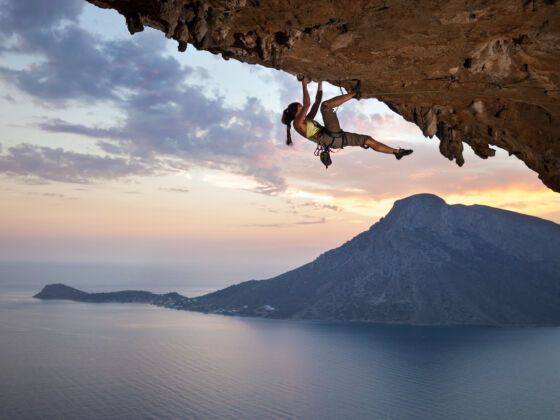
Photo: Hauggen

Reannon Muth wonders if the modern daredevil has become obsolete.

LONG BEFORE MY first attempt at scaling the side of a mountain, I scaled the side of my parents’ two-story house.

Using my bedspread as a make-shift rope, I kicked out my bedroom window and prepared to swing Tarzan-style down to the ground 50 feet below. I was seven.

Luckily, my father caught me dangling from the window-ledge just in time to spare a trip to the ER. But not in time to spare me from a life-long addiction to thrills and daring adventures. That, apparently, had been hard-wired into my brain since birth.

According to research conducted by University of Delaware professor Marvin Zuckerman, not only is my passion for living on the edge a trait of a risk-taking personality type, it’s also hereditary. I’m a risk-taker – or high sensation-seeker – a label Zuckerman attributes to anyone who craves “novel, intense and complex sensations and experiences” and is willing to engage in risky behavior in order to achieve them.

In modern society, daredevils are usually considered oddballs or worse, adrenaline junkies with a death wish.

And while that often involves physical risks, not everyone needs to be a sky-diving instructor in order to consider herself a risk-taker. According to Zuckerman, the risk-taking trait can manifest itself in other behaviors. Someone who enjoys exploring a foreign city without a map, for example, would be considered an “Experience-seeking” risk-taker. And those easily bored by routine and who frequently move or switch jobs are called “Boredom Susceptibility” risk-takers.

Although there might be a little Evel Knievel lurking in your entrepreneurial next-door neighbor, it’s usually the climber on Everest or the crocodile hunter that receive the attention. And it’s often negative. In modern society, daredevils are usually considered oddballs or worse, adrenaline junkies with a death wish. But it wasn’t always like that.

Risk-Takers of Yesteryear

Photo: icyFrance

As the theory goes, the risk-takers of yore were not only valued members of a tribe, but absolutely vital to humankind’s survival.

While the play-it-safers stuck close to their berry patches, their more adventurous counterparts risked life and limb hunting the saber-tooth tiger or investigating a newly-discovered cave.

Not surprisingly, many a risk-taking caveman didn’t survive that elephant tusk to the back or drink from that contaminated watering-hole. But as psychologist Michael Aptor, author of the book “Dangerous Edge: The Psychology of Excitement”, pointed out in the Psychology Today article, Risk, “it’s better for one person to eat a poisonous fruit than for everybody.” It was because of these early risk-takers that our species was able to survive.

But you wouldn’t know it from people’s reactions today. Up until recently, the theory was that human beings main motivation in life was tension-avoidance, so those adventurists who actively sought it were deemed impaired and even crazy. Some researchers not only consider the risk-taking personality “abnormal”, but theorize that it’s becoming obsolete.

They have a point. In the modern world, where no waters are left uncharted or lands undiscovered, there just isn’t a need in society for the girl gutsy enough to dive for oysters in shark-infested water.

Safety Precautions Everywhere

Michael Alvear, in the Salon article Risky Business, wrote: “You can’t swing a helmeted cat without hitting a mandated safety precaution.” And although those helmet laws and health inspections have made the modern world safer, they’ve also sapped it of the very thing that makes life interesting: it’s wild unpredictability.

And this is bad news for those programmed to crave adventure. Because as science has shown, a thirst for novelty is in the risk-taker’s blood. While neuroscientists have yet to agree which gene is responsible for why some prefer paint-balling to painting, a study from Vanderbilt University in Nashville found that those who crave an element of danger do so because their brains have trouble regulating dopamine.

Science has shown, a thirst for novelty is in the risk-taker’s blood.

Dopamine is the brain’s “happy juice”. It’s the chemical you can thank for that blissful feeling you experience while eating that chocolate sundae or sharing a romantic evening with a lover. And in the brain of a high-sensation seeker (who is believed to have fewer of a dopamine-blocking enzyme), it’s overflowing. Which is why the risk-taker may feel bizarrely elated at the prospect of jumping off a cliff, whereas the average person feels merely frightened and stressed.

Not that the average person doesn’t enjoy the occasional weekend ski-trip. On a scale of sensation-seeking tendencies, with the couch potato on one end and the base jumper on the other, most people fall somewhere in between. And that’s unlikely to change, no matter how many safety nets or seat-belts society cocoons itself in.

Need for Speed

Walking into the unknown / Photo: Jsome1

But adrenaline junkies (those who struggle to cope with the mundane existence of every-day life) are a different breed. And as evolution has demonstrated, over time, when a trait ceases to be advantageous, it ceases to exist.

So with an intense desire for adventure literally pumping through their veins and with no spear-throwing tribesman in sight, what’s a modern daredevil to do?

Well, as the article “Risk” and the spike in popularity of adventure tourism would suggest, when you can’t find danger, you create it. And that’s why we find grannies giddily signing up for white-water rafting in Costa Rica or college students heading to orphanages in New Delhi for voluntourism gigs.

Last weekend, 20 years since that day on my window-ledge, I stood on a different sort of ledge, the kind 200 feet above ground and attached to a cliff on the border of a Guatemalan jungle. As I readied myself to zip-line across the tree tops, I prayed that metal and cable would prove studier than the bedspread. I was nervous. But perhaps not unsurprisingly, exhilarated, too.

Maybe we risk-takers are a dying breed. But you can be sure that if we do all die out, we’ll be going out in style: para-gliding, free-falling and bungeeing our way into extinction.

Do you think true risk-taking is still possible in our society? What are some of the risks you have taken? Share them below.

Culture + Religion
 

About The Author

Reannon Muth

Reannon Muth is a part-time writer and full-time travel addict. Over the last decade, she's backpacked through Asia and Central America and lived in five countries, in Disney World and on a cruise ship. Some of her talents include being able to fall asleep anywhere and eat almost anything. She currently lives in Las Vegas.You can read about all of her adventures (abroad and at home) on her blog, Taken by the Wind.

More By This Author

view all →
  • http://jaimeeasa.blogspot.com Asa

    Speaking of Americans, I definitely think risk-taking is a dying breed. I’m not talking about thrill sports – I think there’s still a fair amount of that going on – but I see less people wanting to take risks like “having a gap year on their resume” or “not saving for retirement” or “going without health insurance”. I think many people, out of a desire for perceived security, forgo many large activities, like taking a large around-the-world trip or starting a business that they’re really passionate about. I think it’s a shame. Yes, accidents happen, disasters strike, and to be moderately prepared for the worst is prudent. But from what I’ve experienced, many tend to go overboard with worries about the worst-case-scenario. Especially spending a lot of money on insurance or planning that in the end, often ends up either not being necessary or the insurance doesn’t end up paying off when needed.

  • http://abbiemood.com Abbie

    “Boredom Susceptibility” risk-taker? That’s me!

  • http://joshywashington.wordpress.com joshua johnson

    love this article.
    we would have been great friends as kids!
    I don’t think of things in terms of risk…I asses in Factors of Adventure. And ramping up the adventure gives me the pleasant rush that would possibly be described by so many sky divers.

  • http://dadventurous.com Troy Pattee

    What an excellent and timely post, Reannon! I was in Guatemala last month and we hiked Pacaya just days before the latest eruption. It has been disconcerting to read the comments by the flood of naysayers regarding the rescue of Abby Sunderland and her aborted around-the-world solo sailing attempt. Without the adventurers and risk-takers of the world we would all be living in grass huts and eating porridge. Keep on living!

  • http://www.takenbythewind.com Reannon

    @ Troy – Grass huts and porridge! Ha.

    It’d be interesting to know how the naysayers do on the sensation seeking scale. If you want to see how much of a risk-taker you are, take Zuckerman’s risk-assessment test. It only takes about five minutes…

    http://www.bbc.co.uk/science/humanbody/mind/surveys/sensation/index.shtml

    But I don’t understand what any of the fuss is about either. Out of all the risky situations a teenger can find herself in, sailing around the world is pretty low on the list. Most risk-taking teens put themselves in far greater danger through reckless driving, unprotected sex, drugs, binge drinking, crime, etc.

  • bobby c

    Well said, Reannon!

    Asa – I couldn’t agree more with your point about the modern American risktaker. It’s not just the bungee jumper who is a risk taker. It’s also the person who had the crazy idea to put her life savings into opening a restaurant that only serves PBJ!

  • http://susanstraveltips.com/ Stacey

    This post was the most beautiful thing to read first thing this morning! I agree in every way!

  • Kev Coleman

    Reannon, I could not have said it any better if I tried.

    You keep enjoying life.

    As a Pagan I follow the One Law: ‘If it harms no one and no thing do what thy will’
    Seems like the rest of the world has forgotten their roots.

  • http://propermood.blogspot.com Angela

    Right on! We need to bring back the risk taking race.

  • Logan

    I am 14 and i crave adrenaline rushes i am a huge risk taker and it has never led me in the wrong direction i mean maybe a few trips to the ER every once in a while but just to get out and try the same thing that sent you to the ER in the first place and to actually get it makes it alllll worth it:)

  • Dfkalfdksfj

    LOLZ!!!

  • Dfkalfdksfj

    LOLZ!!!

  • Dfkalfdksfj

    LOLZ!!!

  • Dfkalfdksfj

    LOLZ!!!

  • Anon.

    that’s true.

  • Anon.

    that’s true.

  • Anon.

    that’s true.

  • Anon.

    that’s true.

Culture + Religion →

Check out a different side of New York's museum scene with these 5 recommendations from...

Culture + Religion →

The construction workers also like to blast Punjabi pop on crackling radios during their...

Culture + Religion →

Discounts for not only students but also the unemployed -- and virtually anyone under age...

Culture + Religion →

Ancient sites are crumbling, and yet hordes of tourists still descend upon them. How can...

Culture + Religion →

The month's almost over, but you've still got time to take Valerie Ng's advice on how to...

Culture + Religion →

Dane Phillips saw the recent protests firsthand - and wonders how he could still be so...

Culture + Religion →

When in Rome, right? David Francois talks about his banya experience in St. Petersburg.

Culture + Religion →

Are some subjects simply too volatile for public consumption?