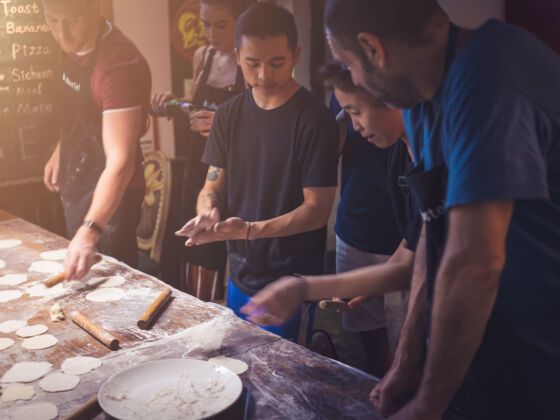
hostel kitchen

Self-catering is an essential element in any backpacker’s budget strategy.

YOU CAN CONTROL how often you move from city to city and where you stay en route, and of course you can restrict the cost and number of your daytime activities as needed.

But you have to eat, and that’s not going to change no matter how much cash is left in your account.

The first time I went traveling, in Australia, I stuck to my budget religiously – which was great. But in doing so, I subsisted almost entirely on Styrofoam cups of noodles and the occasional can of soup. Not so great.

Since then, I’ve vowed to find ways to eat well while still saving money. Here are a few tips I’ve picked up along the way:

1. Book The Right Hostel

The better the kitchen, the more likely you are to actually cook a decent meal.

Plenty of hostels these days claim to have a “kitchen for guest use” – but sometimes that means a fully-functioning kitchen, and other times it means a hot plate on a folding table.

Poke around on the hostel’s website to see if you can find a specific list of facilities within the kitchen, or if possible, ask an employee over the phone. Fridge, stove and sink are a minimum, and microwaves and kettles are gravy. (Not to mention pots and pans to cook things in…)

The better the kitchen, the more likely you are to actually cook a decent meal.

2. Know Where To Shop

Don’t just wander into the nearest corner store and stock up on instant packaged meals. Ask around to find out where the nearest large supermarket is, or (even better) the local fresh produce market.

skillet of goodnessAs well as providing variety and better prices, these places can be attractions in themselves – one of the highlights of my stay in Budapest was trying to navigate a huge grocery store where no one spoke English, and all the products were unfamiliar, labeled in Hungarian.

(Hint: If you’re looking for mayo in Budapest, it’s in the toothpaste tube with the cartoon egg on the package!)

For variety, you can also seek out the local ‘Chinese grocery’ – these are found everywhere, and range from full-on Asian specialty food shops to corner stores that happen to be run by Asian immigrants, who almost inevitably also sell products from their home country.

In Europe my standard fare was pasta and tomato sauce, beefed up with peppers, zucchini or eggplant, and cheese. So after a while it was great to stumble on an Asian food store in a back alley in Florence and treat myself to a Thai-style yellow curry!

3. Buy Items That Multi-Task

Even if you’re traveling with a friend, it can be tough to use up entire bags of rice or pasta, or whole blocks of cheese, before you move on to your next stop. Planning out your meals, using overlapping ingredients, can really help.

My typical grocery list includes bread (toast for breakfast, sandwiches for lunch, maybe a slice with dinner), lettuce (sandwiches for lunch, a bit of salad with dinner), cheese (again, lunch and dinner), and then pasta, sauce and veggies.

The key here is to rotate through different sets of ingredients, so even if you’re eating one food for every meal in Madrid, you’re at least eating something different for every meal in Barcelona.

4. Share with others

Pooling money and ideas usually results in a more interesting meal, and makes cooking more fun, too.

Self-catering is one of many aspects of travel that can become easier if you’re with a buddy: costs are split, food gets used up sooner, and it’s not always your turn to do the dishes.

But even for a solo traveler, it’s easy enough to find someone to share a meal with – it’s usually as simple as walking into the hostel kitchen or common area a little before dinner time and asking.

Pooling money and ideas usually results in a more interesting meal, and makes cooking more fun, too.

5. Always Have a Back-up Plan

The times I’ve spent the most money on the least-enjoyable meals have inevitably been when something goes wrong in transit. The train breaks down, the flight gets cancelled, and, trapped somewhere with an empty stomach and few options, I find myself spending a small fortune on a damp sandwich and a cup of flat pop.

To save yourself from wasting money on entirely undesirable meals, always have a small, lightweight emergency food supply. Mine generally involves granola bars and dried fruit, and sometimes I carry small packets of powdered miso soup, too, so protein is only a kettle away.

6. Reap the Benefits

Make sure you don’t get so caught up in grocery budgeting that you forget about trying the local specialties entirely.

On your last night in a city, or after a particularly long day, put some of the money you’ve saved from all your self-catering towards a really nice meal. Ask fellow travelers where they’ve enjoyed eating, stop people on the street, hit up your hostel staff for advice – obviously, the place you pick doesn’t have to be expensive to provide a mind-blowingly memorable meal.

But thanks to all your careful self-catering, if there is a higher-end place that’s calling out to you, you can go ahead and treat yourself! You’ve earned it.

What tips do you have for self-catering in hostels? Share in the comments!

Eva Holland is a historical researcher and freelance writer based in Ottawa, Canada. She is a blogger for World Hum and for Rolf Potts’ Vagablogging, and her travel writing has appeared in The Ottawa Citizen, The Edmonton Journal, and Matador Travel.

Health + Lifestyle
 

About The Author

Eva Holland

Eva Holland is a freelance writer, Senior Editor of World Hum and a longtime contributor to the Matador community. She lives in Canada’s Yukon Territory and blogs about Alaska and Yukon travel at Travelers North.

  • http://www.rucksackwanderer.com/ Tim Patterson

    Great piece Eva – I like editing your articles. As easy as read, cut, paste. Thanks!

  • http://www.lemurworks.com/lola Lola Akinmade

    Cool tips Eva. Buying local ingredients and actually cooking yourself up a meal in the country immerses you even more and makes you feel less like you’re just passing through.

  • http://www.bravenewtraveler.com Ian MacKenzie

    My friend had this fall-back plan when we traveled across Canada by bus in 2003. Everytime we’d run out of food, or couldn’t think of what to eat, he’d suggest “what about some plain pasta with sugar packets sprinkled on top?”

    Fair enough, turns out, when you’re really broke, it’s a cheap meal. But he kept suggesting this option like it was the first time, almost every night. Needless to say, I asked him to get a little more creative once and a while.

  • John M. Edwards

    Hi Eva:

    Great article. I’ve found sometimes that cooking with a bunch of friends in a hostel is not only cheaper, but sometimes better than eating at local restaurants. It’s amazing what a potlatch (or potluck) dinner can turn up: in a hostel in Cairns, for example, we cooked up gigantic prawns and barramundi, when the closest restaurant majored in toasted ham-and-cheese sandwiches and spaghetti bolognaise. Now if Quentin Tarantino ran the “Hostel,” I’d think twice about sticking around as an invited dinner guest.

  • Pingback: Pulse Picks of the Week: Know Your Host(elier)

  • http://nodebtworldtravel.com brian

    I recently did this Japan and it saved me a tremendous amount of cash. I would suggest adding a little protein like ground beef or chicken if you can afford it (and if you're not vegan or vegetarian). Meat is more filling than plain white pasta and will keep the hunger away longer.

  • http://www.jasminecatering.com Catering San Francisco

    Beautiful! thank’s for the interesting post

  • http://www.cookingpotsnow.com Richard

    Thanks for sharing such great ideals. Being retired military I like hiking outdoors.

  • http://marisalavalette.com Marisa LaValette

    Hi Eva–

    Is the picture in the kitchen of 1004 in Bariloche, Argentina? I swear it looks familiar. I was there Nov. 2011!
    ~ Marisa

Health + Lifestyle →

From herbs to hypnosis: how to kick your cigarette habit naturally.

Culture + Religion →

An American expat in Lahore gets a glimpse into the lives of Pakistani women.

Recipes →

No more nibbling, gnawing and navigating your way around tiny chicken bones. Suddenly,...

Health + Lifestyle →

A British man who faced amputation after a climbing accident will keep his leg, thanks to...

Health + Lifestyle →

If you're in the United States and looking for information about where to get vaccinated,...

Health + Lifestyle →

One more proven health benefit of studying the "supreme ultimate boxing."

Photo + Video + Film →

Travel writing tends to get pigeonholed. Here are sites and publications that promote the...

Health + Lifestyle →

It's important to be aware of yourself and your situation.

Food →

Cooking classes are great ways to learn about local food and make new friends.


Internet cafes can be dangerous places. Here's how to keep your information safe.