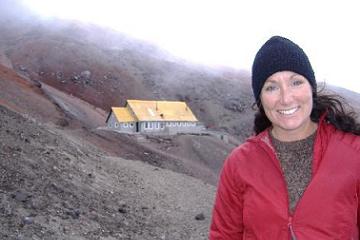
Somewhere between “literature” and “travel writing” and off to the side of literary ‘zines, new media, TBEX, and freelancers, are writers who don’t fit a single profile, but whose work is at the center of travel and place. Named the Next Great Travel Writer by NatGeo Traveler, Suzanne Roberts is creating her own niche with collections of travel poetry and memoir.
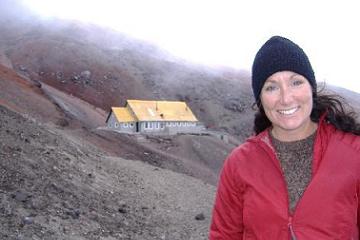
Suzanne Roberts on Cotopaxi, Ecuador

Name: Suzanne Roberts

Age: 39

Cultural heritage / Ethnicity: British mother/Jewish father

Languages spoken: English, Spanish

Based out of: South Lake Tahoe, California

Education: PhD in Literature and the Environment, MA in Creative Writing, BS in Biology

Current work / projects: I am currently working on a book of travel poems, a hiking memoir, and a book of travel essays. I am also co-editing an anthology of skiing and snowboarding stories.

Books published / forthcoming: Shameless (Wordtech Editions, 2007), Nothing to You (Pecan Grove Press, 2008), and Plotting Temporality (forthcoming from Red Hen Press)

Writers / Journalists whose work inspires you:
I am a big reader, so I could name hundreds, but here are some of my favorites: Rainer Maria Rilke, Ralph Waldo Emerson, Emily Dickinson, the Brontes, Gabriel Garcia Marquez, Federico Garcia Lorca, Virginia Woolf, and Sylvia Plath. Contemporary writers I especially admire are Michael Ondaatje, Toni Morrison, Maxine Hong Kingston, Li-Young Lee, Mark Doty, Louis Glück, and Ann Carson.

Photographers whose work inspires you: Annie Lebovitz, Ansel Adams, and Catherine Roberts Leach (that’s my sister!). I also like Nevada Photographer Peter Goin’s Black Rock desert work and local Tahoe photographer Corey Rich’s work.

Books / magazines / media currently reading: Wanderlust by Rebecca Solnit, One More Theory about Happiness by Paul Guest, Black Nature, edited by Camille Dungy, Collected Poems by Lynda Hull, Anna Karenina by Leo Tolstoy, and Autobiography of a Face by Lucy Grealy. I always have at least five books going at once. I read the New York Times everyday as well.

Last concert attended: Does a Bassnectar rave at Burning Man count?

[DM] Your work seems to fit somewhere at the intersection of poetry and travel writing. Although it seems like there should be a natural overlap (and audience) when you put these two elements together, it seems divided, at least in the publications I’ve found.

Most literary journals seem to publish certain styles of nonfiction (with “travel writing” often seeming a pejorative term), whereas travel magazines publish other styles, much of it very homogeneous (with terms like “literary”or “poetic,” potentially seen as pejorative). Have you found this to be true? And if so, how have you “bridged” it?

[SR] I find everything you have said absolutely true, and to tell you the truth, I was surprised when I found out that travel writing is seen in a pejorative light. I think that’s because of the nuts and bolts nature of the where to stay/what to do/where to eat-type articles, but these serve a very important purpose for their audience.

Poetry is the ideal medium to capture sense of place because of the poem’s imagistic in-the-moment nature, but you are right, the travel journals don’t typically publish poetry. Therefore, I don’t think I have “overcome” or “bridged” the attitudes you suggest.

I have been shopping my hiking memoir around, and one agent told me it would be hard to find a mainstream publisher because I don’t have any real books out—she then said, “You know poetry doesn’t count, right?”

We often forget, and I include myself in this, that it is the writing and not the publishing that’s important.

And in the marketplace, poetry doesn’t count unless you are Dante or someone else long dead. We often forget, and I include myself in this, that it is the writing and not the publishing that’s important.

I think most poets finally come to accept this because we have to write the poems while knowing that most likely, they will not find a very large audience. Yet, at the same time, this can be very freeing. In poetry, I often feel like I can write whatever I want, because really, who is going to read it?


In much of the work in your upcoming collection, the narrator is an outside observer to other people’s realities, specifically, poverty in India. The themes deal with distance (the narrator is often looking out on the scene from “the ambassador’s car”) and separation from local people.

As an outside observer to these realities, how do you reconcile creating poetry or art out of them? How do you distinguish what is poetry / art / expression and what is rendering (or even glorifying) guilt or “white man’s burden”?

When I have returned from places, such as India, people have not wanted to look at my photographs; they have said, “Don’t tell me anything sad.” I think by ignoring the sad realities of the word, we make them worse.

Read the full article at MatadorU

Community Connection

Please visit SuzanneRoberts.org to find more about her work and upcoming projects.

How to Write
 

About The Author

David Miller

David Miller is senior editor of Matador (winner of 2010 and 2011 Lowell Thomas awards for travel journalism), and BETA magazine. After living for the last two years in Patagonia, Argentina, he is returning with his wife and two young children to the Southern US. Follow him @dahveed_miller.

  • http://joshywashington.wordpress.com joshua johnson

    The excerpt is moving and transparent, thank you for including it. This interview has me stoked…you two can frame concepts in words in ways I can’t and I feel lucky to be a reader of these conversations.

    Suzanne may be the next great travel writer, but it sounds to me she has been far more than that for a long while!

  • Scott

    As a writer sitting-on two completed/edited manuscripts and two handfuls of shorter pieces, I can second the notion that it is the writing that is important, and not the publishing. There is nothing in the publishing (just recently had my first published piece appear in a national magazine) comparable to sitting alone at my desk, and writing the last word, and the deeply personal satisfaction that attends that moment.

    The whims of the publishing industry are out of our control; if the big houses say that poetry “doesn’t count”, then it doesn’t; but if we are poets, we must continue.

    Thank you for the interview. I, for one, welcome what Suzanne has to offer.

  • http://www.Travel-Writers-Exchange.com Travel-Writers-Exchange.com

    It’s too bad publishers don’t consider poetry writing. This is why more writers are self-publishing instead of going directly to the “big” publishing houses. Who knows, you could self-publish and then be picked up by the publishing company of your dreams.

  • http://expatheather.com Heather

    David and Suzanne, thanks so much for this. The conversation represented here is one that is essential, and I couldn’t agree more with Suzanne’s response: “My hope is to relay an observation, give an unflinching view of the difficult realities to the reader, and he or she can decide what to do with it.”

    While there is an important function and place for informative travel writing (where to stay, what to do, what to eat, etc), I would hate to see the genre reduced to that simply because it’s more marketable than a more ‘literary’ type of writing.

    I’ve been thinking about this a lot lately, in light of spending a good chunk of time reading Adorno and pondering his views on “The Culture Industry.” So much of what is considered ‘travel writing’ ends up being part of this commercial agenda, where the goal is not to “relay an observation” but to mold the reader’s thinking to want to purchase a particular travel ‘experience’ (I’m thinking the glossy mags/in flights, etc).

    I think Adorno would promote the type of writing that Suzanne is doing – writing that recognizes its place within and outside of certain cultures, strives to avoid transcendental criticism of culture and leaves open ended questions / is comfortable with the dialectic nature of what a traveler or writer experiences, and avoids being produced for the purpose of writing/art instead of being produced for the purposes of marketing.

How to Write →

Accomplished travel writer Beebe Bahrami shares her thoughts on the craft and what it...

How to Write →

Start flexing a larger vocabulary now with these simple tips.

How to Write →

Every day, in many different ways, I massage my brand and am pitched by other writers who...

How to Write →

Writers tend to fall easily into the coffee / computer / confined office trap. If this is...

How to Write →

Has the only 'legitimate' form for writing on travel and place become limited to the...

Photo + Video + Film →

Quotes can add dynamic elements to your story, or kill it almost instantly.

How to Write →

Travel is all about dialogue and interaction between characters.

How to Write →

The stories that seem real and alive are stories that contain multiple layers.

How to Write →

But here's the catch: good journalism is dependent on a total stranger's cooperation and...

How to Write →

Most travel writers try to cover everything on their trip. Why that's a bad idea and what...