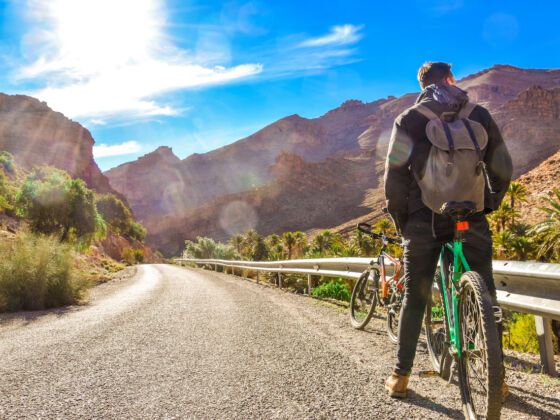
8 adventurous ways to explore Africa
Photo: Ludovic Hirlimann
1. Hitchhike the South
For any kind of long-term travel in Southern Africa (say, Namibia, Botswana, Zimbabwe, Mozambique, and South Africa), it’s best to rent a car. Or, more realistically, some sort of 4×4. But that sounds pricey. A cheaper option would be to hitch.
I’d be reluctant to do this if I hadn’t read the advice of Mary Richardson. When she was working as a Peace Corps volunteer in Namibia, she found hitching to be the most reliable means of transport. Not only that, but:
…hitchhiking contributed some of the most exciting travel experiences I’ve ever had. Over a period of two years, I successfully hitchhiked through Namibia, Zimbabwe, Botswana, South Africa, Mozambique, and Malawi. An adventure that still thrills me to this day.
If she can do it, I’m fairly confident I could too. Even better, she’s shared 15 tips for hitchhiking in Southern Africa, including general advice as well as some solid routes to try out.
Photo: Blyzz
Victoria Falls, Cape Town, the Namib Desert, and the major cities in the region are all accessible to the hitcher.
2. Work as a Bush Pilot
This would take care of transport costs. Plus bring in a wage on the side — though, as Cedric Pieterse notes in How to Become a Bush Pilot — not a lot.
But man, the adventure. Here’s how Pieterse sums it up:
Bush pilots all over the world have earned their respect from fellow pilots. There is a reason for this. To be a bush pilot, you do not fly by the numbers. Most of the time you do not use registered airfields or any airfields at all. It requires seat-of-the-pants flying in adverse conditions… You must be able to deal with abnormal conditions like removing ice from the control surfaces of the plane, because it got frozen over night. In Africa, we had to change tires because the lions chewed through them!…
…At first glance, it looks downright dangerous and scary. With the right training, it is neither…
PPL (Private Pilots License), CPL (Commercial Pilots License), and specialized bush pilot training required. Probably worth it, though.
3. Study Abroad
Just as couchsurfing is different from hostel-surfing, and working abroad is different from backpacking, studying abroad is a form of travel unique from all others.
It’s hard to deny the benefits: You get all of the hard stuff (i.e., room and board) planned for you, access to a support system is (generally) assured should anything go wrong, and you learn (both in the sense of “receiving credit” and having those “big experiences”).
Photo: paulshaffner
I took a month-long creative writing course in Galway, Ireland, after my freshman year and still count it as one of the best choices of my life.
It kicked off my career as a traveler and confirmed for me the type of people I best get along with and what I want to be doing in life.
But, as Matador contributor Alexis Wolff says:
A decade ago, simply deciding to study abroad in Africa assured that your experience would be unique. Today, with growing interest in the continent and more study abroad options than ever, those seeking an experience different from their classmates’ also need to pick the right program.
So, where in Africa should you study abroad? Wolff offers 5 solid suggestions in her piece, including Boston University’s Niamey International Development Program in Niger and the School for Field Studies’ Wildlife Management Studies Program in Kenya.
4. Take It Slow up the East Coast
Ewan McGregor and Charley Boorman kind of popularized the idea of traversing the continent from end to end, but travelers have been doing this in different ways for decades. One of the most recent is travel photographer Darren Ornitz, who journeyed from Cape Town, up the eastern half of Africa to Djibouti, and then over to the Arabian Peninsula, taking local transport all the way.
I was inspired by the photos he brought back and shared with us at Matador Trips. Check them out in Photo Essay: Africa and the Middle East, Overland.
Photo: hermanusbackpackers
5. Dive with Great Whites
For me, this one wouldn’t be so much an African adventure as a psychological one — sharks scare the crap out of me. News stories like Tourist killed by ‘dinosaur-sized’ shark off South African beach don’t help.
The waters around Cape Town are a popular hangout for great whites, and a tourism industry has been built around putting people in cages and dunking them in the water when one swims by.
Carly Blatt has some words of advice for anyone interested in a cage dive (um, yeah, probably not me):
The best months for shark sightings are April to August, while early January to mid-March tend to be the worst. When planning a shark diving adventure, keep in mind that inclement weather may prevent the boats from going out, so it’s best to allocate an extra day in case your original outing is postponed.
Read more in Face to Face with South Africa’s Great Whites.
6. Volunteer
Again, volunteering is a way to get a completely different “travel experience.” You see firsthand what comprises daily life for the people around you, and where help is needed you might be lucky enough to be able to lend a hand.
Photo: US Army Africa
When I volunteered in Bolivia for 3+ months last year, I got to travel to pueblitos on the high, cold Andean Altiplano and come to comprehend the struggles people face when they have no electricity in their homes, schools, clinics.
I worked with local org Energetica, who partners with groups in Tanzania, a country experiencing many of the same issues.
Choosing a volunteer gig requires substantial research; a good place to start is with 44 Organizations Providing Internships, Volunteer Vacations, and Long-Term Programs in Africa.
There’s also Lola Akinmade‘s excellent Nations Less Traveled: Volunteer Opportunities in Africa, a guide to volunteer work in countries outside of the “big names.”
7. Island Hop the East Coast
An alternative to the overland route of #4 is to stick to the sea. The “Swahili Coast” off Tanzania and Kenya is dotted with islands like Zanzibar and Lamu.
In describing the latter, Gregory Kruse says:
Photo: geoftheref
The narrow alleyways of the old town hardly permit the passage of two people side-by-side. There’s only one automobile on the island, and almost everyone gets around on foot, or on donkey-back.
A bit farther south is a much bigger island, one that Matador founder Ross Borden had the chance to explore this past spring. See the connections he made with its people and its land in Photo Essay: Life in Western Madagascar.
8. Cycle the Western Sahara
I’ve logged 2,700 miles’ worth of pedal strokes in the tropics of Southeast Asia and through an even wetter Maritime Canada. Time for the desert?
I’m not sure I’ve got the balls to follow in Helen Lloyd‘s tracks, though. She’s another continent crosser, only her chosen means of transport was a bicycle, and her route took her through 900km of sand and desolation in the Spanish-colony-turned-disputed-territory of the Western Sahara.
She was kind enough to share photos to let copycats like me know what we’re up against.
Community Connection
For more exploration ideas, check out Three Little-Known Beach Getaways in Western Africa and 50+ Things to Do in 50 African Countries.
And don’t forget to hit up the Matador community of travelers to see who’s on-continent and what they’re up to.
Related Posts
Hal Amen
Hal Amen is a managing editor for Matador. His personal travel blog is at WayWorded.
More By This Author
- Austin-based group builds community center in Cambodia
- 16 ways technology is mapping the universe (19 comments)
- DIY videos: 50 projects for home and travel (2 comments)
-
http://lesliekochtravel.blogspot.com/ LeslieTravel
-
Kathy
-
tinisoli
-
http://matadortrips.com/ Hal Amen
-
tinisoli


