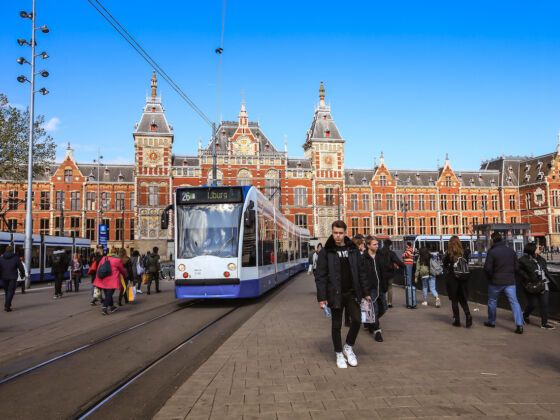
Tram tracers, Amsterdam

Photo: bhav.bhav

Abbie Mood picks up some public transport skills during a recent trip to Amsterdam.

THE THINKING ON my first day in Amsterdam went something like this: “I will conquer Amsterdam by foot! I have my handy map and I can figure this thing out. How hard could it be?”

And then I realized that Amsterdam is a really big city.

I was visiting for a couple days for the grand reopening of the Hotel Novotel, and they had hooked me up with an “I amsterdam” card. It basically gave me free reign of the main attractions in the city, as well as its public transportation.

I pride myself on my navigational skills in new cities, but Amsterdam was a different story. This place has a metro, cars, bicycles, motorbikes, boats, trams, buses, and trains. All those options translate to greater access if you know how to use them — and great confusion if you don’t.

The easiest way to break it down is this:

  • Trains are for going to the airport and other cities/countries
  • the metro is for getting in and out of the city to the suburbs
  • boats are for sightseeing groups like the hop-on-hop-off museum tours
  • cars are for the ambitious (it’s difficult to get around any big city’s tourist destinations by car)
  • bicycles and motorbikes are for residents and daring tourists
  • and trams and buses are the easiest and most inexpensive way for anyone to get from A to B, with trams being the best choice (and also my transportation of choice) during the day.
Get your tickets

If you’re going to be hitting many of the top attractions, you might want to consider a 24-, 48-, or 72-hour I amsterdam card, which either gets you in or gets you a discount at most museums and other sights, while functioning as a multi-transport card for the same number of hours.

Of course, individual tickets are available too. They cost €1.60 and give 1 hour of travel time on the bus, tram, or metro system. On the bus and tram, get your ticket onboard; at the metro, from a ticket machine.

Amsterdam tram ticket

Photo: Author

Strip tickets (strippenkaart) are another good deal and can be bought all over the city. The standard strippenkaart comes with 15 strips and costs €6.50.

When you get on the tram or bus, tell the conductor your final destination and s/he will stamp the proper number of strips for you. A trip around Amsterdam Central will generally cost 2 strips, and a nearby town will probably eat up 4.

If you’re staying several days, or plan on running around the entire city like I did, a 24-, 48-, 72-, or 96-hour GVB ticket might be the best choice. This one allows unlimited rides on tram, bus, and metro, and is activated when you swipe it for your first ride.

They’re reasonably priced, too: 24 hours for €7.00, 48 for €11.50, 72 for €15.50, and 96 for €19.50. There are even 120-, 144-, and 168-hour tickets for week-long visits.

Pick these up at the GVB public-transport office, any tourist office, or you can get a 24-hour card as you board (but this will cost €0.50 extra).

I’ve got my ticket, now what?

I was staying in the suburbs, so I always started at the Central Station (via the metro), which is where most trams and buses start and end.

It’s helpful to have a map or know which tram you’re looking for, because I found the maps posted to be a bit confusing. If yours has the tram routes on it, look for the blue number located closest to the attraction you’re visiting, and get on that route.

For example, if I’m going to the Amsterdam Historical Museum, I find it on the map and look for the closest blue numbers, which are 1, 2, and 5. Any of those trams will take me there, and they all leave from Central Station. So whichever comes first, hop aboard!

Trams 1, 2, and 5 will take you to most of the sights — they run north-south from Central Station to Dam Square to Leidseplein to Museumplein. They depart from the west side of the station in front of a row of shops.

If you get lost, get yourself back to Central Station and start over again.

Community Connection

For help on getting around other big cities using public transport, check out our guides for New York, London, and Buenos Aires.

Transportation Guides


About The Author

Abbie Mood

Abbie lives in Denver and can usually be found hiking somewhere with her two dogs, Daisy & Sadie. She is the Editor of Matador Change, a freelance writer, and a Pre-K Special Ed. teacher. Check out her website at abbiemood.com, or follower her on Twitter @AbbieMood.

  • thomasw

    trams in amsterdam no longer take the strippenkaart (strip tickets). they rely entirely on the electronic check-in/check-out system.

  • V Bryan

    What a fantastic piece! I have printed this out and will keep it in my notebook. Hopefully soon I can put your advice to the test.

  • http://wallynes.muppets.ws Wally

    I left the Netherlands a while back, but they were phasing out the strip card.
    As far as I know they stopped selling them a little while ago

    http://www.rnw.nl/english/bulletin/amsterdam-says-goodbye-strippenkaart
    http://www.amsterdamtips.com/getting-around-amsterdam-the-strippenkaart.php

  • http://www.melodiefabriek.nl Marco Raaphorst

    Thanks for using my photo!

    I also recorded some audio during the trip:

    tram Damrak by Raaphorst

  • Ellen

    Good tips. But I would argue that Amsterdam is one of the most walkable cities that I’ve been to in Europe. And most of the main sites in Amsterdam are within a 30-40 minute walk from the central station. The walk itself is perhaps one of the highlights, as there is a lot worth seeing along the way.

    With the trams, I would say that the strippenkaart is probably your best bet (if you are staying/sleeping in the city centre), although most of the times I’ve been to Amsterdam I’ve spent the day walking and only rely on the tram as a way to get back to the central station if I’m sick of walking.

    Nice to see a useful article on Amsterdam, thanks!

  • http://orangesplaash.blogspot.com/ Arwa

    Nice and detailed description. Though I prefer to walk in Amsterdam as almost all the major attractions can be covered on foot.

  • Abbie

    @Thomas – is that a new policy? I was just there at the end of May and saw them both for sale and used on the tram.

    Thanks for the comments everyone, I’m glad the article was/is useful! While I walked the first day, I found that even with a detailed map it was a bit difficult to find my way around, so it took me forever to get anywhere, but I’m sure the straight shot distances to the attractions aren’t too bad!

  • http://www.nehasweb.com neha

    Great post Abbie! What I really liked about the trams in Amsterdam were the people manning them. They were very helpful with directions and change. And not grumpy.

  • thomasw

    @abbie the strippenkaart was replaced by the OV-chipkaart on june 1st. the strippenkaart is still valid on buses in Amsterdam but is slowly being phased out all over the country.

  • Hari

    The GVB card is not the best option if you are staying at the Airport Hotels (the hotels there are cheaper) or outside the city central. This card works on the trams and the Metro but not on the red colored buses – which are not GVB buses. We learned it the hard way when we visited Amsterdam in mid May this year. As suggested correctly, you should get a TRAIN DAY PASS (not to be confused with metro tickets) for travelling to the city from the Airport area or beyond.

  • Abbie

    @Wally & @Thomas – thanks for the updated info!

  • Ellen

    I went to Amsterdam yesterday and was unable to use my (newly purchased) strippenkaart on the trams, as Thomas said.

    Instead, once you get on the tram, you need to purchase a one-way ticket from someone in a booth near the back. Both of the trips I took yesterday cost 2.60 Euro each. (Quite expensive, compared to the strippenkaart!). However, this price may change depending how far you travel. For the time being, you can still use the strippenkaart in other areas of the Netherlands.

    • Abbie

      Thanks for the info., Ellen!

  • http://www.westary.wordpress.com Mary

    I just got back from studying in Amsterdam for a semester and I can tell you that the public transportation can sometimes be pretty confusing! Like others have said, the strippenkaart has been completely phased out. Instead, everyone now uses OV-chipkaart, whether in the form of disposable hourly or day passes, or personalized cards attached to a bank account. For the average tourist, I would suggest that instead of buying a single ride or day pass (let alone the IAMsterdam card which is so expensive!), at the beginning of your time in Amsterdam, you should go to the GVB office in Central Station or the one just across from it and purchase an anonymous OV chipkaart. It costs 7.50 Euros, but I believe 2.50 is the price of the card, and the other 5 Euros is travel credit. So you get a card for cheaper than the price of one single tram ride, it is loaded with 5 Euros of credit, you can reload it at the GVB office if you run out of credit, you can use it on all forms of transportation (including trains if you have more than 20 euros credit on your card), and it is valid for 4 or 5 years. This means that if you have money left on your card, you could save it and use it on your next trip, or give it to someone who is travelling to Amsterdam. Since most trips you will make by tram or bus are quite cheap, the daily passes actually work out to be quite expensive. With the anonymous OV chipkaart, you are paying for the rides you take, not the hours it is valid. Good luck!

  • http://www.sternejourneys.blogspot.com Matt

    I lived in Amsterdam last year and I completely agree that it is a better and more interesting option to walk around the city although I do admit that it is very easy to get lost. One thing I can point out for more daring and budget-minded travelers is that you can ride the no. 5 tram for free from Dam Square to Leidseplein. When I say free I mean they don’t force you to pay but if the police check then you will get fined but odds are it is better to wing it. It is what I did every day for six months and never got fined.

  • Abbie

    @Mary & @Matt – thanks for the tips!

  • Ilja

    Be aware that if you buy a train ticket to or from the airport at one of the English-language vending machines, they’ll try to flog you a first-class (‘comfort class’) ticket. This is quite a bit more expensive than second class and it’s also useless. Second class is quite comfortable and IF the train’s full (which does happen, esp. around peak hours) both classes will probably be standing room only anyway.

    The ‘Strippenkaart’ has now entirely been replaced by the rather nasty OV Chip card system, but attendants will see to it that you check in upon entering the trams (a lot of residents do check out immediately again, though). There are no attendants on the No. 5 tram to Amstelveen, so IF you want to hitch a free ride, that is your best bet. The fines when being caught are pretty steep though and they don’t accept the ‘clueless tourist’ approach – so you’ll have to pay up in cash, either in the tram if you have the money or at a nearby cash point, under supervision.

    Amsterdam’s old city is a tricky place to navigate because of its odd, horseshoe-like shape. But there are basically two types of tram lines: those that radiate outward from Central Station have been mentioned. But if you’re not moving from or to the station, it’s good to know that there are also a number of lines that cross these radiating lines: nos. 3, 7, and 10 can save you a lot of time.

    • http://abbiemood.com Abbie

      Thanks for the update, Ilja!

Photo Essay →

Window shopping has a different meaning in this part of town.

Transportation Guides →

Ride the maglev train from Shanghai to the airport at 420 km per hour.

Transportation Guides →

Find out how to tour the Portuguese capital via a single transit line.

Transportation Guides →

The choose-your-own-adventure that is the Vietnam backpacker bus scene.

Transportation Guides →

Some rails to ride if you don't feel like driving, flying, sailing, biking, or hiking.

Transportation Guides →

Travel vlogger Lindsay expresses her frustration about being scammed by Thai tourism...

Culture + Religion →

Trace Van Gogh's wayward route around the Netherlands and France and see the cities and...

Health + Lifestyle →

Some people see the tour bus as a rolling retirement home. But what if you have to take...

Transportation Guides →

The bus is a great alternative to the underground in London. You just have to know how to...

Drugs →

Even if you're not a stoner, these are some Amsterdam coffee shops still worth checking...