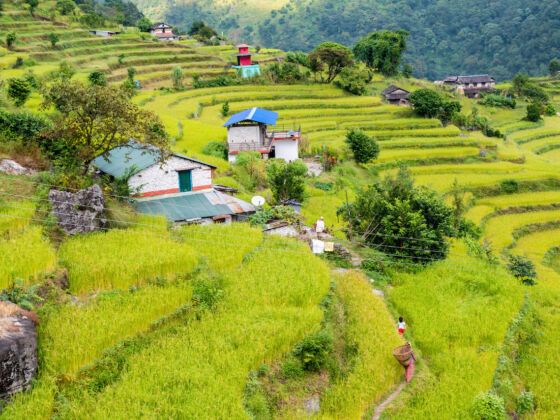
Feature photo by ah zut. Photo above by ah zut.

Imagine an alpine teahouse in the mountains of Nepal. Feel the warmth of a fire, taste the hot milk tea and smell the spicy daal bhat.

[Editor's note: For a detailed itinerary tailored to independent travelers, check out How to Independently Trek Nepal’s Annapurna Sanctuary.]

Nepal is a country of great diversity. Though small, it contains a wide variety of climates, terrains, cultures, and people. Still, the reason most travelers make the effort to visit Nepal are the Himalaya mountains.

If your goal is to get into the high mountains, there is no better path than the trek into the Annapurna Sanctuary.

Photo by ddefranza.

What to Expect

The Annapurna Sanctuary is a natural amphitheater created by a ring of high mountains. The centerpiece is Annapurna I at 8,091 meters (26,538 feet) which rises out of the glacier that extends from base camp, the trek’s highest point.

The mountain was the first of the 8,000 meter peaks to be climbed. However, this does not mean that it is a simple or safe task. The somber memorial to Anatoli Boukreev, who perished while attempting to summit the mountain in 1997, attests to the danger of ascending the peak. Don’t worry though, the trek does not approach the summit.

Though often added as an extension to the much longer Annapurna Circuit trek, the trip into the sanctuary can be done as an objective unto itself. The trek, which begins in Pokhara, usually takes between eight and ten days. This makes it an excellent option for those on a tight schedule.

Photo by ddefranza.

Getting There and Back Again

The base for the trek is the lake-side town of Pokhara. Smaller and more relaxed than Kathmandu, Pokhara is a great place to prepare for a trek and is an even better place to refresh yourself after one.

Most travelers stay in one of the hotels within the “Lakeside” district. This area is roughly equivalent to Kathmandu’s Thamel, and offers dozens of shops, cafes, guest houses, and guide services. If you are looking for something a bit quieter, the neighboring “Damside” district offers many of the same amenities, with a greatly reduced density.

Travel between Kathmandu and Pokhara is well established and fairly straightforward. Options include a 30 minute flight, usually under $100 USD, or a variety of buses, ranging in price from $2 USD to $10 USD, taking anywhere from five to ten hours.

The trek itself begins from the small town of Nayapul, which is an hour’s bus or taxi ride from Pokhara.

Permits, Porters and Guides

The Annapurna Sanctuary trek is largely contained within the Annapurna Conservation Area Project (ACAP), a national park that covers 7,629 square kilometers. Entry into the park requires the purchase of an ACAP Entry Permit. The permit requires an application and two passport photos. It costs about $60 USD and can be obtained in a single day from offices in Kathmandu and Pokhara.

In addition to this permit, all trekkers in Nepal are now required to register for and obtain a card through the Trekkers Information Management System (TIMS). This new card has replaced the controversial TRC permit introduced in 2006 and is available for free through a trekking agency, the Nepal Tourism Board, or the Trekkers Agencies’ Association of Nepal. The card can be issued in either Kathmandu or Pokhara.

Although people still circumvent the system, trekkers are now required to hire at least one Nepali staff member (a porter or guide) per group.

Many independent travelers are initially upset by this proposition. However, almost everyone who finds a knowledgeable guide from a quality company comes away admitting that it improved the overall trekking experience.

One of the best trekking agencies in Nepal is 3 Sisters Adventure Treks. Based in Pokhara, the 3 Sisters provide responsible, well-trained, staff and manage several development projects throughout Nepal that help women and children.

Photo by utrechtman.

What to Pack

Like most popular routes in Nepal, the Annapurna Sanctuary is a “teahouse trek.” Trails pass through villages, each with its own lodging. Camping gear like heavy sleeping bags, tents, and cook stoves are not required on this trail. As a result, trekkers can get by with fairly light loads.

Essential items include a flashlight or headlamp, at least two water bottles, a few changes of socks, several layers of clothing including a down jacket, sweater, and woolen hat and gloves, plus a waterproof / windproof jacket or parka.

While most teahouses provide quilts, it is a good idea to have your own sleeping bag, even if it is only a summer-weight one, as a supplement and in case an overbooked lodge has run out.

Even in the summer, the trek will take you through snow and ice and over some rough terrain. Bring a sturdy pair of boots, broken in before you arrive at the trail-head.

Also recommended is a tested and trusted backpack large enough to carry all of your belongings.

Other items to consider include sunscreen, candy bars, some form of water purification (if you are nervous or have a sensitive stomach), and a pair of sandals or light shoes to wear at the end of the day.

All kinds of mountain gear, of all qualities, can be purchased in either Kathmandu or Pokhara.

Photo by ddefranza.

Dangers and Concerns

The trail into the Annapurna Sanctuary is well traveled and trekkers should not be overly concerned about danger. Rock and icefall is always a concern, especially at higher elevations in the spring.

If you are unsure of your ability to asses the conditions of an alpine environment, hiring an experienced guide is an excellent idea.

Of greater concern to most trekkers will be altitude sickness. One of the Annapurna Sanctuary trek’s greatest appeals–the fact that it quickly gets you into the high mountains–is also one of its greatest drawbacks. Pokhara lies at 941 meters (2,700 feet), while the Annapurna base camp sits at 4130 meters (13,550 feet). Climbing to this altitude in only five or six days is an invitation for altitude sickness.

Trekkers should take care to study the signs and symptoms of altitude sickness before they leave and adjust their pace accordingly once on the trail.

Resources

Photo by dave watts.

A trek in Nepal can be the trip of a lifetime but planning one can be daunting. Fortunately, there are some excellent resources.

One of the best general guides, even when compared to those in print, is available for free at Yetizone. The description of the Annapurna Sanctuary is included with the guide to the greater Annapurna Circuit and begins at day 16b of the itinerary.

Probably the best guidebook in print is Trekking in the Annapurna Region, 4th: Nepal Trekking Guides.

Lonely Planet also publishes Trekking in the Nepal Himalaya which features some excellent topographic maps but gets mixed reviews from trekkers.

The classic is Trekking in Nepal: A Traveler’s Guideby Dr. Stephen Bezruchka.

Both Annapurna: Conquest of the First 8,000-meter Peak by Maurice Herzog and Above the Clouds: The Diaries of a High-Altitude Mountaineerby Anatoli Boukreev provide excellent reading related to the trek.

Community Connection!

For an overview of classic treks in Nepal, check out 5 Best Treks In Nepal. Hardcore adventurers who want to get way off the tourist trail should read the excellent guide to Trekking The Mt. Kangchenjunga Circuit In Nepal.

Grassroots NGOs that offer volunteer opportunities in Nepal include The Red Panda Project and The Everest Peace Project.

About The Author

David DeFranza

David DeFranza is an editor at large for the Matador Network. He has studied in China, worked in Japan, and wandered all over Asia, Europe and North America.

  • J.R.

    Thanks for a great post and photos. The latter are stunning. I've been an armchair (wannabe?) mountaineer for years and have read just about every book on trekking/climbing in the Himalayas. So be safe, enjoy, and keep up the good work here.

  • J.L

    Join 3 sisters on a trek to support the women team. Good business Ideas + Good community responsible to improve life for women and children. Dissappointed with the poor quality of service. Need more improvement. Advise: Interview Guide or Porter-Guide before engaged.

  • Jacqui Forte

    Just found this site – WoW! and what a great article to read first – one of my dreams yet to be realised, but inching closer all the time – great article- GREAT site :-)

  • http://www.richardtulloch.wordpress.com Richard Tulloch

    Excellent article (and site!)

    I was recently trekking in Nepal’s Everest region and, while hiring guides is not compulsory there, the ethical thing seems to be to hire one if you can afford it. If you can afford to get there, you can are richer than any Nepali guide!

    Meeting our guides and getting to know them while working alongside them on a community project was the best aspect of our adventure.

    http://richardtulloch.wordpress.com/2011/01/30/trekking-nepal-simply-the-best/

  • Andrew

    Contrary to what this author says, guides or porters are not required on Annapurna treks, we did this in Oct 2010 with all required permits, totally independently, Circuit and Sanctuary

  • Adhikari_s1986

    Recently we returned from a four-day trek with a friend in the Annapurna Himalayan range. Boasting spectacular scenery, rugged terrain and extremely welcoming locals, I’ve never visited another place on earth like Annapurna. 
    Helping us get the most out of our trek was our friendly and knowledgeable guide Sanjib Adhikari, a specialist trekking guide and expedition organizer based in Thamel, the bustling heart of Kathmandu. He skillfully guided us across treacherous mountain passes, pointed out the rich variety of flora we passed and, in the evening after hiking, served our meals and played cards with us. 
    Knowing that there are quite a few other less capable and experienced guides than Sanjib, I’d certainly recommend him to other trekkers. His website is: http://www.nepalguideinfo.com 
    sanjib-adhikari@hotmail.com 
    977+98416138822

  • Nepalhiking2010

    Sanjib Adikhari ist recomended 2011 by German trekkers Sabine and Frank from Berlin The ultimate compliment for Sanjib came from fellow trekkers we met along the way who remarked how lucky we were to have a guide so personable, knowledgeable and dedicated to us and our experience. We could not have agreed with them more. *We did a 21 day Annapurna circuit, Annapurna base camp trek and Langtang Valley trek and having never trekked this length before, we were both novices. It is without a doubt, that had our guide been anyone other than Sanjib, we would not have had nearly the rich, authentic and thoroughly enjoyable experience we did. When trekking with Sanjib we enjoyed: * honest, knowledgeable and sincere discussions regarding anything from Nepal’s history and current politics, local religions and culture history, to geography natural landscape and all Mountains Name * a sensitivity and sensibility to allow a good balance between conversation and respecting an individual or couple’s need for privacy * over 9 years of trekking guide experience * a respect for an individual’s desired pace and physical condition * an intimate knowledge of the best accommodations, tea stops and places of interest along the way, according to our own individual budget We would highly recommend any potential trekker in Nepal to enlist the services of Sanjib Adhikari. It is without a doubt that you will be richly rewarded if you do so Trek in Nepal his contact address is: sanjib-adhikari@hotmail.com and his website : http://www.nepalguideinfo.com


Here's a look inside my Annapurna Sanctuary trekking pack.

Climbing →

Hiking is South Korea's national pastime. Hike, climb and scale frozen waterfalls with...

Trip Planning →

Mountain biking, shotguns, and sand dunes. In Chicago?!

Parks + Wilderness →

Megan Hill lays down the trek to the Sahale Glacier.

Trekking + Exploring →

A mini-documentary on the most beautiful mountain hike in the world.

Trekking + Exploring →

Two bucks' worth of transport is all it takes to craft a weekend away in Santiago.

Photo Essay →

The Annapurna Sanctuary is one of The 5 Best Treks in Nepal.

Trip Planning →

Here, sixteen lakes spread across three mountain ranges flirt with sun and stone to...

Trip Planning →

Mongolia gets its first ski resort, and Matador goes in early to check it out.

Trekking + Exploring →

Yes, driving the Great Ocean Road is nice. But walking the coastline is a much deeper...

Trekking + Exploring →

Follow Tabatha Smith on a trek less traveled in northern Nepal.

Trekking + Exploring →

How to measure your country's progress? The Bhutanese use GNH, or Gross National...