Photo: Rebecca Rayner

Madagascar's Baobabs Are Struggling to Regrow. Travelers Are Part of the Story.

Madagascar Sustainability National Parks
by Rebecca Rayner Dec 21, 2025

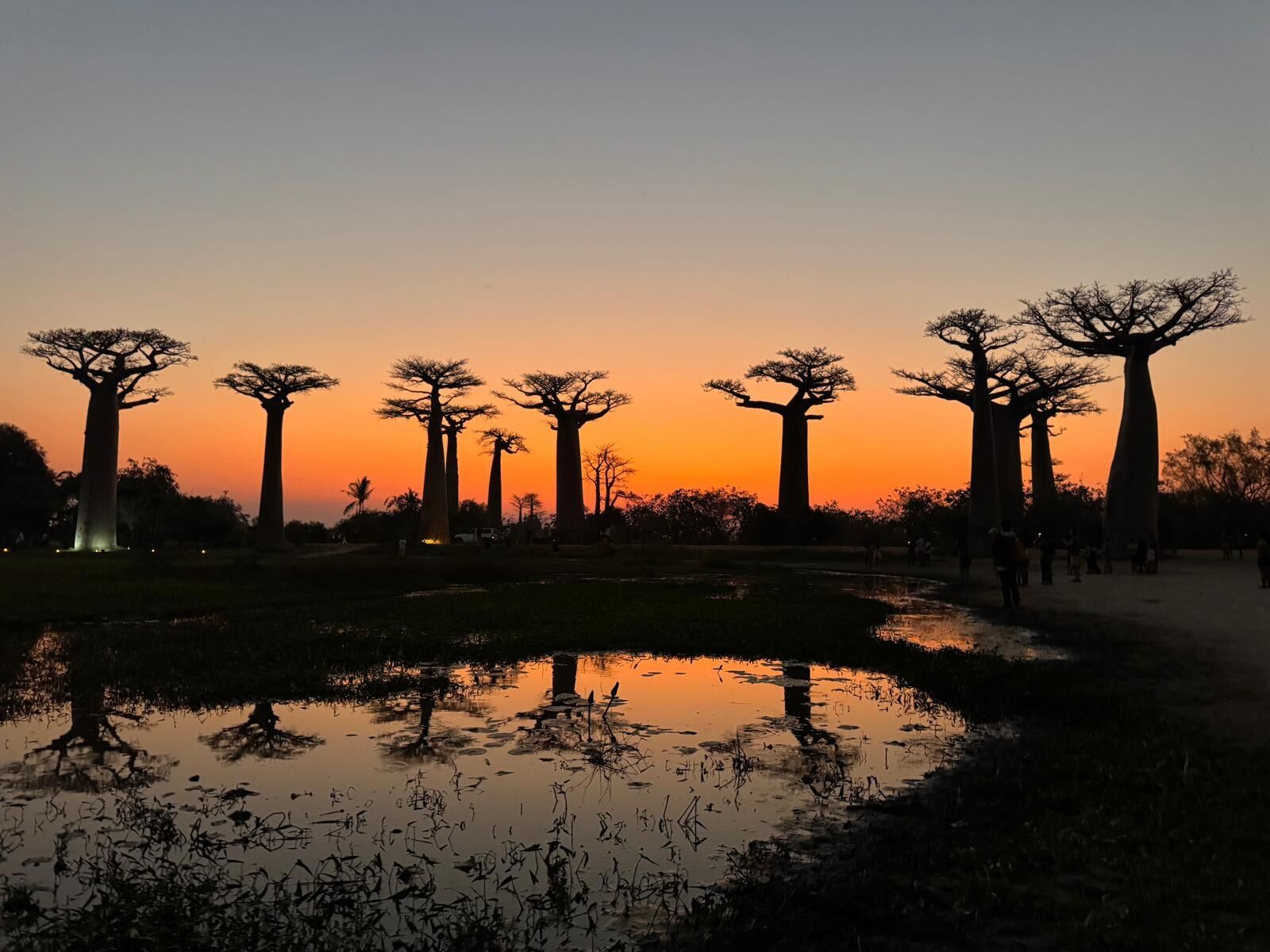
At sunset, Madagascar’s Avenue of the Baobabs seems eternal. Light changes the sky from gold to rose, leaving each colossal trunk silhouetted against a sky stretched broad and nearly empty.

Tourists gather with phones lifted while a drone hums lazily overhead. Young boys guide two-wheeled zebu carts pulled by oxen along a rutted track, wheels clattering through the powder-fine red dust. A child calls out to the cattle, cowbells answering in faint, irregular chimes. Laughter rises, then fades, giving way to a soft, layered chorus of evening insects.
Still, the baobabs do not move.

But tourists who linger long enough to get through these first feelings of wonder may soon notice that these giants are not as timeless as they seem. These trees cannot live forever, and around them, almost no young trees are growing to take their place.

Baobabs once naturally regenerated across Madagascar’s dry forests, but shifting climates, habitat loss, and the decline of key seed dispersers like lemurs and fruit bats mean trees no longer grow at the rate needed to replace the forests. To stand near the Avenue of the Baobabs today is to witness beauty layered with fragility. The ancient giants endure, but the conditions that created them are changing.

The importance of Madagascar’s baobabs


avenue of the baobabs - author and tree

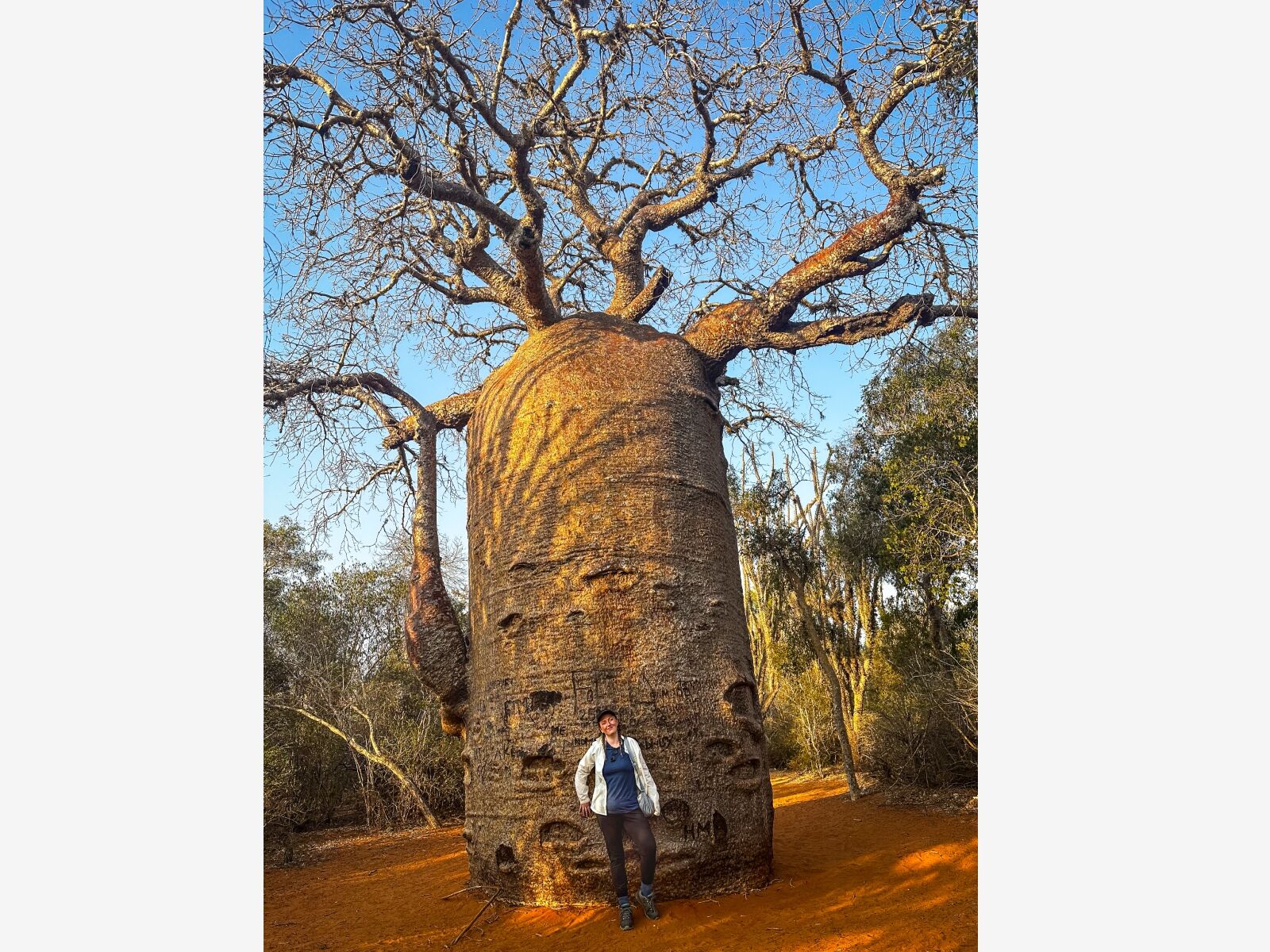
The author with a baobab tree in Madagascar. Photo: Rebecca Rayner

The Avenue of the Baobabs, now protected as a natural monument, is one of Madagascar’s most photographed landscapes. The tree species here, Adansonia grandidieri, grows nowhere else in the world. Some can reach nearly 100 feet tall, storing water deep in their trunks as reservoirs that sustain them through the long dry season.

Madagascar is the evolutionary cradle of the baobab family. Recent research suggests baobabs originated on this island around 21 million years ago, before dispersing to Africa and Australia. Today, six baobab species are found only in Madagascar. Some, like Adansonia perrieri in the north, have fewer than 250 mature individuals remaining in the wild. It’s a reminder of how narrow the future has become for parts of this lineage.

“Baobabs are truly keystone species in Madagascar’s dry forests,” says ecologist Dr. Seheno Andriantsaralaza, who has studied them for nearly 20 years. “They provide food, shelter, and water to a wide range of species — from insects to lemurs. For example, in the western dry forests, the red-fronted brown lemur feeds on baobab fruits. Many pollinators, especially bats and nocturnal insects, depend on baobab flowers for nectar.”


But the ecosystem around them has changed.

“Some of the primary seed dispersers that once helped regenerate baobabs have disappeared,” she explains. “Today, only secondary dispersers remain. This affects the natural regeneration of the species.”

Unfortunately, it’s not just the seed dispersers disappearing: Western Madagascar’s dry forests are disappearing rapidly, too. Slash-and-burn clearing to support subsistence farming is encroaching on national parks and conservation zones where farming is legally prohibited, driven by internal migration, prolonged droughts, and worsening economic pressures.

In the Menabe Antimena landscape, where the Avenue of the Baobabs is located, forest loss has accelerated in recent years as climate-related displacement pushes people toward remaining fertile land. And even areas with legal protections are feeling the effects. During the COVID-19 pandemic, when on-site management of protected areas was suspended for several months, fire activity inside reserves surged dramatically. It was a stark illustration of how quickly forests can become vulnerable when active protection falters. When patrols stop or firebreaks go unmaintained during the dry season, flames can spread unchecked for miles, destroying everything in their path.

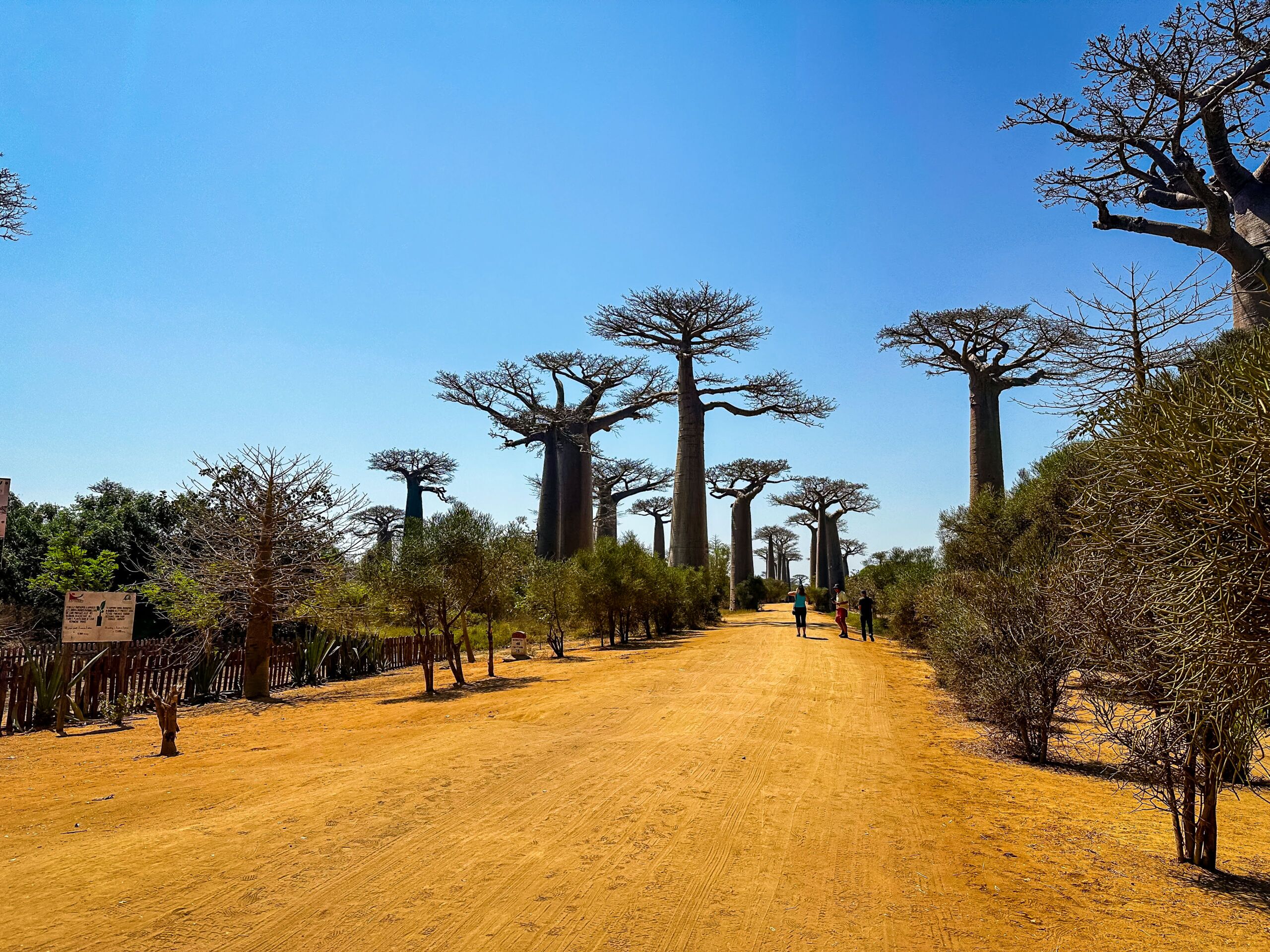
Avenue of the Baobabs during the day

Avenue of the Baobabs. Photo: Rebecca Rayner

It’s not based on a disregard for the trees or environment, but on survival. As one Malagasy tour guide, who has been leading visitors across Madagascar for decades, told me without accusation, “people burn because they need land to live. If the law does not protect the forest, it is because someone benefits from the destruction.”

In 2017, the World Wildlife Fund reported that approximately seven percent of the remaining dry forest where baobabs grow was lost to slash-and-burn clearing that year, with officials estimating an ongoing four percent annual decline due to human activity in some way. That damage is most obvious in places where people and the forest meet, where both are trying to survive.

Long-term conservation research in Madagascar has shown that forest protection is most effective when it supports local livelihoods rather than excluding them. In places where conservation creates economic and professional opportunities in fields like community management, sustainable resource use, or alternative income, forests gain long-term guardians.

Roughly a two-hour drive from the Avenue is Kirindy Mitea National Park, a vast protected landscape in western Madagascar that merges dry-deciduous forest, spiny forest, coastal scrub, and mangrove trees. It’s also home to three species of baobab: the famous Adansonia grandidieri, the shorter and squatter Adansonia rubrostipa (also called fony baobab), and Adansonia za, the most common baobab species in the country.


View this post on Instagram


A post shared by Madagascar Tourism (@my_madagascar)


At first, the forests of the national park appear lifeless. They’re bone-dry, with pale, leafless branches and a dry forest floor that cracks under footsteps. But with a bit of patience, you’ll start to notice lemurs, chameleons, birds, and the elusive fossa, Madagascar’s largest carnivore.

My guide here, who simply goes by Harry, works in tourism during the high season and on farms when visitors are scarce. “When tourists come, I work as a guide. When they don’t, I farm,” he told me. “I have to be both. The forest feeds my heart, but the land must feed my family.”

The people protecting the baobabs


In Madagascar, environmental protection is not driven solely from government offices, but from villages themselves. Community-based forest management groups known as Vondron’olona Ifotony, or VOIs, carry out much of the day-to-day work of organizing patrols, monitoring illegal clearing, and supporting forest restoration. It’s work that can carry real risk. Forest guardians across Madagascar, whether VOI members or park agents, have faced threats and reprisals for defending land and resources. It’s a danger underscored in 2021 by the mob killing of a forest officer during an anti-logging operation in eastern Madagascar.

Community-led conservation can fail in places where land and livelihoods are under pressure, particularly during periods of scarcity. The most successful situations are those where conservation offers alternatives for people, rather than just missing restrictions.

“When people feel ownership of the process and see direct benefits,” Dr. Andriantsaralaza says, “they protect the forest naturally.”

In Andranopasy, a local organization collects baobab seeds, raises seedlings, and returns each year to monitor when trees have survived. It’s called the Aro Baobab Association, supported in part by the now-dismantled U.S. Agency for International Development (USAID). The project is led by Dr. Andriantsaralaza, who says ensuring benefits to the community from conservation is one of its key values.

But tourism, too, plays a supporting role by strengthening these community systems. Money spent by tourists on local guides, site access fees, and community-run services and hotels helps fund patrol work, guide training, and restoration activities. It is not enough on its own, but when that money goes directly to communities, it helps turn conservation from an external, limiting mandate to a desirable force for good that supports local families.

sunset at the avenue of the baobabs

Photo: Rebecca Rayner


However, it’s not just formal conservation rules and the income potential from tourism that drives locals to protect the forests. There’s an older, deeply local form of guardianship in the region, called fady, translating loosely to “taboo.”

Fady are community-specific prohibitions rooted in Malagasy animist belief systems and the tradition of honoring ancestors, and they shape how people interact with animals, landscapes, and even individual trees. The rules vary widely across Madagascar, differing from region to region and community to community.

In many Malagasy traditions, nature is understood as inhabited rather than inert. Certain trees become sacred not simply because of what they are, but because of what they are believed to hold, such as an ancestral presence, spiritual power, or historical meaning. In western Madagascar, this means some baobabs are regarded as renala, meaning “mother of the forest.” These trees are respected and treated more like living elders than natural resources.

Such trees may be approached barefoot, wrapped in cloth, or have offerings left at their bases. Those are signs of the cultural fady that historically protected individual baobabs long before conservation laws existed. But those protections are not absolute or enforced, and under growing economic and environmental pressures, that cultural reverence alone is not enough to ensure their survival. Baobabs increasingly depend on deliberate human intervention to survive.

baobab planting sign

A sign encouraging visitor donations by sponsoring a baobab planting. Photo: Rebecca Rayner

Today, visitors can see clear signs that they can and should be part of the conservation process. On the Avenue of the Baobabs, there’s a small baobab seedling nursery that sits just off the road, with shade frames sheltering rows of young trees from the worst of the sun and wind. The nursery is operated in partnership with local ranger groups and conservation organizations, including the Malagasy nonprofit Fanamby and the international organization Women for Conservation. It is tended by patrollers who also help protect the surrounding forest.

For visitors, a hand-painted sign explains how it works: travelers are invited to purchase a baobab seedling for the equivalent of roughly $3, with the proceeds supporting KMMFA rangers, who patrol the Avenue of the Baobabs protected area. The seedlings are not souvenirs to take away, but young trees raised to replant nearby. It’s a simple idea that links visitor contributions directly to on-the-ground restoration and protection.

Without attention, the trees’ survival rate is low. “Young baobabs, especially seedlings, need moisture and shade to survive their early stages,” says Dr. Andriantsaralaza. “But with increasingly dry conditions and more frequent droughts, their survival rates are dropping sharply.”

How to visit the baobabs responsibly


daytime at avenue of the baobabs

Photo: Rebecca Rayner

The journey to the Avenue usually begins in Morondava, a coastal town where the air is thick with salt and rickshaws move between market stalls stacked with everything from mangoes to sunglasses. North of town, the asphalt gives way to red dust as the first baobabs appear one by one as solitary, unusual shapes rising from open grassland.

Farther on, the trees start to align, forming the Avenue itself. Even in the heat of empty afternoons, the place feels ceremonial, as if the giants arranged themselves to be as impressive as possible. The Avenue lies about 12 miles north of Morondava, and the drive typically takes 45 minutes, depending on road conditions. Four-wheel-drive or off-road vehicles are recommended due to the rough road conditions.

The best time to visit is during the dry season between May and October. Between November and April, the region’s wet season, the roads can become rutted and muddy – but it’s also when the landscape is greenest and there are fewer tourists.

Confident drivers used to navigating rough roads can rent a car in Morondava to visit independently, though the island’s international airport in Antananarivo is where most car rentals are based. Still, most visitors travel with a local driver or guide, usually arranged via tour operators or hotels in Morondava. It’s common to fold the Avenue into a longer road trip along the country’s west coast, combining it with the likes of Tsingy de Bemaraha National Park and Kirindy Mitea National Park.

There’s no formal entrance gate, fences, or ticket booth, as the Avenue is on a public road, but visitors typically pay a small parking fee of about fifty cents. If you can, visit twice: once at sunrise for quiet and softer light, and again at sunset for the famous silhouettes (as well as the crowds that come with them).

To visit the Avenue is to step into a landscape shaped as much by people as by trees — and to recognize that its future depends not just on the choices made by those who live there, but also those who are fortunate enough to pass through.

Discover Matador

Save Bookmark

We use cookies for analytics tracking and advertising from our partners.

For more information read our privacy policy.