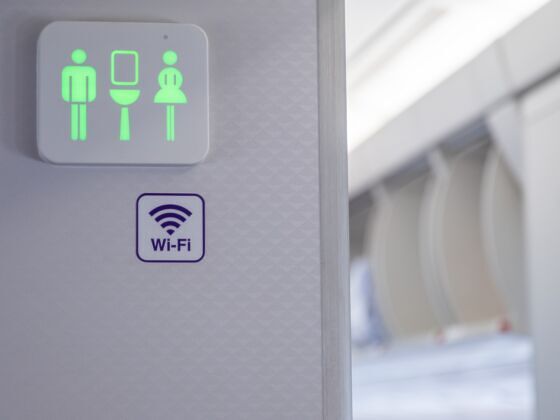
Photo: supakitswn/Shutterstock

Stop Washing Your Hands With Airplane Bathroom Sink Water, Says New Study

News Airports + Flying
by Nickolaus Hines Jan 13, 2026

It’s no secret that the coffee and tea served on an airplane is a no-go for travelers in the know. Water cleanliness when it comes to anything not served in a can or bottle is simply too suspect. Turns out, those same suspicions can be equally applied to the non-potable water coming from the bathroom sink.

A new study from the Center for Food as Medicine and Longevity suggests that passengers on airlines based in the United States shouldn’t wash their hands with airplane tap water. The analysis suggests onboard water systems pose too great of a contamination risk.

Specifically, the “bottom-line advice” to be extra safe is: “Do not wash your hands in the bathroom; use alcohol-based hand sanitizer containing at least 60 percent alcohol instead.”

Lavatory sinks, galley taps, and coffee makers all draw from the same aircraft tanks, according to the study, which are vulnerable to stagnation, temperature swings, and maintenance lapses. In data from 21 airlines between October 2022 and September 2025, 2.66 percent of 35,674 sample locations tested positive for total coliform bacteria, and there were 32 “Maximum Contaminant Level” violations for E. coli.

The study builds on a 2019 investigation into airline water quality and enforcement gaps in the Environmental Protection Agency’s Aircraft Drinking Water Rule. The new analysis examines recent federal compliance data for 10 major and 11 regional airlines, normalizing results by fleet size and combining violations, total coliform findings, E. coli events, public notices, and disinfection frequency into a 0 to 5 Water Safety Score.

Overall, major airlines fared better than regional. Among sample locations on large carriers, 1.89 percent of tested locations showed positive for total coliform, compared with 4.75 percent on regional airlines.

Why sanitizer beats a questionable tap

As popular as hand sanitizer became during the height of the pandemic, in most settings, public health agencies still emphasize washing with soap and clean running water. The Centers for Disease Control and Prevention specifies that when soap and clean water are available, they should be used first; alcohol-based sanitizer is recommended when clean water is not accessible.

The key word here is clean.

Aircraft bathroom water meets regulatory requirements some of the time, but the study found a stead number of violations for high levels of specific bacteria and E. coli. In that context, washing with soap and potentially contaminated water can bring pathogens into direct contact with your hands. That really becomes a problem for anyone who has small cuts on their hands or who are prone to touching their eyes, nose, or mouth shortly after washing.

Sounds easy enough to get around, but as a parent of a 3-year-old and an 8-month-old, I know there’s no getting around the fact that someone, at some point, is going to be doing one of those things shortly after washing.

The World Health Organization’s hand hygiene guidelines identify alcohol-based sanitizers as the preferred method for getting rid of bacteria in clinical settings when hands are not visibly soiled, because they act quickly and have broad microbicidal activity. Multiple studies in hospitals have found that alcohol-based products reduce bacterial contamination on hands more effectively than routine handwashing with soap and water, and are associated with lower infection rates when properly used.

Guidance from the Centers for Disease Control and Prevention for emergencies reaches a similar conclusion: when clean water cannot be guaranteed, alcohol-based products with at least 60 percent alcohol are an appropriate substitute to prevent disease transmission.

Under the Aircraft Drinking Water Rule, airlines must monitor for total coliform bacteria and, when they are detected, test for E. coli. Coliforms are bacteria commonly found in soil, on plants, and in animal intestines, and are easily transmitted through water. Presence alone doesn’t mean the infected substance is going to strike you with an extreme illness. They are, after all, a crucial part of many life cycles. Coliform detection does mean that the water has a higher chance for dangerous pathogen contamination, however.

E. coli is a coliform bacteria found in poop, and is a more serious warning sign. When E. coli is found in drinking water, it indicates contamination with human or animal waste and triggers a Maximum Contaminant Level violation under federal rules. Public health agencies link exposure to E. coli or heavily contaminated coliform water with diarrhea, abdominal cramps, nausea, headaches, and fever. Infants, older adults, pregnant people, and those with weakened immune systems are at higher risk. Severe cases involving certain E. coli strains can progress to bloody diarrhea and, in rare instances, kidney damage.

The airline study does not document specific disease outbreaks tied to aircraft water. Instead, it treats repeated coliform positives and dozens of E. coli violations across the fleet as a warning that there’s a pattern of risk.

Which airlines score best — and worst

Major Airlines

  • Delta Air Lines: 5.00 (Grade A)
  • Frontier Airlines: 4.80 (Grade A)
  • Alaska Airlines: 3.85 (Grade B)
  • Allegiant Air: 3.65 (Grade B)
  • Southwest Airlines: 3.30 (Grade C)
  • Hawaiian Airlines: 3.15 (Grade C)
  • United Airlines: 2.70 (Grade C)
  • Spirit Airlines: 2.05 (Grade D)
  • JetBlue: 1.80 (Grade D)
  • American Airlines: 1.75 (Grade D)

Regional Airlines

  • GoJet Airlines: 3.85 (Grade B)
  • Piedmont Airlines: 3.05 (Grade C)
  • Sun Country Airlines: 3.00 (Grade C)
  • Endeavor Air: 2.95 (Grade C)
  • SkyWest Airlines: 2.40 (Grade D)
  • Envoy Air: 2.30 (Grade D)
  • PSA Airlines: 2.25 (Grade D)
  • Air Wisconsin Airlines: 2.15 (Grade D)
  • Republic Airways: 2.05 (Grade D)
  • CommuteAir: 1.60 (Grade D)
  • Mesa Airlines: 1.35 (Grade F)

The report delivers a detailed scoreboard that is likely to get the attention of both passengers and carriers. Among major airlines, Delta tops the list with a perfect Water Safety Score of 5.00 and an A grade; Frontier follows at 4.80, also earning an A. Alaska ranks third with 3.85 and a B. At the bottom of the major-carrier list are JetBlue at 1.80 and American Airlines at 1.75, both graded D.

Regional airlines, which often operate shorter flights under big-brand names, show a more troubling pattern. GoJet leads this group with a 3.85 score and a B. But nearly all regional carriers land in C, D, or F territory. Mesa posts the lowest Water Safety Score at 1.35 (Grade F), while CommuteAir is second lowest at 1.60 (Grade D) — 33.33 percent of its sampled locations tested positive for total coliform.

Civil penalties for Aircraft Drinking Water Rule violations remain “extremely rare if at all,” the study authors write, noting that they were unable to obtain clear answers on penalties from the agency.

Given consistent coliform findings and episodic E. coli violations, passengers should treat aircraft taps as a last resort rather than a default. That means carrying a small bottle of alcohol-based sanitizer, relying on sealed bottled and canned beverages, and being aware that the water flowing into the lavatory sink is part of the same system feeding the coffee pot.

Discover Matador

Save Bookmark

We use cookies for analytics tracking and advertising from our partners.

For more information read our privacy policy.