Any who remember the Priceline Negotiator commercials are aware that quirkiness is kinda Priceline’s thing – and there’s not a brand better positioned to put a cool UI and UX behind an awkward tool to make it enjoyable for users. This quirkiness has entered the artificial intelligence era. Priceline’s new Neighborhood Navigator tool, launched as part of the booking platform’s Spring 2025 “Trip Intelligence: The Neighborhood Edition” update, uses proprietary AI to match travelers with neighborhoods that fit their personal “vibe,” interests, and passions. vCurrently available in beta across 35 locations (mostly big cities, though popular travel destinations like Maui are available), the tool lets users identify local equivalents to their favorite neighborhoods in different cities.

Priceline's Neighborhood Navigator Lets You Find Your Fav Neighborhood in a New City
Pros:
- Easily lets you find a neighborhood you’ll like based on what you like in your hometown
- Fast and easy user interface
Cons:
- Corny and repetitive comparisons
- Not all neighborhoods in a city are available to compare
Breaking down the features of Priceline Neighborhood Navigator
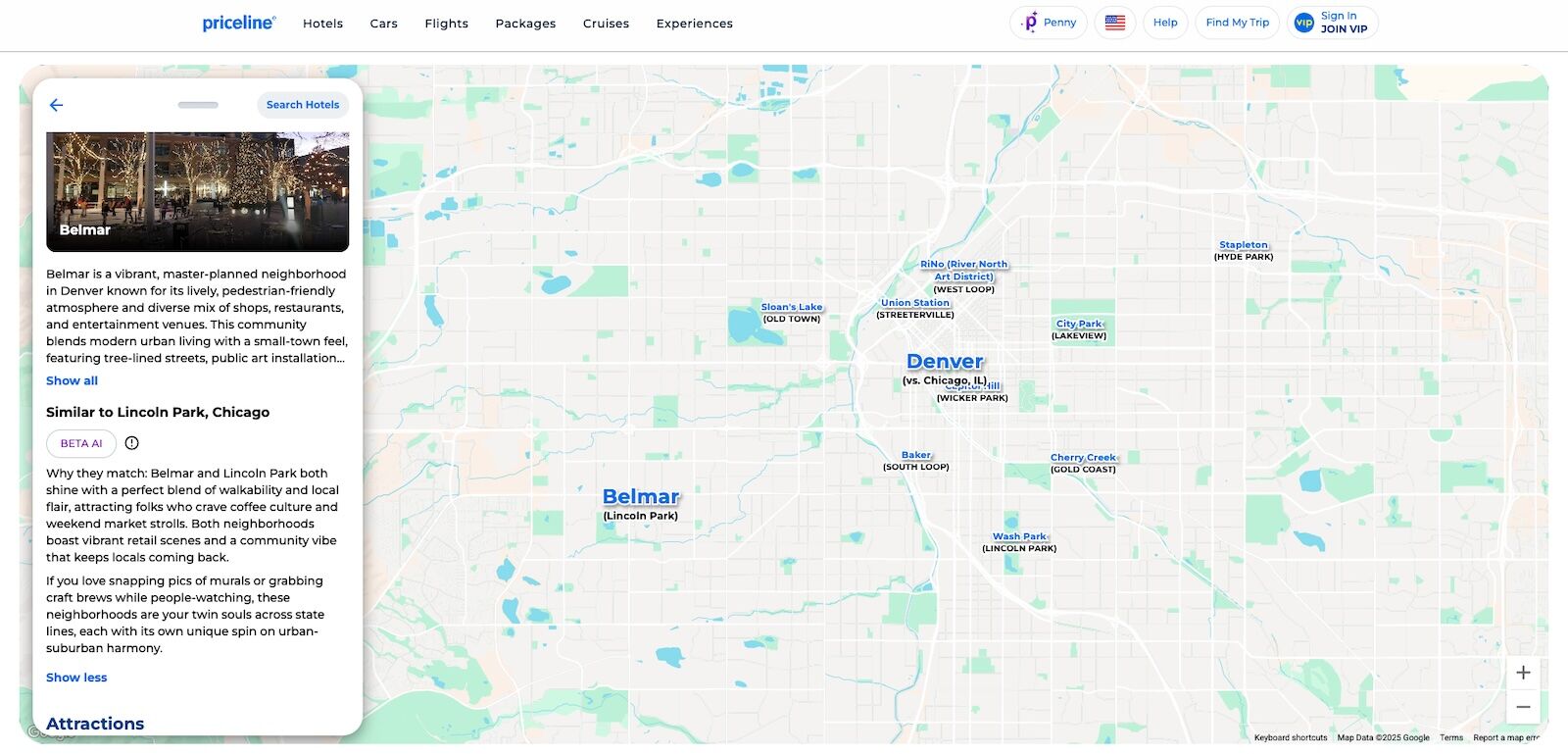
Screenshot taken from Priceline Neighborhood Navigator
The tool is built on AI that ingests information about specific neighborhoods and identifies similar traits in neighborhoods in other cities. Neighborhood Content Pages provide detailed AI-generated descriptions and activity suggestions, while the Trip Vibe Selector helps users match accommodations to their tastes—be it nightlife, food, or relaxation. The experience is further enriched with Penny Maps for planning and an integration with Turo for booking cars directly in chosen neighborhoods, all aiming to help travelers craft authentic, personalized trips beyond the tourist trail.
It’s standout feature, though, is the neighborhood comparison tool. It’s new, and not perfect, but I’d describe the tool as the digital recreation of a conversation between residents of two cities about the coolest spots in their town. “I like Capitol Hill because of its music venues and vegetarian cafes,” one Denver resident might say, to which her friend replies, “Oooh, then you’ve got to come to Wicker Park in Chicago.”
I visited Chicago for a conference in July, so my first test of the Priceline Neighborhood Navigator compared my hometown of Denver to the Windy City. Interestingly, it matched Lincoln Park in Chicago with Belmar, a master-planned outdoor mall in the west Denver suburbs. The tool is correct to say that the neighborhoods share features including walkability and a vibrant “coffee shop culture,” but the two areas are quite different in many ways. Most notably, Lincoln Park is in central Chicago and accessible on foot or transit from other parts of the city center, which Belmar is not. Nor is Belmar reachable via Denver’s light rail system. I did appreciate, though, that the tool noted both Belmar and Lincoln Park’s “unique spin on urban-suburban harmony.” Belmar might be out in the suburbs, but it’s a good implementation of what suburban life could look like in an ideal world where people are more apt to get out of their cars and walk around.
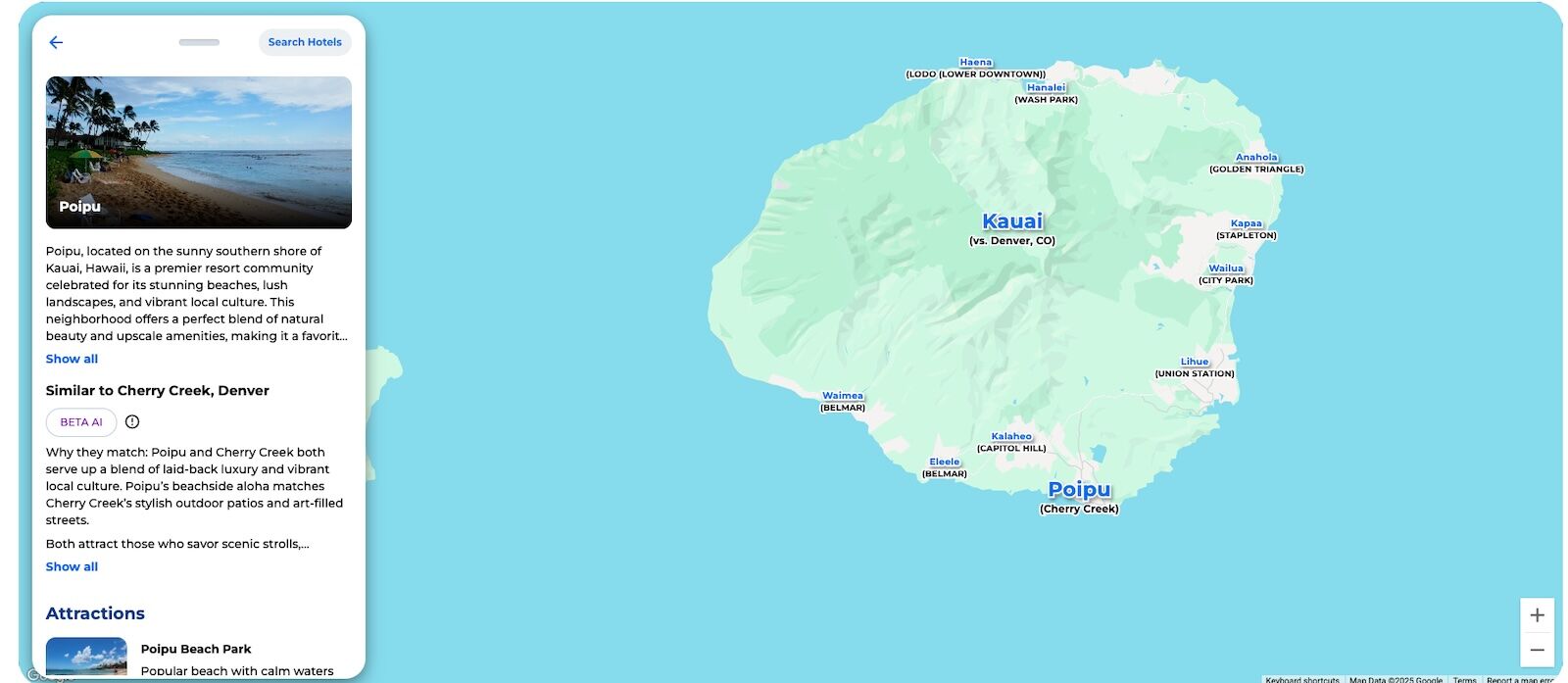
Screenshot taken from Priceline Neighborhood Navigator
The Neighborhood Navigator tool matched Denver’s Capitol Hill neighborhood with Wicker Park in Chicago. This match makes a lot more sense – both are dense, central urban districts home to music venues, boutiques, and long-running restaurants beloved by locals. And, both neighborhoods are frequented by travelers and have lively LGBTQ+ scenes. Each optimizes urban culture while remaining a step removed from the hecticness of downtown.
Other aspects of the Priceline Neighborhood Navigator are a stretch. Comparing Denver to Maui is tough – there are few things in common for travelers in these destinations. But, it could be useful for identifying where you’re likely to find your neighbors vacationing. The tool does its best, matching Denver’s notoriously high-end Cherry Creek neighborhood with the glitzy resort community of Poipu. Lihue matched with Union Station as both are transit hubs. I failed to see the connection in matching the remote north shore town of Haena with Denver’s posh Washington Park.
Where I’d like to see the Priceline Neighborhood Navigator tool evolve
-
- As the tool develops, it’d be immensely helpful to dive deeper and match restaurants, music venues, pubs – the places that make a neighborhood shine.
- The descriptions of neighborhoods gets a bit repetitive. Nearly every neighborhood comparison I read breaks neighborhoods into cliches like “a mix of unique boutiques and hipster urban flair.” It’s generally accurate in matching neighborhoods but the AI behind it could be better trained on demographics and cost of living in those neighborhoods (Denver’s Belmar and Chicago’s Lincoln Park wouldn’t pair as well in the case of the latter).

