There is a certain resignation that sets in when you book a flight in 2026. If you’re like me, you flat-out refuse to fly any airline other than the one you hold a credit card from because you firmly believe that’s the only way to minimize anxiety around flying. I’ll take that free checked bag and a couple lounge passes, yes, but what I really want is a Premium Economy seat so I can get off the plane in under 30 minutes and Group 2 boarding so I know there will be bin space available when I get on.
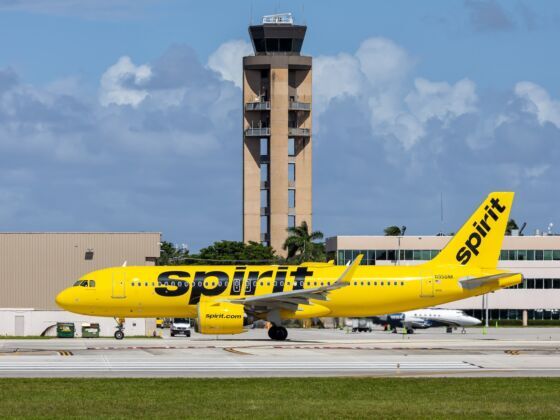
Photo: https://www.shutterstock.com/fr/g/markusmainka/Shutterstock
If you don’t have airline status, that resignation starts as you toggle between tabs, watching prices that bear no resemblance to the cost of a flight five years ago. You squint at upgrade options. You decide whether you’ve become the kind of person who pays $80 for a reserved seat. And underneath it all, you quietly accept that flying has become something the middle class does carefully, and the working class does rarely, if at all.
That resignation is the soil Hunter Peterson is planting in.
If you missed it: Peterson, a voice actor and social media personality, watched Spirit Airlines announce the orderly wind-down of its operations on May 2 and posted a video proposing that regular people buy the carcass and run it themselves. Here it is:
He framed it like this: There are roughly 250 million American adults. If 20% of them put in $30 or $40 — about the price of a Spirit ticket — there would be enough capital to acquire the airline and operate it as a democratically governed entity, one shareholder, one vote, modeled on the Green Bay Packers. Within 48 hours, his website had collected nearly 150,000 email signups and roughly $88 million in non-binding pledges. It also kept crashing under the traffic.
I want to take the proposal seriously, and I also want to be honest about what it is and isn’t because Americans deserve a better way to fly as much as the industry needs a diverse approach.
What it isn’t: a deal. Eighty-eight million dollars in soft pledges is not a bid. Spirit’s debt load runs into the billions. Private equity is already at the door, and private equity moves faster than viral momentum. The history of cooperatively owned airlines is, frankly, a graveyard — People Express, the various worker-ownership experiments at United and others, all eventually swallowed by the same forces that swallowed Spirit. There is no clean precedent for what Peterson is sketching, and the Packers analogy, while emotionally attractive, papers over the fact that the NFL is a regulated cartel with guaranteed revenue sharing and no fuel exposure. An airline is none of those things.
What it is: the clearest signal in years that Americans understand, at a macro level, what has happened to commercial aviation, and that they are looking for a way to fight back. In the past year, all four legacy carriers (including Southwest) have publicly reoriented around premium cabins. The phrase “premium leisure traveler” now appears in earnings calls the way “growth” used to. Jet fuel prices have stayed elevated through the U.S.-Israeli war with Iran. Spirit, for all its baggage-fee jokes, was the last meaningful price discipline in the domestic market. Its absence is not a market correction. It is a market consolidation, and consolidation in a sector with this much regulatory capture means the price floor moves up and stays there.
Peterson’s proposal matters less as a business plan than as a referendum. The 150,000 people who signed up in 48 hours are not really voting to buy an airline. They are voting against a future in which flying to see your grandmother is a luxury good.
So here is my position. I will commit $100 to being a shareholder if this gets past the signal-gathering stage and into something real. And I will ease up on my United loyalty: the status, the card, the default booking behavior, to the degree that a credible alternative exists. Not because I think a crowd-owned Spirit will out-execute United on operational reliability. It almost certainly won’t, at least not at first. But because the question of who owns the infrastructure of American mobility is not a question I want decided exclusively by the faceless names running my IRA.
The case for putting $100 behind a long-shot is not that the long-shot will win. It is that the act of putting money behind it is itself a vote. A small, legible, market-readable signal that there is a constituency for a different kind of air travel, and that this constituency is willing to stop subsidizing the alternative with its loyalty.
The legacy carriers have spent a decade teaching us that we are a price-insensitive premium market. Peterson, accidentally or not, is testing whether that is true.
I would like the answer to be no.
Trending Now
What to Do if an Airline Loses Your Bag
Sep 9, 2026
Sponsored
RatePunk Review: Can an Algorithm Catch Your Foliage Fare Before It Disappears?
Sep 4, 2026