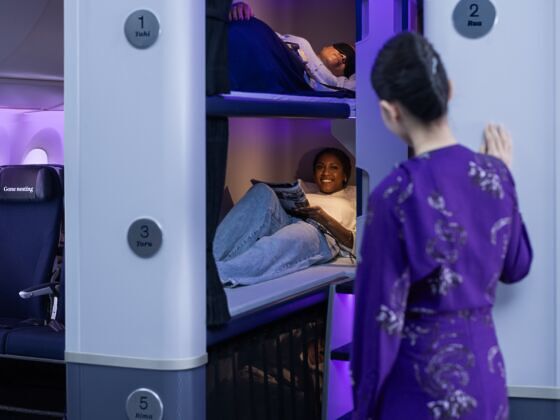
Photo: Air New Zealand

Air New Zealand Is Bringing Bunk-Style Sleeping to Economy Class

New York City Auckland Airports + Flying
by Suzie Dundas Apr 14, 2026

For decades, the ability to lie flat on a plane has been one of the clearest dividing lines between premium-class seats and everyone else on the plane. It usually meant having to pay thousands of dollars for an upgrade, or flying one of the few airlines that offers the opportunity to buy a full row in economy class (currently limited to Air New Zealand and, soon, United Airlines).

Air New Zealand was the first to introduce the “SkyCouch” in 2011, allowing passengers to pay a premium for an empty row that converts into a padded bed. However, it just announced an even more sleep-focused version, to be called the “Economy Skynest.” And it’s priced for economy-class customers.
A “world-first” for economy passengers

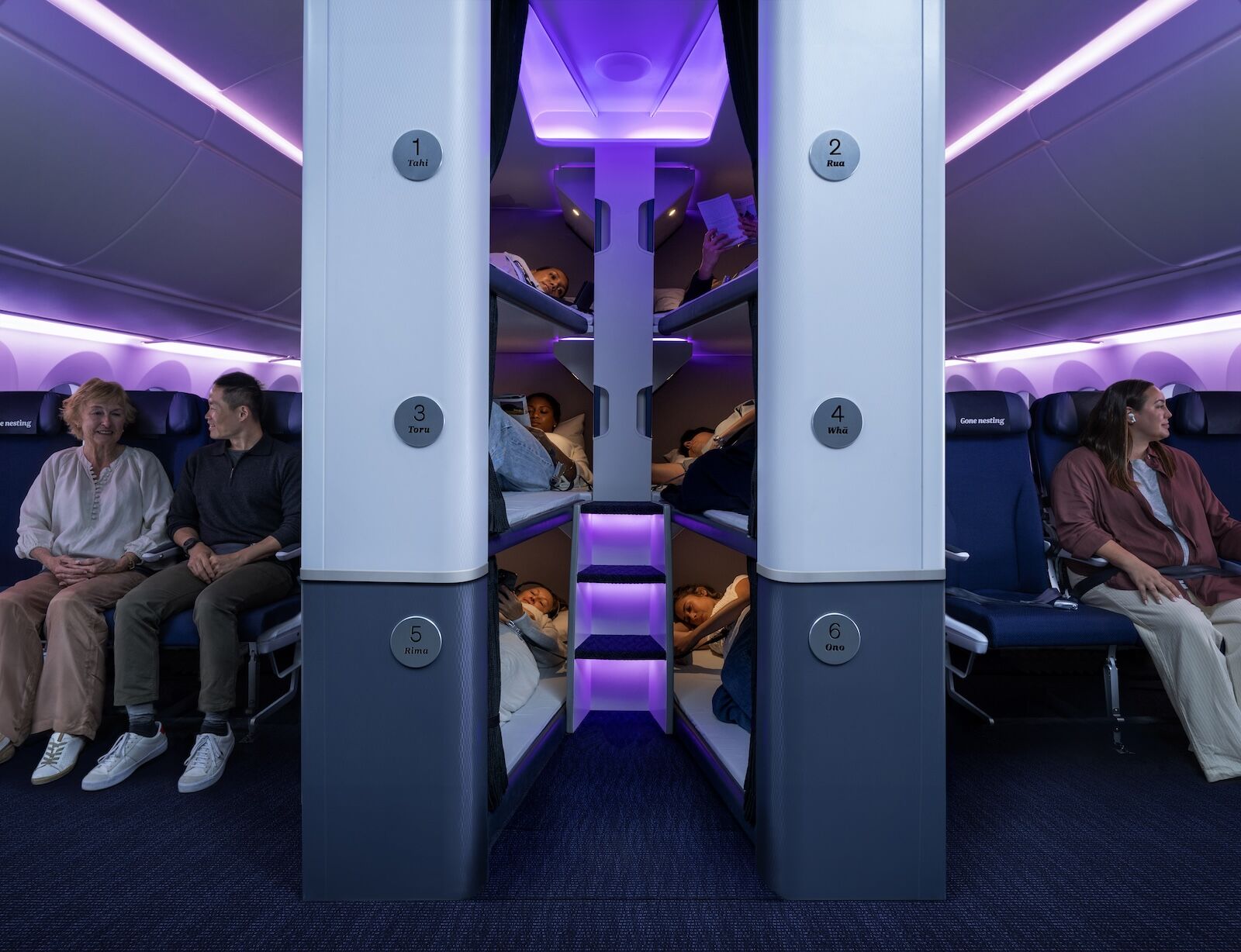
The Economy Skynest is different from the Skycouch. Rather than being a customization of an economy-class row, it’s a separate section of the plane with pods available to economy passengers. It’s planned to open for booking in May 2026 for flights launching later this year between New York City and Auckland (which will be one of the longest commercial routes in the world). The pods are arranged in a bunk-style layout between the economy and premium economy cabins.

Unlike the Skycouch, passengers won’t book the pods for the entire flight. Instead, passengers can book the Skynest in four-hour blocks, selecting a reserved time to leave their seat and climb into their pod, which they can select at the time of booking. All Skynesters rotate at the same time, so you won’t be two hours into your sleep session while someone new is climbing into the bunk above you. According to the airline, sessions are scheduled around meal times, and Skynesters will be given notifications on their seat-back screens when it’s almost time for their session to begin. Crew will refresh each Skynest between users, and each pod has a full-length mattress, fresh bedding, ambient lighting, ventilation, and charging ports, along with a privacy curtain. There are no entertainment screens, and headphones are mandatory for anyone that wants to use a screen or listen to music.

Pricing for the Skynest experience starts at $495 USD and includes an amenity kit with items like an eye mask, ear plugs, socks, and basic wellness items.

How it’s different from lie-flat seats


On paper, Skynest offers something familiar: a flat bed. But in reality, it’s a totally new concept. Traditional lie-flat seats, whether they’re in first class or an economy bed concept, are part of a passenger’s assigned seat. In the case of first class, the lie-flat bed is just one perk of a more expensive package that includes other luxe perks like better dining and priority access. But Skynest is a totally separate section of the plane where users come and go, positioning it more as an add-on versus a replacement for a standard seat. And unlike standard seats, the pods are stacked vertically in a bunk bed-style design, more akin to hourly sleeping pods available in some airports. This means that Skynesters may need to crouch or climb a ladder to get into their assigned pod, which are stacked three high. Flyers are only allowed to book on session per flight.

It mirrors an ongoing shift toward premium services

The launch reflects a broader trend in air travel toward airlines offering premium and premium add-on experiences. Skynests fit into that, but are targeted more at the middle class/upper middle class traveler, rather than targeting flyers who can spend several thousand on a single flight.

The flight from New York to Auckland is expected to take roughly 18 hours, and will leave New York City in the evening. According to jet lag calculators, the best time to sleep to maximize your adjustment to New Zealand time is toward the second half of the flight, so you wake up roughly early morning Auckland time. With just six pods and two four-hour sessions in each available, this means it’s likely the best time slots will get taken quickly, which could encourage early bookings.

While it’ll be available on just a few flights for now, it could function as a proof-of-concept test to see if it’s popular with more budget-conscious flyers. But if nothing else, it’s one of the first times the luxury of a dedicated sleeping space has been available to non-premium class travelers — and could be an indicator of the future of airplane design.

Discover Matador

Save Bookmark

We use cookies for analytics tracking and advertising from our partners.

For more information read our privacy policy.