More hotels are converging on the same LEED-driven biophilic design. This is, to borrow one of my favorite phrases from a former US president, “a big f*king deal.”

Photo: Sugar House Hotel
Marriott's First All-Electric Hotel Tells You Where the Industry Is Headed
Every time I book a hotel now, I search its website for a sustainability page. Not because I’m shopping for a halo (I sat on a Destination Marketing Organization board for years and watched how cheaply “green” gets slapped onto anything related to tourism) but because the info I hope to find there is pertinent to my stay. Are there EV chargers? Is there a restaurant and what do its menu and sourcing look like? How close is the property to public transit?
With increasing frequency, I find this information on a page, or at least a drop-down tab within a page, outlining the hotel’s environmental ethos. I see less and less nonsense about reusing towels and minimizing housekeeping. Still, when a press release lands promising the first all-electric, net-zero energy, LEED Platinum hotel in Marriott’s entire global portfolio, my default is skepticism first, credit second.
Sugar House Hotel, opening this fall in Winooski, Vermont, earns the credit.

Photos: Sugar House Hotel
The property runs on geothermal heating and cooling, a high-performance building envelope, and solar. There’s no gas line, no combustion, nothing to offset later because there was nothing to burn in the first place. Fathom Companies is managing it as part of Marriott’s Tribute Portfolio, backed by Vermont developer Nedde Real Estate and Lodging Capital Partners.
“By pursuing LEED Platinum and net-zero energy status, we are working to prove that the future of hospitality can be both environmentally sustainable and financially successful,” said Doug Nedde, the project’s principal. In short, this was underwritten as a business decision, not a marketing line.
What actually sold me, though, is the design logic. The lobby’s spiral staircase is anchored by a mantel salvaged from the old North Hero drawbridge. The 115 rooms are named for local sugarhouses. Local metalworkers, glassblowers, and woodworkers contributed to the interior. It’s the same instinct driving Aparium Hotel Group’s Populus properties in Denver and Seattle — biophilic architecture, reclaimed and low-carbon materials, and a notable lack of parking. Populus Denver, developed by Urban Villages and designed by Studio Gang, has diverted 14 tons of food waste from landfills through an on-site biodigester and partnered with the National Forest Foundation to plant a tree for every stay. Hotel Marcel in New Haven, an adaptive reuse of Marcel Breuer’s Brutalist Pirelli Building, owned by Becker + Becker and flagged under Hilton’s Tapestry Collection, runs entirely fossil-fuel-free and is saving its owner an estimated quarter-million dollars a year in energy costs.
None of them share a developer, a brand, or an operator. Marriott, Hilton, and independent operator Aparium are not coordinating. What they’re doing is arriving, separately, at the same formula: aggressive decarbonization plus a building that tells a local story instead of a corporate one. It’s a market signal when three unrelated companies converge on the same playbook without talking to each other.
Here’s where I have to be honest about the data, because the industry’s own research complicates the easy version of this story. Booking.com’s 2026 sustainability report found 85 percent of travelers say sustainable travel matters to them. Skift’s research for 2026 found something closer to the truth of how people actually behave: 78 percent say sustainability will factor into their decisions, but only 24 percent actively seek out sustainable options and accept a trade-off to get them. More than half will still pick the faster, higher-emissions flight.
“Hotels like the ones I’m discussing here are removing that gap. When the best hotel available doesn’t give you a choice on the matter, you’re going to book the more eco-friendly option by default.“
-Tim Wenger
The hotel isn’t asking a guest to accept a trade-off. Nobody staying there is sacrificing hot water or convenience for the geothermal wells under the parking lot — they’re getting a maple creemee at check-in and a rooftop restaurant suspended above a nature preserve. The effort that went into that is invisible to guests in exactly the way it needs to be to actually scale. That’s the actual lesson in the data: people don’t reliably choose inconvenience for the planet, but they’ll happily choose a well-designed hotel that already made the harder choice for them.
The other tell is where Marriott chose to plant this flag. Not Manhattan, not a coastal flagship market, but a 115-room property in a Vermont mill town best known, until now, for being five minutes from Burlington. A portfolio the size of Marriott’s, with more than 30 brands and a standing target to cut landfill waste company-wide, doesn’t burn its “first-ever” milestone on a market that can’t support it unless the underlying economics already pencil out. Corporate hotel groups don’t experiment in small markets to lose money; they experiment in small markets because the capital risk is lower and the story travels regardless of zip code.
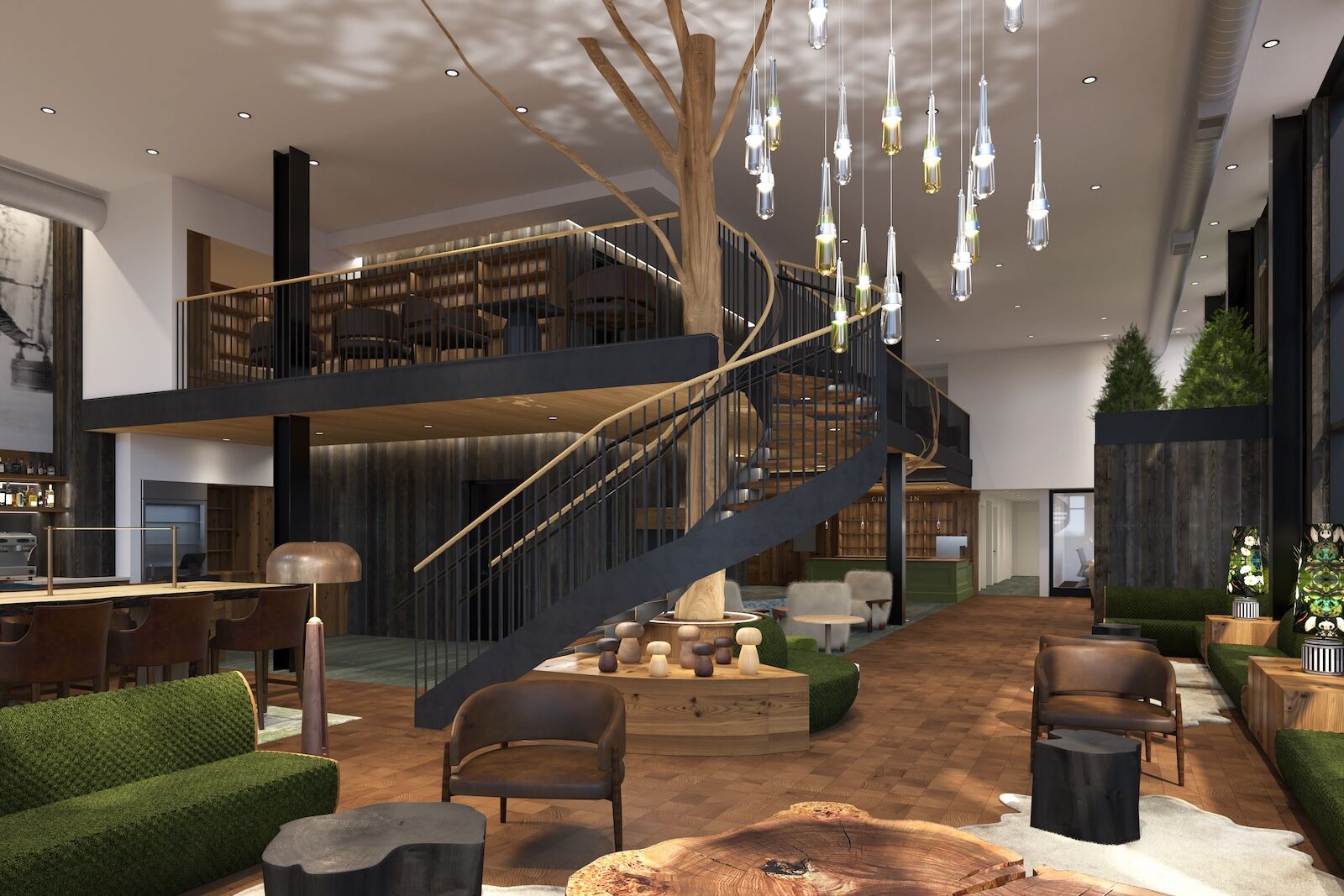
Photo: Sugar House Hotel
I’d love to be wrong about how rare this still is. But the fact that they’re popping up inside Marriott, Hilton, and an independent operator simultaneously tells me the exception is becoming the baseline expectation for what a well-capitalized new hotel is supposed to look like. There are others that are striking the same chord — Limelight’s new Boulder property is a great example. Despite what the daily headlines about climate rollback and ESG retreat would have you believe, the actual capital being poured into concrete, geothermal wells, and reclaimed drawbridge timber says the industry is still betting that travelers want this. I hope Sugar House is the first of many more hotels in corporate portfolios willing to make that bet. 
Subscribe to Matador Network’s
Free Insider Travel Substack