Stars have stories. Looking up into the northern Arizona sky, I could see them in all their diamantine thousands. But this was the Grand Canyon. I was in Navajo territory. I wasn’t seeing the Big Dipper but Náhookòs Bi’kà, the Male Revolving One, leader and protector. He sits opposite Náhookòs Bi’áád, the Female Revolving One, whose stars are those of Cassiopeia, representing motherhood and regeneration. Between them is the North Star, or Náhookòs Bikò’, the Central Fire.
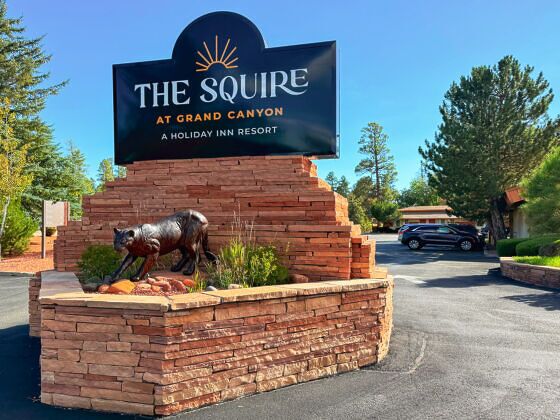
Photo: David Perry
Calling All Photographers: Night Is the Right Time at This Grand Canyon Hotel
Living in New York City, I’m lucky to make out one star, much less a constellation. This is why I headed west to The Squire at Grand Canyon in Tusayan, the gateway to the South Rim of Grand Canyon National Park.
A national park becomes a Dark Sky Park, and its southern gateway grows
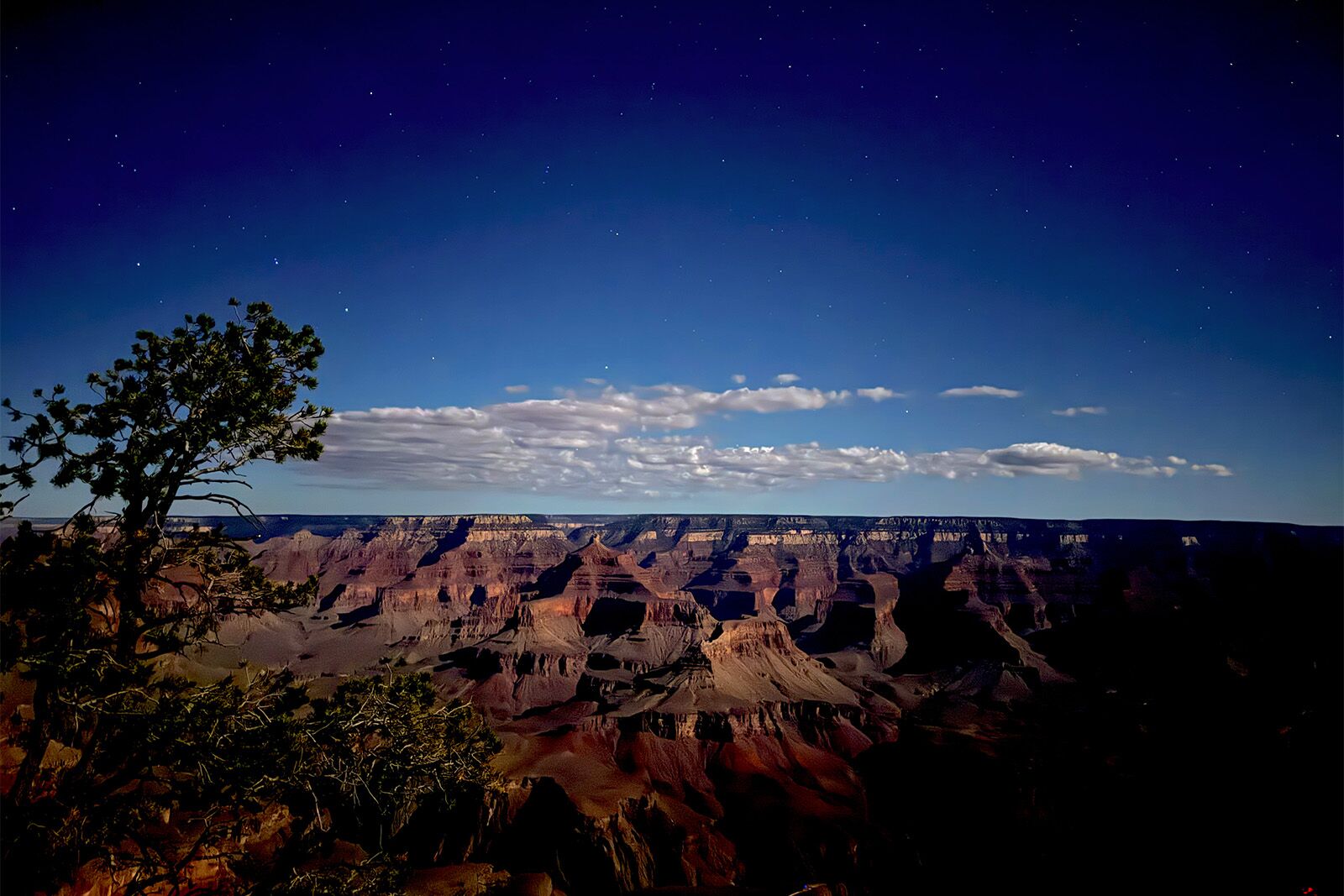
Photo: David Perry
To be sure, the Grand Canyon is made for daylight. Over five million years, the Colorado River carved a masterpiece of cliffs and crags 277 miles long, 18 miles wide, over one mile deep, with two billion years of geological history revealed. Visitors and photographers cram the viewpoints from dawn to dusk. But in 2019, the Grand Canyon also became a certified International Dark Sky Park, taking measures to keep its night free of human-made light, and it became one of the best sky-watching sites in the country. Tusayan plays along, collaring lampposts to direct light down.
Essentially, Tusayan is the bedroom community of the Grand Canyon. First a smattering of tourist stops and hotels, it has since become a tidy, well-manicured, and fully fledged town with tourist stops. But as the IMAX theater at the Grand Canyon Visitor Center, the canyon shuttles and Hummer tours, and the morning-to-sunset sightseeing planes and helicopters flying overhead from Grand Canyon National Park Airport indicate, these are not buy-a-keychain tourist stops.
In every way, Tusayan and the Grand Canyon operate in tandem. If you want to tour the canyon, pick a card — you can hike it, bike it, drive it, raft it, ride it on horseback, or take an aerial tour. I did the first three, but I was wiped out by sunset. I needed food, water, and a serious power nap on a queen-sized bed with a thread count off the charts. Enter The Squire at Grand Canyon.
A hotel that honors its setting: The Squire at Grand Canyon
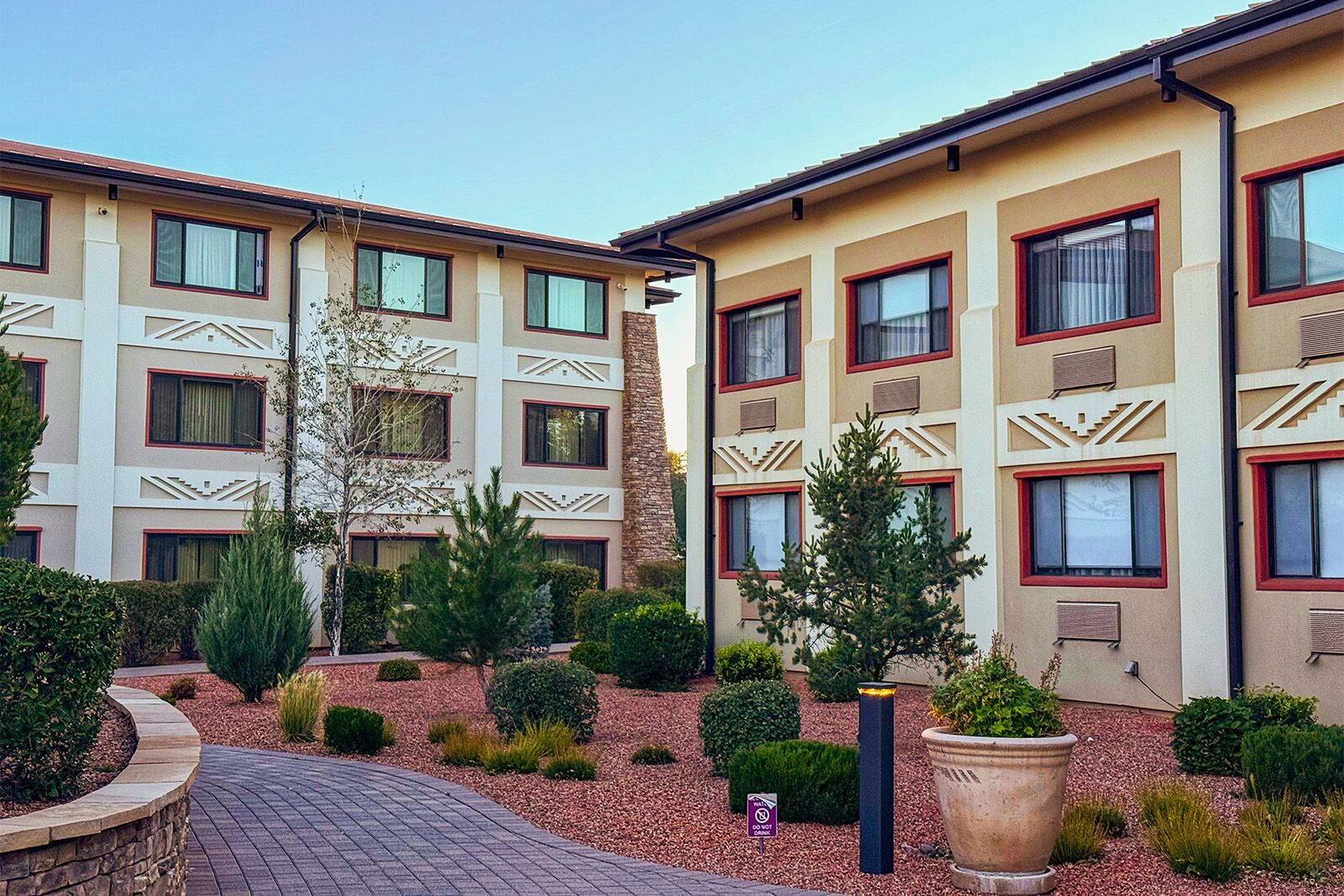
Photo: David Perry
Opened in 1965 as the Squire Inn, what’s now known as The Squire at Grand Canyon was one of the first full-service hotels on the South Rim. By 1974, the Squire Inn was renovated and expanded to accommodate the growing visitors to Grand Canyon National Park.
The hotel took on its current name in 2025 and now counts eight guest buildings, two pools, an arcade, and four dining venues (the signature Desert Lounge + Grill for American fare, Canyon Room for breakfast and boxed lunches, Squire Pub + Social for pub grub plus bowling and games, and Watchtower Pool + Patio for alfresco drinks and quick bites). From movies by the indoor pool and s’mores by the fire pits to e-bikes, it’s clear that The Squire at Grand Canyon never met an amenity it didn’t like.
Neither has the hotel failed to meet a responsibility. It’s acutely aware of its location, and I don’t mean the Grand Canyon. The pottery, kachina dolls, statues, and geometric design of the check-in desks all bespeak of Navajo aesthetics (the reservation is just a few miles east). Food is sourced locally within Arizona, while prickly pear and chipotle dot the menu, a nod to native foodstuffs and the historic Mexican presence. Photos of local history hang on the walls.
Considering the American Southwest is in a 25-year megadrought, the hotel also does its part to save water. Guests can opt not to have their sheets and towels changed (a choice I welcomed). Reclaimed grey water is used in the toilets and irrigation. The Squire at Grand Canyon has an overarching nature-friendly mission beyond light and water, replacing plastic with glass and aluminum, while bath amenities are refillable. In service to skywatching, much like the lamposts in Tusayan at large, the outdoor illumination at The Squire at Grand Canyon also points down.
After sunset in the South Rim: Night photography in the Grand Canyon
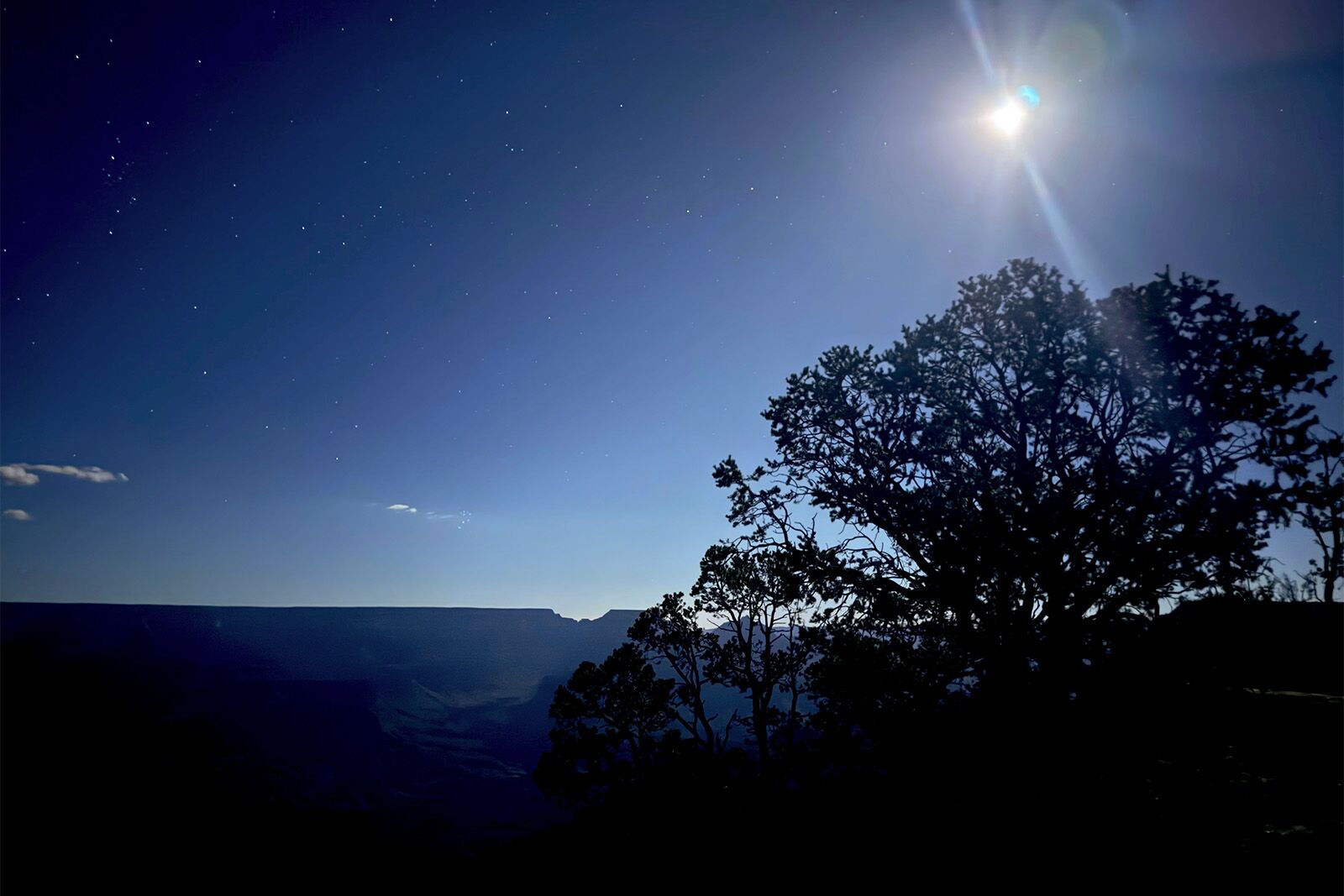
Photo: David Perry
Long the province of professional photographers with professional equipment, night photography requires a large degree of finesse, which today most modern cameras can take care of by themselves thanks to the switch from film to digital technologies. Some things, however, remain the same: to capture stars, camera shutters have to remain open for several seconds (at least) to let in a maximum amount of light. It also has to be dark; however subtle to the human eye, skyglow (light pollution that washes out stars) bleaches long-exposure photos. When I started night photography two years ago, doing it in the countryside was a given.
The Grand Canyon is nothing if not the countryside — it’s in the middle of nowhere. After a power nap at The Squire, I set my sights on Yavapai Point, Hopi Point, and Yaki Point in the South Rim, all of which have vistas that jut out into the canyon free of trees. Grand Canyon National Park is open 24 hours (I still had to pay the basic seven-day $35 fee) and was so gloriously dark that I needed a flashlight to avoid tripping — much of the South Rim Trail does not have a protective rail, and that first step is a doozy.
Setting up at Yavapai — having consulted the Native Skywatchers Project, an online resource preserving Indigenous astronomy — the plan was to first find the distinctive “backwards three” shape forming Náhookòs Bi’áád (Cassiopeia) to orient myself, and then stay for the next three days. I almost couldn’t find it. I was agog at how many stars appear when there’s no competing light pollution, as well as how quickly a 45-mile-per-hour gale can come out of nowhere.
The Grand Canyon cleaves through the 130,000-square-mile Colorado Plateau, whose high elevation and low humidity all but guarantee clear skies. However, its relative flatness means there’s nothing to stop a breeze once it starts. A good night photo not only requires the camera shutter to be open for a certain amount of time but also that said camera be still. Both are tall orders when your monopod (a single-legged support used to stabilize a camera) keeps blowing over. I’d traveled across the country, found a crystalline night sky to photograph, and was stymied by wind. I was vexed.
But as I pulled back into The Squire parking lot, I spied possible salvation: Forest Service Road 302.
Finding the perfect spot to shoot the stars
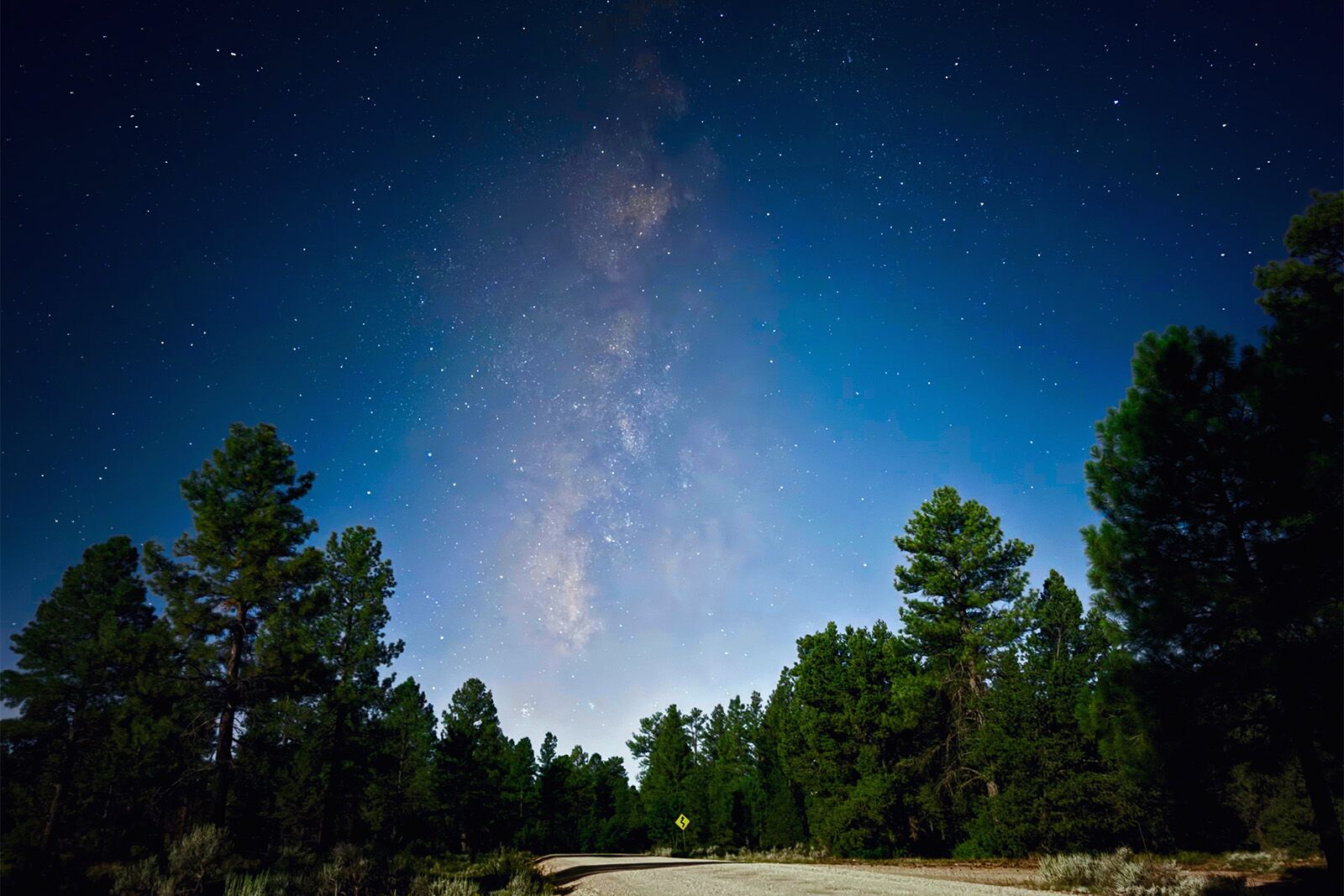
Photo: David Perry
Across Route 64 from The Squire at Grand Canyon, Forest Service Road 302 is a dirt lane heading deep into the Kaibab National Forest, a swath of ponderosa pines hugging both rims of the Grand Canyon. Taking a gamble, I hiked in and found that the trees blocked the wind enough that my equipment held still, although I did switch my camera for my smartphone to lessen my monopod’s top-heaviness (Night Mode technology really is that good). Tusayan vanished into darkness just a quarter mile down the road.
Because so many stars were out, it was difficult discerning one constellation from another. I planned for this and focused on big things in the night sky. After a few shots of the moon, I turned my lens west, past Náhookòs Bi’áád (found her) to where Yikáísdáhá, the Milky Way, towered over the ponderosas. To the Navajo, our galaxy is “That Which Awaits The Dawn,” a constellation by itself whose journey across the sky represents completeness.
Western and Navajo asterisms (groups of stars) are very different until they aren’t. The last stars of Átsé Ets’ózí — the First Slender One, or Orion — were quickly setting because father-in-law Átsé Etsoh — the First Big One — was rising. The two don’t get along. Similarly, Orion flees his nemesis Scorpio, whose claws form Átsé Etsoh.
I looked over my images back at The Squire. It was a little past midnight, and given that the hotel is as family-oriented as the Grand Canyon itself, it was quiet. Some of my images were hopelessly blurred from the wind, while lunar flare ruined others. But ask any photographer: you’ll take 100 photos to get just a single good one (although more photos than I was expecting turned out great). With its silvery rays, the moon looked like a pulsar, and the Milky Way was an arc of light against the firmament. So many people had seen those stars, just as our own sun is a point of light in some other world’s night. Stars have stories, and as I turned out the lights and drew the covers up, I wondered what new ones were out there. 