12 Essential Gear Items for Travelers Who Run on Vacation
For many adventurous travelers, hitting the road is a chance to go somewhere new and take advantage of a new activity. That’s true for anyone who’s ever backpacked in a national park, flown cross-country for a ski trip, or driven across their state for a camping weekend.
However, there are a few sports out there that are a lot easier to do just about anywhere — like running. That makes it one of the best ways to stay active on vacation, whether it’s a 30-minute workout in a hotel gym or an outdoor run in a new city before you start sightseeing for the day. However, with the cost to check bags and the competition for overhead bin space, bringing items like extra running shoes and clothing can sometimes be a little difficult to pull off. Fortunately, the best travel running gear isn’t one or the other: it’s running gear that pulls double-duty as travel gear.
Below, our writers and editors tested some of the most popular running gear on the market, judging not just whether it works for pounding the pavement, but whether it was useful while traveling. From running shoes that podiatrists swear are the absolute best for walking around new cities to moisture-wicking shirts that can stand up to days of activity without needing to be washed, this is the best travel running gear we’re excited about right now. We feel confident that the gear below will help most travelers stick to their running routines while away from home, whether they’re running on a hotel treadmill, sightseeing in Bruges, or racking up the miles through a sprawling national forest.
Matador Network‘s editors tested the running gear best suited to our style of running, and recruited a few dedicated runners to test out gear designed for athletes who take running — and running while traveling — quite seriously.
We hope you love the gear we recommend (or don’t recommend) below! Just so you know, Matador may collect a small commission from the links on this page if you decide to make a purchase. Listed prices are accurate as of the time of publication.
Jump to:
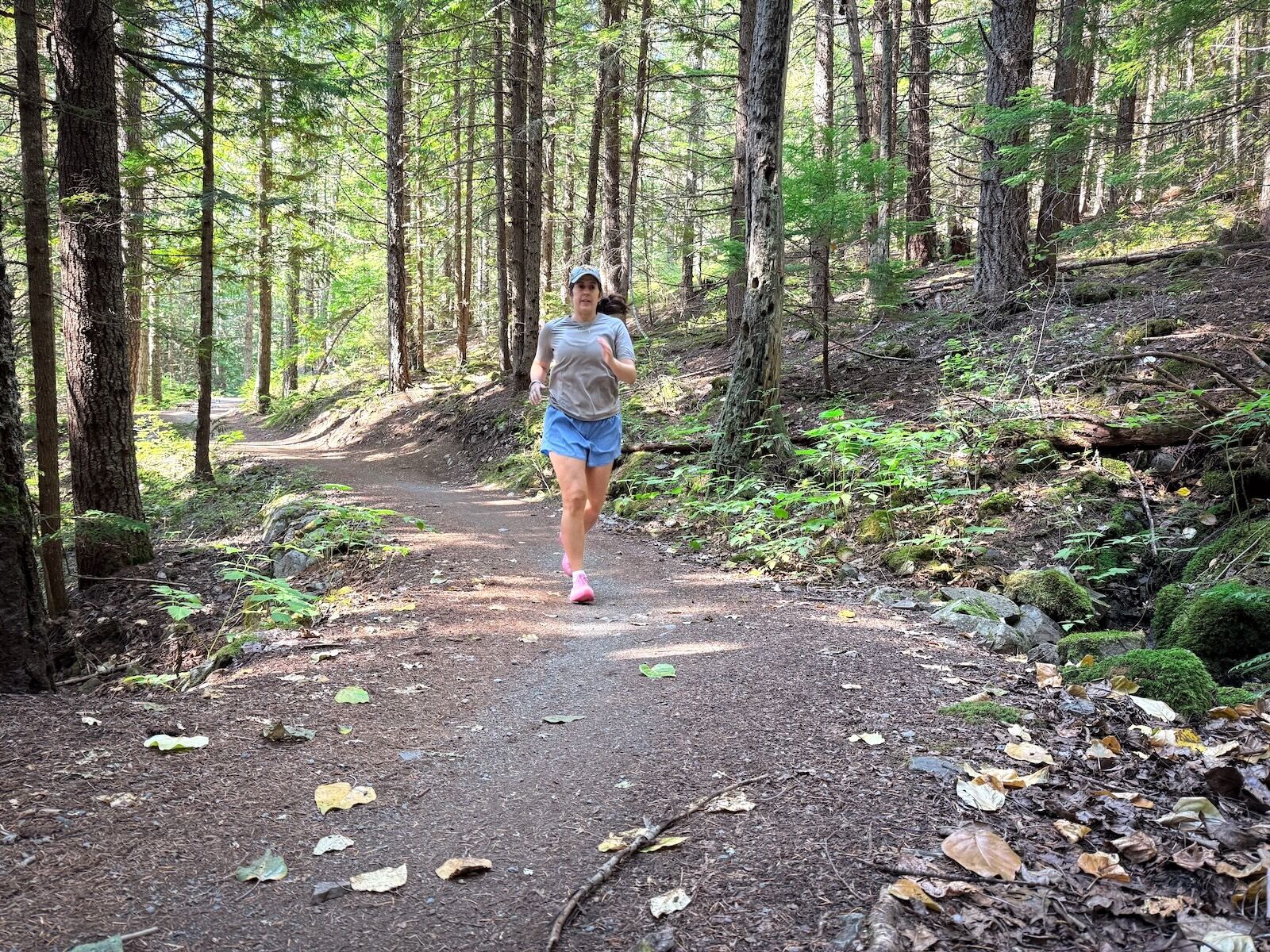
Photo: Suzie Dundas
Footwear
- Craft Xplor 2
- Hoka One One Clifton 10
- Saucony Endorphin Speed
- Altra Experience Wild 2
- New Balance Fresh Foam 1080
- UYN Alacrify
Clothing and Gear
- icebreaker Cool-Lite T
- Orvis DriCast Hoodie
- Roark Alta Running Short
- UYN Kymra Shirt
- Smith Wildcat Sunglasses
- Stance Light Socks
Travel Running Gear: Shoes
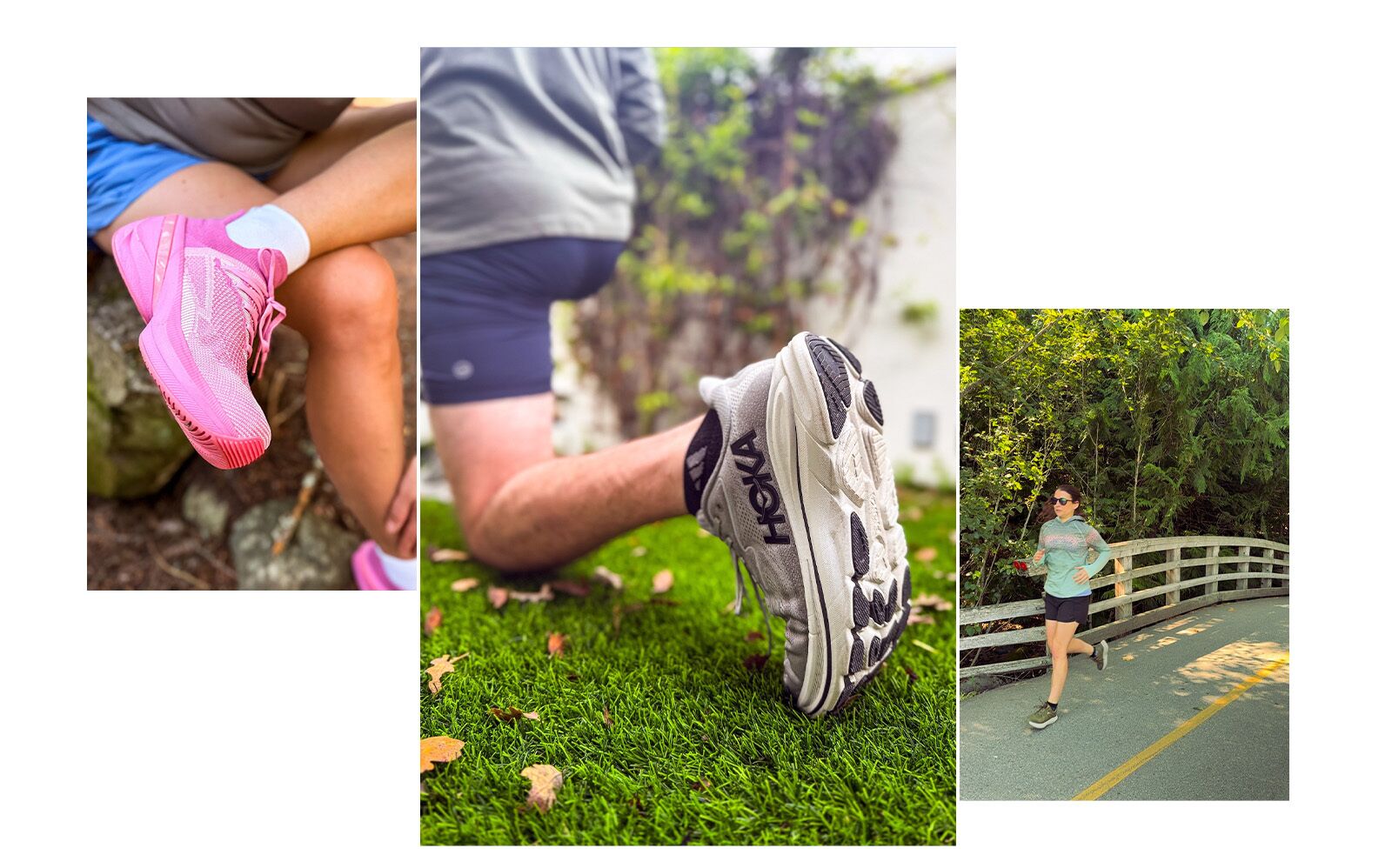
Running shoes should be the most important thing in your running kit, as they influence your comfort, your efficiency, and your risk of injury. Plus, the right shoes can make running more fun. We’ve tested plenty of shoes ranging from dedicated runners to mutli-purpose trainers for hiking and trail running, and these are our current favorites we think are both worth travel-ready, and worth your money. Bonus: they start at only around $100.
Craft Xplor 2
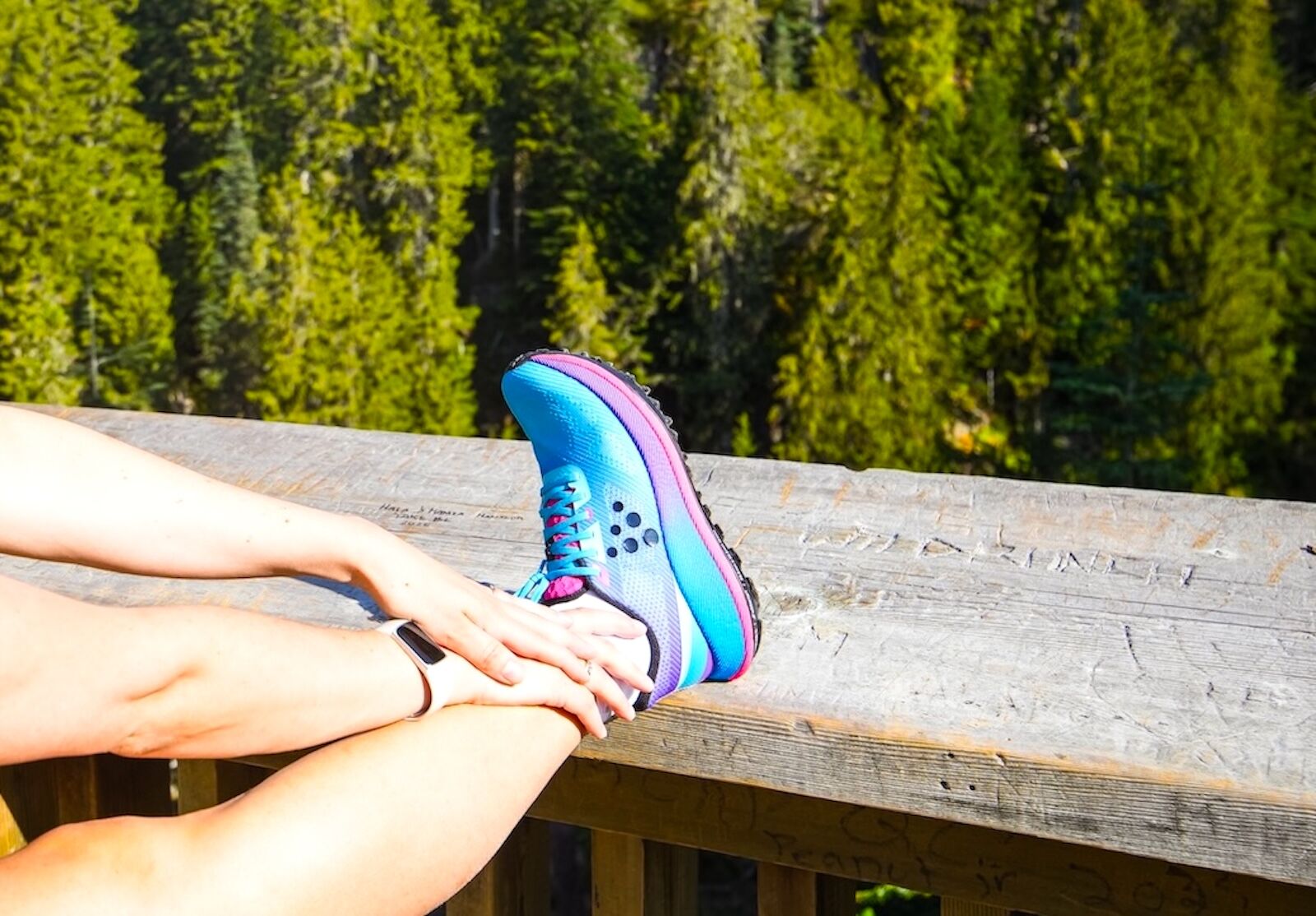
Photo: Suzie Dundas
- Pros: Stylish and unique design, awesome grip, wide toe box, comfortable
- Cons: Short shoelaces, slightly heavier than some comparable options
The Craft Xplor 2 is a fun shoe to wear and very comfortable straight out of the box, with no break-in period needed. I appreciate the bold color design, which stands out in a sea of what’s normally more muted and Earth-toned running shoes.
My running club often does group runs that mix trail and road running, so having a pair of shoes optimized for both is ideal for my weekly activities, especially if I don’t know exactly where we’re headed when we meet up. The grippy outsole made it easy to feel each step landing in place and helped keep my form on track, and I felt secure running on loose surfaces like pebbles and wet ground. That’s probably because the outsoles are made from super-grippy bike tire material, which has helped them become my go-to pair for short and mid-length runs.
If you’re prone to foot fatigue, the weight (at roughly 11 ounces per shoe) could be a little noticeable on long-distance runs. It’s also not the most rugged shoe on the market — but for most people who run while traveling, having a shoe that’s evenly designed for urban and light trail wear is probably better than a shoe focused primarily on off-road use.
— Katie D.
Hoka One One Clifton 10
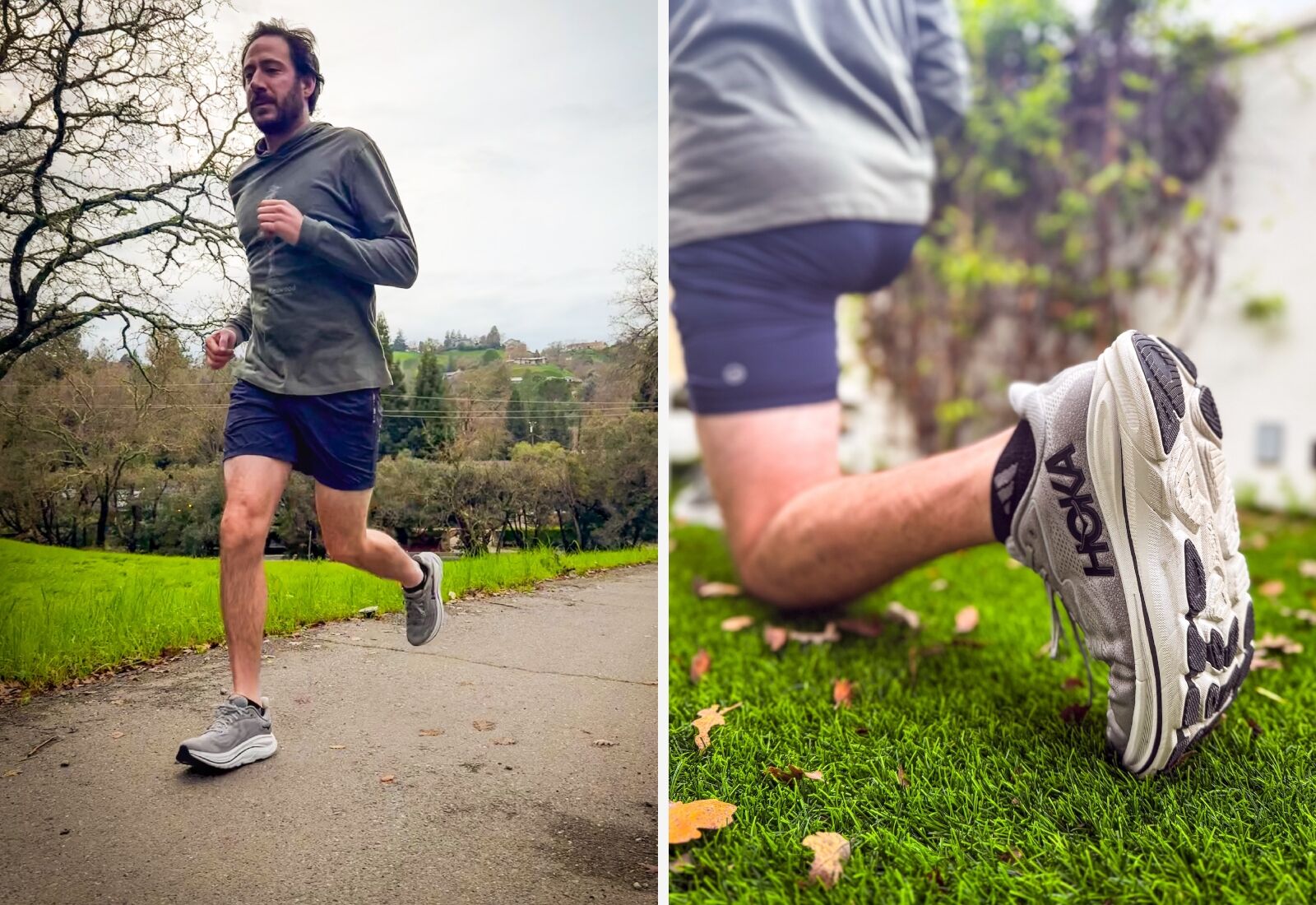
Photo: Suzie Dundas
- Pros: Supportive, good for running and all-day walking, dampens step impact
- Cons: Distinctive look, thick outsole may wear out quicker than thinner styles
“I don’t remember ever having a pair of running shoes that felt this natural,” said our tester, Aaron, after his first road run in the Hoka One One Clifton 10s. He’s an athlete in his early 40s who ran competitive track in high school and some of college, but recently got back into running after a few hand injuries left him unable to ski or bike for months at a time.
He reported that the Hokas absorbed impact well and eliminated some of the jarring that can travel into your knees and hips on long or uneven runs. He said he noticed a bit of heel slippage, but quickly added that he has narrow, thin heels, and was able to eliminate that by ensuring the laces were tied through every eyelet, rather than skipping the one closest to the heel.
The large outsole that extends past the back of the heel isn’t exactly the slickest looking shoe on the market, but at this point, Hokas are so beloved in the running community that the distinctive shape almost has a bit of a “those who know, know” cachet — not unlike the beloved Teva Ember Moccasins. However, Hoka One Ones are consistently rated by podiatrists as one of the best shoes for people who spend long days on their feet, and the Clifton is potentially the most popular of all Hoka styles. Aaron confirmed that to be true after wearing them to walk around construction sites a few days in a row.
“I think they’ll be great for wearing on vacation when I’m walking all day but also want something I can run in,” he noted, “instead of having to bring a separate pair of running shoes.”
Saucony Endorphin Speed
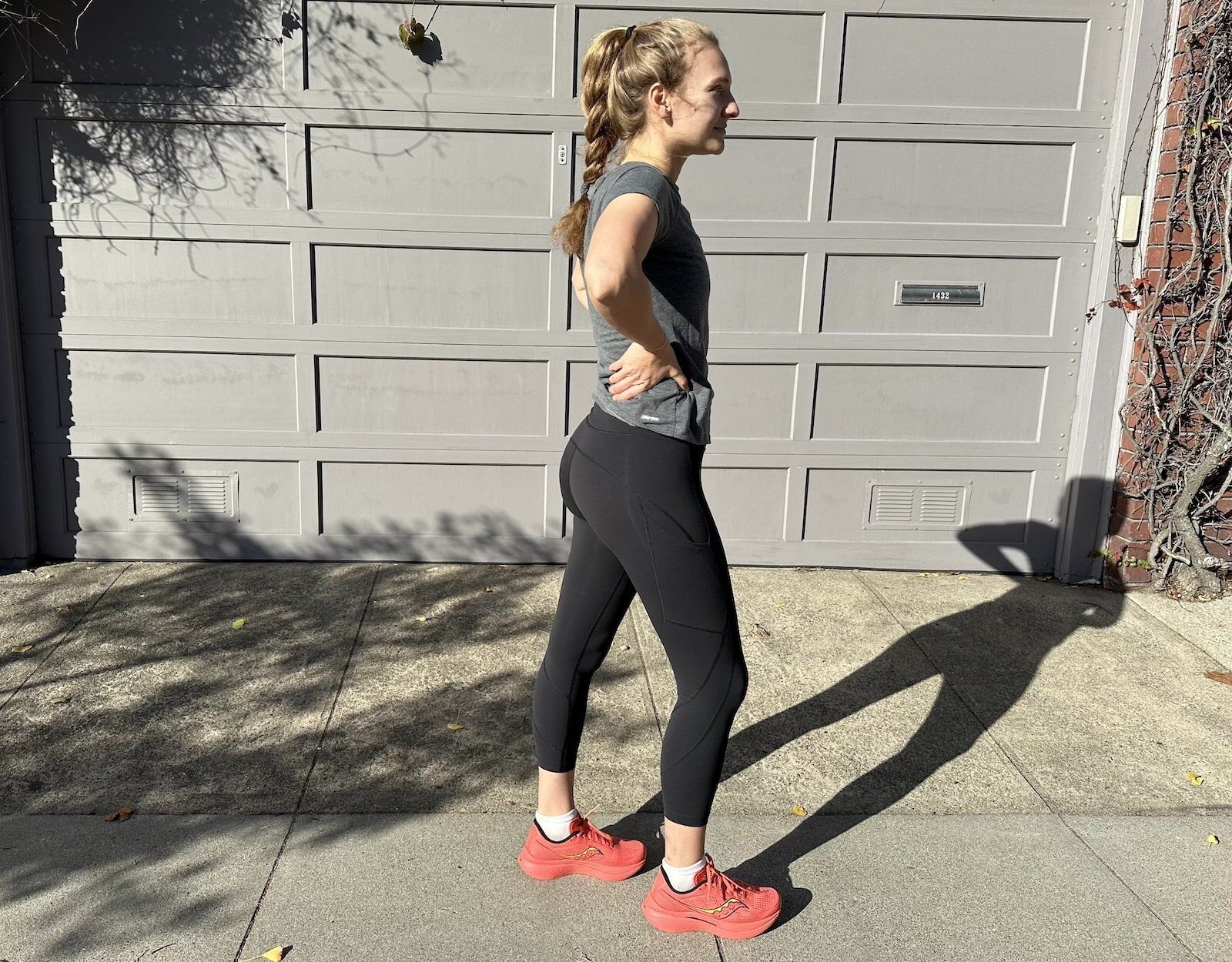
Photo: Alex Bresler
- Pros: Lightweight, rocker shape for natural strides, fast
- Cons: May not have enough support for longer runs
Matador Network‘s own in-house runner Alex Bresler put the Saucony Endorphin Speed 3 to the test by integrating them not just into her running lineup, but into marathon training. She reported the shoes felt noticeably lighter and faster than her other training shoes, largely because of the PWRRUN PB foam and nylon plate, which made each step feel more responsive and reduced how hard the pavement felt underfoot. To her, this helped make pacing easier on quick workouts and shorter runs, when the shoe’s rocker shape helped her make quicker steps with less effort.
At 7.2 ounces per shoe, the lighter weight made a clear difference compared to heavier trainers, and she credits the shoe with helping her hit personal bests on runs up to six miles. However, she also noted that the same springy, less structured feel made the shoe less stable on long runs or uneven surfaces, where she wanted more support and control. While she didn’t race in them due to traction concerns on wet pavement, she emphasized that the Endorphin Speed 3 excelled as a fast, cushioned training shoe designed to make harder efforts feel smoother and more efficient, rather than as an all-purpose daily trainer.
Since her testing, Saucony has come out with the Speed 4 and Speed 5. Reviewers say the Speed 4 is better for longer distances, and has a slightly firmer and snugger feel around the foot. The Speed 5 is softer and better suited to long runs. That likely makes the Speed 5 the best pick for most travelers who run on vacation, especially as both the men’s and women’s versions come in several muted color options that won’t stand out if you use them as your everyday shoe while traveling. However, you can usually find the Speed 4 and Speed 3 on sale, sometimes as low as around $100 — an excellent price for a quality running shoe these days.
Altra Experience Wild 2
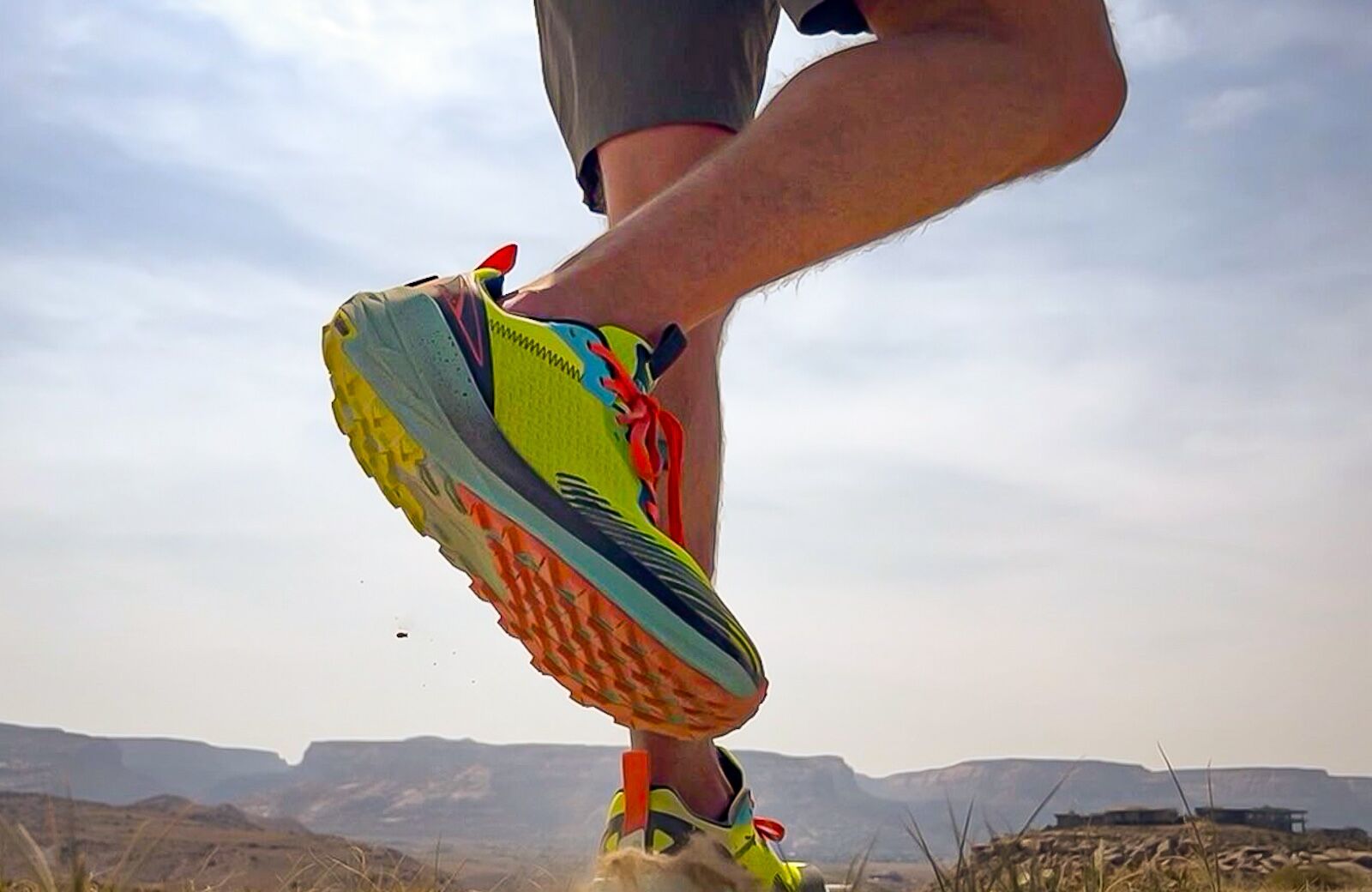
Photo: Tim Wenger
- Pros: Wide toe box, cushy heel, helped minimize post-run pain,
- Cons: Not robust enough for very technical trails, low-drop style may take some getting used to
As Matador Network’s transactional content editor, I get a lot of offers to test gear. And in the fall, I put some running gear to the test on rocky desert trails near my home in Grand Junction, Colorado.
My favorite shoes were the Altra Experience Wild 2 trail runners, mostly because it felt like they improved my running form after just a short distance. Altra shoes are known for their wide toe boxes and low-drop design, which many runners think encourage a more natural stride while building leg and foot muscles more evenly.
I’m no professional athlete, but I could feel the difference. And the extra space around my toes helped eliminate the constant friction I often feel with narrower shoes and hiking boots, particularly around a bunion on my right foot. That alone made longer runs in the Experience Wild 2s more tolerable. More surprising, though, was how the shoe’s geometry and cushioning changed my run. The cushioned heel encouraged a more balanced foot strike and made me less likely to land on my toes — something I think contributes to my persistent knee pain. Within a few runs, my post-run soreness dropped from lingering knee pain to mild stiffness that stretching could resolve.
The Experience Wild 2 had enough pop to keep me moving but didn’t feel unstable, even on rocky trails after rain. They’re also lightweight (8 to 10 ounces per shoe) and easy to pack, making it easy to carry them on the road and get outside more often, rather than sticking to boring hotel treadmills.
— Tim W.
New Balance Fresh Foam 1080v12
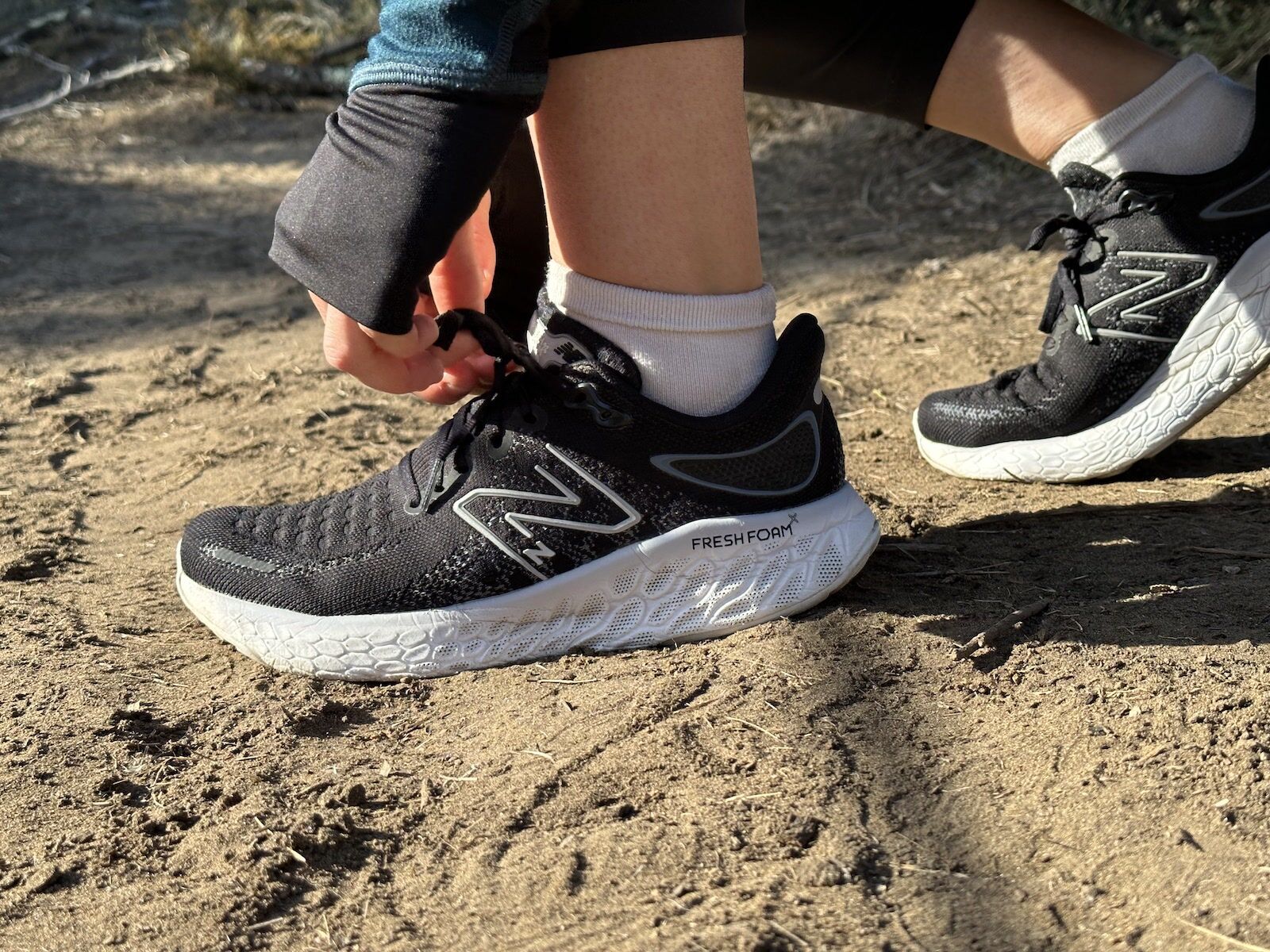
Photo: Alex Bresler
I also tested the comfortable Fresh Foam 1080v12 from New Balance. I quickly decided I liked it, and it almost made up for my lack of training when I ran a half-marathon in Amsterdam. It also hit the sweet spot on support, absorbing most impact shock without making it feel like I was running in platform shoes.
I came to prefer it for road, track, and treadmill running, as it’s definitely a road-running shoe, rather than a trail or hybrid model. I wore the Fresh Foam 1080v12 for weeks of half-marathon training, including longer, double digit runs, and the shoe remained consistent, supportive, and predictable — qualities that matter when running in unfamiliar cities and roads while traveling. While the outsole did okay on trails, it’s a road shoe designed for paved surfaces, not a trail runner. So it could be an excellent pick for travelers headed to cities where they plan on running each morning before doing some urban sightseeing the rest of the day.
Like the Speed 3 from Saucony, New Balance has also updated the 1080v12 to the 1080v14. The V14 is generally a bit more cushioned with a higher heel, trending more toward Hoka One One territory. Snag that one if you like a more cushioned feel, or search for sales on the now-discontinued v12 if you prefer slightly less give when running and walking. Fortunately, both versions have a fairly solid color design that won’t scream “I’m American” (as much, at least) when you’re wearing them to walk around foreign cities.
— Alex B.
UYN Alacrify
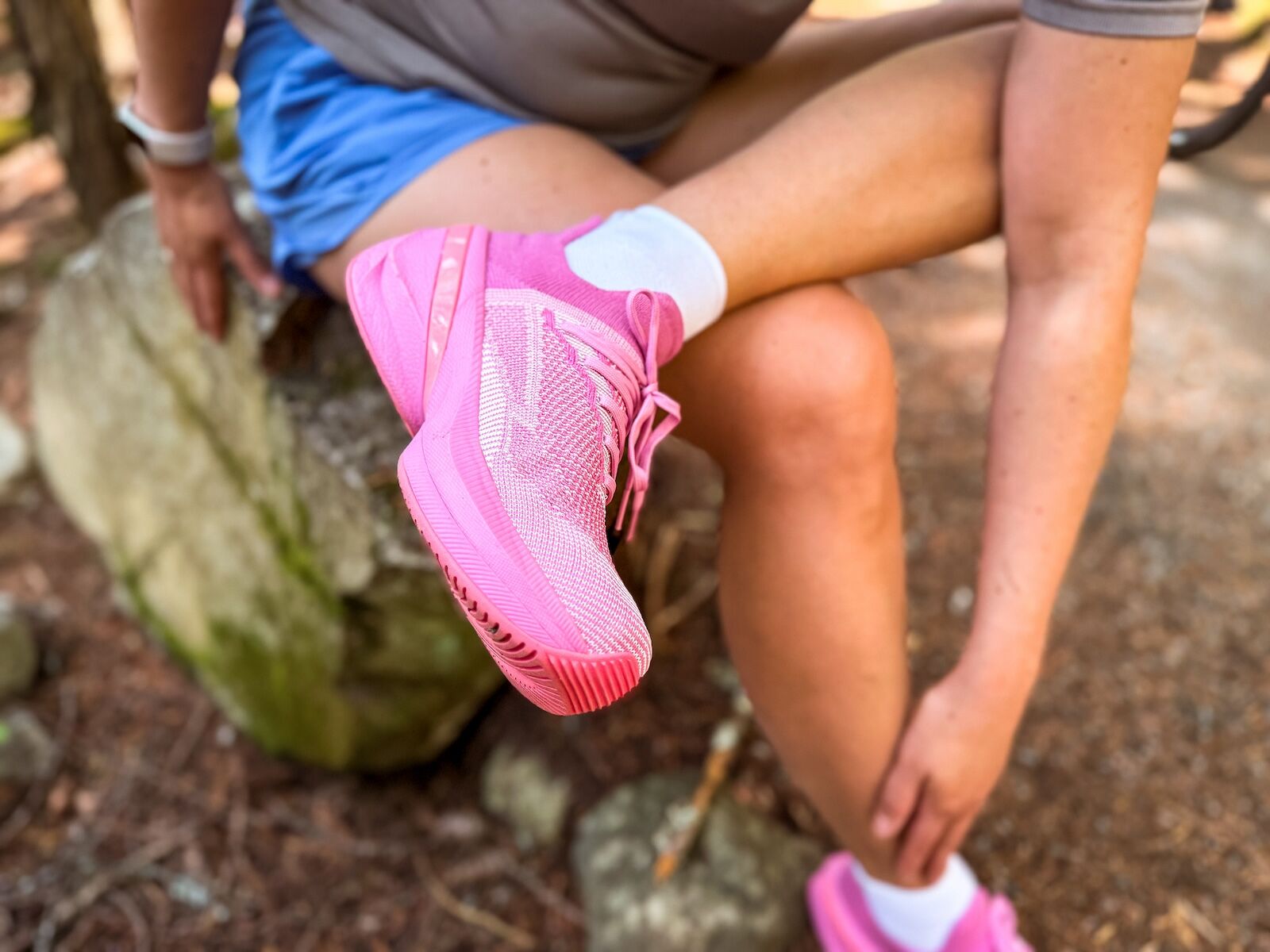
Photo: Suzie Dundas
- Pros: Seriously eye-catching, sustainable materials, rigid feel for runners seeking stability
- Cons: Sock-style cuff is a love-it-or-hate-it design element, could be too stiff for runners with higher arches or foot issues
The show-stopping, neon pink Alacrify running shoe from UYN made some bold design choices, which I appreciated in a sea of running shoes that can usually look somewhat interchangeable. They’re made with eucalyptus fibers, which not only means they’re more sustainable, but has some real-world implications. The fibers add strength without weight, allowing each shoe to be fairly light at around nine ounces. Natural fibers also manage moisture and heat better, and I didn’t notice much foot sweat, even when I wore them on runs in muggy British Columbia and hot-as-heck Sydney, Australia.
However, it’s a snappy shoe, and definitely has a more rigid heel (UYN calls it the “H.A.L.O. system”) and firmer outsole than many shoes designed for pavement. It provides a lot of stability, but led to some foot fatigue on runs of more than six or seven miles. If you prefer firmer shoes with more support, it could be an excellent choice.
Interestingly, the Alacrify has a sock-like upper that I haven’t seen before on a running shoe, though I have started seeing it on a few hiking shoes and multiuse outdoor shoes. It’s designed to provide a bit of ankle support while still being breathable and lightweight, as opposed to using a thicker or more restrictive material around the ankle. I found the material a little annoying against the back of my heel, but that could have been for any number of reasons. UYN makes almost all their running shoes with that same technology, so I’m inclined to think the issue relates more to my personal stride and ankle shape than some inherent design flaw in the shoe.
Though they didn’t work as well for me, I can definitely see how lots of other runners would love the stability and support (not to mention the fun neon pink color scheme).
– Katie D.
Running Clothing and Gear
Most people would probably agree your running shoes are the most important item of gear. But when it comes to travel running gear, clothing matters — you don’t want your vacation photos to mostly be of you wearing a sweaty, oversized running shirt. That’s why our favorite running clothing also works as travel clothing, from moisture-wicking and solid-color T-shirts to thin socks that won’t overheat your feet to a pair of short-inseam shorts that fold up nice and tiny in your suitcase.
Icebreaker Cool-Lite T-Shirt
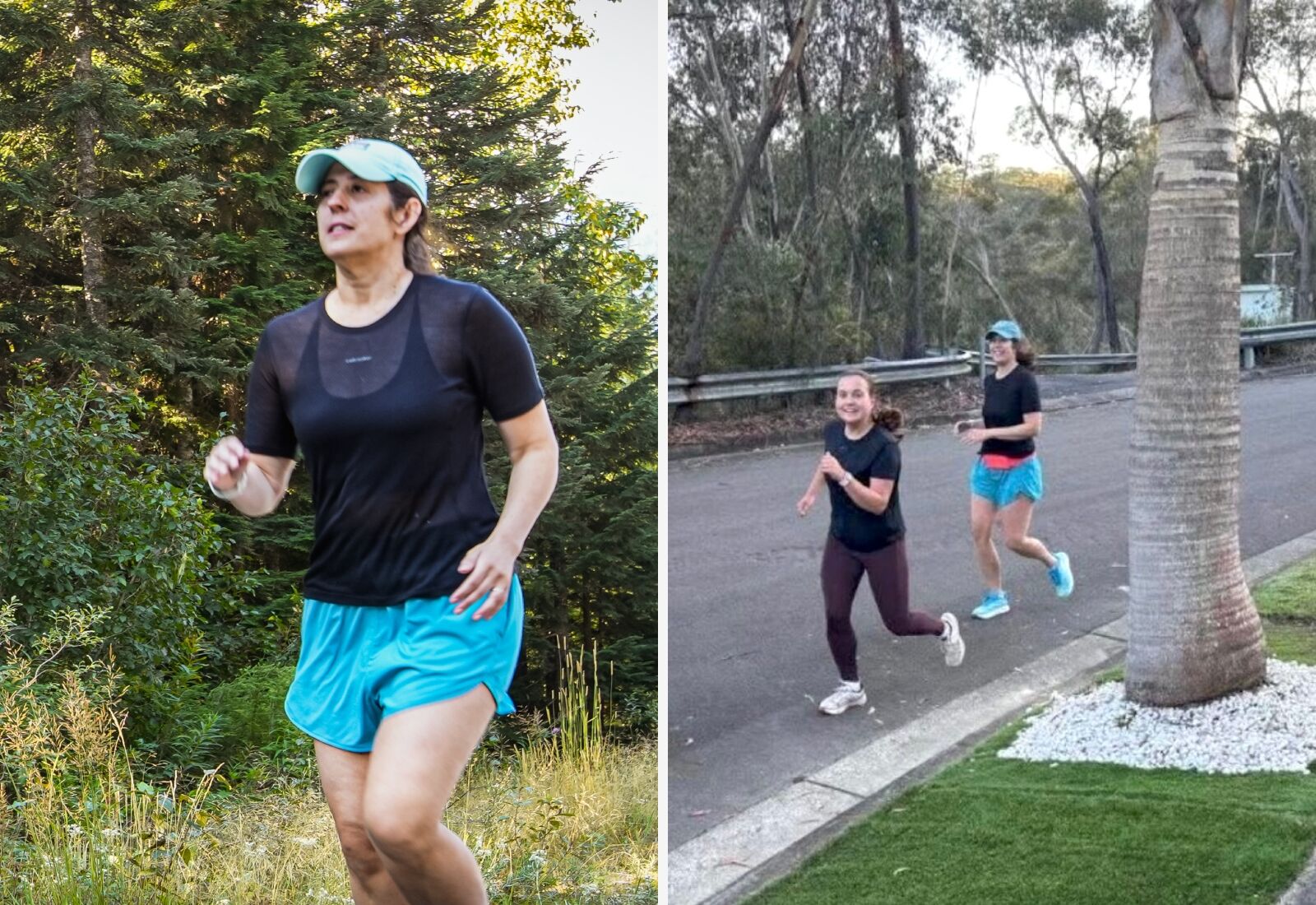
Our tester reported that the Cool Lite T-shirt quickly became her go-to shirt for running multiple days in a row . Photo: Katie Dundas/Strava
- Pros: Very soft, well-constructed seams, insulates and cools well, ultra lightweight
- Cons: Could be too short for longer torsos, pricey, brand logo is front and center
I never considered Icebreaker a running brand, always associating it more with ski gear and cold-weather layering. But the Merino Cool-Lite Shirt has changed my mind. It’s extremely lightweight, soft, and comfortable to wear, with soft seams that won’t irritate or chafe your skin. This one is a 10/10 for me and I’ve been wearing it regularly for both long and short runs. I live in Sydney, traveled a bit in the fall, and ran a marathon in Auckland, and this shirt definitely scored points for being travel-ready, too.
It’s odor-resistant so it can be worn a few times before needing to be washed, and I actually went for a run before wearing it on a cross-country flight (and didn’t get any odd looks from my seatmates). The thin fabric and lack of seams also make it easy to layer under a long-sleeve shirt on colder days, or just use as an everyday layer.
I would definitely consider buying more Merino wool/Tencel-blended running gear from Icebreaker, especially as it felt nicer on my skin than nearly all synthetic-fiber running shirts I own. I went one size up for a looser fit, which I’d recommend.
— Katie D.
Orvis DriCast Hoodie
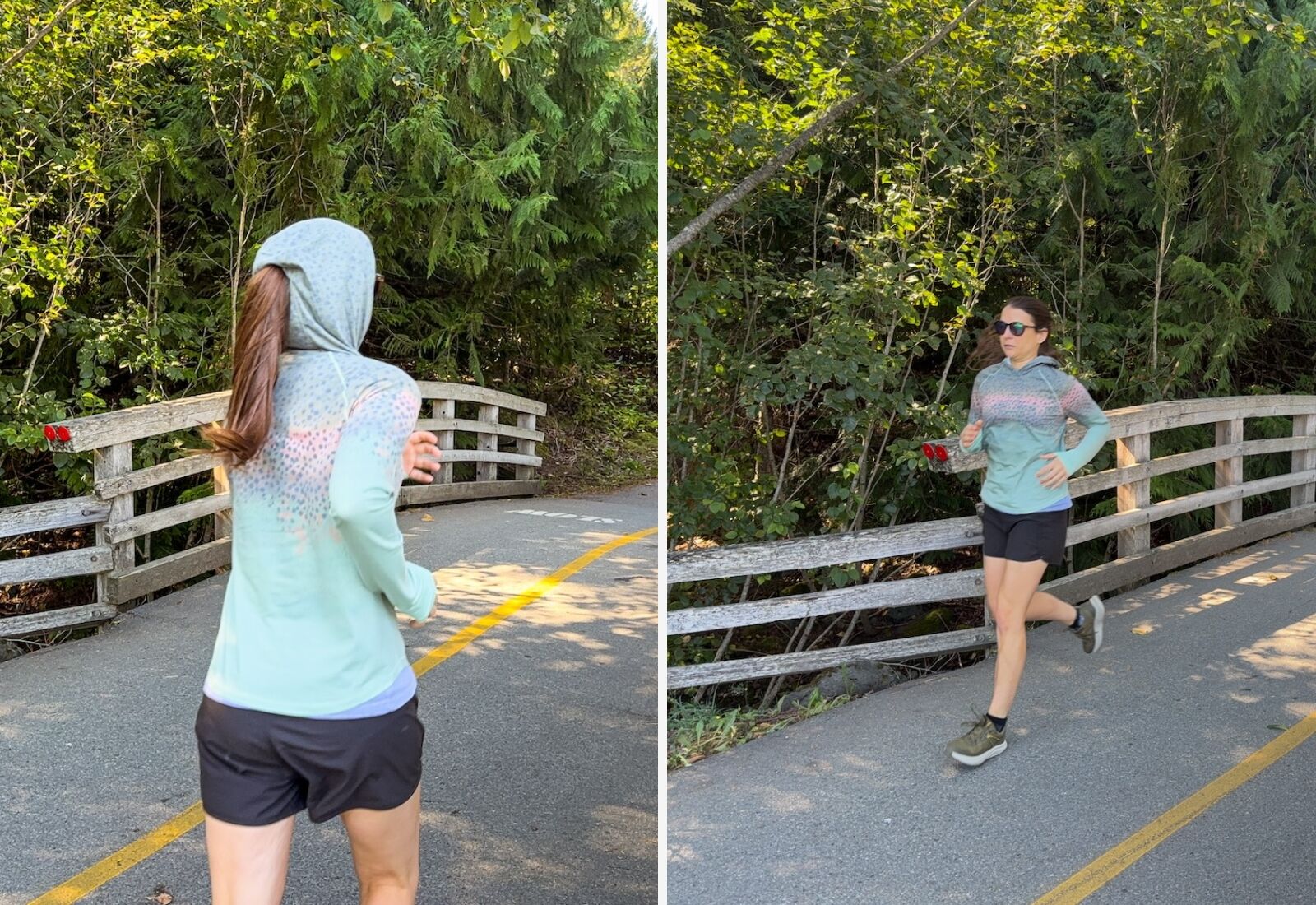
Photo: Suzie Dundas
- Pros: Moisture-wicking, UPF protection, cut-out for ponytail
- Cons: A little short for long torsos
I’ll go for a jog here and there, but I mostly run when I’m tight on time but still want to do something active. That’s why most of my running gear is actually more general workout gear — and why I think sun shirts with UPF protection, such as the lightweight DriCast Hoodie from Orvis, are essential. I’m pretty pale and I worry about too much sun exposure, since most of my favorite activities involve being outside. So having a super lightweight UPF-blocking shirt, especially one that dries quickly and doesn’t feel heavy on my skin, is essential.
But I particularly liked the DriCast Hoodie for one extra feature that makes it really well suited to running or hiking: it has a small slit on the back of the hood for a ponytail. Pulling my hair through means I can protect my face and scalp while running in cool but bright conditions. I much prefer the minimal weight of the hood on my head to a heavier baseball cap, and — bonus — I found that putting my ponytail through the hole helped the hood stay in place, even in light wind. Sizing is pretty standard — I usually wear a small in Orvis, and the small fits me well, with room for a tank top underneath.
It has UPF 50 sun protection, and even though I don’t fish, I find the rainbow trout print actually pretty awesome. I’ve gotten a lot of wear out of it for jogging, hiking, and just running errands around town. Unfortunately, you’re out of luck if you’re a man with long hair: only the women’s version has the ponytail cutout (though you can still pick the same rad rainbow trout print).
– Suzie D.
Roark Alta Shorts
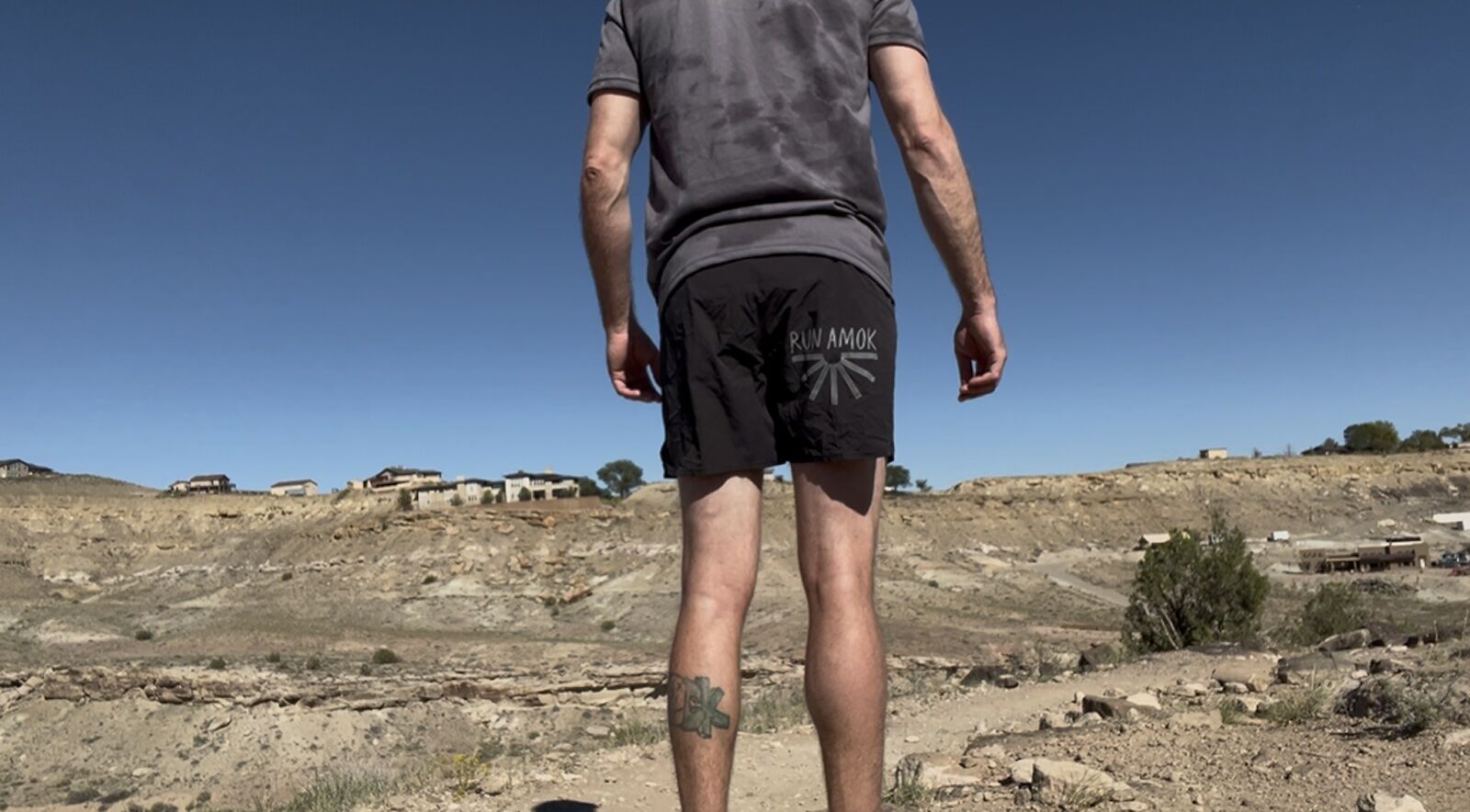
Who wears short shorts? Photo: Tim Wenger
- Pros: Breathable, minimalist, doesn’t ride up
- Cons: Very short
I’m already a Roark devotee and decided to lean into the brand’s “Run Amok” line with the Roark Alta 5-inch run shorts. They feel minimalist and made for hot-weather runs, with an unapologetically short five-inch inseam. But the payoff is immediate in hot weather: excellent airflow, no bunching, and a secure fit that stayed put on climbs without riding up or shifting. On one especially warm uphill climb, the breathability made a noticeable difference, keeping things comfortable where longer or heavier shorts would have trapped heat.
Storage is intentionally sparse, which could be seen as a selling point or downside, depending on what you like to carry. There’s a single zippered back pocket that works best for a phone and single key, but a full key ring will start getting tight and clunky. The minimal storage isn’t surprising to me, as the shorts are styled to be lightweight, minimalist, and optimized for movement, rather than packed with features.
— Tim W.
UYN Kymra Shirt
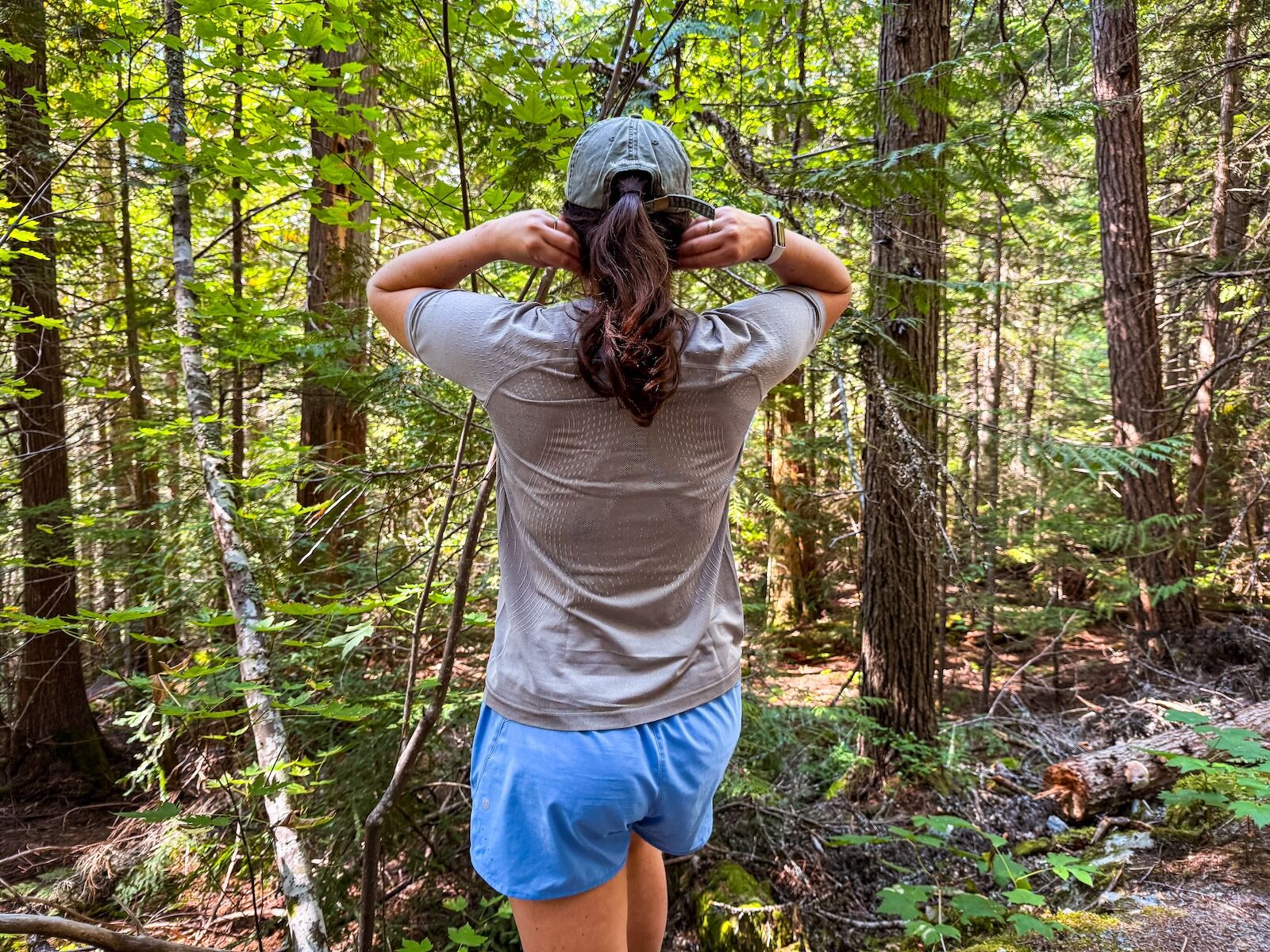
Photo: Suzie Dundas
- Pros: Synthetic-free, natural materials, no vertical seams, bright colors
- Cons: Pattern looks a bit like a sweat mark, reviewer would prefer looser sleeves
This comfortable and lightweight shirt is soft and easy to wear on long runs, as there are no irritating seams that can lead to chafing or red marks. It fits well and dries really fast. That quick-drying property is both great when you’re sweating on warm-weather runs, but also comes in handy when you realize it needs to be washed before you meet your running buddy in 30 minutes. The shirt’s cut and fit are great, except for one sort of annoying detail: the wave design is futuristic looking, but it’s a bit misplaced as it can look like sweat marks (especially for women). I normally wear a women’s medium or large, and the unisex medium fit me well.
That said, if that doesn’t bother you, it could be a good choice for someone who needs a comfortable and sweat-resistant shirt that won’t chafe or rub, especially if you’re wearing a running vest or other piece of clothing over it. The shirt comes in three colors and is unisex, and even after a few runs without heavy washing, it didn’t stretch out. This also makes it ideal for travel, especially in hot-weather destinations where you’re trying to go carry-on-only. It also scores high points for sustainability, as it’s made from natural wood-pulp-based fibers, rather than fibers produced using synthetic materials or fossil fuels.
— Katie D.
Smith Wildcat Sunglasses
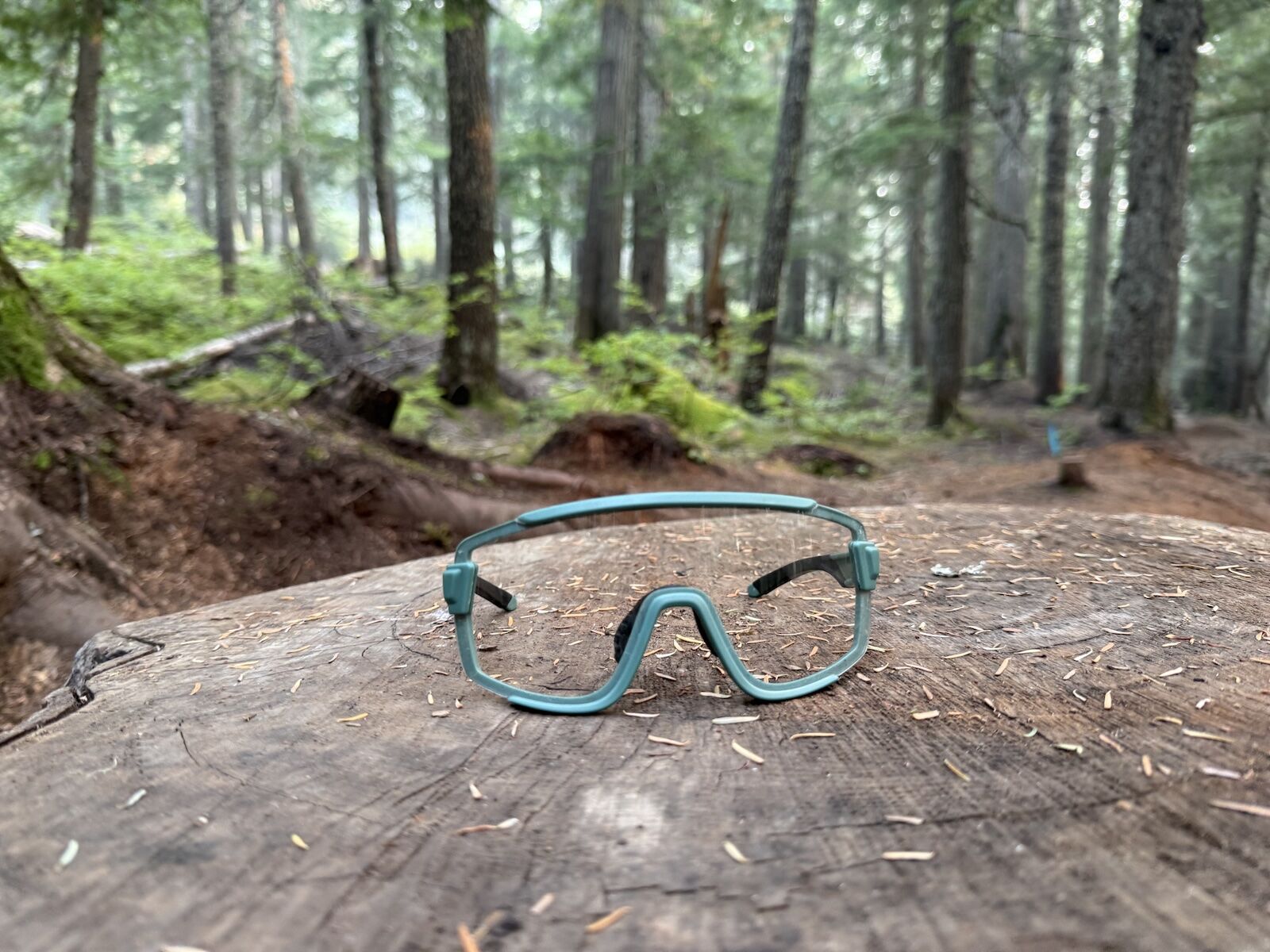
Photo: Suzie Dundas
- Pros: Ultralight, doesn’t shift while running, great coverage, enhanced contrast
- Cons: Expensive, too specialized to be an everyday pair
I’ve long been a huge fan of the Smith Wildcats and wear them nearly every day between spring and fall as they’re my go-to pair of shades for mountain biking. But it took me a shockingly long time to realize they’re also the best pair of sunglasses for running and jogging outdoors.
The Smith Wildcats provide plenty of coverage, almost akin to a small goggle, which protects your eyes from wind and trail debris when moving quickly. They also have Smith’s ChromaPop™ technology to enhance contrast and natural colors, allowing me to quickly spot roots, wet patches, and uneven surfaces on trails. It sounds a bit like marketing jargon, but you can see the difference as soon as you put them on (literally — the lenses are high-tech).
I sometimes think how much a piece of gear weighs gets overblown in marketing — most casual runners won’t notice the difference between a 13-ounce or 14-ounce shoe, for example. But with sunglasses, weight makes a big difference if you want them to both stay on your face and not put pressure on the sides of your head with each step. Fortunately, the Wildcats are extremely lightweight, and have a useful (and adjustable) non-slip nose pad that keeps them in place, even if you’re a heavy-impact, awkward trail runner (like me).
The Smith Wildcat is the first pair of sunglasses I owned that actually made me feel like it was worth the price tag. That’s especially true as they come with a second clear lens; I’ve gotten my lens-switching time down to about 15 seconds.
— Suzie D.
Stance Light Socks
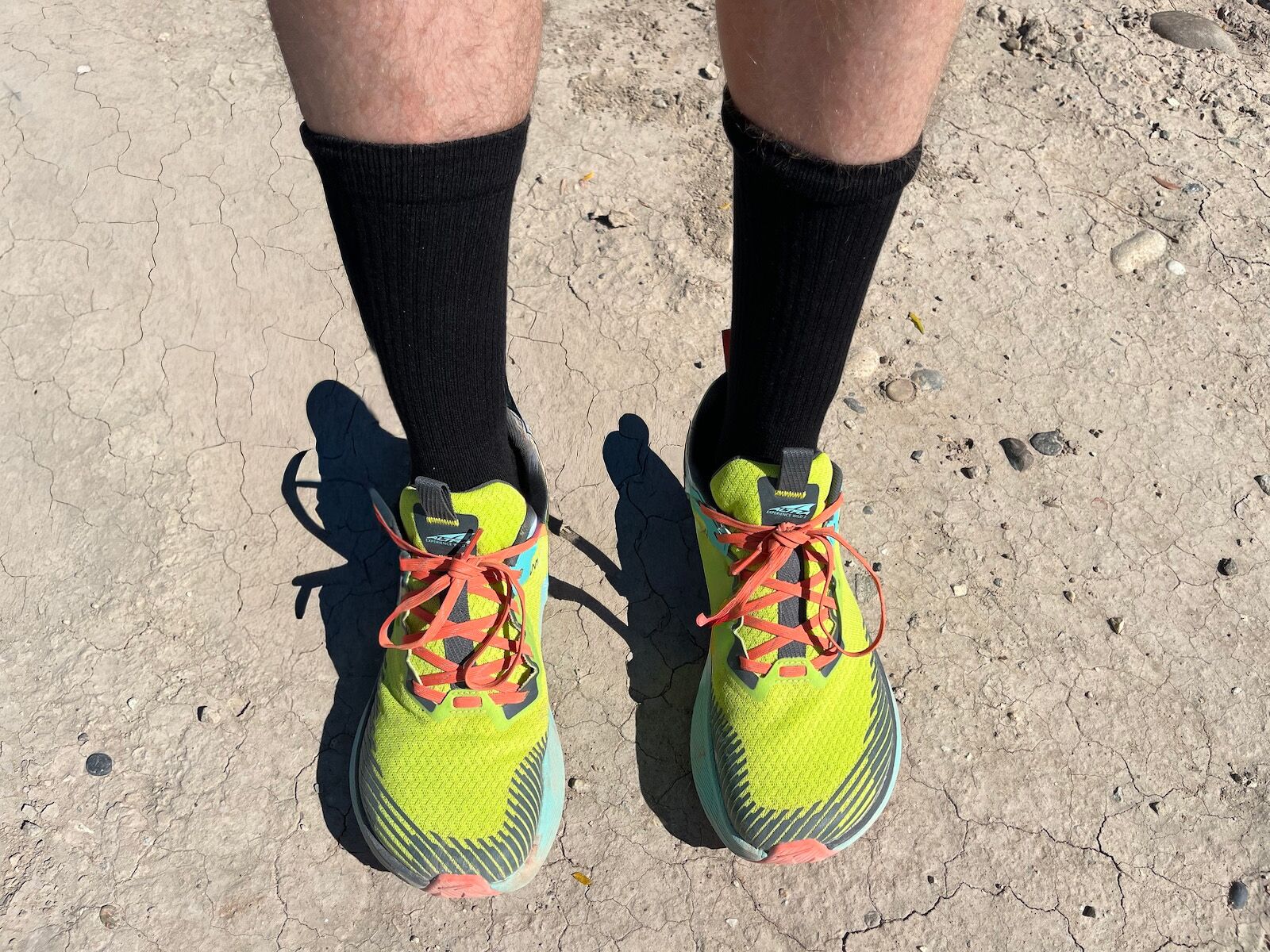
Photo: Tim Wenger
- Pros: Mid-to-light thickness, moisture-wicking, reinforced heels
- Cons: Pricey, may be too thin when paired with minimally cushioned shoes
Lots of sock brands will leave you to believe modern technical socks are packed with technology. But ultimately, a sock is far less complicated than a shoe, and I like the Stance Light Socks for a simple reason: I like the thickness. They’re thicker than typical crew socks and the brand’s Ultralight crews, but still thin enough to not encase my feet in sweat after half a mile (something I’ve felt when I run in my usual thin hiking socks).
At $54.99 for a three-pack, they’re not inexpensive, but they paired really nicely with the roomy toe box of the Altra Experience Wild 2 shoes to keep my bunion in check. They’re made of a moisture-wicking nylon/polyester blend with a touch of cotton for softness, and have the brand’s Infiknit reinforced heels, supposedly adding extra durability and support in higher-use areas. Pairing these socks with a good shoe really felt like it saved my knees, and when I arrived back at the trailhead each time, my feet were the least-sweaty part of my body.
— Tim W.
About Our Testers
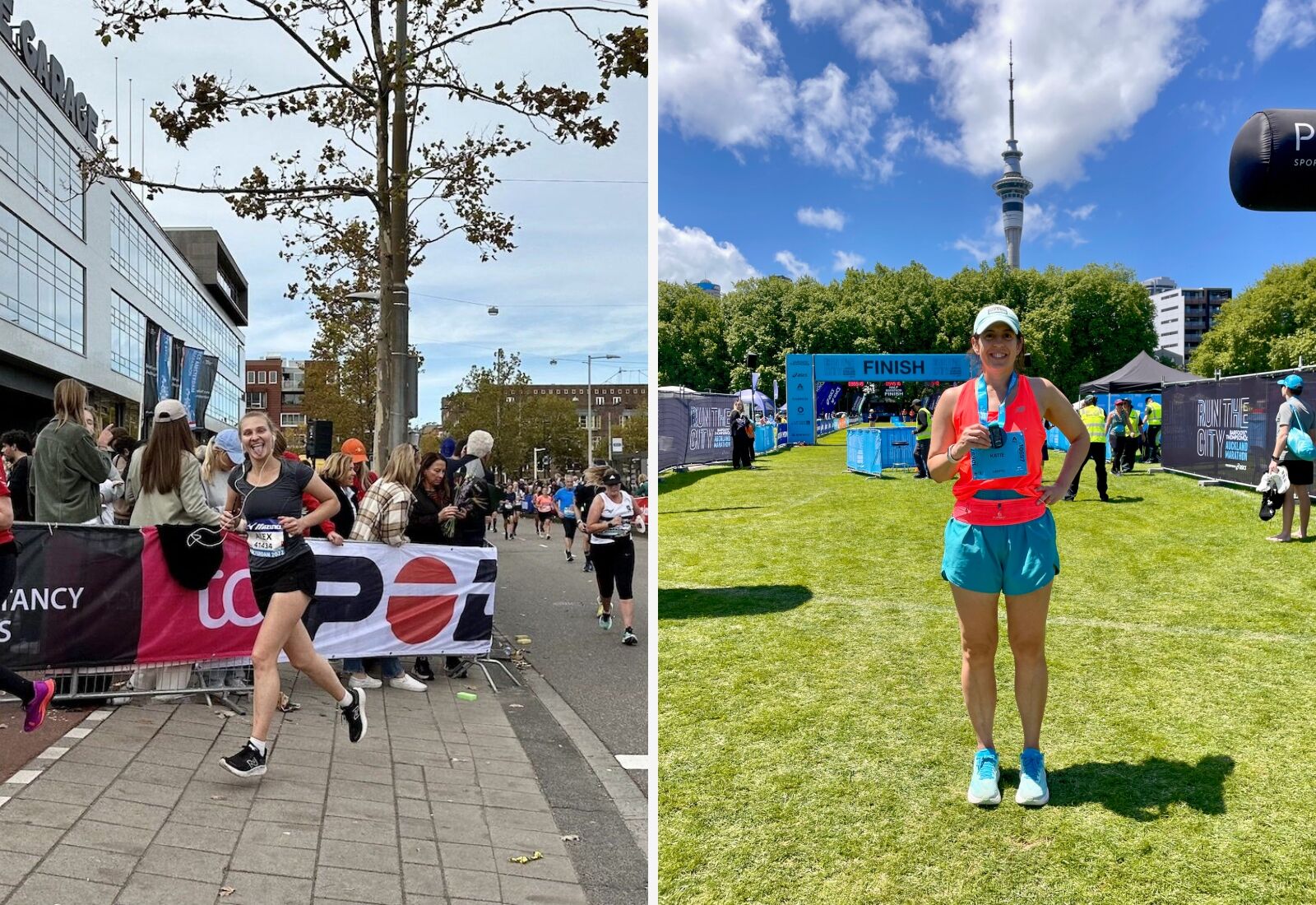
Alex during an Amsterdam half marathon, and Katie after the Auckland Marathon. Photos: Alex Bresler and Katie Dundas
Matador Network recruited a blend of avid, new, and long-time runners to test the items above. We sent them the gear and asked them to work it into their running routine, and let us know what they thought once they had put it through the paces (pun intended).
- Tim Wenger lives in southwest Colorado and is an avid snowboarder and casual runner, though he wants to run more. He’s 41, with knees that are also 41, and finds the wrong running gear can knock him out of commission for a week or more with knee pain. He runs for the cardiovascular benefits, the metabolism boost, and the runner’s high that he says leaves him “stoked beyond comparison.” However, he also travels a lot for work, and does a lot of his running in hotel gyms with variable quality treadmills. He normally sticks to short jogs of a mile or two, but is working on adding distance. He split his testing between Colorado and various US cities during work trips.
- Suzie Dundas is Matador Network‘s commissioning editor, and while she wouldn’t say running is her primary sport of choice, she’s extremely active and uses it to counter-stretch and complement other activities like mountain biking and snowboarding. She runs almost exclusively on trails, and maintains more of a “slow jog” pace than a “I’m going for time” pace (though she’s done a few obstacle and mountain races). For her, running is a way to get outside and be active when she doesn’t have enough time for her main activities. She tested the two items above on trails around British Columbia on a mix of trail runs and what would more accurately be called “trail fast walks.”
- Alex Bresler is Matador Network‘s branded content editor and a former competitive soccer player turned runner. She runs all over San Francisco, though the trails through Golden Gate Park are her favorites. in Marin County, California. She tested the shoes in this article both in California and while training in Amsterdam for the Amsterdam Half Marathon. She considers herself a hobby runner, noting “sometimes, I’ll run a 10K every day for months at a time, and then I’ll get into something else active and not run for the next two months.”
- Aaron David is a former college and high school runner who got more into mountain sports like skiing and climbing in his adult years. He started running again a few years ago after a series of back and hand injuries meant running was one of the few activities he could do during injury recovery. He’s fairly active, but prone to hip and back tightness from years of extreme sports. He did most of his testing on paved and gravel roads around Walnut Creek, California, though he also did a few trail runs in nearby parks in both dry and dewy, semi-wet conditions.
- Katie Dundas ran track in high school but got out of the hobby in her 20s, picking it up again in her early 30s. Since then, she’s been a dedicated running enthusiast. She’s completed 10Ks, 14Ks, and several half marathons, and finished her first full marathon in the process of gear testing. She tested the gear above at her home in Sydney and while traveling, testing it indoors and outdoors. She usually averages about 25-35 miles per week on varied terrain.

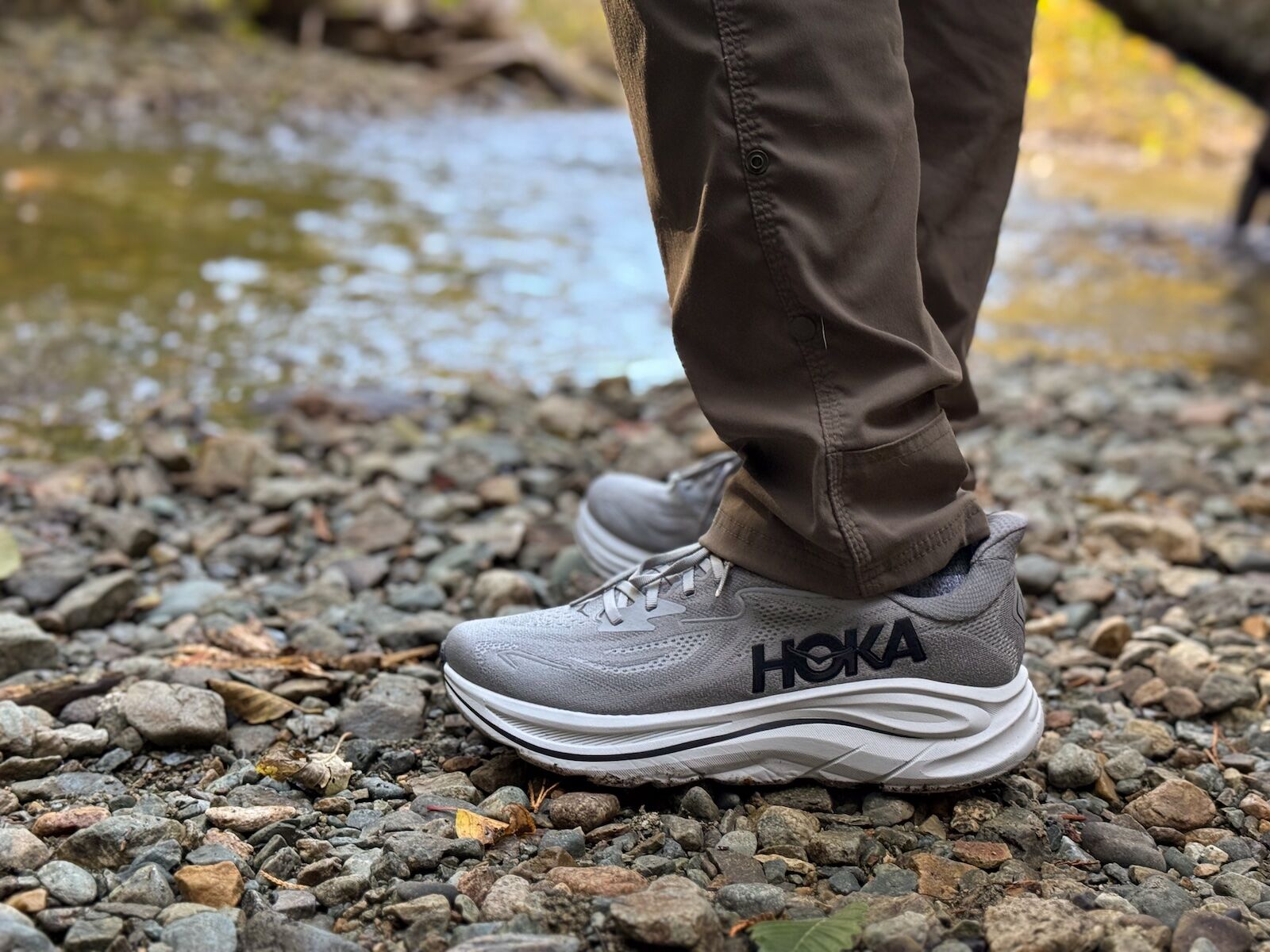
Our testers used gear both for running and everyday walking while traveling. Photo: Suzie Dundas
