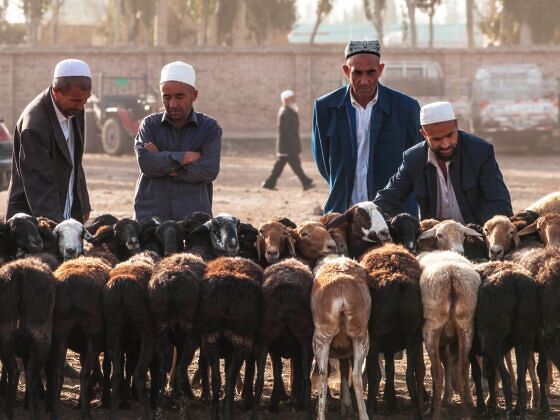
Feature Photo: sandandtsunamis Photo: reurinkjan

Expat Josh Summers spent four years living in Xinjiang, an autonomous region in the far west of China.

My wife and I were packing for another vacation getaway on the motorcycle when a single phone call ruined our travel plans.

“Turn on your TV,” my friend told me. “There’s some scary stuff going on in the capital right now.”

We did as he said and both stared in shock, unwilling to accept that massive ethnic riots in Ürümqi were killing hundreds of people in China’s western province of Xinjiang, our current home. We knew that any more preparations would be useless. Travel, at least for this next week, would not be wise.

The events of that evening changed more than just our current travel plans though. The riots changed the way we lived and traveled in Xinjiang, period. The internet had been completely shut off , international phone lines were down, and new security measures were put in place to secure the region.

For eight months following the riots, my wife and I dealt with these frustrating circumstances and still managed to explore new parts of the beautiful province. Here are some of the things I learned during this time in Xinjiang.

1. Opening a Sina Account is the Only Way to Use Email

Photo: Josh Summers

It wasn’t until six months after the initial riots that email became a practical means of communication again. The government announced that Sina.com.cn, a Chinese-language news portal, would be the only email provider to send and receive messages within the province.

My excitement over this new development was short-lived, however, when I realized that my entire address book was stored online. Sites like Gmail, Yahoo and Hotmail were still completely blocked and I never realized how much information that I kept I stored online until I no longer had access to it. On my next trip outside Xinjiang, I printed out a list of all my email contacts so I could add them to my Sina account.

Because nobody knows when full email access will be restored, it’s best to have what you know will work. If you plan on visiting Xinjiang, open a Sina account before leaving and set it up so that all your emails can be forwarded there during your tip.

2.Living Without Internet Is Doable

When I first found out that the internet had been completely blocked, I wasn’t immediately alarmed. China is well-known for its “Great Firewall” that censors unwanted material, but the proxies and programs available to avoid this block are numerous.

Unfortunately, something about Xinjiang’s internet situation is different. Almost every option to circumvent the block, both free services and paid private networks, fails to work. The work-arounds that are available are usually very difficult to find and extremely expensive. A satellite link I saw in Ürümqi ran about $300 per month with a $500 set up fee!

For eight long months I learned to live isolated and globally uninformed. Eventually I was able to check news on major Chinese sites or book flights on Ctrip.com, but updating my website or communicating with family was almost impossible.

3. Guidebooks Can be Invaluable

Having no internet meant it was impossible to access online travel guides and forums while in Xinjiang. While planning a visit to Turpan, a popular Silk Road outpost, all research for what I wanted to see and where I would stay had to be done well in advance.

This was one of the few instances where I found those hefty travel guides to be worth their weight. I found that both the Lonely Planet and The Rough Guide have detailed Xinjiang information in their China editions that many other books don’t cover. Although they may have taken up valuable room in my bag, these thick books proved useful on more than one occasion when I found myself in a tiny desert oasis with few other travelers and no internet recommendations to guide me.

Turpan, Photo: Josh Summers

4. Taking Photos Can Get You in Trouble

The most visible change I noticed after the July riots was the increased police presence in popular tourist towns such as Ürümqi, Turpan and Kashgar. Groups of police were stationed at almost every street corner for a few weeks after the incident, and even now they can be seen in small patrol groups.

A good friend of mine had her camera confiscated and the memory card erased after accidentally taking a photo of a patrol near Kashgar’s Old City. She was given back her camera but had unfortunately lost all the pictures she had taken up until that point.

Lesson learned: Little boys playing in the street like their picture taken; camels in the desert like their picture taken; police and military do NOT like their picture taken.

5. The News Shouldn’t Stop You from Traveling

The most important lesson I learned over the past four years of traveling in Xinjiang is that news has a way of creating unnecessary fear. Both the Uyghur and Han people, the two sides of last year’s ethnic riots, are beautiful people groups that are a joy to get to know, even if they don’t always get along with each other.

Safety is a valid concern, but I would have missed out on so many beautiful cities in Xinjiang had I allowed fear to dictate my journey.

After only a short time, I completely forgot that I couldn’t access the internet or send an email. I got used to the added security and the highway checkpoints. It all became part of the experience of living and traveling in Xinjiang, and I believe the value of what I learned surpasses the inconveniences I faced along the journey.

Community Connection

Want to live and work in China? Check out Matador’s China Focus Page or read up on How Much it Costs to Live in China.

Expat Life
 

About The Author

Josh Summers

Josh has lived and traveled in Xinjiang for almost 4 years as an English teacher. When not at school he can usually be found touring the province on his motorcycle or writing. Read more on his blog Far West China.

  • http://global-gal.com Heather

    I’ve been a follower of your blog for the last few years and I always appreciate your writing on Xinjiang. My husband and I visited Urumqi, Turpan and Kashgar last October and we were thoroughly enchanted by everything we saw (and ate!) I couldn’t agree with point 5 more. All of our Han friends back in East China warned us Xinjiang was too dangerous to visit, but we found the opposite to be true. I must admit I was a little concerned when uniformed policemen pulled us aside immediately upon exiting the airplane in Kashgar, however, but they just wanted to see our passports. Again.
    The trip was challenging at times since it was fairly last-minute and we have come to rely almost entirely on the Internet for our planning (no guidebooks to buy in our small Chinese city.) I felt bad for the tour operators and guides who suddenly lost access to potential clients through email and Internet. We were only inconvenienced for one week; I can’t imagine how difficult it must have been to go months without access. I look forward to hearing more of your stories.

    • http://www.farwestchina.com Josh

      Thanks so much, Heather! I’m glad to hear that you made it out last October and I hope the entire trip was memorable.

      I think it’s interesting how both the international community AND the Chinese people are guilty of incredible misconceptions about Xinjiang. To many Chinese people whom I met in cities like Beijing and Shanghai, they would never imagine stepping foot in Xinjiang for fear of their safety. When I told one saleswoman in Beijing that I lived in Xinjiang she actually gave me a sympathetic look and 50% off because she told me “everybody in Xinjiang is dirt poor”.

      • Tingting

        By the way, on your speech of that prejudice from southeast ones, i would like to see that’s totally true. I took my uni. education in Suzhou, Jiangsu province. The first question my new classmates asked me when i told his i’m from Urumqi is that “Do you ride (a horse)to school?” I feel offended in a rude way. And more over, most of them don’t know Urumqi is the capital, and as far as they go is still in Jiangsu Province….. I’v travelled a lot of place in China, and i always feel appriciate for the culture there which i’ve been through. I never judged a city so wrong like them, what’s the matter with them, what’s the matter with us…

  • Tingting

    Actually it’s more like reactions after “July 5th” rather than 5 tips living in Xinjiang. But i like your story sharing. Almost one year has past, but still lots of people from other province warned others that Xinjiang is in danger. That’s not true. People there has been through a tough time both on physical and mental, no matter which nations they are. It takes time for get over it, but i believe most of us do welcome everyone to Urumqi, and we do love our place indeed.

  • http://www.mikesryukyugallery.com Ryukyu Mike

    Man, what an experiernce. I get frustrated with the on again, off again internet service in Okinawa and blame it on China, all the time. Guess I should be counting my blessings.

    • http://www.farwestchina.com Josh

      Ha! I’m sure having an unreliable internet connection would be quite frustrating. You’d be surprised, though, at how quickly people adjust to not having the internet. Once it is removed as an option you no longer think about it – which eliminates the frustration.

      That’s not to say I wish not to have the internet now :) I just recognize that there were benefits and it was never as frustrating as most people imagined it to be.

  • Bren

    loved this piece. I was just about to book a trip there with my school and the dates of departure was when the riots started. Of course, the trip was canceled.

    I hope there aren’t any lasting effects from this incident. I always wanted to visit Xinjiang. But I’m nervous – I’m American but of Han Chinese descent. I wonder how I’ll be received by the people there.

    • http://www.farwestchina.com Josh

      You know, your case is the only one I would be nervous about as well. Tourist with a Chinese background are most likely safe in Xinjiang during normal circumstances but I know many Americans that are of Chinese decent that share your same fear.

      In your case I would just do my best to wear American-style clothing (I can spot a foreign Chinese person SO easily just by what they wear) and smile at the people. Simple gestures like that aren’t common between Han and Uyghur and that would immediately set you apart as different.

      However, despite need for added caution, I would still say that you don’t need to be too afraid. Watch yourself, of course, but enjoy the trip. It’ll be awesome!

  • http://alainarose.wordpress.com Alaina O’Brien

    Huh, so people CAN survive without the Internet.

    Sounds like a tumultuous but interesting time! Thanks for sharing.

  • http://wheretherebedragons.com Tim Patterson

    Fabulous article. I’ve been paying a lot of attention to Xinjiang lately, to make sure it’s safe enough to take American high-school kids there for the summer.

    Does anyone know the latest word on access to communication in Xinjiang, particularly rural areas?

    • Tingting

      There’s no special events happened there in recent days. But i’m afraid that in rural areas, not too many could talk in English. May be you will need an interpreter.

    • http://www.farwestchina.com Josh

      Hey Tim, even with the changing of the guard (Xinjiang’s previous governor was recently replaced with a new leader) the internet situation still remains the same. There are a handful of sites hosted outside of Xinjiang (generally news-related sites) which can be accessed in Xinjiang, but that’s about it. VPN’s and proxies don’t work.

      All email has to be directed through Sina.com.cn, which was linked to in the above article.

      Rural areas would be in the same situation although depending on how “rural” you’re talking about, they may not even have access to the internet at all. You CAN make international phone calls, however, so that should help ease any anxiety from teenager’s parents.

  • http://www.fdsdgwertqw.com Stella Gander

    Very informative! Thank you!

Expat Life →

Phnom Penh had taken away the bummer elements of Christmas.

Expat Life →

“I got to choose where to live, and I didn’t even choose somewhere interesting.”

Human Rights →

Their smiles are stained with betelnut, and the path spattered blood-red with spittle.

Culture Guides →

It can't be without a few harmonious consequences.

Expat Life →

Community is the cornerstone of a safe and meaningful life abroad.

Expat Life →

The sun comes up as I begin my walk, and starts to burn off the mist.

Expat Life →

The habits and instincts that linger long after you've returned from abroad.

Suggestions for your Beijing itinerary after you're done with the Forbidden City and...

Expat Life →

There's the sense of creative abandon abroad, the liberation from whatever aesthetic,...