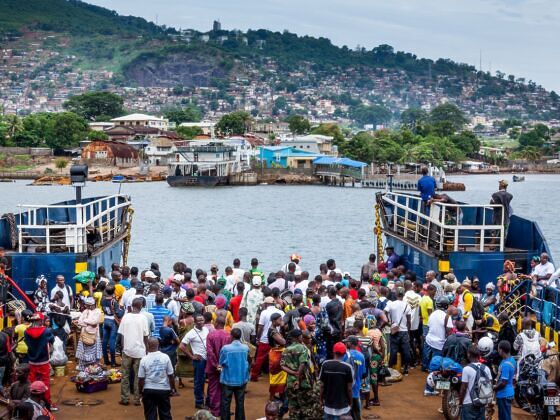
Beachwalkers / Photo: Allison Cross

If you don’t push yourself into new and uncomfortable experiences, it’s unlikely you’ll ever discover how adaptable you really are.

Most of the foreigners in Sierra Leone are here to work or volunteer, rather than to travel for the sake of traveling.

I have yet to encounter a bona fide tourist who’s in the West African country purely for pleasure and exploration. Most of the sun worshippers at River No. 2 beach on Saturdays – arguably the nicest beach in Sierra Leone – are NGO workers like myself, taking time off work to enjoy the country’s undeniable beauty.

“Risk is the only guarantee for being truly alive.” – Osho

It’s not particularly surprising tourists are largely absent from Sierra Leone.

Most people only know of the country because of its brutal 11-year civil war that ended in 2002, where rebel and government soldiers murdered thousands of people and cut off the hands and feet of many others.

Since then, Sierra Leone has gained a reputation for being one of the poorest countries in the world, with extremely high rates of maternal and infant mortality. Crime and petty theft are common. Advanced medical care is largely unavailable and most of the roads are in awful condition.

Even if these conditions that discourage tourism didn’t exist, anyone wishing to visit Sierra Leone must still obtain a visa, at least three or four vaccinations and a generous number of malaria pills before they enter the country. It’s no doubt intimidating for many.

Heed the Warnings

Former British Prime Minister Tony Blair was in Sierra Leone a few months ago, trying to promote the country as a tourist destination for Europeans, even though the country still confronts major infrastructure issues like the inconsistent supply of water and electricity.

No 2. River beach / Photo: Allison Cross

As a result of this list of warnings and dangers, development workers are full of stories about what you should and shouldn’t do. Many of them make sense for any sensible traveler.

You shouldn’t walk alone at night. You shouldn’t carry large amounts of cash. You should be cautious about making friends, until you know you can trust them.

But some of their advice I find myself ignoring. I eat at local restaurants where the food is cheap and I take motorcycle taxis that drive far too fast. I do this partly because my budget is much smaller than the average development worker in Sierra Leone.

No one drives me to work in an SUV and my budget for training is small, as is my living stipend. It’s enough to live and eat, but it’s nowhere near extravagant or comparable to a North American wage.

Even though the house I live in leaks when it rains too hard, is sometimes overrun by spiders and snakes and has no running water, it’s still far plusher than the home of an average Sierra Leonean. But when I tell other foreigners how I live, they often shudder and proclaim: “I could never live like that.”

Experience What Is

I go further to ignore other pieces of advice because I’d rather get to know the country I’m living in for what it is, rather than
experience the niche foreigners have carved out for themselves.

Why travel halfway across the world to eat the same food I can get at home?

It’s certainly comforting to enjoy some overpriced bacon and eggs and a coffee at an assortment of popular ex-pat hangouts, but I’m careful not to make a habit out of it. Why travel halfway across the world to eat the same food I can get at home?

Admittedly, I often pine for the ease of a vehicle, and its air conditioning and seat belts, but I still believe I’d miss too much if I went everywhere in a car.

The journalist in me would ask the car to the stop, so that I could explore that village on the other side of the bridge on foot or talk to the women who wave to me as they sit in a circle, cooking their food.

If you’re always in an SUV with tinted windows, always in Western-style restaurants with air conditioning, you will indeed miss experiencing the real culture and atmosphere of your destination.

Of course, the manner in which you travel and the risks you take are personal choices. Living in a country as chaotic as Sierra Leone isn’t easy and every foreigner will have a different way of coping.

But human beings are incredibly adaptable, as I have very quickly learned about myself.

If you don’t push yourself into new and uncomfortable experiences, it’s unlikely you’ll ever discover how adaptable you really are.

How has travel pushed your own personal boundaries? Share in the comments!

About The Author

Allison Cross

Allison Cross is a Canadian journalist working in media development for a Canadian NGO in Sierra Leone. Visit her personal blog.

  • tom gates

    I loved this – you’re in the zone. I’ve yelled at friends for taking “dangerous motorcycle rides” back home…then, hypocritically, i’ll get on any bike that will have me in southeast asia. I get it :)

    • http://www.ianmack.com Ian MacKenzie

      I’m the same way. I’d never get on a motorbike at home, but put me on Koh Phangan without a helmet and I’m ready to rip. There has to be something about travel that makes you feel invincible… (I can’t get hurt, I’m a traveler!)

      • http://thelonglayover.blogspot.com Carlo

        True. But we’re not invincible.

        Sorry for the shameless plug :)

        When you think back at all the dangerous things did (and will do) while traveling, it really is shocking. Things you would never do at home – but it’s just part of the experience, and usually, you really have no other choice.

        • http://www.rebel-workinprogress.blogspot.com Rebel

          I know I’m not invincible. [url=http://xkcd.com/180/] If you die in Thailand you die in real life[/url] has been a bit of a motto here. But while living abroad I’ve started to make peace with my mortality. You know, better to die while out here really living, than to literally die of boredom locked up safe in my little apartment back home. As the author says, everyone needs to decide for themselves which risks they want to take.

      • http://www.gobackpacking.com/Blog Dave

        Ian – didn’t you see all those backpackers on crutches with white bandages around their road-rashed legs hobbling along Haad Rin on Koh Phangan? lol

        I don’t ride motorbikes at home either, and didn’t have the guts to try it on the islands, but I was hiring rides on them with someone else in the driver’s seat….and that was enough!

        Oh, and after having a great experience breaking through the media stereotypes and fear to visit Colombia, I have a much higher tolerance for visiting places deemed unworthy (ie. too risky or dangerous by others).

  • http://caffeinatedtraveller.com Cate

    Your story is a perfect example of not just how to survive physically but mentally. The limits are there, not everyone can go as far as you have and they will tell you without being asked for their opinion.But there are others who admire you for what you are doing — and I’m one of them.

    It’s articles like these coming from nations like Sierra Leone that need to be published more often, I hope to read more from you, and I’ll be looking at your blog as well. Thanks for sharing.

  • http://musictravelwrite.wordpress.com Michelle

    I love that last line. It’s really so true- we convince ourselves that every want is really a need. It’s amazing how little we actually do need, after all.

  • http://www.rebel-workinprogress.blogspot.com Rebel

    I totally agree. The best way to get the real flavor of a country is to try to live as close to a local lifestyle as possible (never really achievable for a foreigner, but you can try). Eating where locals eat, using the standard form of transportation – this is as much a part of the culture as any festival or ancient ruin.

    And yeah, back home I never would have imagined myself riding helmetless & side-saddle on the back of a speeding motorbike… but it’s my favorite way to travel here. =)

  • Amanda

    Great article, I really needed that reminder. I am in Bangladesh and was yelled at by my rickshaw driver for being cheap and he called me stupid (he didn’t have change for my bill!) I won’t lie, I cried, wishing I had a private car like my friends, but, like you, my government stipend is not enough to hire one.

    But you’re right – while I like to be driven home by my friends after one night of expat italian food, in the end I love that I am the only one at my language school that walks to a local lunch joint after class instead of being picked up by their driver.
    Again, thanks for the reminder, this article is being bookmarked :)

  • http://lavieenchina.wordpress.com/ Ashley Bruckbauer

    Thanks for sharing this, Allison! It is so refreshing to hear stories such as yours in the midst of all the nay-sayers and warnings. This is exactly the mentality I’m taking as I move to China to teach English. I don’t want to do the typical American ex-pat thing. If I wanted to experience American culture, I would have stayed home. Though I might sneak the occasional Starbucks! ;)

  • http://www.travelcalling.blogspot.com Angela Corrias

    Describing your house you made me want to go too! Well done on your adventure, you’re right, we need to push our boundaries!

  • http://www.maltabulb.com Marica

    Loved reading this. Thanks for sharing your experiences – very inspirational and also very true!

  • http://www.keepingpaceinjapan.com Turner

    Very nice, Allison. This is the main reason I like traveling.

  • http://www.theafricatravelblog.com Hakon – The Africa Travel Blog

    Good points! When I am traveling in Africa I always try to use minibuses, eating local food, etc, and I love traveling like that. As you say, it allows you to really experience the culture. BUT: I also always dream of staying at those beautiful resorts, driving a nice car with a/c, etc, and I know that if I one day can afford it I won’t be able to resist!

    Hopefully I’ll always be able to keep a good balance between comforts and experiences!

Activism + Politics →

How the system that makes doing good so easy, makes it impossible to really change...

Activism + Politics →

"Standard of living" should not equate to "amount of spending".

Culture + Religion →

Project Explorer is a nonprofit organization that produces free, online travel series for...

Culture + Religion →

Get your cremains pressed into vinyl. Why be scattered when your family's eardrums could...

Culture + Religion →

When you stop to ask yourself what homeless people spend money on, why not ask yourself...

Culture + Religion →

All that kissing! One cheek and then the other, the two faces weaving dangerously close,...

Culture + Religion →

Check out a different side of New York's museum scene with these 5 recommendations from...

Culture + Religion →

What it means to leave a life of thrills in Thailand only to return to the...

Culture + Religion →

A good quote can sometimes act as a magical spark, setting in motion thoughts, ideas and...

Culture + Religion →

Santiago, Chile: Take a break from the norm and discover the city locals love and...

Culture + Religion →

Trips co-editor Hal Amen publicizes one of his many travel longings and calls out the...