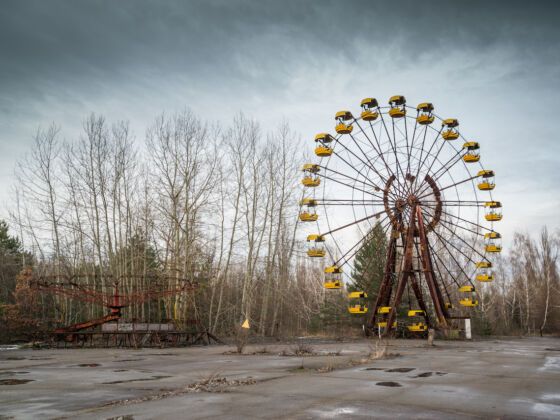
The practice of visiting sites related to death and suffering is known as “Dark Tourism.”

65108873_a628ed76e5_oIt’s been two years since Hurricane Katrina devastated New Orleans. Slowly but surely, tourists are returning.

Coupled with the city’s old bag of tricks is a new draw card: the chance to glimpse New Orleans’ destruction firsthand.

But New Orleans isn’t the only place where suffering has turned into a tourist attraction. In New York, Ground Zero is the iconic memorial to the September 11 attacks.

Outside the United States, places like Auschwitz and Cambodia’s killing fields have been drawing tourists for decades.

The practice of visiting sites related to death and suffering is known as “Dark Tourism.”

Dark tourism is not a new phenomenon. Scholars see parallels in such historical activities as gladiatorial contests in Ancient Rome, public executions in the Middle Ages, and guided tours of morgues in Victorian England.

Today, dark tourism still presents a few hard questions for ethical travelers.

Is it right to turn other people’s death or misery into a spectacle? Why are humans even attracted to morbid places?

The Benefits Of Dark Tourism

Like any tourist attraction, “dark sites” can turn a handsome dollar for those shrewd enough to capitalize on the site’s popularity.

But does the commercialization of dark sites necessarily mean that we travelers should avoid visiting them? Not quite.

Often, the countries or cities featuring dark attractions are in great need of tourist dollars.

Take New Orleans for example. After Katrina, the city’s tourism figures have dropped to about 35% of what they were in 2004. A surge in tourism is vital if the city is to successfully rebuild.

Isabelle Cossart, a New Orleans tour operator, alludes to another benefit of dark tourism: its educational value.

“Nobody realizes, [Hurricane Katrina] destroyed seven times more than Manhattan. It was larger than the size of Great Britain. This is two years later. We have to show it. At first, people feel guilty to say they want to see the tours. After, they’re amazed at the destruction that’s there after two years, and the size of it.”

P1010075Dark tourism puts you face to face with some of the most painful and frightening aspects of human existence: genocide, natural disasters, terrorism, slavery.

As much as our society may tout its historical “progress”, it has not seen the end of any of these grave evils. By raising our awareness of horrific events in the past, dark tourism guides us to a sobering understanding of the world we live in.

Why The Attraction?

Earlier this year, Rolf Potts wrote about a trip into New Orleans’ Lower Ninth Ward, one of the areas worst affected by Katrina. He described it as a “vividly, irrevocably authentic” experience.

While much of modern tourism is simply about recreation, dark tourism is different.

Rather than offer you a few hours of entertainment, it ought to provoke and confront you in a profound way. It is a multi-dimensional experience that can have a deep impact on your life.

It is a multi-dimensional experience that can have a deep impact on your life.

Much of modern-day travel revolves around scripted experiences. Package deals. Group tours.

With crafty expertise, the tourism industry creates our holiday for us. Some holidays require about as much interaction as watching a movie – just hit play and watch the scenery unfold.

The appeal of dark tourism is not that we get away from this kind of scripted travel. It’s just that the script is a whole lot more confronting.

If “scripted tourism” is like watching a movie, dark tourism is like watching Hotel Rwanda.

The Choice to Bear Witness

Whether we choose to witness dark tourism in this profound way is another matter. Dark attractions are often also famous attractions. It’s easy to let them become mere spectacles – like the Eiffel Tower or Sydney Opera House.

But if dark tourism is little more to us than entertainment, surely we are disgracing those whose suffering, past and present, has become a “spectacle”?

If you’re thinking about visiting a dark attraction, ask yourself why you want to visit.

Do you genuinely want to honor and learn about the victims whose lives and deaths are commemorated at the site?

Or is it just an attraction to you – a way to be entertained?

Frankly, if entertainment is all you’re looking for, in my opinion you should spend your tourist dollars elsewhere.

I hear Disneyland is a lot of fun.

Eric Daams has lived in the Solomon Islands, Netherlands and Micronesia, but these days he calls Australia home. He is the editor of Travellerspoint and enjoys hunting down spammers, reading about people’s travel adventures, and writing for the Travellerspoint blog.

What do you think about “dark tourism?” Share you thoughts in the comments!


About The Author

Eric Daams

Eric Daams has lived in the Solomon Islands, Netherlands and Micronesia, but these days he calls Australia home. He is the editor of Travellerspoint and enjoys hunting down spammers, reading about people’s travel adventures, and writing for the Travellerspoint blog.

More By This Author

view all →
  • http://gregwtravels.travellerspoint.com Greg Wesson

    Eric said, “Much of modern-day travel revolves around scripted experiences. Package deals. Group tours.”

    I think this is one of the prime points that draws people to the “dark” aspects of tourism. People are searching for a more authentic opportunity to see a place. It’s an opportunity to learn and see and be impacted on your vacation, not just to get a sun-tan and have a drink.

    I do think that most people who would do a tour of a devestated places like New Orleans ninth ward couldn’t help but come away being impacted emotionally, even if they just went originally for the “entertainment value.”

    I do know that I was surprised how impacted I was seeing the World Trade Center site in New York City, especially in visiting the church across the street, which had a series of pictures from the September 11th attacks. I hadn’t expected to get much out of seeing the World Trade Center site, and actually came away feeling both incredibly sad at the loss of life and also incredibly bouyed by the heroic efforts of everyone on that day.

  • Eva

    Great post!

    One of the ways I try to draw lines for myself is by deciding whether the bit of darkness I’m learning about is a closed book or an ongoing situation – and whether my presence is likely to help anyone if it’s the latter. For example, I find the “Township Tours” in South Africa, where you are driven through the country’s worst urban slums in a tour bus, kind of strange and maybe inappropriate. None of the money you’re paying is going to the residents, and they have to watch you roll through, looking at them like zoo animals from behind bulletproof glass. In that case I think the good – learning about the realities of poverty – might be outweighed by the bad.

  • http://www.champagnetravelonabeerbudget.com Tara

    Interesting post. I think it is important to question our motives if we’re seeking to be responsible travllers.
    From my experience, visiting the Toul Sleng museum in Cambodia (the site of the Khmer Rogue’s main prison and place of torture) was a life changing experience. I went with a friend who is a humanitarian worker in the country and some young Khmer high school students. They feel it is important that visitors to their country visit the museum to gain greater understanding of what happened to their aunties, grandfathers etc.
    For me, it resulted in joining a group of friends in forming a foundation to help fund the tertiary education of disadvantaged high school students.
    I don’t think I would have been so moved to take action if I had not really grasped the atrocity of what happened by visiting Toul Sleng.
    In saying that, Toul Sleng has managed to avoid the ‘souveneir gift shop’ style of dark tourism that does exist.

  • http://www.rucksackwanderer.com/ Tim Patterson

    Great comments so far. I really hope we get a good discussion going on this issue, because it’s a difficult question that needs to be addressed.

    Tara – When I visited Toul Seng prison, the people going up the stairs in front of me were drinking beer. It’s incredible how unwilling some people are to confront hard, ugly truths – but confront them we must, or else the horrors will be repeated.

  • nolafugee

    If it makes you feel any better, every local New Orleanian I’ve spoken to digs the dark tours, because they bring eyes to the scenes of still devastated areas and they bring money to the neighborhoods that are trying to rebuild.
    They are not to be confused with ghosts tours and the like.

  • http://jeelago.net jeela

    I’m wondering where military memorials fit in on the scale between scripted and dark, for example at Pearl Harbor with the thousands entombed there.

    Might one catagorize any sort of large-scale remembrance of death and destruction as “dark” (Vietnam War Memorial, cross-filled cemeteries in Belgium, a plaque in Saipan at the cliff where Japanese women and children leapt to their deaths, Wounded Knee, etc. ad nauseam)?

    If that is the case, there is probably no country without such an “attraction”…yet atrocities continue in the name of war. The ability of such sites/memorials/museums to prevent future horrors is highly debatable IMO. But they are useful (necessary?) for remembrance, healing & educating visitors.

    good post, thx!

  • Eva

    Hmm… Jeela mentioned war memorials, cemeteries, etc, and it’s funny – for some reason I’ve never categorized them as “dark tourism” the way I do for the concentration camp tours, the sites in Cambodia, the growing number of genocide-related sites in Rwanda, etc. I’ve been trying to figure out why that is, and I think it’s because – in the case of WW1 and WW2 monuments anyway – I see it as part of my own history, so there’s no fear of feeling like a voyeur into someone else’s troubles, or any concern that suffering is being exploited. Visiting the Normandy beaches or the Somme monument, I wouldn’t think twice about whether I was going in with the right attitude or capturing it appropriately – all of that would be assumed.

    Does it make sense to draw a distinction like that? And if I’m so confident that I can approach those war monuments respectfully, do I need to worry so much about how I go about seeing the rest?

    (Of course, as far as I know WW1 and WW2 memorials are generally free of charge, which helps to make it feel less like “entertainment”.

  • Jim

    Dark tourism, the killing fields,Hitler’s death camps, add them both, multiply by 4,and you come close to what Hilary’s hero Stalin killed in his Gulogs , only with Stalin they where all starved to death. Now how in the hell do you compare the above to Katrina, it was just a storm, if the dikes wouldn’t have failed (Bill Clinton’s fault for not following the Corps advice)it would have been just another storm. Andrew was actually the worst of the recorded storms

  • Eva

    Jim, I don’t think anyone was comparing Katrina to the Holocaust in terms of scale of suffering or numbers killed – just comparing the experience of visiting the sites of so much death. But the fact that fewer people were killed does not lessen the horror for those involved – calling it “just a storm” is pretty callous.

    I think the ideal that most of these “dark tourism” sites strive for, or at least should strive for, is for the visitor to gain some greater understanding or knowledge of suffering, so that in future they are more likely to react with empathy – instead of, say, using tragedy as an opportunity to take political cheapshots at the people they disagree with.

  • http://www.rucksackwanderer.com/ Tim Patterson

    Well said, Eva.

  • http://www.dark-tourism.org.uk Philip Stone

    Interesting article which raises the unsurprising notion of ethics within dark tourism, and general questions of motivation behind ‘consumption’. Of course, the term ‘dark tourism’ is multi-dimensional and exists in various ‘shades’. Equally, the motivations (and consequences) for ‘consuming’ the so-called dark tourism product will rest on many factors. As dark tourism provides a socially acceptable environment upon which contemporary visitors gaze upon ‘Other’ death, perhaps we need to consider how we, ourselves in modern (Western)
    society, confront death and dying. With increasing medicalization and secularlization, have our experiences of death and dying been largely relocated to a ‘back region’ where media image of the macabre now dominates? Perhaps, dark tourism is simply a contemporary mechanism to ‘contemplate’ mortality (and morality), either explicity or implicity?

  • http://pickledeel.blogspot.com Pickled Eel

    Nicely put. Any of those places we visit which have a dark past should connect us with the rest of humanity – they are places that should soften us and fuel the compassion we need to have for our fellows, regardless of race, colour or creed. The compassion that stirs us in Iraq, at Ground Zero, in Palestine, at the Arizona Memorial or on a lost Guadacanal memorial to the US Marines should be just that, not a reaction to some sort of morbid fascination that does not compel us to be better neighbours and compassionate citizens of the world.

  • Olivebeard

    I’m probably too late for any of this to matter but…

    If someone is running a “tour” to the 9th, is probably put little–if any–money back into it. I can almost guarantee you that. And as of 2007, New Orleans tourism is doing just fine–the problem is that politicians seem weary about putting that money back into “the bowl”.

    http://blog.nola.com/tpmoney/2007/10/number_of_tourists_visiting_lo.html

    I think there’s a thick line that separates the Lower 9th from the Gulag/Auschwitz/Toul Sleng. Having toured the lower 9th and Auschwitz, I would say the difference would be between admiring someone’s scar and staring at someone’s gaping wound. Those homes are not abandoned (completely), and the little teddy bears among the debris was probably owned by a living child. I don’t think its quite as macabre to be fascinated by a memorial as it is to be fascinated by–well, the fresh scene of a mass murder.

    There was a great term I first heard in New Orleans: Voluntourism. Walking around the Habitat for Humanity sites in Musician’s village, I was startled by the number of people who were literally taking their 2 weeks of holiday to travel to NOLA to work; hard labor, 5 days a week.

  • http://www.rucksackwanderer.com/ Tim Patterson

    Thanks for the fresh thoughts Olivebeard – never too late to comment and I appreciate your perspective.

  • Jonathan

    Very interesting article. I will definitely add this to my travel and tourism geography course that I’m teaching.

    The discussions about dark tourism reminds me of a few things.

    Ever since having stumbled upon Michael Moore’s films and their discussions about Flint, MI, I’ve always wanted to go there to see just how bad it is. Same with Detroit, MI. Is this dark tourism?

    How about visiting ghost towns or abandoned sections of communities, such as Chernobyl?

    During my study abroad program, I went to a number of cemeteries and war sites where there are trenches, bombed bunkers, etc. Are they dark tourism too?

    And while studying abroad, I went to a few museums that focused on various aspects of war. The Imperial War Museum in London, England, had a section that provides a multi-sensory (sound, smell, feel, etc) experience of what it was like to be in the trenches and a graphical provoking display related to the Holocaust. Again, is this dark tourism?

    I’d be interested in knowing what are your responses to these different examples.

  • http://www.happenchance.net Seth M Baker

    Great article, quite thought provoking, but I wonder if ‘dark tourism’ is the correct term. I mean, yes, these things that happened are quite dark, but they are a part of a country’s history.

    I think ‘Realist Tourism’ might be more accurate.

    If the average visitor travels to Cambodia and goes only to Siam Reap or Sihanoukville, skipping Tuol Sleng and Choeung Ek, will you come away a balanced sense of Cambodia’s recent, bloody past?

    Again, great article. Yes, it’s three years old, but three years ago, all I knew about Cambodia was what I learned from the movie.

  • Dennis O’Higgins

    Eric – a fantistic and truly thought provoking article. I think you’re right to draw distinctions of two classes of dark tourism – entertainment & personal growth.

    Certainly for me, it’s about getting to understand the place I am in. Often the ‘dark tourist’ locations give an phenomenal insight into what has shaped the area that you are are in, and the world in general. I think it can help you to adopt a more rounded approach to the world and be more understanding.

  • Carol-Ann

    I am a late entrant in this discussion, but I really feel moved to comment. I agree with Seth – great, thought provoking article; and, how could one visit a region with a “dark” past and not visit these sites, if a balanced view is to be gleaned?

    I recently visited Yad Vashem in Jerusalem (after knowing about the Holocaust my whole life) and I feel that only now do I truly understand why we should always include these places of collective memory when we travel.

    Kurt Tucholsky said:
    “A country is not just what it does, it is also what it tolerates.”

  • Laura

    Another late entrant sorry! I’m actually studding this topic at the moment and have come across some interesting perspectives:

    one is the idea that war cemeteries are also classified as dark tourist attractions – they are, however most people agree that such places can be put on a sliding scale from white, through grey to black, in terms of how ‘dark’ the tourist site is. Therefore places like the Taj Mahal (the tomb of a much loved wife) would be towards the lighter end of the scale, while Auschwitz would be closer to the darker end.

    Also, there is this idea that in modern day society death is very much hidden from most of us. We only ever experience death if a relative or someone close to us dies. The theory goes that because we are so unfamiliar with our own mortality, a desire exists to explore this; one way to do this is by visiting dark tourist destinations. The theory goes on to say that we conceive this as a much more ‘comfortable’ and socially acceptable way to explore death than contemplating it in the confines of our own room, often leading to feelings of depression and terror.

    Another concept I found interesting was the ‘need’ for the memory of certain events to be maintained; the same idea of “lest we forget”. Interesting because most people will agree that some things should not be forgotten, but who then is the best person to choose what should be remembered and what should be preserved? A victim of the atrocity? Or are they too emotionally involved? An outsider, not directly affected by the atrocity? Or are they too removed to understand all dimensions of the event. And then of course – what is the most appropriate way or communicating it to a wider audience, which respects all affected parties, which maintains integrity and addresses financial issues of maintaining the site and/or raising money for affected peoples and areas of the atrocity concerned.

    After researching this topic for a while now I get the sense that there is a separation between the academic interpretation of dark tourism, and the human interpretation. Even if we do seek dark tourist site to explore our own mortality in an attempt to confront and understand it – does that make it ok to do so? I think Eric Daams successfully brings the issue back to where it started and where it ultimately finished: To us. To the tourists paying to visit these places and deciding if it is ethical to do so. An answer to which no amount of academia can solve.

    I guess it is our responsibility as fellow humans to be informed about a wider range of issues associated with dark tourism, beyond its ‘entertainment’ value (who are the stakeholders, how important are their beliefes, what are our own motives, how do these affect the stakeholders concerned). But ultimately the choice to engage in dark tourism and to what degree solely relies on us – to bear witness, or to make these sites another entertaining spectacle.

    • pj

      Hello do you know of any stakeholders for dark tourism?

    • pj

      Hello do you know of any stakeholders for dark tourism?

  • http://twitter.com/daamsie Peter Daams

    Just a heads up — that photo isn’t of Eric. Not sure who it is, but it’s definitely not Eric ;-)

Culture Guides →

Photos from Afghanistan's Mazar-e-Sheriff, Jalalabad and Panjeer Valley.


This month's Blast From the Past talks about what many don't want to talk about.

Interviews →

David has retraced the voyages of Jason and the Argonauts, hunted for the Ark of the...

Road Trip Guides →

Graham finds his way through Belize, Guatemala and El Salvador, only needing a police...

Culture Guides →

Savor these tasty tidbits of Peru, because her beauty is truly in the details.

inTransit →

Peter witnesses a horrific part of Nicaraguan culture by attending a cock fight.

Consciousness →

Death is not something many of us like to associate with traveling. But when it happens...

Climbing →

Majka Burhardt and a small team of climbers set their sights on some unclimbed granite in...

inTransit →

Peter snags a bus to Oaxaca, finds a suitably cheap hostel and chills out in the plaza...

Culture + Religion →

A journey through the heart of the Brazilian Amazon.

Narrative →

Learning more than just how to cook in Teotitlan del Valle, Oaxaca.


Across the network this week, we've been bringing you entertaining articles that...

Trip Planning →

Angola is one of the most overlooked countries in Africa. Claudio Silva shares five...